
The 7 Biblical Signs of the End Times
1. Introduction
Biblical eschatology teaches that God has given identifiable signs of the end times—observable conditions that indicate the world is moving toward the climactic events preceding the return of Jesus Christ. While Scripture forbids date-setting (Matthew 24:36; Acts 1:7), it also affirms that believers can recognize the season of His coming by paying attention to these prophetic indicators (Matthew 24:32–33; Hebrews 10:25).
This article surveys seven key biblical signs of the end times, grounding each in Scripture and showing how they fit together within a coherent end‑time framework.
2. Sign 1: Widespread Apostasy and the Rise of False Teaching
One of the clearest end-time signs in the New Testament is a dramatic falling away from the truth within professing Christianity.
"Now the Spirit expressly says that in later times some will depart from the faith by devoting themselves to deceitful spirits and teachings of demons."
— 1 Timothy 4:1
"For the time is coming when people will not endure sound teaching… and will turn away from listening to the truth and wander off into myths."
— 2 Timothy 4:3–4
Key elements of this sign:
- Departure from sound doctrine – central truths such as the authority of Scripture, the uniqueness of Christ, and the reality of judgment are denied or redefined.
- False teachers within the church – Scripture warns of those who appear religious yet undermine biblical truth from inside the visible church (2 Peter 2:1–2; Jude 3–4).
- Final climactic apostasy – Paul links a great “rebellion” with the unveiling of the “man of lawlessness” just before the day of the Lord (2 Thessalonians 2:3).
This spiritual apostasy is not mere ignorance; it is a willful rejection of revealed truth, preparing the religious climate for the deception of the coming Antichrist.
3. Sign 2: Moral Collapse and Lawlessness in Society
Alongside religious apostasy, Scripture predicts a deepening moral crisis as history approaches its climax.
"But understand this, that in the last days there will come times of difficulty. For people will be lovers of self, lovers of money… unholy… without self‑control… lovers of pleasure rather than lovers of God, having the appearance of godliness, but denying its power."
— 2 Timothy 3:1–5
Characteristics of this sign include:
- Radical self‑centeredness – “lovers of self… lovers of money… lovers of pleasure rather than lovers of God.”
- Breakdown of family and natural affection – disobedience to parents, lack of love, and the erosion of basic moral norms.
- Hypocritical religiosity – “a form of godliness” with no transforming power.
Jesus similarly described the end times as marked by increasing lawlessness and growing indifference to God:
"Because lawlessness will be increased, the love of many will grow cold."
— Matthew 24:12
This sign shows a world that is not gradually improving but morally deteriorating, creating “times of difficulty” as the return of Christ draws near.
4. Sign 3: The Rebirth and Regathering of Israel
From a prophetic standpoint, the rebirth of Israel as a nation is a central, structural sign of the end times. Many end‑time prophecies presuppose Israel’s existence in her land.
"I will take you from the nations and gather you from all the countries and bring you into your own land."
— Ezekiel 36:24
"He will… assemble the banished of Israel, and will gather the dispersed of Judah from the four corners of the earth."
— Isaiah 11:12
Key biblical points:
- This regathering is global (“from all the countries,” “four corners of the earth”), distinct from earlier returns from single empires like Babylon.
- Ezekiel’s vision of the dry bones portrays Israel returning first to national life and only later to spiritual life (Ezekiel 37:1–14): physical restoration before full conversion.
End‑time events that require a national Israel include:
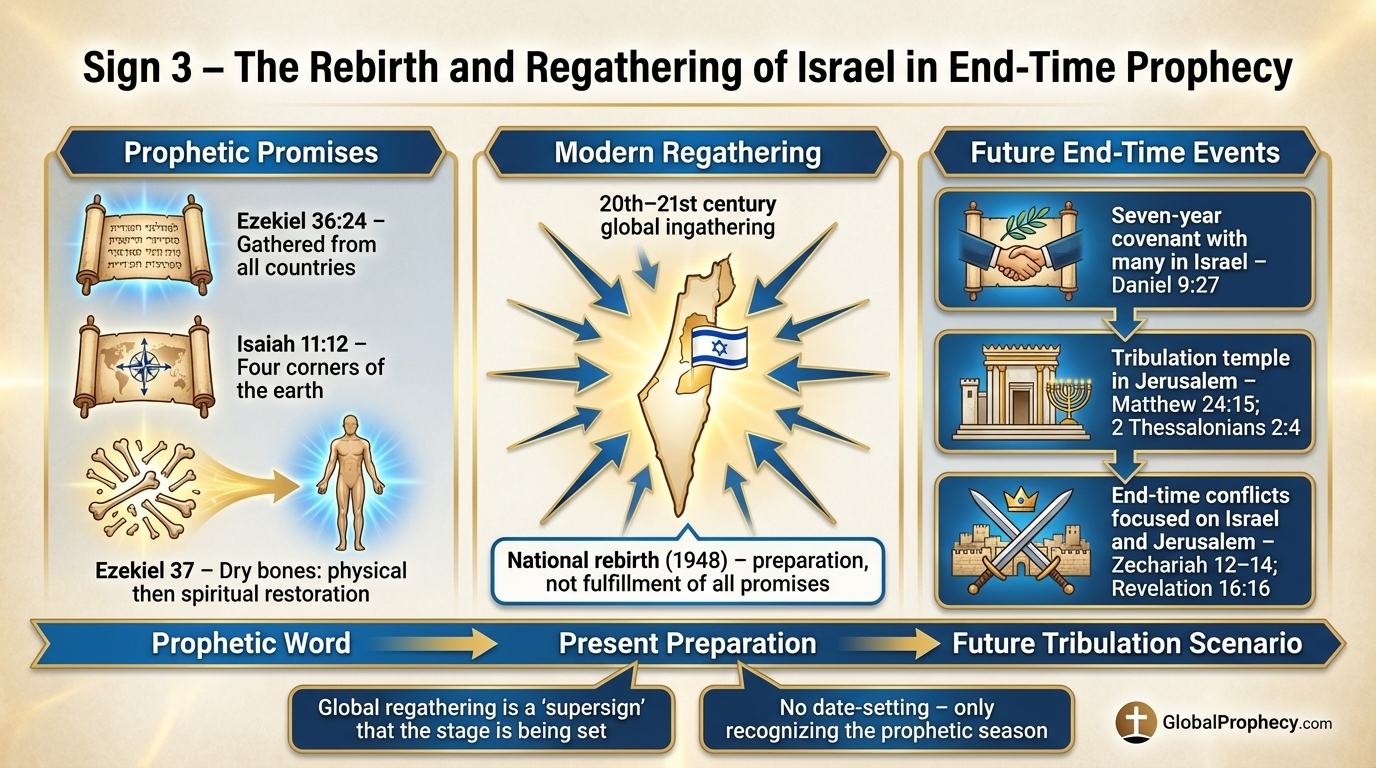
- A seven‑year covenant made by the future Antichrist with “many” in Israel (Daniel 9:27).
- A Jerusalem temple standing again during the tribulation (Matthew 24:15; 2 Thessalonians 2:4).
- End‑time invasions and conflicts focused on Israel and Jerusalem (Zechariah 12:2–3; 14:1–3; Revelation 16:16).
Because so many prophecies depend on Israel’s presence in the land, her modern regathering functions as a “supersign” that the end‑time scenario is being prepared.
5. Sign 4: Movement Toward Global Government, Economy, and Religion
The book of Revelation depicts a worldwide political, economic, and religious system under the control of a single end‑time ruler, commonly called the Antichrist.
"And authority was given it over every tribe and people and language and nation."
— Revelation 13:7
"And all who dwell on earth will worship it…"
— Revelation 13:8
"...that no one can buy or sell unless he has the mark, that is, the name of the beast or the number of its name."
— Revelation 13:17
Three dimensions of this sign:
- Global government – political authority extending to “every tribe and people and language and nation.”
- Global economy – centralized control of buying and selling through the mark of the beast.
- Global religion – a unified worship system venerating the beast and rejecting the true God (Revelation 13; 17).
The prophetic picture is of a world increasingly knit together and prepared for centralized control, making possible the final world empire that will openly oppose Christ just prior to His return.
6. Sign 5: Technological Developments Enabling End‑Time Control and Events
Scripture anticipates conditions in the tribulation period that presuppose advanced technology, even though the biblical writers did not use modern terminology.
Examples include:
- Global economic control – the enforcement of the mark of the beast system (Revelation 13:16–17) implies the ability to track and regulate all commerce.
- Worldwide communication and visibility – the world’s ability to witness certain events almost in real time (compare Revelation 11:9–10).
- Mass‑destruction warfare and environmental devastation – judgments that burn a third of the earth, sea, and heavenly lights (Revelation 8:7–12) are fully conceivable in a nuclear and high‑technology age.
Daniel was told that prophetic insight would expand “at the time of the end”:
"…seal up the book, until the time of the end. Many shall run to and fro, and knowledge shall increase."
— Daniel 12:4
While this primarily concerns knowledge of God’s prophetic plan, it coincides historically with a dramatic explosion in scientific, informational, and surveillance technology—precisely the tools that can support a tightly controlled global system during the tribulation.
7. Sign 6: Increasing Natural Disasters and Cosmic Disturbances
Jesus identified intensifying natural upheavals as part of the early birth pains of the end times.
"For nation will rise against nation, and kingdom against kingdom, and there will be famines and earthquakes in various places. All these are but the beginning of the birth pains."
— Matthew 24:7–8
Luke adds further detail:
"There will be great earthquakes, and in various places famines and pestilences. And there will be terrors and great signs from heaven."
— Luke 21:11
In the tribulation itself, Revelation describes:
- Catastrophic earthquakes and geological upheavals.
- Severe famine and pestilence (Revelation 6:5–8).
- Striking cosmic signs—darkening of sun, moon, and stars, and impacts from celestial bodies (Revelation 6:12–13; 8:10–12).
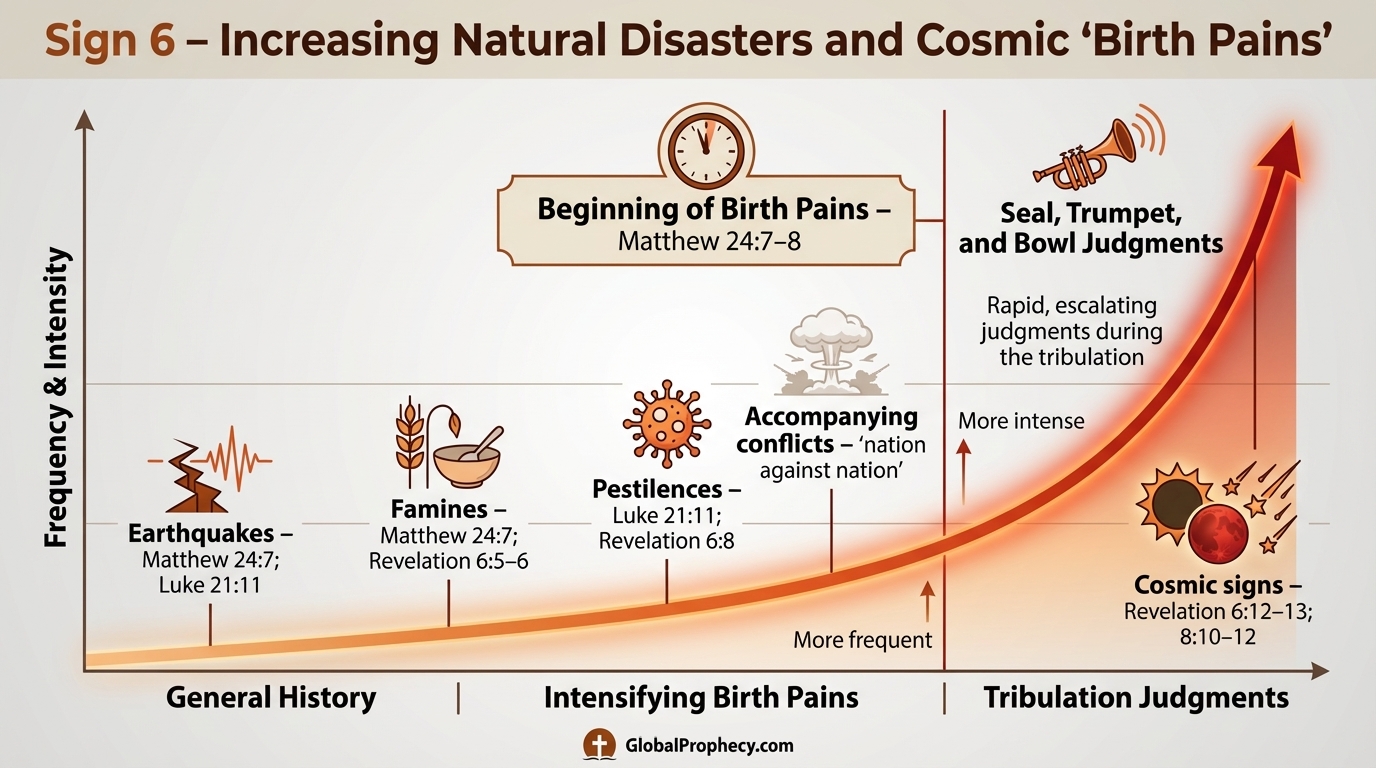
Jesus likened these to birth pains: as the end approaches, such phenomena will increase in frequency and intensity, signaling that the final judgments are drawing near.
8. Sign 7: Escalating International Conflict Centered on Israel
War in general is a persistent reality in a fallen world, but Scripture points to a unique end‑time concentration of conflict that centers on Israel and culminates in the final campaign often called Armageddon.
"You will hear of wars and rumors of wars… For nation will rise against nation, and kingdom against kingdom."
— Matthew 24:6–7
Specific end‑time features include:
- A time of unprecedented distress for Israel and the world:
"There shall be a time of trouble, such as never has been since there was a nation till that time."
— Daniel 12:1 - Gathering of nations against Jerusalem:
"Behold, I am about to make Jerusalem a cup of staggering to all the surrounding peoples… I will gather all the nations against Jerusalem to battle."
— Zechariah 12:2; 14:2 - The battle of Armageddon:
"And they assembled them at the place that in Hebrew is called Armageddon."
— Revelation 16:16
This escalating hostility toward Israel and the final convergence of armies in the land of Israel form a major prophetic sign cluster, immediately preceding the visible return of Christ in glory to judge the nations and deliver His people (Zechariah 12:10; Matthew 24:29–31; Revelation 19:11–16).
9. Conclusion
The Bible presents a coherent picture of the end times marked by seven major signs:
- Widespread apostasy and false teaching in the visible church
- Deepening moral collapse and lawlessness in society
- The rebirth and regathering of Israel to her land
- A globalizing world system in government, economy, and religion
- Technological conditions enabling end‑time control and judgment
- Intensifying natural disasters and cosmic disturbances
- Escalating international conflict centered on Israel, culminating in Armageddon
These signs do not allow us to calculate dates, but they do show that history is moving toward the fulfillment of God’s prophetic plan. For believers, the proper response is not speculation but watchfulness, holiness, and hope, “waiting for our blessed hope, the appearing of the glory of our great God and Savior Jesus Christ” (Titus 2:13).
FAQ
Q: Can we know exactly when the end times will begin?
No. Jesus explicitly taught that no one knows the day or hour of His coming (Matthew 24:36). The signs of the end times reveal the general season, not an exact date. Believers are called to live in constant readiness rather than attempt prophetic date‑setting.
Q: Is the rebirth of Israel in 1948 really a biblical sign of the end times?
Yes. Prophecies such as Ezekiel 36:24 and Isaiah 11:11–12 predict a global regathering of Israel to her own land in the last days. Many end‑time events—like the Antichrist’s covenant with Israel (Daniel 9:27) and future conflicts over Jerusalem—require a national Israel, making 1948 highly significant prophetically.
Q: How is apostasy different from ordinary error or confusion?
Apostasy is a deliberate falling away from revealed truth, not mere ignorance or immaturity. Scripture describes end‑time apostasy as a conscious turning from sound doctrine to myths and deception (1 Timothy 4:1; 2 Timothy 4:3–4; 2 Thessalonians 2:3), often led by influential false teachers within the visible church.
Q: Are natural disasters always signs of the end times?
Natural disasters have occurred throughout history. According to Jesus, what marks the end times is their increasing frequency and intensity, especially in connection with other prophetic signs (Matthew 24:7–8; Luke 21:11). They are part of a larger pattern of “birth pains” indicating that God’s climactic judgments are approaching.
Q: What should Christians do in light of these seven signs of the end times?
Scripture calls believers to respond with sobriety, watchfulness, and faithfulness. We are to hold firmly to sound doctrine, pursue holiness in a corrupt age, proclaim the gospel, support God’s purposes for Israel, and live in daily expectation of Christ’s return (1 Peter 4:7; 2 Peter 3:11–12; Titus 2:11–13).
Frequently Asked Questions
Can we know exactly when the end times will begin?
Is the rebirth of Israel in 1948 really a biblical sign of the end times?
How is apostasy different from ordinary error or confusion?
Are natural disasters always signs of the end times?
What should Christians do in light of these seven signs of the end times?
L. A. C.
Theologian specializing in eschatology, committed to helping believers understand God's prophetic Word.
Related Articles
Israel's Rebirth: The Supersign of the End Times
Israel's rebirth as a nation is the supersign of the end times, fulfilling key prophecies and signaling that God’s prophetic clock is moving toward completion.
What the Bible Says about Antichrist?
Antichrist in the Bible: discover what Scripture reveals about his identity, character, deceptive power, and end-time role in the Tribulation.
What the Bible Says about False Prophet?
False Prophet biblical identity and role in end times. Discover what Scripture reveals about this key figure in Revelation's tribulation prophecy.
The Biblical Covenants: Framework for Understanding Prophecy
Biblical covenants form the framework for understanding prophecy, clarifying Israel, the church, and God’s kingdom plan across the Old and New Testaments.