
The 70 Weeks of Daniel: Understanding Bible's Prophetic Timeline
1. Introduction
The prophecy of the seventy weeks in Daniel 9:24–27 is one of the most precise and far‑reaching time prophecies in Scripture. It forms the chronological backbone for understanding Messiah’s first coming, the present church age, and the future seven‑year Tribulation that immediately precedes Christ’s second coming.
This passage is addressed not to the church but explicitly to “your people and your holy city” (Dan 9:24), that is, to Israel and Jerusalem. Properly understood, it explains:
- Why the prophetic clock for Israel paused after Christ’s first coming
- Why one final “week” (seven years) still remains
- How this final week relates to the coming Antichrist and the Great Tribulation
This article will trace the seventy weeks of Daniel, the fulfillment of the first sixty‑nine weeks, and the yet‑future fulfillment of the seventieth week.
2. Text and Scope of the Seventy Weeks (Daniel 9:24–27)
The prophecy is given as God’s answer to Daniel’s prayer about the end of the Babylonian captivity (Dan 9:1–19). Daniel had understood from Jeremiah that the exile would last seventy literal years (Dan 9:2; Jer 25:11–12; 29:10). As he prays for forgiveness and restoration, the angel Gabriel reveals that God’s plan for Israel goes far beyond the immediate return from Babylon:
“Seventy weeks are decreed about your people and your holy city,
to finish the transgression, to put an end to sin, and to atone for iniquity,
to bring in everlasting righteousness, to seal both vision and prophet,
and to anoint a most holy place.”
— Daniel 9:24
Several foundational points emerge:
- The beneficiaries: “your people and your holy city” = national Israel and Jerusalem
- The total period: “seventy weeks” = seventy “sevens” (Hebrew: shavu‘im)
- The goal: six redemptive and kingdom outcomes (v. 24) tied to Israel’s full restoration
2.1 “Weeks” as Sevens of Years
The expression is literally “seventy sevens.” In the Old Testament, “sevens” can refer to days or to years (cf. sabbatical years, Lev 25:1–8). Several factors show that Daniel 9 uses sevens of years:
- Daniel is already thinking in years (the seventy years of captivity, Dan 9:2).
- The events foretold (coming and death of Messiah, destruction of Jerusalem, rise of the final ruler) cannot fit into seventy literal weeks of days.
- Israel’s history includes blocks of 490 years (70 × 7) associated with neglect of sabbatical years (2 Chr 36:20–21).
Thus seventy sevens = 70 × 7 years = 490 years of God’s special dealings with Israel.
3. The Six Purposes of the Seventy Weeks (Daniel 9:24)
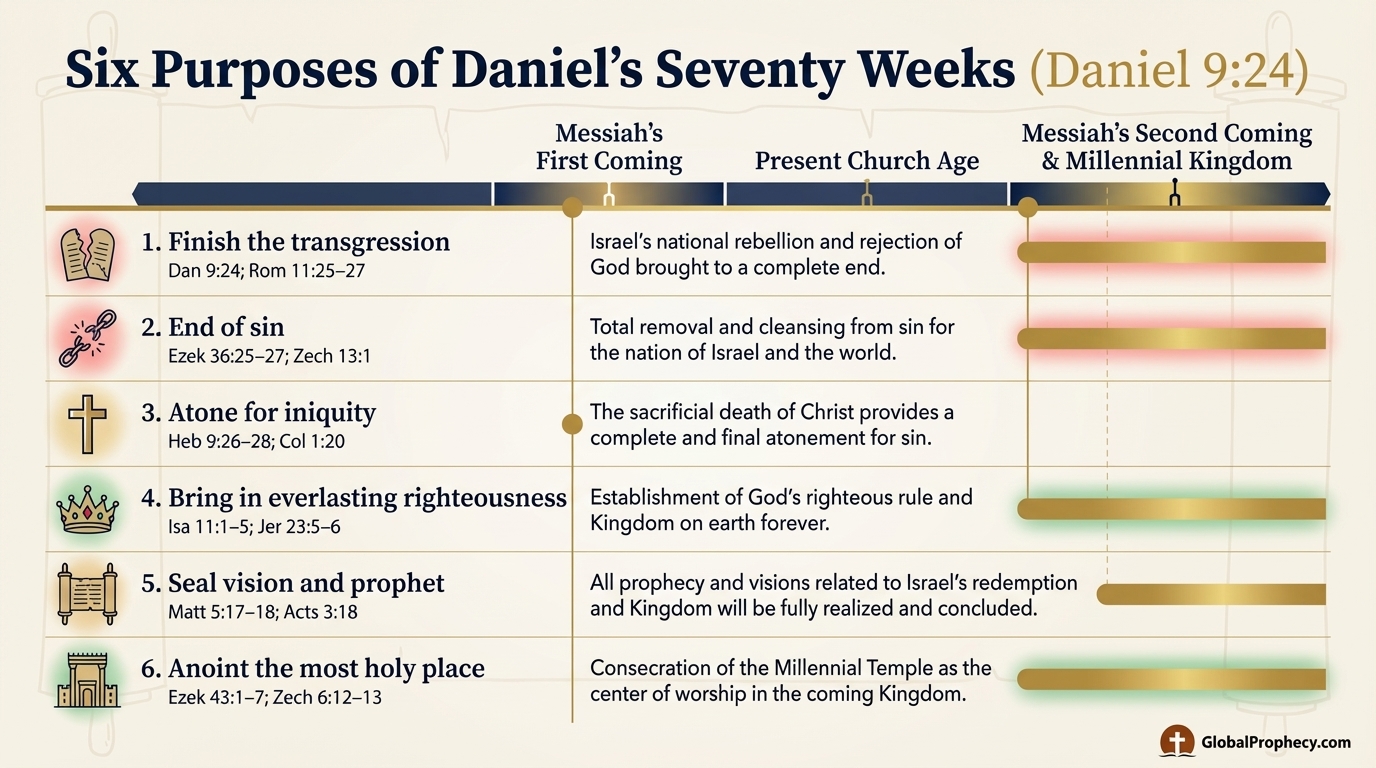
Verse 24 lists six objectives that will be accomplished for Israel and Jerusalem within the 490‑year program:
-
“to finish the transgression”
Israel’s long history of covenant rebellion will be brought to an end. At Messiah’s return, national apostasy will cease and the nation will be spiritually restored (cf. Rom 11:25–27). -
“to put an end to sin”
Not only will the pattern of rebellion end, but sin’s dominion over the nation will be broken. Israel will no longer persist in unbelief and idolatry (cf. Ezek 36:25–27). -
“to atone for iniquity”
The atonement was provided once for all at Christ’s first coming (Heb 9:26–28), but its full national application to Israel awaits their future repentance and faith in their rejected Messiah (Zech 12:10; Rom 11:26–27). -
“to bring in everlasting righteousness”
This points to the establishment of Messiah’s righteous rule on earth—His millennial kingdom—when righteousness characterizes Jerusalem and the nations (cf. Isa 11:1–5; Jer 23:5–6). -
“to seal both vision and prophet”
All prophetic revelation given to Israel will be fully verified and brought to completion. Nothing will remain “unfulfilled”; the entire prophetic program is “sealed up” in the sense of consummation. -
“to anoint a most holy place” (or “the most holy”)
Most naturally this refers to the consecration of the millennial temple (cf. Ezek 40–48). Some also see a reference to the public enthronement of Messiah Himself.
These outcomes are not yet fully realized in history. While Christ's first coming secured the basis for atonement, the national end of Israel's sin, the bringing in of everlasting righteousness, and the final sealing of prophecy await His second coming after the seventieth week.
4. The First 69 Weeks: From the Decree to Messiah the Prince
Verse 25 divides the 490 years into seven weeks, sixty‑two weeks, and one week:
“Know therefore and understand that
from the going out of the word to restore and build Jerusalem
to the coming of an anointed one, a prince,
there shall be seven weeks. Then for sixty‑two weeks it shall be built again
with squares and moat, but in a troubled time.”
— Daniel 9:25
4.1 The Starting Point: The Decree to Rebuild Jerusalem
Several Persian decrees appear in Scripture, but only one explicitly authorizes rebuilding the city and its walls:
- Artaxerxes’ decree to Nehemiah in the twentieth year of his reign (commonly dated 444/445 BC)
- Nehemiah 2:1–8 records this command “to rebuild the city” and its fortifications.
This decree best matches the requirement “to restore and build Jerusalem.”
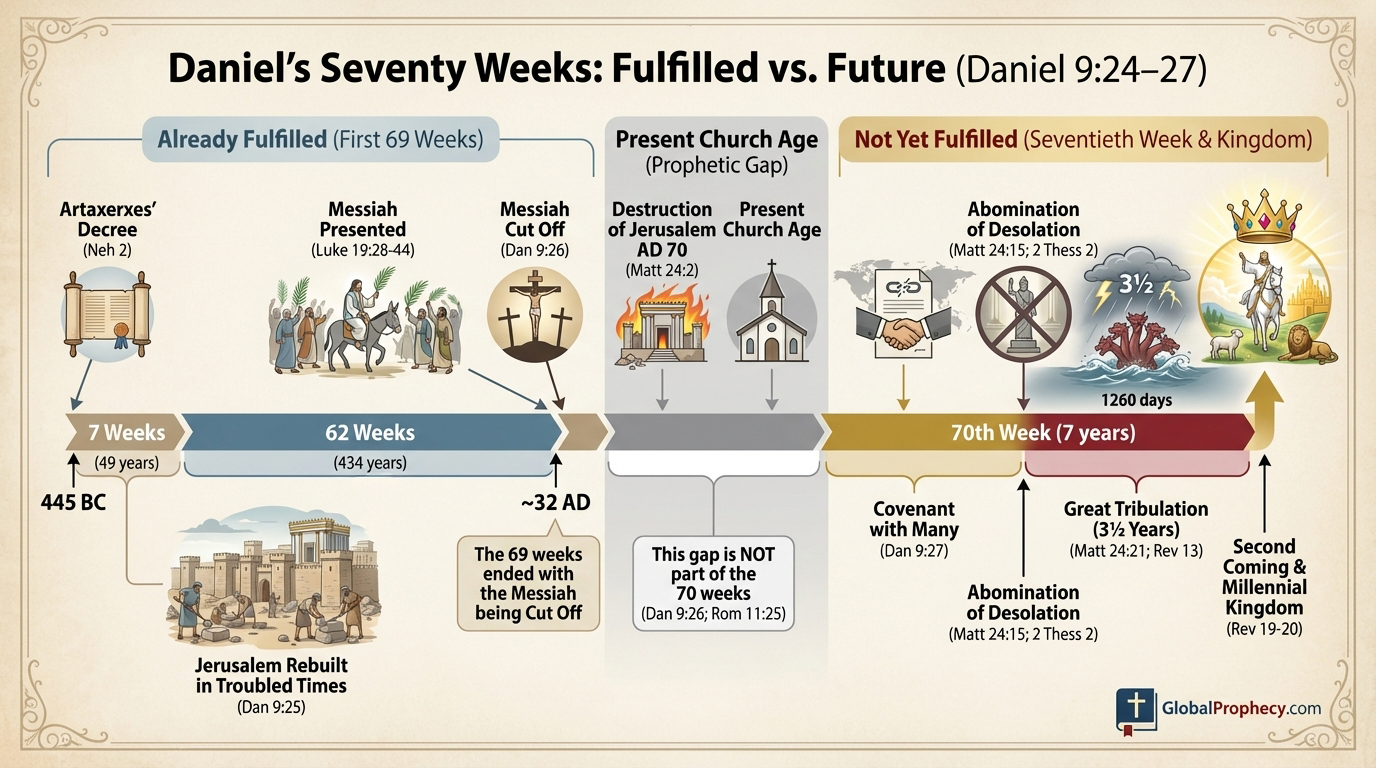
4.2 The Structure of the 69 Weeks (7 + 62)
The first two segments total 69 weeks = 69 × 7 = 483 years.
A helpful summary:
| Segment | Duration (in years) | Key Events |
|---|---|---|
| 7 weeks | 49 years | Rebuilding of Jerusalem in “troubled times” (Nehemiah’s era and aftermath) |
| 62 weeks | 434 years | Continuation until the appearance of “Messiah the Prince” |
Using a 360‑day “prophetic year” (attested in Rev 11:2–3; 12:6; 13:5 where 42 months = 1,260 days), many evangelical scholars have shown that:
- 483 prophetic years = 173,880 days
- Counting from Artaxerxes’ decree (444/445 BC) leads precisely to Messiah’s public presentation of Himself in Jerusalem—the Triumphal Entry (Luke 19:28–44), typically dated AD 30–33.
On that day Israel’s King arrived, fulfilling Zechariah 9:9. Yet instead of receiving Him, the nation largely rejected Him.
4.3 After the 69 Weeks: Messiah Cut Off and Jerusalem Destroyed
Verse 26 explicitly places two major events “after the sixty‑two weeks” (i.e., after the total 69 weeks), not during the seventieth:
“And after the sixty‑two weeks, an anointed one shall be cut off and shall have nothing.
And the people of the prince who is to come shall destroy the city and the sanctuary.
Its end shall come with a flood, and to the end there shall be war.
Desolations are decreed.”
— Daniel 9:26
Two distinct realities:
-
“An anointed one shall be cut off and shall have nothing”
- The “anointed one” (Messiah) is killed; He appears to receive none of the promised kingdom.
- This precisely matches the crucifixion of Jesus Christ shortly after His Triumphal Entry.
-
“The people of the prince who is to come shall destroy the city and the sanctuary”
- The “people” are the Romans who destroyed Jerusalem and the temple in AD 70.
- The “prince who is to come” is not Titus himself but a future ruler of the same people—a latter‑day leader arising from the revived form of the Roman world power, known elsewhere as the Antichrist (cf. Dan 7:8, 24–25; 2 Thess 2:3–4; Rev 13).
This language implies a gap: the Messiah’s death (AD 30–33) and the destruction of Jerusalem (AD 70) both occur after the 69 weeks, yet the seventieth week has not begun in the text until verse 27.
5. The Gap Between the 69th and 70th Weeks
A key feature of the dispensational understanding of Daniel 9 is the recognition of a chronological interval between the sixty‑ninth and the seventieth week.
5.1 Why a Gap Is Required by the Text
Several considerations show that the seventieth week does not immediately follow the sixty‑ninth:
-
Verse 26 uses “after”
- Messiah is cut off after the 69 weeks—not “in” the seventieth week.
- The destruction of Jerusalem likewise occurs after the 69 weeks.
-
Historical timing
- If all 70 weeks ran consecutively from 444/445 BC, the 490 years would end in the first century.
- Yet the six goals of Daniel 9:24 are clearly not fulfilled by AD 70:
- Everlasting righteousness has not been brought in globally.
- Vision and prophecy are not yet “sealed up” in fulfillment.
- Israel has not experienced national repentance and the full kingdom blessings.
-
New Testament confirmation of future fulfillment
- Jesus, decades after Daniel and after Antiochus, cites “the abomination of desolation spoken of by the prophet Daniel” as a future event immediately prior to His second coming (Matt 24:15–21, 29–31).
- Paul, in the first century, speaks of a future “man of lawlessness” who will sit in the temple of God and proclaim himself to be God (2 Thess 2:3–4), echoing Daniel 9:27.
- John, writing around AD 95, describes a future 42‑month (three‑and‑a‑half‑year) period of intense persecution (Rev 11:2–3; 13:5), corresponding to half of Daniel’s final “week.”
5.2 The Present Church Age as the Gap
Gabriel told Daniel that the seventy sevens were “decreed about your people and your holy city” (Dan 9:24). The prophetic clock measures God’s special dealings with Israel as a nation, not His program for the church, which is a distinct entity (cf. Eph 3:1–6; Rom 11:25–27).
Thus:
- The first 69 weeks ran from the decree of Artaxerxes to Messiah’s presentation and subsequent rejection.
- With Israel’s rejection of her Messiah and the destruction of Jerusalem, the prophetic clock for Israel paused.
- God began a new work, forming the church, composed of Jews and Gentiles in one body (Eph 2:11–16; Acts 2). This “mystery” (Eph 3) was not revealed in the Old Testament and therefore is not counted within the seventy weeks.
We are presently living in this intervening age, sometimes called “the times of the Gentiles” (Luke 21:24) and “the fullness of the Gentiles” (Rom 11:25). The prophetic clock for Israel will resume when the events of Daniel 9:27 begin.
6. The Seventieth Week: Future Tribulation and the Antichrist
The final week—seven years—is described in Daniel 9:27:
“And he shall make a strong covenant with many for one week,
and for half of the week he shall put an end to sacrifice and offering.
And on the wing of abominations shall come one who makes desolate,
until the decreed end is poured out on the desolator.”
— Daniel 9:27
6.1 The “He” of Verse 27: The Coming Prince
Grammatically, “he” refers back to “the prince who is to come” in verse 26, not to the Messiah. This “prince” arises from the people (the Romans) who destroyed the city and sanctuary, but appears in the last days as the final world ruler—the Antichrist.
Key features:
-
“He shall make a strong covenant with many for one week”
- A binding seven‑year covenant with “the many” in Israel (Jewish leadership).
- This agreement likely guarantees Israel’s security and allows renewed temple worship. It marks the start of the seventieth week and, therefore, the beginning of the Tribulation period.
-
“For half of the week he shall put an end to sacrifice and offering”
- At the midpoint (three and a half years in), he betrays the covenant.
- He stops the regular sacrifices, implying an operating Jewish temple in the last days.
-
“On the wing of abominations shall come one who makes desolate”
- He sets up an idolatrous, detestable act (the abomination of desolation) in the temple, demanding worship for himself (cf. Matt 24:15; 2 Thess 2:4; Rev 13:14–15).
- This triggers the Great Tribulation, the unparalleled time of distress for Israel (Matt 24:21; Jer 30:7).
-
“Until the decreed end is poured out on the desolator”
- His reign of terror is strictly limited.
- At Christ's second coming, the Antichrist is destroyed (cf. 2 Thess 2:8; Rev 19:19–20).
6.2 The Seventieth Week and the Seven‑Year Tribulation
The seventieth week = seven years corresponds to the period commonly called the Tribulation, divided into two equal halves:
| Period | Duration | Main Features |
|---|---|---|
| First half | 3½ years / 42 months / 1,260 days | Covenant in force; relative protection for Israel; first series of judgments (Rev 6–9) |
| Second half | 3½ years / 42 months / 1,260 days | Covenant broken; sacrifices halted; abomination of desolation; intense persecution of Israel and saints (Matt 24:21; Rev 12–13) |
Revelation’s repeated references to 42 months, 1,260 days, and “time, times, and half a time” (Rev 11:2–3; 12:6, 14; 13:5) match Daniel’s half‑week. Together, they describe the same eschatological period immediately preceding Christ’s visible return.
7. Fulfillment and Remaining Prophecy
From a dispensational, premillennial perspective, Daniel’s seventy weeks divide into fulfilled and future segments:
7.1 Already Fulfilled
-
The first 69 weeks (483 years):
- Began with Artaxerxes’ decree to rebuild Jerusalem (Neh 2:1–8).
- Culminated in the public presentation of Messiah the Prince in Jerusalem.
- Soon after, the Messiah was “cut off” (crucified) and “had nothing” (no visible kingdom at that time).
-
Events in the gap (but foretold in v. 26):
- The destruction of Jerusalem and the temple by the Romans in AD 70.
- Continuing “wars” and “desolations” decreed for the land.
Christ’s atoning death secured the foundation for the first three goals of verse 24—atonement for iniquity and the eventual end of Israel’s transgression and sin—though their national application is still future.
7.2 Not Yet Fulfilled
The following elements await fulfillment in the seventieth week and beyond:
- A seven‑year covenant between the coming world ruler (Antichrist) and “the many” in Israel (Dan 9:27a).
- The rebuilding (or re‑establishing) of a Jewish temple where sacrifices and offerings again occur.
- The mid‑week betrayal: cessation of sacrifice, the abomination of desolation, and intense persecution of Israel.
- The completion of the six goals in Daniel 9:24:
- Israel’s full repentance
- The end of national sin
- The bringing in of everlasting righteousness in the messianic kingdom
- The sealing up of all prophetic vision
- The anointing of the most holy place
These events culminate at Christ’s second coming, when He destroys the Antichrist, delivers Israel, and establishes His millennial reign.
8. Conclusion
The prophecy of the seventy weeks of Daniel is God’s prophetic calendar for Israel. It reveals:
- A precise countdown of 483 years from the decree to rebuild Jerusalem to the coming and rejection of Messiah the Prince.
- A gap in which the church age unfolds—a period not counted in the seventy weeks but clearly foreknown by God and revealed in the New Testament as a “mystery.”
- A future seventieth week—a final seven‑year period during which a coming world ruler will make and then break a covenant with Israel, desecrate the temple, and unleash unprecedented tribulation, only to be destroyed at Messiah’s return.
Thus Daniel 9:24–27 stands at the heart of biblical eschatology. It binds together the cross of Christ, the present age, and the climactic events of the end times, guaranteeing that God’s purposes for Israel, Jerusalem, and the kingdom of Messiah will be perfectly and literally fulfilled.
FAQ
Q: What are the “seventy weeks” of Daniel?
The “seventy weeks” are seventy “sevens” of years, totaling 490 years of God’s special dealings with Israel and Jerusalem (Dan 9:24). The first 69 weeks (483 years) ran from Artaxerxes’ decree to rebuild Jerusalem to the coming and death of Messiah. One final week (seven years) remains future and corresponds to the end‑time Tribulation.
Q: Has Daniel’s seventieth week already been fulfilled?
No. The seventieth week of Daniel 9:27 has not yet occurred. It involves a seven‑year covenant between a future ruler (the Antichrist) and Israel, the cessation of sacrifices at the midpoint, and the setting up of the abomination of desolation in the temple. Jesus (Matt 24:15), Paul (2 Thess 2:3–4), and John (Rev 11–13) all treat these events as future.
Q: How do the seventy weeks relate to the Tribulation?
The seventieth week is a literal seven‑year period that aligns with what Scripture elsewhere calls the Tribulation, especially its last half, the Great Tribulation (Matt 24:21; Rev 7:14). It begins with the Antichrist’s covenant with Israel and reaches its climax with his betrayal, temple desecration, and global persecution of God’s people.
Q: Why is there a gap between the 69th and 70th weeks of Daniel?
The gap is required because Daniel 9:26 places the Messiah’s death and the destruction of Jerusalem after the 69 weeks but before the seventieth. Moreover, the six goals of verse 24 are not yet fulfilled, and the New Testament presents the abomination of desolation and the Antichrist’s career as still future. This intervening period corresponds to the present church age, during which God is forming a new people composed of Jews and Gentiles in one body.
Q: Who is the “prince who is to come” in Daniel 9:26–27?
The “prince who is to come” is a future world ruler arising from the same people who destroyed Jerusalem in AD 70—the Roman world. He is the Antichrist, who will confirm a seven‑year covenant with Israel, break it after three and a half years, stop temple sacrifices, set up the abomination of desolation, and be destroyed by Christ at His second coming (2 Thess 2:3–8; Rev 13; 19:19–20).
Frequently Asked Questions
What are the seventy weeks of Daniel?
Has Daniel's seventieth week already been fulfilled?
How do the seventy weeks relate to the Tribulation?
Why is there a gap between the 69th and 70th weeks of Daniel?
Who is the prince who is to come in Daniel 9:26–27?
L. A. C.
Theologian specializing in eschatology, committed to helping believers understand God's prophetic Word.
Related Articles
The Gap Between the 69th and 70th Week: Why the Church Age Interrupts Daniel's Prophecy
Gap between the 69th and 70th week explains how Daniel’s prophecy pauses for the church age, detailing why this interval precedes Israel’s final week.
What is the Tribulation Period?
Tribulation period explained: discover the biblical definition, seven-year duration, and God’s prophetic purpose for this intense future time.
Babylon the Great
Babylon the Great in Revelation 17–18 reveals end-time religious and commercial rebellion against God and its sudden, final destruction in judgment.
What the Bible Says about Antichrist?
Antichrist in the Bible: discover what Scripture reveals about his identity, character, deceptive power, and end-time role in the Tribulation.