
The Abrahamic Covenant: God's Unconditional Promise to Israel
1. Introduction
The Abrahamic Covenant is the foundational covenant of biblical prophecy. God’s oath to Abraham and his descendants shapes the whole course of redemptive history, determines Israel’s future, and clarifies how Gentiles share in God’s blessing without replacing Israel. Understanding this covenant—its terms, its unconditional nature, and its relation to later covenants—is essential for a coherent eschatology.
This article focuses on the Abrahamic Covenant as God’s unconditional promise to Israel and explains its prophetic significance, especially regarding the land, the nation, and the coming messianic kingdom.
2. The Text and Structure of the Abrahamic Covenant
The Abrahamic Covenant is revealed and expanded through several key passages:
- Genesis 12:1–3, 7
- Genesis 13:14–17
- Genesis 15:1–21
- Genesis 17:1–21
- Genesis 22:15–18
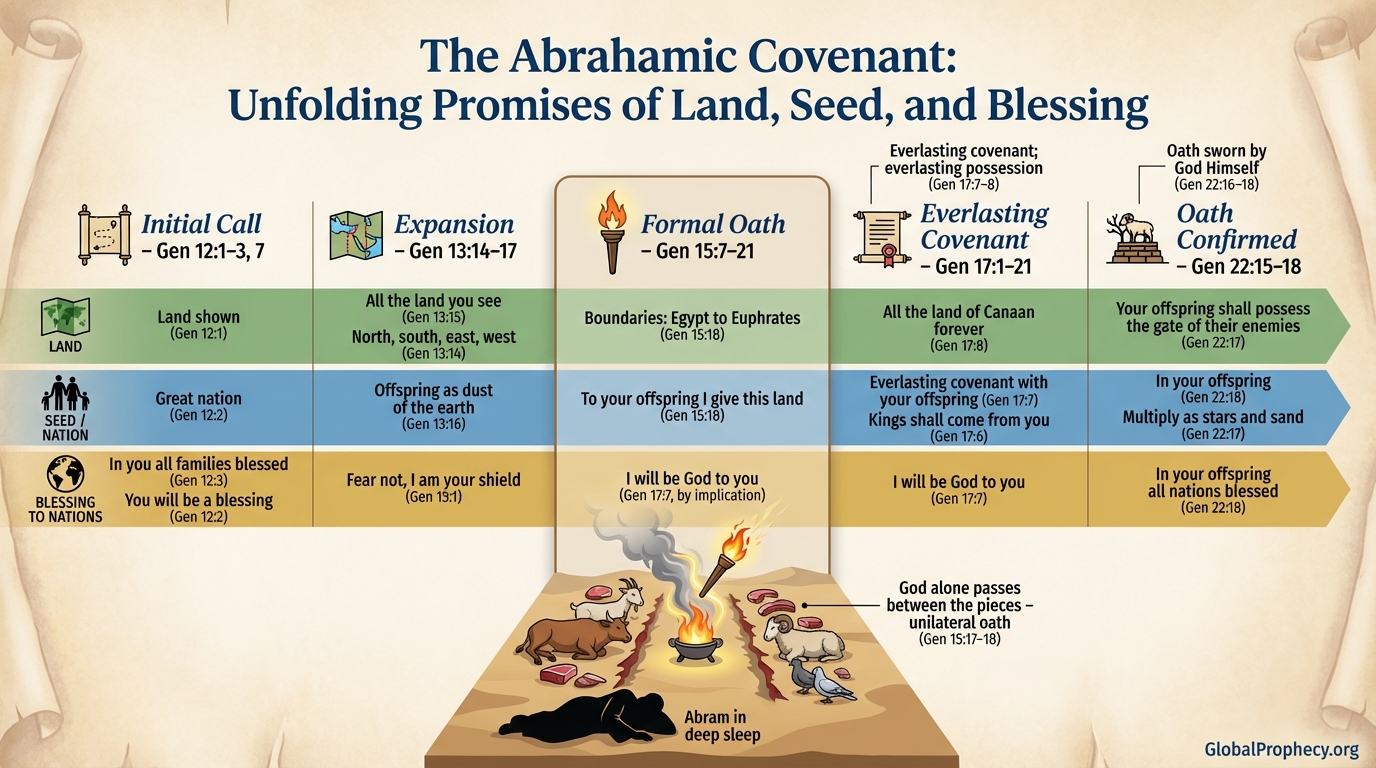
2.1 Initial Promise (Genesis 12:1–3, 7)
God first calls Abram with a sevenfold promise:
“Go from your country and your kindred and your father’s house to the land that I will show you.
And I will make of you a great nation, and I will bless you and make your name great, so that you will be a blessing.
I will bless those who bless you, and him who dishonors you I will curse, and in you all the families of the earth shall be blessed.” — Genesis 12:1–3
Verse 7 adds:
“To your offspring I will give this land.” — Genesis 12:7
Already three core elements appear:
- Land – “the land that I will show you” (12:1, 7)
- Nation/Seed – “a great nation” (12:2)
- Blessing – “in you all the families of the earth shall be blessed” (12:3)
2.2 Formal Ratification (Genesis 15)
In Genesis 15:7–21 God formalizes the covenant in a solemn ceremony. He specifies the geographical boundaries:
“To your offspring I give this land, from the river of Egypt to the great river, the river Euphrates.” — Genesis 15:18
And He alone passes between the divided animals (vv. 17–18), indicating a one‑party oath.
2.3 Everlasting and Multi‑Generational (Genesis 17)
In Genesis 17:7–8 God describes the covenant as:
“an everlasting covenant between me and you and your offspring after you … And I will give to you and to your offspring after you … all the land of Canaan, for an everlasting possession.” — Genesis 17:7–8
The covenant is explicitly:
- With Abraham’s physical descendants (through Isaac and Jacob)
- Everlasting
- Focused on land, nationhood, and relationship with God
3. The Unconditional and Everlasting Nature of the Covenant
A central question in eschatology is whether the Abrahamic Covenant is conditional (dependent on Israel’s obedience) or unconditional (resting solely on God’s faithfulness). The biblical data consistently present it as unconditional and irrevocable, though the enjoyment of its blessings in any generation can be affected by obedience or disobedience.
3.1 God Alone Obligates Himself (Genesis 15)
In ancient covenant rituals, both parties would walk between the pieces of sacrificed animals, symbolically saying, “May this happen to me if I break the covenant” (cf. Jer. 34:18–19). In Genesis 15:
- Abram is in a deep sleep (15:12).
- A “smoking fire pot and a flaming torch” (symbols of God’s presence) alone pass between the pieces (15:17).
“On that day the LORD made a covenant with Abram…” — Genesis 15:18
Abram takes no oath; God binds Himself. This is the clearest textual sign that the Abrahamic Covenant is unilateral and unconditional.
3.2 God Calls It “Everlasting”
In Genesis 17:
- “I will establish my covenant as an everlasting covenant…” (17:7)
- “I will give… all the land of Canaan, as an everlasting possession” (17:8)
Later Scripture affirms the same:
“…the covenant that he made with Abraham, his sworn promise to Isaac, which he confirmed to Jacob as a statute, to Israel as an everlasting covenant…” — Psalm 105:9–10
Paul likewise insists:
“For the gifts and the calling of God are irrevocable.” — Romans 11:29
The land promise and national calling of Israel cannot be permanently annulled without impugning God’s faithfulness.
3.3 Distinguishing Covenant Grant from Mosaic Conditions
The Mosaic Covenant (given centuries later at Sinai) is explicitly conditional:
“Now therefore, if you will indeed obey my voice and keep my covenant, you shall be my treasured possession…” — Exodus 19:5
The Mosaic Law governed Israel’s life in the land—their experience of blessing or cursing (Lev. 26; Deut. 28). But Paul is emphatic:
“The law, which came 430 years afterward, does not annul a covenant previously ratified by God, so as to make the promise void.” — Galatians 3:17
So:
- Abrahamic Covenant: unconditional, everlasting grant of land, seed, and blessing.
- Mosaic Covenant: conditional administration of blessing and cursing within that land.
Israel’s disobedience could lead to temporary exile, but not the cancellation of God’s earlier, unconditional oath to Abraham.
4. The Core Promises: Land, Seed, and Blessing
4.1 Land: A Real, Geographical Territory
The land component is repeated and intensified:
- Genesis 13:14–15 – “All the land that you see I will give to you and to your offspring forever.”
- Genesis 15:18 – From “the river of Egypt” to “the river Euphrates.”
- Genesis 17:8 – “All the land of Canaan, for an everlasting possession.”
Key points:
- The land is given to Abraham and his physical descendants.
- The promise is forever; it has never yet been possessed in its full extent forever.
- Israel’s partial historical occupation (even under David and Solomon) does not exhaust this promise.
Prophets link Israel’s future restoration with this same land:
“I will bring back my exiled people Israel; they shall build the ruined cities… I will plant them on their land, and they shall never again be uprooted out of the land that I have given them.” — Amos 9:14–15
This requires a future, permanent, national restoration of Israel to her promised territory.
4.2 Seed: A Nation and a Messiah
The “seed” promise has both:
-
A national aspect – a great nation from Abraham:
- “I will make of you a great nation” (Gen. 12:2).
- “I will make your offspring as the dust of the earth” (Gen. 13:16).
-
A messianic aspect – a singular Seed who brings salvation:
- “In your offspring shall all the nations of the earth be blessed” (Gen. 22:18).
- Paul identifies this Seed ultimately as Christ (Gal. 3:16).
Thus the Abrahamic Covenant guarantees:
- The continuing existence of ethnic Israel.
- The coming of the Messiah through Abraham’s line—fulfilled in Jesus.
4.3 Blessing: To Israel and to All Nations
God promised:
“I will bless you… so that you will be a blessing… in you all the families of the earth shall be blessed.” — Genesis 12:2–3
Israel is both:
- The recipient of blessing, and
- The instrument of blessing to the nations (ultimately through the Messiah).
The New Testament affirms that Gentile believers share in this spiritual blessing:
“…the Scripture, foreseeing that God would justify the Gentiles by faith, preached the gospel beforehand to Abraham, saying, ‘In you shall all the nations be blessed.’” — Galatians 3:8
Gentiles become Abraham’s spiritual seed by faith (Gal. 3:7, 29), but this does not cancel the distinct national promises to Israel as Abraham’s physical seed.
5. The Abrahamic Covenant and Later Biblical Covenants
From the Abrahamic Covenant flow three major, later covenants that each develop one aspect of the original promise:
| Abrahamic Promise | Later Covenant | Focus |
|---|---|---|
| Land | Land / “Palestinian” Covenant (Deut 30:1–10) | Israel’s permanent possession of the land |
| Seed / Kings | Davidic Covenant (2 Sam 7:12–16) | Eternal dynasty and throne in David’s line |
| Blessing / New Heart | New Covenant (Jer 31:31–34) | Spiritual renewal, forgiveness, Spirit indwelling |
5.1 Land Covenant (Deuteronomy 30:1–10)
This covenant reaffirms Israel’s eventual regathering and restoration after dispersion:
- Repentance in exile (Deut 30:1–2).
- Regathering “from all the peoples” (30:3–4).
- Return to the land and prosperity there (30:5, 9).
- A circumcised heart to love the LORD (30:6).
It makes clear that while possession of the land’s blessings is conditioned on repentance, the grant of the land itself falls under the unconditional Abrahamic oath.
5.2 Davidic Covenant (2 Samuel 7:12–16)
God promises David:
- A house (dynasty)
- A throne
- A kingdom
- Established forever
“Your house and your kingdom shall be made sure forever before me. Your throne shall be established forever.” — 2 Samuel 7:16
This covenant guarantees:
- A perpetual Davidic line.
- A coming Davidic Messiah who will reign over Israel and the nations.
It expands the “seed” aspect of the Abrahamic Covenant, focusing it on David’s royal line.
5.3 New Covenant (Jeremiah 31:31–34)
Spoken explicitly to:
“…the house of Israel and the house of Judah…” — Jeremiah 31:31
This covenant promises:
- God’s law written on the heart (31:33).
- An unbreakable relationship: “I will be their God, and they shall be my people.”
- Universal knowledge of the LORD in Israel.
- Full forgiveness of sins.
Jeremiah adds that as long as the created order stands, Israel will remain a nation before God (Jer. 31:35–37). This underlines again that God’s national commitments to Israel—rooted in the Abrahamic Covenant—are irrevocable.
In the New Testament, Jesus inaugurates the New Covenant by His blood (Luke 22:20), and the church already participates in its spiritual blessings (forgiveness, indwelling Spirit) without exhausting its national fulfillment for Israel, which awaits the Messiah’s return and Israel’s national conversion (Rom. 11:25–27).
6. Prophetic Significance of the Abrahamic Covenant
From a prophetic perspective, the Abrahamic Covenant is the structural backbone of Israel’s eschatology.
6.1 Guaranteed Future for Ethnic Israel
Paul asks:
“Has God rejected his people?”
“By no means!… God has not rejected his people whom he foreknew.” — Romans 11:1–2
Because the Abrahamic Covenant is unconditional and everlasting:
- Israel’s existence as a nation is guaranteed.
- Their present hardening is partial and temporary (Rom. 11:25).
- Their future salvation (“all Israel will be saved,” Rom. 11:26) is tethered to the New Covenant and to God’s oath to Abraham.
6.2 Literal Land Restoration in the Messianic Kingdom
Since the Abrahamic land promise has never been fully realized in history, and Scripture repeatedly ties Israel’s future restoration to the same geographic land, premillennial theology sees its literal fulfillment in the millennial kingdom:
- Israel regathered in belief.
- The Messiah reigning on David’s throne in Jerusalem.
- The land boundaries of Genesis 15:18 ultimately realized.
This aligns with prophecies like Isaiah 11; Ezekiel 36–37; Amos 9:11–15.
6.3 Gentile Participation Without Replacement
The Abrahamic Covenant also explains how Gentiles fit God’s plan:
- Gentiles are blessed in Abraham by faith (Gal. 3:8–9).
- In Christ, believing Jews and Gentiles are one spiritual body, the church (Eph. 2:11–22).
- Yet the church does not cancel or absorb Israel’s national promises; rather, it participates in the spiritual blessings of the Abrahamic and New Covenants while God’s national program for Israel is completed in the future.
Thus, the Abrahamic Covenant guards against both:
- Replacement theology (denying a future for Israel), and
- Dual‑covenant theology (suggesting Israel can be saved apart from Christ).
There is one way of salvation (by grace through faith in Christ), but distinct roles for Israel and the church within God’s unified redemptive plan.
7. Conclusion
The Abrahamic Covenant is God’s unbreakable oath to Abraham and his descendants:
- To give them a land as an everlasting possession.
- To make them a great nation.
- To bring worldwide blessing through his Seed, the Messiah.
This covenant is unconditional, everlasting, and irrevocable. It undergirds the later Land, Davidic, and New Covenants and requires:
- A future national restoration of Israel.
- A literal messianic kingdom in the land promised to Abraham.
- Ongoing spiritual blessing for Gentiles in Christ, Abraham’s Seed.
Any eschatology that takes Scripture’s covenant language in its natural, historical‑grammatical sense will see that God’s promises to Israel have not been transferred or cancelled but await glorious, literal fulfillment in the age to come.
FAQ
Q: What is the Abrahamic Covenant in simple terms?
The Abrahamic Covenant is God’s solemn promise to Abraham and his physical descendants to give them a specific land forever, make them a great nation, and bring blessing to all nations through Abraham’s Seed, ultimately Christ. It is an unconditional, everlasting covenant grounded in God’s own oath, not in Israel’s performance.
Q: Is the Abrahamic Covenant conditional on Israel’s obedience?
No. The covenant grant itself is unconditional—God alone passed between the animal pieces in Genesis 15, binding Himself to fulfill it. Israel’s obedience under the later Mosaic Law affected their experience of blessing in the land (blessing vs. cursing), but it did not annul God’s prior, unconditional promise of land, nationhood, and blessing.
Q: How does the Abrahamic Covenant relate to biblical prophecy?
It provides the framework for all major prophetic themes about Israel: their continued existence, their exile and regathering, their land inheritance, the coming of the Davidic Messiah, and the New Covenant blessings. Prophecies about a future restoration of Israel and a messianic kingdom in the land are the outworking of God’s Abrahamic oath.
Q: Do Christians today participate in the Abrahamic Covenant?
Yes, but in a specific way. Believing Jews and Gentiles are counted as Abraham’s spiritual seed by faith in Christ (Gal. 3:7, 29) and share in the spiritual blessing promised—justification and the gift of the Spirit. However, this does not cancel the national and territorial promises to Abraham’s physical seed, Israel.
Q: Has the land promise of the Abrahamic Covenant already been fulfilled?
No, not in its full, everlasting sense. Israel has never possessed all the territory specified in Genesis 15:18 for any extended period, nor “forever.” Prophetic passages like Amos 9:14–15 and Ezekiel 36–37 anticipate a future, permanent restoration of Israel to their land under the reign of the Messiah, which premillennial eschatology locates in the millennial kingdom.
Frequently Asked Questions
What is the Abrahamic Covenant in simple terms?
Is the Abrahamic Covenant conditional on Israel’s obedience?
How does the Abrahamic Covenant relate to biblical prophecy?
Do Christians today participate in the Abrahamic Covenant?
Has the land promise of the Abrahamic Covenant already been fulfilled?
L. A. C.
Theologian specializing in eschatology, committed to helping believers understand God's prophetic Word.
Related Articles
The 144,000 Sealed Israelites
144,000 sealed Israelites in Revelation identified and explained—their identity, purpose, and distinct role as preserved witnesses during the Tribulation.
What the Bible Says about Antichrist?
Antichrist in the Bible: discover what Scripture reveals about his identity, character, deceptive power, and end-time role in the Tribulation.
What the Bible Says about False Prophet?
False Prophet biblical identity and role in end times. Discover what Scripture reveals about this key figure in Revelation's tribulation prophecy.
The Biblical Covenants: Framework for Understanding Prophecy
Biblical covenants form the framework for understanding prophecy, clarifying Israel, the church, and God’s kingdom plan across the Old and New Testaments.