
What Is Abraham's Bosom and Paradise?
1. Introduction
In biblical eschatology, two key terms describe where believers go immediately after death: Abraham’s bosom and Paradise. These expressions refer to the blessed condition of the righteous in the intermediate state—the conscious existence between physical death and bodily resurrection. Understanding these terms clarifies what Scripture teaches about the believer’s comfort, location, and fellowship with God after death.
This article surveys the main biblical data and theological conclusions about Abraham’s bosom and Paradise, focusing on their role as the destination of believers between death and resurrection.
2. The Intermediate State of Believers: Basic Framework
Before defining Abraham’s bosom and Paradise, we must grasp the framework of the intermediate state.
The Bible teaches that:
-
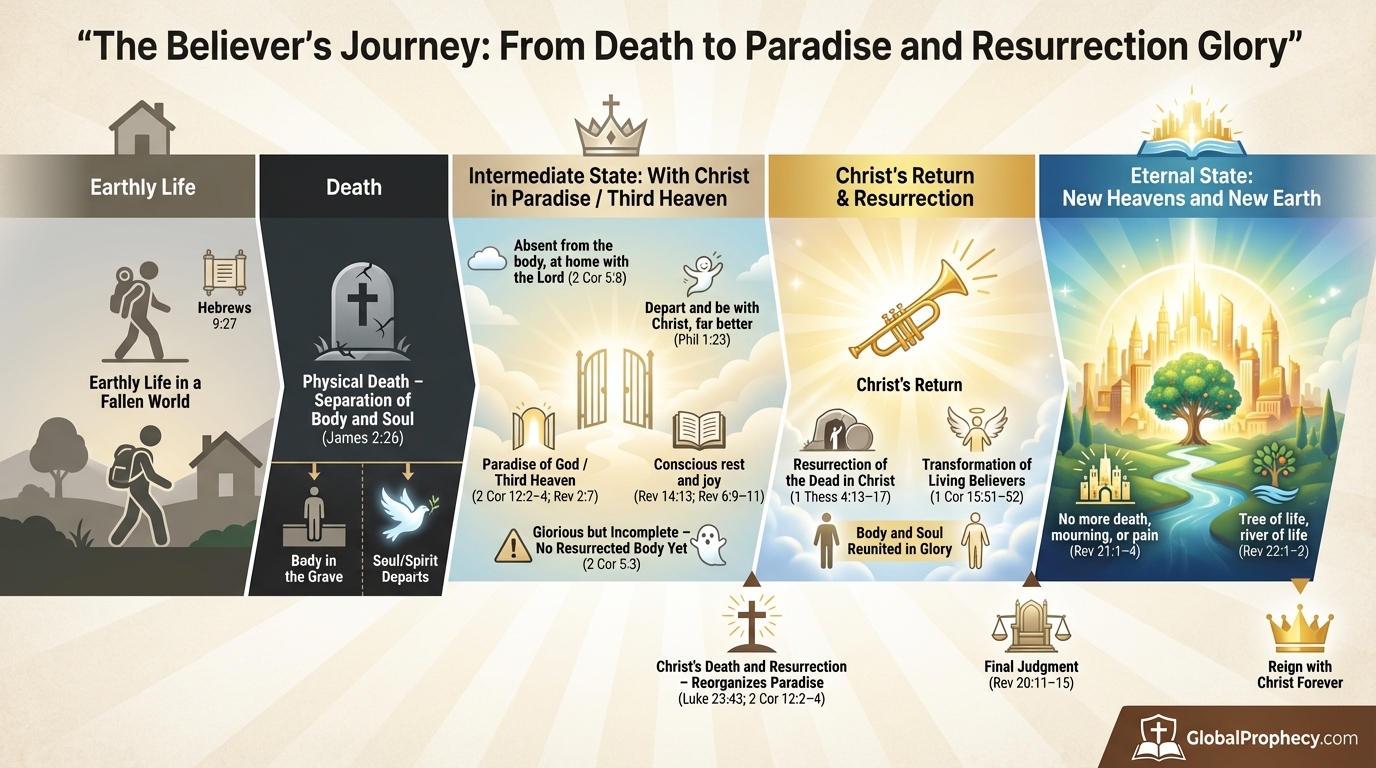
At death, the body and soul are separated.
“The body apart from the spirit is dead.”
— James 2:26 -
The body returns to the dust or the grave.
-
The soul/spirit of the believer continues in conscious personal existence.
For believers, death is not extinction or unconscious “soul sleep” but immediate entrance into a state of conscious fellowship with God:
“We would rather be away from the body and at home with the Lord.”
— 2 Corinthians 5:8
“My desire is to depart and be with Christ, for that is far better.”
— Philippians 1:23
These texts assume a real, personal, aware existence with Christ between death and the final resurrection.
Within this framework, Abraham’s bosom and Paradise describe the blessed side of this intermediate state for the righteous.
3. Abraham’s Bosom: Meaning and Old Testament Background
3.1 The Key Text: Luke 16:19–31
The expression “Abraham’s bosom” appears explicitly in Luke 16:19–31, in Jesus’ account of the rich man and Lazarus:
“The poor man died and was carried by the angels to Abraham’s side [bosom].”
— Luke 16:22
Lazarus, a believing beggar, dies and is carried by angels into a place of comfort identified as Abraham’s bosom, while the rich man, an unbeliever, finds himself “in Hades, being in torment” (Luke 16:23).
Even if the story is parabolic, Jesus intentionally uses imagery that accurately reflects post-mortem realities:
- Lazarus is conscious.
- He is in comfort (Luke 16:25).
- He is in fellowship with Abraham, the covenant father of the faithful.
- There is a fixed separation (“a great chasm … has been fixed,” Luke 16:26) between the righteous and the wicked.
3.2 What “Abraham’s Bosom” Signifies
The phrase evokes the banquet posture of reclining at table, where one leans on the chest (“bosom”) of another. It communicates:
- Intimate fellowship – close communion with Abraham, and thus with the people of God.
- Honor and acceptance – to be at Abraham’s bosom is to be counted among the true children of Abraham (cf. Galatians 3:7).
- Comfort and rest – in contrast to the agony of the rich man in Hades.
In the broader biblical theology of the intermediate state:
- Abraham’s bosom functions as a name for the blessed abode of the righteous dead.
- In the Old Testament era, this blessed realm is often connected with Sheol understood in a two-compartment way: a place of torment for the wicked and a place of comfort for the righteous.
From a dispensational reading (as reflected in many conservative systems):
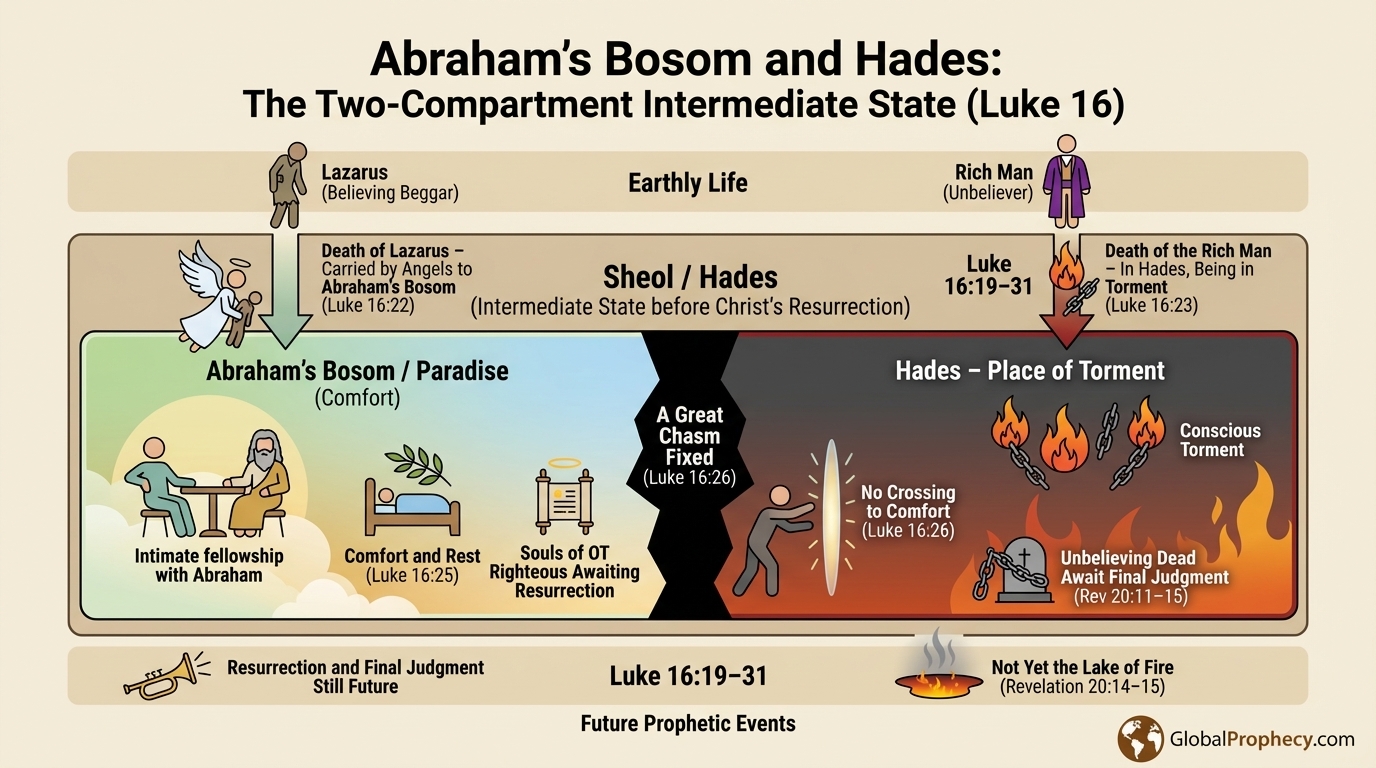
- Before Christ’s resurrection, the souls of the righteous went to the “upper compartment” of Sheol/Hades, called Abraham’s bosom (or Paradise).
- The wicked went to the lower, punitive compartment of Hades.
Thus Abraham’s bosom designates the pre-resurrection resting-place of Old Testament believers, in conscious joy and comfort.
4. Paradise: The Blessed Dwelling of the Righteous
4.1 Etymology and Concept
The word Paradise (Greek paradeisos) originally referred to a walled garden or park, and was used in the Greek Old Testament (LXX) for the Garden of Eden. Over time, it became a metaphor for a divine garden of delight, and eventually a title for the blessed abode of the righteous.
4.2 Paradise in the New Testament
The New Testament uses “Paradise” three times, each in a context of blessed afterlife:
-
Luke 23:43 – Jesus and the repentant thief
“Truly, I say to you, today you will be with me in Paradise.”
— Luke 23:43Key implications:
- Immediate entrance: “today you will be with me,” not at a distant future resurrection only.
- Personal presence with Christ: “with me in Paradise.”
- The thief’s body went to the grave; his soul went to Paradise with Christ.
In light of the intermediate state:
- At that moment in redemptive history (before Christ’s resurrection and ascension), Paradise coincides with the blessed realm of the righteous dead—the same place designated as Abraham’s bosom in Luke 16.
-
2 Corinthians 12:2–4 – Paul’s heavenly vision
“I know a man in Christ who fourteen years ago was caught up to the third heaven … caught up into Paradise…”
— 2 Corinthians 12:2–4Here, Paul equates “third heaven” and “Paradise”, indicating that in the post-resurrection era, Paradise is located in the immediate presence of God in heaven.
-
Revelation 2:7 – The tree of life
“To the one who conquers I will grant to eat of the tree of life, which is in the paradise of God.”
— Revelation 2:7This links Paradise with the tree of life and anticipates the eternal state (cf. Revelation 22:1–2), but it also confirms Paradise as the realm of divine life and blessing.
4.3 Paradise and Abraham’s Bosom: Relationship Across Redemptive History
Putting these passages together:
-
Before Christ’s resurrection
- The righteous dead (like Lazarus, and the thief upon dying later that day) entered the blessed compartment of Sheol/Hades.
- This realm is called Abraham’s bosom (Luke 16:22) and Paradise (Luke 23:43).
- It is characterized by rest, comfort, and fellowship with the faithful (especially Abraham) and with God.
-
After Christ’s resurrection and ascension
- Christ, having completed redemption and risen in glory, reorganizes the intermediate state of believers.
- Paradise is now identified with the third heaven, the localized presence of God (2 Corinthians 12:2–4).
- The souls of believers no longer go to Sheol/Hades but go directly to be with Christ in heaven (cf. 2 Corinthians 5:8; Philippians 1:23).
In this sense:
- Abraham’s bosom is the title primarily used for the pre-resurrection location of the righteous dead.
- Paradise begins as a synonym for that blessed place, then, after Christ’s ascension, denotes the heavenly dwelling of God where Christ and the saints now are.
5. The Present Destination of Believers: With Christ in Paradise
From the vantage point of the church age, the crucial question is: Where do believers go now when they die?
5.1 Immediate Presence with Christ
Several New Testament texts give a clear, unified answer:
“We would rather be away from the body and at home with the Lord.”
— 2 Corinthians 5:8
“My desire is to depart and be with Christ, for that is far better.”
— Philippians 1:23
“Lord Jesus, receive my spirit.”
— Acts 7:59
These statements show:
- No interval of unconsciousness; departure from the body means immediate presence with Christ.
- This presence is “far better” than life in a fallen world, even though resurrection glory is still future.
- The location of this presence is heaven, the third heaven/Paradise of God (2 Corinthians 12:2–4; Revelation 2:7).
Thus, for believers after Christ’s resurrection:
- Abraham’s bosom and Paradise, in functional terms, now correspond to being “with Christ” in heaven.
- The intermediate state of the believer is best summarized as:
- Absent from the body
- Present with the Lord
- In Paradise, the blessed presence of God.
5.2 Conscious Rest, Joy, and Anticipation
The Scriptures describe the current intermediate state of believers as:
- Rest from earthly labors (Revelation 14:13).
- Conscious fellowship and awareness (e.g., the martyrs under the altar in Revelation 6:9–11 who speak, remember, and long for God’s justice).
- Comfort and encouragement, like Lazarus in Abraham’s bosom (Luke 16:25).
Yet this state is still called a kind of “nakedness” (2 Corinthians 5:3), because humans were created to be embodied. Therefore:
- The intermediate state in Paradise is glorious but incomplete.
- The believer still awaits the resurrection of the body at Christ’s coming (1 Thessalonians 4:13–17; 1 Corinthians 15).
6. Summary: Abraham’s Bosom and Paradise as the Believer’s Intermediate Home
To synthesize the biblical teaching:
| Aspect | Abraham’s Bosom | Paradise | Present Application |
|---|---|---|---|
| Core idea | Comfort with Abraham, covenant fellowship | Garden-like realm of blessedness in God’s presence | Blessed abode of believers between death and resurrection |
| Key texts | Luke 16:19–31 | Luke 23:43; 2 Cor 12:2–4; Rev 2:7 | 2 Cor 5:8; Phil 1:23; Acts 7:59 |
| Historical phase | Pre-resurrection intermediate state of OT righteous | First: same as Abraham’s bosom; now: heaven/third heaven | Used now for the heavenly presence with Christ |
| Main characteristics | Comfort, rest, fellowship with Abraham, not in torment | Delight, life, presence of God, tree of life | Rest, conscious joy, presence with Christ, awaiting resurrection |
In every phase of redemptive history:
- Believers are never abandoned at death.
- They are carried into a realm of comfort, rest, and fellowship with God—first depicted as Abraham’s bosom, then also called Paradise, and now identified specifically with heaven, the third heaven, where Christ is.
- The final goal remains the resurrection of the body and life on a new earth, but until then, Abraham’s bosom/Paradise denotes the blessed intermediate home of the redeemed.
Conclusion
Abraham’s bosom and Paradise are biblical terms that illuminate the believer’s destiny immediately after death. Far from teaching annihilation, unconscious sleep, or a vague shadowy existence, Scripture presents a rich picture:
- The believer’s soul is carried by God’s care into a place of comfort.
- This place is marked by intimate fellowship with the faithful (symbolized by Abraham) and, above all, by being with Christ.
- Historically, this realm is portrayed as the comfort side of Sheol/Hades (Abraham’s bosom/Paradise) and, after Christ’s ascension, as Paradise in the third heaven.
- While this intermediate state is not the final goal, it is far better than our present life and totally secure in Christ.
For the Christian, then, death is a passage from the body to Christ, from earth to Paradise, with the sure promise of future resurrection and eternal glory.
FAQ
Q: What is Abraham’s bosom in the Bible?
Abraham’s bosom, mentioned in Luke 16:22, is a Jewish expression describing the blessed state of the righteous dead, pictured as reclining in intimate fellowship with Abraham at a banquet. In biblical eschatology it designates the comfort side of the intermediate state, where Old Testament believers went after death to await resurrection.
Q: Is Abraham’s bosom the same as Paradise?
Functionally, yes. In the pre-resurrection era, Abraham’s bosom and Paradise both refer to the blessed abode of the righteous dead. Jesus promised the repentant thief, “Today you will be with me in Paradise” (Luke 23:43), which corresponds to the same realm of comfort described as Abraham’s bosom in Luke 16. After Christ’s ascension, Paradise is specifically identified with heaven, the third heaven (2 Corinthians 12:2–4).
Q: Where do believers go when they die today?
According to 2 Corinthians 5:8 and Philippians 1:23, believers who die now go immediately into the presence of Christ, which the New Testament calls Paradise or the third heaven. Their bodies rest in the grave, but their souls are “at home with the Lord”, in conscious joy and rest, awaiting the resurrection.
Q: Are believers in Abraham’s bosom/Paradise conscious or asleep?
Scripture consistently portrays believers in the intermediate state as conscious and aware. Lazarus is “comforted” in Abraham’s bosom (Luke 16:25), the thief is “with” Christ in Paradise (Luke 23:43), and the martyrs in heaven speak, remember, and wait for God’s justice (Revelation 6:9–11). The language of “sleep” in Scripture refers to the body in death, not to the soul’s unconsciousness.
Q: How does Abraham’s bosom and Paradise relate to the final resurrection?
Abraham’s bosom and Paradise describe the intermediate state, not the final condition. Believers in Paradise enjoy real, conscious fellowship with Christ, but they are still “naked” in the sense of being disembodied (2 Corinthians 5:3). At Christ’s return, they will receive resurrected, glorified bodies (1 Thessalonians 4:13–17; 1 Corinthians 15), and will then live eternally in the new heavens and new earth.
Frequently Asked Questions
What is Abraham’s bosom in the Bible?
Is Abraham’s bosom the same as Paradise?
Where do believers go when they die today?
Are believers in Abraham’s bosom/Paradise conscious or asleep?
How does Abraham’s bosom and Paradise relate to the final resurrection?
L. A. C.
Theologian specializing in eschatology, committed to helping believers understand God's prophetic Word.
Related Articles
The Crowns of Heaven: Eternal Rewards for Believers
Discover the five eternal crowns believers can receive as rewards in heaven. Learn what Scripture teaches about earning the imperishable, rejoicing, righteousness, glory, and life crowns.
Will We Eat and Drink in Heaven?
Will we eat and drink in heaven? Explore what Scripture reveals about dining in eternity, the marriage supper of the Lamb, and our resurrected bodies.
What Is Heaven?
Heaven in the Bible: explore what heaven is, the three heavens Scripture describes, and what eternal life with God means for believers.
Heaven vs Hell: The Great Contrast
Heaven vs hell: explore the great contrast between eternal life and eternal punishment, highlighting destiny, judgment, joy, and separation from God.