
Amillennialism Examined: Is the Church the Millennial Kingdom?
1. Introduction
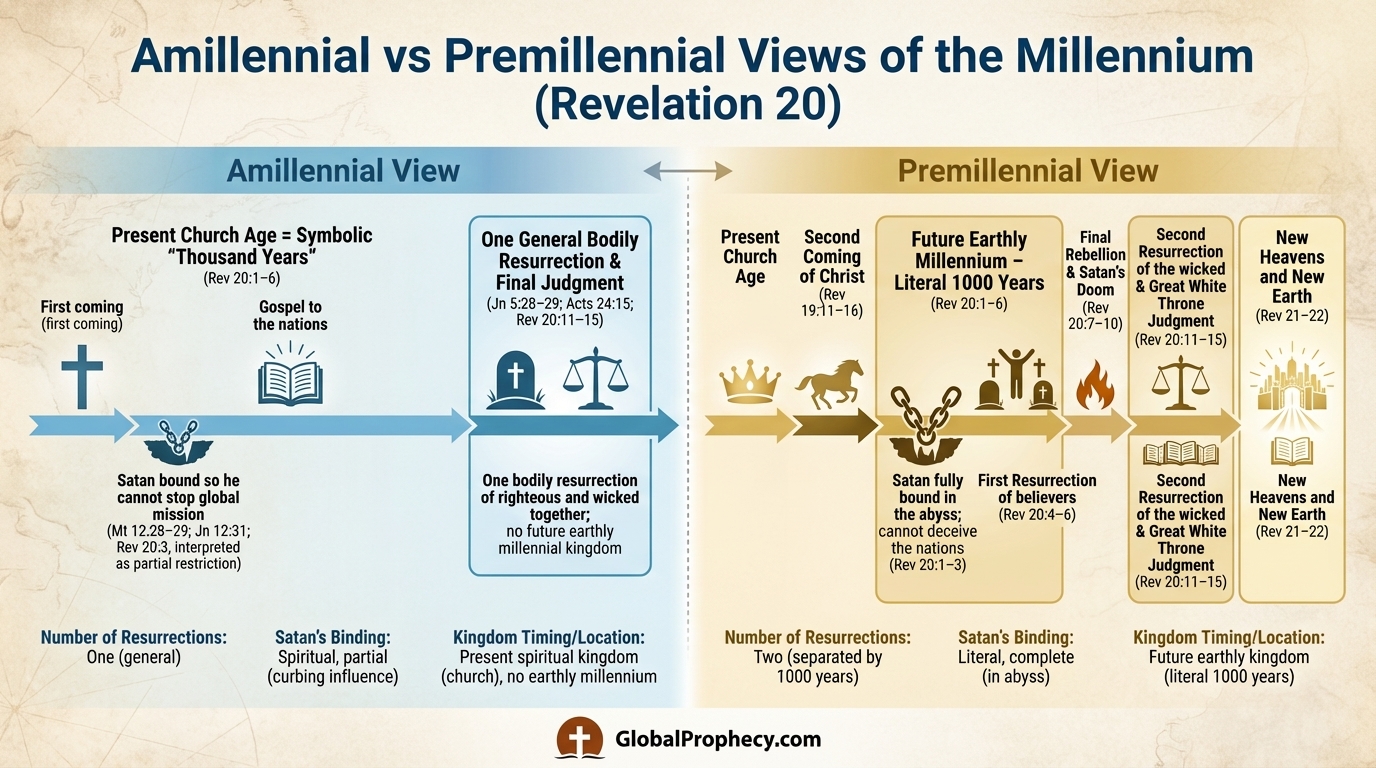
Amillennialism is one of the most influential views of biblical eschatology. It is held by the Roman Catholic and Eastern Orthodox churches and by many Reformed and evangelical theologians (e.g., Augustine, Luther, Calvin, Berkhof, Hoekema). It reads Revelation 20 symbolically and understands the “thousand years” not as a future earthly kingdom, but as the present church age.
This article will (1) explain what amillennialism teaches, and then (2) evaluate that system biblically, especially in light of Revelation 20 and related Old and New Testament texts. The underlying question is: Is the church age itself the millennial kingdom?
2. Core Tenets of Amillennialism
2.1 Meaning of “Millennium” and Present Kingdom
The term amillennialism literally means “no millennium,” but amillennialists insist they do not deny a millennium; they deny a future, earthly, thousand-year reign of Christ.
Key affirmations:
- The “thousand years” of Revelation 20:1–6 is:
- Symbolic, not chronological.
- A “long, complete period” between Christ’s first and second coming.
- The millennial kingdom is now:
- Christ reigns spiritually from heaven (and in the church) during the present age.
- Some say Revelation 20 pictures the saints reigning in heaven (e.g., Hoekema, Hendriksen).
- Others see it as Christ’s rule through the church on earth (Augustine’s view).
Thus the church age = millennium; there is no distinct future phase in history between Christ’s return and the eternal state.
2.2 Binding of Satan
Amillennialists interpret Revelation 20:1–3 as already fulfilled:
“He seized the dragon, that ancient serpent, who is the devil and Satan, and bound him for a thousand years…” — Revelation 20:2
They argue:
- Satan was “bound” at Christ’s first coming (Mt 12:28–29; Lk 10:18; Jn 12:31).
- His binding means restriction of one specific activity: “that he might not deceive the nations” (Rev 20:3).
- Practically, this means:
- He can no longer prevent the global spread of the gospel.
- He still tempts and opposes believers, but cannot halt world evangelization.
2.3 The Two Resurrections in Revelation 20
Revelation 20 speaks of a “first resurrection” and of “the rest of the dead” coming to life later (Rev 20:4–6).
Amillennial interpretation:
- First resurrection (20:4–5a):
- Not bodily, but spiritual.
- Common views:
- Regeneration (Augustine).
- The entrance of the believer’s soul into heaven at death (Hoekema, Hendriksen).
- Second resurrection (20:5b, 11–15):
- One general bodily resurrection of righteous and wicked together at the last day (cf. Dan 12:2; Jn 5:28–29; Acts 24:15).
Thus there is one bodily resurrection, not two separated by a thousand years.
2.4 Hermeneutic: Symbolic Prophecy and Recapitulation
Two interpretive commitments are crucial.
-
Symbolic / spiritual interpretation of prophecy
- Many Old Testament kingdom prophecies are fulfilled spiritually in the church, not literally in national Israel.
- Numbers (including “thousand”) in Revelation are often taken as figurative.
-
Progressive parallelism (recapitulation) in Revelation
- The book consists of parallel sections, not a continuous chronology.
- Revelation 20 does not follow Revelation 19 chronologically; it rewinds to the first coming and re-describes the entire church age from another angle.
This allows amillennialism to place Satan’s binding and the saints’ reign before, not after, the second coming of Revelation 19.
2.5 Israel and the Church
Amillennialism generally teaches a form of replacement / fulfillment theology:
- Israel and the church are one people of God under one covenant of grace.
- Promises of land, throne, and kingdom given to Israel are:
- Either conditional and forfeited, or already fulfilled historically, or
- Spiritualized and fulfilled in the church (e.g., Abrahamic and Davidic covenants).
- The church is often seen as “the new Israel” or “Israel of God” (Gal 6:16).
3. Biblical Evaluation: The Binding of Satan
3.1 Is Satan Bound Now in the Sense of Revelation 20?
Revelation 20 describes Satan’s imprisonment in maximal terms:
“He threw him into the pit, and shut it and sealed it over him,
so that he might not deceive the nations any longer…” — Revelation 20:3
Elements:
- Seized.
- Bound.
- Cast into the abyss.
- Shut and sealed.
This language suggests total incarceration, not partial restriction.
By contrast, the New Testament continually portrays Satan’s active deception during the church age:
- “The god of this world has blinded the minds of the unbelievers” (2 Cor 4:4).
- He “prowls around like a roaring lion, seeking someone to devour” (1 Pet 5:8).
- He currently “deceives the whole world” (Rev 12:9).
- Paul warns of his schemes (Eph 6:11), his hindrance of gospel workers (1 Thess 2:18), and his activity in the “man of lawlessness” (2 Thess 2:9–10).
If Revelation 20 meant only that Satan is somewhat constrained while still deceiving nations, the strong imagery of a sealed abyss and the explicit statement “that he might not deceive the nations any longer” would be oddly overstated.
3.2 The Problem of Deceiving the Nations
Amillennialists narrow “deceiving the nations” to preventing global mission. But Scripture shows Satan:
- Actively deceiving both individuals and nations throughout the church age.
- Stirring up beastly empires (Rev 13).
- Exercising real authority as “ruler of this world” (Jn 12:31; 14:30).
If Satan is already bound in Revelation 20’s sense, what remains for his future binding to accomplish? The description in Rev 20:1–3 corresponds far better to a decisive, future curtailment of his activity than to his current, observable influence.
4. Biblical Evaluation: The “First Resurrection”
4.1 The Text of Revelation 20:4–6
“They came to life and reigned with Christ for a thousand years.
The rest of the dead did not come to life until the thousand years were ended.
This is the first resurrection.”
— Revelation 20:4–5
Key observations:
- The same verb ezēsan (“came to life”) is used of:
- The martyrs who reign with Christ (v. 4).
- “The rest of the dead” at the end of the thousand years (v. 5).
- John explicitly calls the first event “the first resurrection” (v. 5).
4.2 Consistency of the Term “Resurrection”
The noun anastasis (“resurrection”) appears 42 times in the New Testament. With one debated exception (here, if the amillennial view is correct), it always denotes bodily resurrection.
To argue that anastasis in Revelation 20 means:
- “Spiritual rebirth” or
- “The soul’s translation to heaven,”
while the second resurrection is bodily, creates a severe lexical inconsistency. As Henry Alford famously argued, if one makes the “first resurrection” spiritual and the second literal, “there is an end of all significance to language.”
Moreover, the context argues strongly for bodily resurrection:
- The martyrs “had been beheaded” (physical death), then “came to life” (physical resurrection).
- Their resurrection is the long-delayed answer to promises of bodily vindication (Rev 2:10–11; 6:9–11).
4.3 Relation to General Resurrection Texts
Amillennialists appeal to texts like John 5:28–29 and Daniel 12:2 to argue for one general resurrection. But these passages state that both groups will be raised, not when or how far apart in time.
- John 5:28–29 speaks of “an hour” in which all in the tombs will hear his voice and come out.
- “Hour” (hōra) can denote a period, not a literal 60 minutes; it does not specify whether the resurrections are divided by an interval.
- Revelation 20 provides the chronological detail other texts omit: two resurrections, separated by a thousand years.
The amillennial position preserves the unity of a final judgment, but only by flattening the very distinctions Revelation 20 emphasizes.
5. Biblical Evaluation: Israel, the Church, and the Kingdom
5.1 The Abrahamic and Davidic Covenants
Amillennialism commonly argues that these covenants were:
- Conditional, thus forfeited by Israel’s disobedience, or
- Spiritualized and fulfilled in the church.
Yet Scripture repeatedly describes them as everlasting and unconditional:
- Abrahamic covenant:
- “I will establish my covenant… for an everlasting covenant…
And I will give to you and to your offspring… all the land of Canaan, for an everlasting possession” (Gen 17:7–8). - Ratified in Genesis 15 by a unilateral oath: God alone passes between the pieces.
- “I will establish my covenant… for an everlasting covenant…
- Davidic covenant:
- “Your throne shall be established forever” (2 Sam 7:16).
- Reaffirmed with emphatic language in Psalm 89:28–37: God will not “violate” or “alter” his covenant; David’s line and throne will endure “as long as the sun.”
The New Testament applies the Davidic promise directly to Jesus:
“The Lord God will give to him the throne of his father David,
and he will reign over the house of Jacob forever, and of his kingdom there will be no end.” — Luke 1:32–33
To say that Christ reigns now from heaven is true, but Luke 1 and Acts 1:6–7 leave intact Jewish expectations of a future restoration of the kingdom to Israel, without any correction that the promises have been transferred to the church or solely “heavenized.”
5.2 Old Testament Kingdom Texts and the Need for an Earthly Intermediary Kingdom
Amillennialism must fit all remaining kingdom prophecies either into:
- The present church age, or
- The final eternal state (new heavens and new earth).
But several texts resist both placements and naturally point to an intermediate earthly kingdom before the eternal state.
Isaiah 65:20–25
- Describes:
- Extended longevity: “He who dies at a hundred years will be thought a youth” (v. 20).
- Presence of sin and curse: The sinner who dies at 100 is “accursed.”
- Worldwide peace and animal transformation (vv. 25).
These conditions:
- Are far better than the present age: death is rare and long-delayed.
- Do not fit the eternal state, where “death shall be no more” and “no more curse” (Rev 21:4; 22:3).
Thus they require a future, improved but not yet perfect earth—exactly what Revelation 20 portrays.
Zechariah 14:16–19
- After the Lord’s dramatic return and victory (Zech 14:1–5), nations survive and annually go to Jerusalem to worship.
- Those who refuse will experience drought and plague.
Again:
- This post-second-coming scene includes disobedient nations and temporal judgments—incompatible with the eternal state, but fully compatible with a millennial reign.
5.3 The Distinction Between Israel and the Church
The New Testament repeatedly maintains a distinction between ethnic Israel and the (largely Gentile) church:
-
Romans 11 expects a future salvation of “all Israel” after “the fullness of the Gentiles has come in” (vv. 25–26), not their absorption into the church with no national identity.
-
Acts 1:6–7 records the disciples’ question:
“Lord, will you at this time restore the kingdom to Israel?”
Jesus does not correct their expectation of a future restoration; He corrects only their timing curiosity.
-
1 Corinthians 10:32 distinguishes Jews, Greeks, and the church of God.
Amillennialism’s “one people of God” model affirms a crucial soteriological unity (all saved by grace in Christ), but it prematurely collapses legitimate redemptive-historical distinctions that Scripture both affirms and carries into the future kingdom.
6. Revelation 19–20: Chronology or Recapitulation?
Amillennialists maintain that Revelation 20 is not chronological after Revelation 19. Instead, they argue for parallel sections covering the same church age.
However:
- John repeatedly uses “Then I saw…” (kai eidon) in Rev 19:11, 17, 19; 20:1, 4, 11; 21:1 as a sequential narrative marker.
- Most of the scenes from 19:11–21:8 are universally recognized as future and post-parousia:
- Christ’s visible return (19:11–16).
- Final battle and destruction of the beast and false prophet (19:19–21).
- Great white throne judgment (20:11–15).
- New heavens and new earth (21:1–8).
To single out 20:1–6 as a retroactive flashback without textual signals is hermeneutically unstable. The natural reading is:
- Second coming and defeat of earthly enemies (Rev 19).
- Binding of Satan and millennial reign (Rev 20:1–6).
- Final rebellion and Satan’s doom (Rev 20:7–10).
- Great white throne judgment of the unsaved (Rev 20:11–15).
- Eternal state (Rev 21–22).
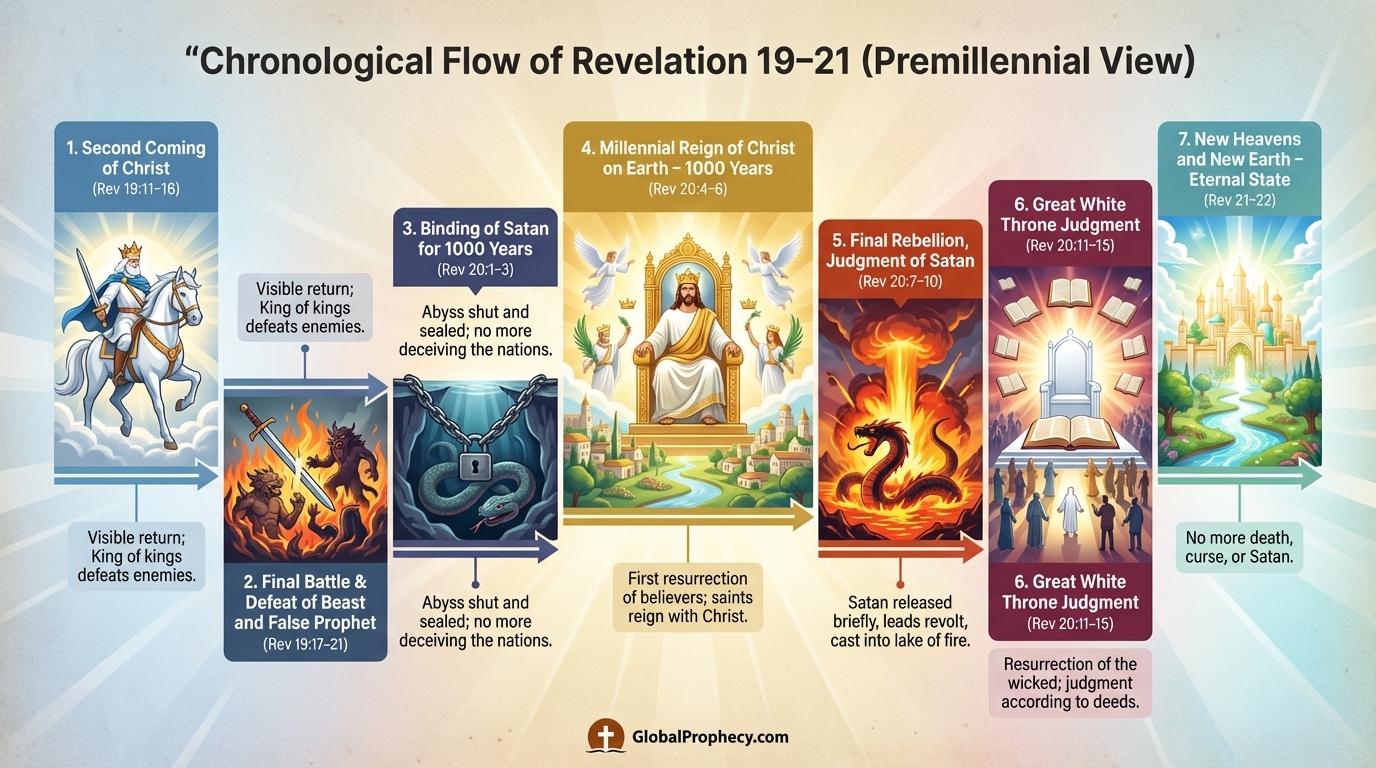
The millennium thus appears as one of the direct consequences of Christ’s return, not as a symbolic re-description of the church age.
7. Conclusion
Amillennialism offers a coherent and historically significant approach to biblical eschatology. It rightly emphasizes:
- The present reign of Christ at the Father’s right hand.
- The already–not yet structure of the kingdom.
- The unity of God’s people in Christ.
Yet, when the key texts are read in their own terms, several serious problems emerge:
- The binding of Satan in Revelation 20 does not match his observable activity during the church age.
- The “first resurrection” language strongly favors a bodily resurrection distinct from the resurrection of the wicked a thousand years later.
- Prophetic passages like Isaiah 65 and Zechariah 14 do not fit either the present age or the eternal state, but do fit a future intermediate kingdom.
- The Abrahamic and Davidic covenants are framed as everlasting and unconditional, anchored in God’s own oath, and naturally point to a future, earthly fulfillment in connection with Israel and the nations.
- The chronology of Revelation 19–20 most naturally places the millennium after Christ’s return, not as a symbolic overlay of the present age.
For these reasons, the biblical data favors viewing the church age as a prelude to, not the substance of, the promised millennial kingdom. The church now experiences the spiritual firstfruits of the kingdom; the full, earthly, Davidic reign of Christ over Israel and the nations still lies ahead.
FAQ
Q: What is amillennialism in simple terms?
Amillennialism teaches that there will be no future earthly thousand-year reign of Christ between His second coming and the eternal state. Instead, the “millennium” of Revelation 20 is understood as the present church age, during which Christ reigns spiritually from heaven and Satan is partially bound so the gospel can go to the nations.
Q: Does amillennialism deny a literal second coming and final judgment?
No. Amillennialists strongly affirm a literal, visible second coming of Christ, a general bodily resurrection of all people, and a final judgment, followed by the new heavens and new earth. Their debate with premillennialism concerns what happens before that event, not whether Christ will literally return.
Q: Why do many evangelicals critique amillennialism?
Critics argue that amillennialism spiritualizes key prophetic texts and flattens important distinctions in Scripture. They contend that Revelation 20, Isaiah 65, Zechariah 14, and the unconditional covenants with Abraham and David point to a future, earthly millennial kingdom distinct from both the present age and the eternal state.
Q: How does amillennialism view Israel and the church?
Amillennialism generally sees Israel and the church as one people of God, so promises to Israel are usually interpreted as fulfilled spiritually in the church. Premillennial critics respond that the New Testament maintains a future role for ethnic Israel and that national promises of land and throne should not be dissolved into purely spiritual blessings.
Q: Is the “thousand years” in Revelation 20 literal?
Amillennialists interpret the “thousand years” symbolically as a long, complete period, the entire span between Christ’s first and second coming. Premillennialists note that numbers in Revelation are often used literally, and argue that the repeated sixfold mention of “a thousand years” in Revelation 20 should be understood as a real, divinely defined period in which Christ reigns on earth after His return.
Frequently Asked Questions
What is amillennialism in simple terms?
Does amillennialism deny a literal second coming and final judgment?
Why do many evangelicals critique amillennialism?
How does amillennialism view Israel and the church?
Is the “thousand years” in Revelation 20 literal?
L. A. C.
Theologian specializing in eschatology, committed to helping believers understand God's prophetic Word.
Related Articles
Postmillennialism Examined: Will the Church Christianize the World?
Postmillennialism examined and tested by Scripture: can the church truly Christianize the world before Christ returns and the millennium begins?
What are the Marriage of the Lamb?
Marriage of the Lamb reveals Christ’s union with His church in Revelation 19. Explore its meaning, timing, and eternal significance in God’s plan.
Comparing the Millennial Views: Which View Is Biblical?
Millennial views compared: premillennialism, amillennialism, and postmillennialism. Examine key texts to see which view best fits Scripture.
What is the Millennium? The 1000-Year Reign of Christ
Millennium: the 1000-year reign of Christ explained. Discover its duration, nature, and prophetic significance in God’s future kingdom plan.