
Annihilationism Examined and Refuted
1. Introduction
Among contemporary evangelicals, annihilationism (often called conditional immortality) has gained fresh support as an alternative to the historic doctrine of eternal conscious punishment. Because this teaching directly affects our understanding of God, the gospel, and final judgment, it must be examined carefully and biblically.
This article will (1) define annihilationism, (2) present its main arguments fairly, and then (3) refute it from Scripture, demonstrating that the Bible teaches the unending, conscious punishment of the unsaved in hell.
2. What Is Annihilationism (Conditional Immortality)?
Annihilationism teaches that:
- There is a real hell and a final judgment.
- Not all will be saved.
- The wicked will be punished for a time and then cease to exist; their souls are finally destroyed.
- Immortality is “conditional”—a gift given only to the redeemed. The lost do not live forever.
Many advocates prefer the term conditional immortality, emphasizing that only believers receive endless life; unbelievers are ultimately extinguished rather than eternally tormented.
2.1 Main Biblical Arguments Used by Annihilationists
While details vary, several recurring arguments appear:
-
Terms of destruction and perishing
Words like destroy and perish (e.g., Matt 7:13; 10:28; 2 Thess 1:9; John 3:16) are said to imply extinction, not ongoing existence in misery. -
“Eternal destruction” as result, not process
Phrases such as “eternal destruction” (2 Thessalonians 1:9) and “eternal punishment” (Matthew 25:46) are taken to mean that the outcome is eternal (non‑existence), not that the punishment itself continues forever. -
God alone has immortality
1 Timothy 6:16 says God “alone has immortality,” so human beings are said not to be naturally immortal; only those in Christ receive immortality (1 Corinthians 15:52‑54; 2 Timothy 1:10). Hence the wicked cannot suffer eternally. -
God’s love and justice
Eternal conscious torment is alleged to be incompatible with divine love and justice. It is said to be disproportionate punishment for finite sins and portrays God as vindictive.
These arguments deserve a direct, Scripture‑based response.
3. Key Biblical Texts: Hell as Eternal Conscious Punishment
The core issue is not philosophical preference but what God has actually revealed. Several strands of biblical evidence together rule out annihilationism.
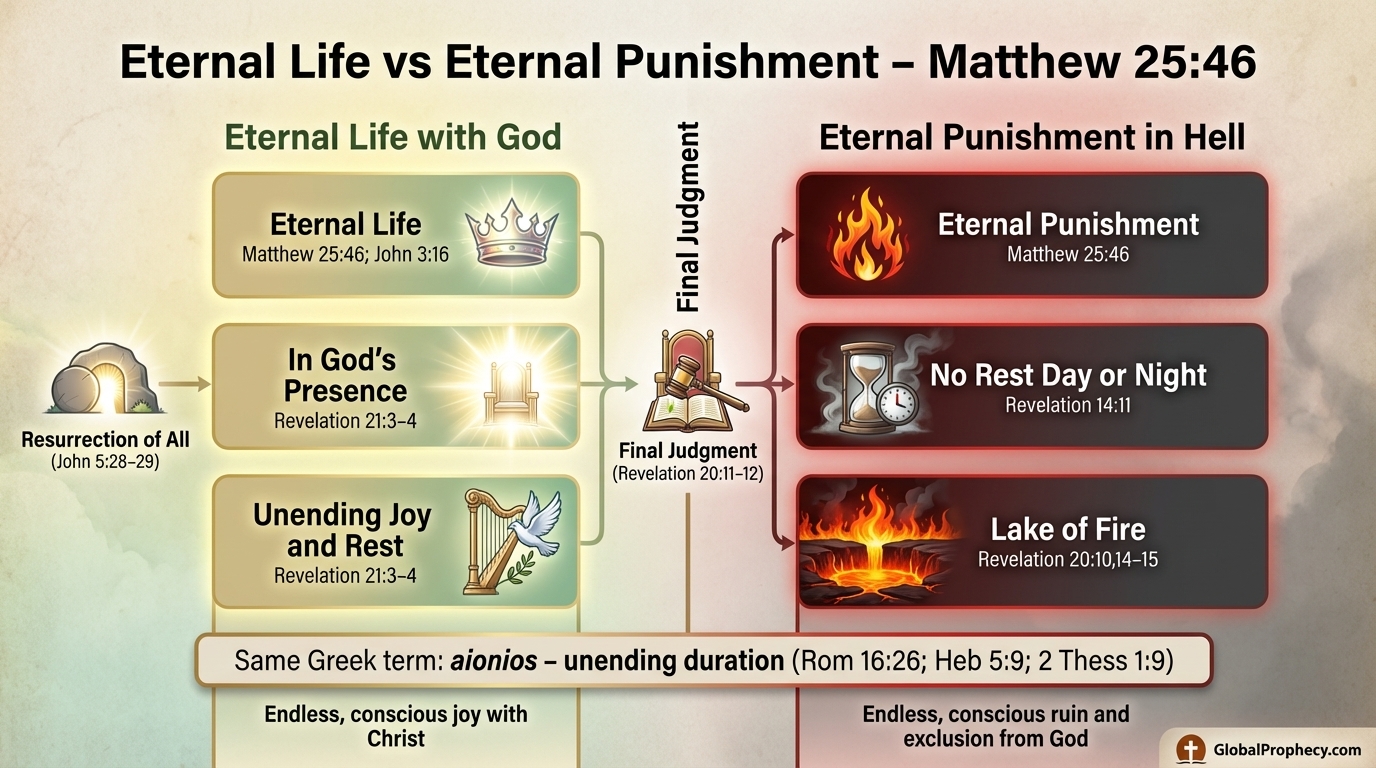
3.1 The Parallel of Eternal Life and Eternal Punishment (Matthew 25:46)
“And these will go away into eternal punishment, but the righteous into eternal life.”
— Matthew 25:46
The very same adjective, aionios (“eternal”), is applied in the same verse:
- to the life of the righteous
- and the punishment of the wicked.
If aionios means “truly unending” when describing the believer’s life with God, it cannot, in the same sentence, mean only “temporary effect” or “extinction” when describing the unbeliever’s punishment. As numerous lexicons and contexts show, aionios denotes unending duration, especially when linked to God, salvation, and final states (Rom 16:26; Heb 5:9; 9:12; 1 Pet 5:10).
To deny that eternal punishment is actually eternal is to undermine, by the same logic, eternal life and even the eternal God.
3.2 Unending Torment, No Rest Day or Night (Revelation 14; 20)
In Revelation we find explicit, time‑marked descriptions that cannot reasonably be read as annihilation.
“He will be tormented with fire and sulfur in the presence of the holy angels and in the presence of the Lamb. And the smoke of their torment goes up forever and ever, and they have no rest, day or night…”
— Revelation 14:10–11
Here:
- Torment is conscious (you cannot have torment without awareness).
- It continues “forever and ever” (literally, “unto the ages of the ages”).
- They have “no rest day or night”, ruling out extinction.
Likewise:
“…they will be tormented day and night forever and ever.”
— Revelation 20:10
Satan, the beast, and the false prophet are not annihilated but endlessly tormented in the lake of fire. Immediately following, the unsaved dead are thrown into the same lake (Rev 20:14–15). Nothing in the text indicates a fundamentally different experience for them; the lake of fire is the shared final state of all the impenitent.
3.3 “Their Worm Does Not Die and the Fire Is Not Quenched” (Mark 9)
Jesus’ solemn warning about Gehenna (hell) quotes Isaiah 66:24:
“…to be thrown into hell, ‘where their worm does not die and the fire is not quenched.’”
— Mark 9:47–48
“Does not die” and “is not quenched” are emphatic denials of ending. If the person were annihilated, the imagery of an unending process—undying worm, unquenchable fire—would be misleading. The point is ongoing disgrace and suffering, not a quick end.
3.4 “Eternal Destruction Away from the Presence of the Lord” (2 Thessalonians 1:9)
“They will suffer the punishment of eternal destruction, away from the presence of the Lord and from the glory of his might…”
— 2 Thessalonians 1:9 (ESV)
“Destruction” here (olethron aionion) is often cited for annihilationism, but Paul explains what he means: it is being shut out from the presence of the Lord and His glory. The state of exclusion is eternal, not the simple event of being snuffed out.
Moreover, in Galatians 6:8 destruction is contrasted with eternal life, again indicating an ongoing, not momentary, condition.
3.5 Conscious Suffering After Death (Luke 16)
Jesus’ account of the rich man and Lazarus (Luke 16:19–31) depicts the rich man:
- In torment in Hades (v. 23)
- Thirsty and desiring relief (v. 24)
- Remembering his life and brothers (vv. 25–28)
- Facing an unbridgeable “great chasm” (v. 26)
Even if one calls this a parable, parables employ realities, not theological fictions, to teach truth. Jesus presents post‑mortem torment and irreversible separation—not sleep, not extinction.
4. Do “Destroy” and “Perish” Mean Annihilation?
Annihilationists frequently appeal to verbs such as “destroy” (apollymi) and “perish” to argue that the wicked simply cease to exist. But careful lexical and contextual study shows otherwise.
-
Matthew 10:28: “destroy both soul and body in hell”
“Destroy” cannot mean “cause to be nonexistent” in every context. The same verb can mean ruin, lose, or bring to a wretched end (cf. Matt 10:39; Luke 15:4–6, 24—the lost sheep and lost son were not annihilated). -
2 Thessalonians 1:9: “eternal destruction”
As seen, Paul explains this as separation from God’s presence, not non‑existence. -
John 3:16: “should not perish but have eternal life”
“Perish” stands in contrast with “eternal life.” If the latter is an everlasting conscious condition, the former is its dreadful opposite: everlasting ruin, not instant disappearance.
In Scripture, destruction commonly means ruin, loss of well‑being, or being rendered useless for the purpose intended, not metaphysical extinction.
5. Theological Objections Answered
5.1 “Eternal Torment Is Incompatible with God’s Love”
Scripture reveals that God is not only love (1 John 4:8) but also holy, righteous, and just. His love does not cancel His justice; the cross itself is the supreme display of both.
Every sin is committed against an infinitely holy God, and therefore has an infinite weight. Human courts recognize that the dignity of the one offended affects the gravity of the crime. Striking a neighbor is one thing; striking a head of state is quite another. Likewise, sin against the infinite God merits an infinite punishment.
God has gone to infinite lengths in love—giving His own Son as a propitiation for sin. To reject such grace is a colossal, ongoing offense. Hell is not a failure of love, but the necessary expression of God’s holiness against unrepentant evil.
5.2 “Eternal Torment Is Disproportionate to Finite Sin”
This objection assumes sin is merely a finite, temporal act. But biblically:
- Sin is an expression of a nature at war with God, not just isolated acts.
- The impenitent continue in rebellion forever; hell does not transform hearts. Consequently, the punishment matches the ongoing state of the sinner.
Furthermore, the alternative to eternal punishment is either:
- Forcing the wicked into heaven, overriding their will; or
- Annihilating persons made in God’s image, which would itself be a drastic and unbiblical act.
God instead honors human responsibility: those who refuse God’s presence and reign in this life are given what they persistently choose—eternal exclusion from His blessed presence.
5.3 “God Alone Has Immortality”
1 Timothy 6:16 says God “alone has immortality.” Annihilationists take this to mean that no creature can be immortal unless specially gifted. But:
- Scripture also says God alone is “wise” (Rom 16:27) and other attributes “alone” of God that are still reflected in creatures to a finite degree.
- The point of 1 Timothy 6:16 is that God has immortality in Himself, underived and absolute. He can—and does—grant ongoing existence to angels and humans.
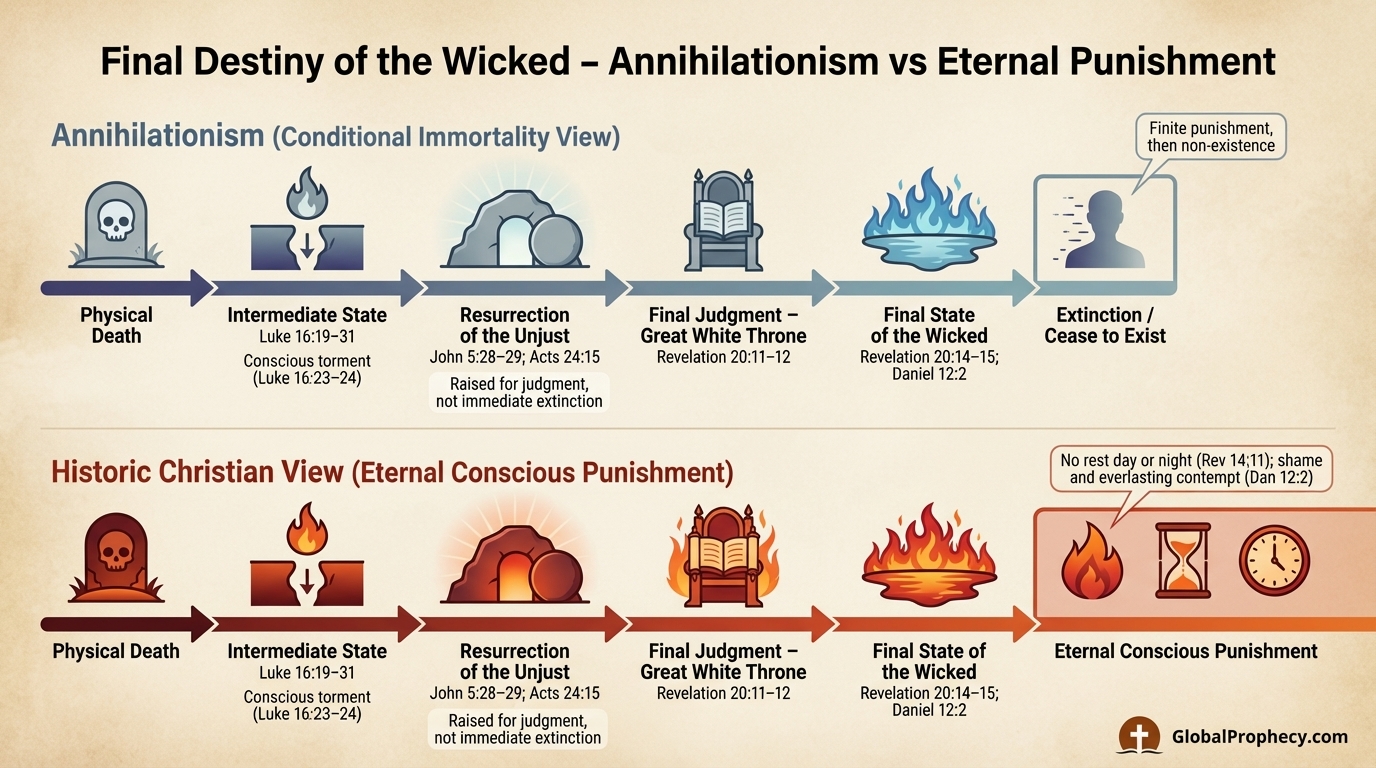
The same New Testament that stresses human mortality also teaches the resurrection of the righteous and the wicked (John 5:28–29; Acts 24:15). The risen bodies of the unsaved are suited not for quick extinction, but for enduring “shame and everlasting contempt” (Dan 12:2).
6. Why Annihilationism Fails Biblically
Summarizing the biblical case:
-
Direct statements: Verses like Matthew 25:46; Revelation 14:11; 20:10–15; Mark 9:48 explicitly describe unending, conscious suffering.
-
Lexical consistency: The key term aionios is used for:
- God’s eternality (Rom 16:26)
- Eternal redemption and salvation (Heb 5:9; 9:12)
- Eternal life (John 3:16)
- Eternal punishment and destruction (Matt 25:46; 2 Thess 1:9)
To make it mean “unending” in one set of texts and “temporary” in the others is arbitrary.
-
Resurrection of the unjust: Scripture teaches that the lost are not left in non‑being but are raised bodily for judgment (John 5:29; Rev 20:11–15). A resurrection unto “damnation” is pointless if the person is immediately extinguished.
-
Nature of hell’s imagery: “Undying worm,” “unquenchable fire,” “no rest day or night” are designed to communicate ongoing reality, not a momentary flash.
-
Historical consistency: Throughout church history, the vast majority of orthodox Christian theologians have understood Scripture to teach eternal conscious punishment. Novel reinterpretations arise largely from moral discomfort, not new exegesis.
7. Conclusion
Annihilationism arises, in large measure, from a sincere desire to defend the love and goodness of God. Yet good intentions cannot overturn clear revelation. When the relevant texts are allowed to speak in their plain sense, the picture is consistent and sobering:
- Hell is a real place of eternal conscious punishment.
- The finally impenitent will experience unending ruin and exclusion from God’s presence.
- The same eternity that awaits believers in joy awaits unbelievers in judgment.
Far from making God less loving, this reality magnifies both the seriousness of sin and the magnitude of Christ’s saving work. If the penalty is eternal, then the cross, which delivers from that penalty, displays a grace beyond measure. The doctrine of hell, rightly understood, should not make us harsh but urgent, humble, and evangelistic, pleading with sinners to flee the wrath to come and receive eternal life in Christ.
FAQ
Q: What is annihilationism in simple terms?
Annihilationism (or conditional immortality) is the view that the wicked will be punished and then completely cease to exist, rather than endure eternal conscious torment. It affirms a real hell and judgment but denies that unbelievers live forever in punishment.
Q: Does the Bible actually teach eternal conscious punishment, or is it just a traditional interpretation?
The language of Scripture—especially Matthew 25:46; Mark 9:48; 2 Thessalonians 1:9; Revelation 14:11; 20:10–15—explicitly points to unending, conscious torment and exclusion from God’s presence. The same Greek word for “eternal” describes both the believer’s life and the unbeliever’s punishment, indicating that both are truly everlasting.
Q: How do terms like “destroy” and “perish” fit with eternal punishment?
Biblically, “destroy” and “perish” often mean ruin, loss, or being rendered useless, not vanishing into non‑existence. For example, the “lost sheep” in Luke 15 was not annihilated but in a ruined condition. Applied to the wicked, these terms describe a state of irreversible ruin and misery, not simple extinction.
Q: Isn’t eternal punishment unfair for sins committed in a short earthly life?
Sin is not merely a finite act; it is rebellion against an infinitely holy God, and the impenitent persist in that rebellion. Because God is infinitely holy, even one sin has infinite seriousness. Eternal punishment reflects both the gravity of the offense and the ongoing state of the sinner who refuses God’s grace.
Q: How should the doctrine of eternal hell affect Christians?
It should produce holy fear of God, deep gratitude for Christ’s atonement, and urgent compassion for the lost. Knowing that hell is eternal conscious punishment should move believers to bold, loving evangelism and to sober worship of the God who saves us from “the wrath to come” (1 Thessalonians 1:10).
Frequently Asked Questions
What is annihilationism in simple terms?
Does the Bible actually teach eternal conscious punishment, or is it just a traditional interpretation?
How do terms like “destroy” and “perish” fit with eternal punishment?
Isn’t eternal punishment unfair for sins committed in a short earthly life?
How should the doctrine of eternal hell affect Christians?
L. A. C.
Theologian specializing in eschatology, committed to helping believers understand God's prophetic Word.
Related Articles
What Is Hell?
Hell is the eternal place of punishment for the unrighteous. Discover what the Bible teaches about hell's nature, purpose, and who goes there.
Is Hell's Punishment Eternal?
Is hell's punishment eternal or temporary? Explore key Bible texts, assess alternative views, and see why Scripture teaches conscious, everlasting judgment.
The Lake of Fire Explained
The lake of fire is the final eternal destination for the unrighteous. Discover what Scripture reveals about this place of judgment and who will be cast there.
Are There Degrees of Punishment in Hell?
Hell degrees of punishment: explore Bible passages where Jesus and other texts teach varying levels of judgment and accountability in eternal torment.