
Babylon the Great
1. Introduction
In the Book of Revelation, Babylon the Great stands as one of the most striking and ominous symbols of the end times. Two entire chapters—Revelation 17–18—are devoted to describing this end-time power and its sudden, irreversible destruction. To understand biblical eschatology and the climax of history in the Tribulation period, one must understand what Babylon the Great represents and how God brings it to an end.
This article focuses exclusively on Babylon the Great in Revelation 17–18—its identity, character, global influence, and catastrophic fall.
2. The Biblical Portrait of Babylon the Great
2.1 The Symbol of a Prostitute and a City
John is shown a vision of a woman:
“Come, I will show you the judgment of the great prostitute who is seated on many waters, with whom the kings of the earth have committed sexual immorality...”
— Revelation 17:1–2
This woman is later explicitly identified:
“And the woman that you saw is the great city that has dominion over the kings of the earth.”
— Revelation 17:18
Key points:
-
She is both a symbol and a city.
- She appears as a prostitute (symbolizing spiritual adultery and idolatry).
- She is also “the great city” that dominates world politics and economics.
-
She is called:
“BABYLON THE GREAT, MOTHER OF PROSTITUTES AND OF EARTH’S ABOMINATIONS.”
— Revelation 17:5This name connects her to ancient Babylon, the historic center of organized rebellion against God (cf. Genesis 10–11).
2.2 Global Reach and Influence
Babylon the Great is portrayed as having worldwide influence:
-
She sits on “many waters” (Revelation 17:1), explained as:
“peoples and multitudes and nations and languages.”
— Revelation 17:15 -
The kings of the earth commit spiritual “fornication” with her (Revelation 17:2; 18:3).
-
The merchants of the earth grow rich from her luxury (Revelation 18:3, 11–15).
-
Sea traders and shipmasters mourn her fall (Revelation 18:17–19).
Babylon the Great is therefore a transnational, global center of religion, politics, and commerce in the last days.
3. What Babylon the Great Represents
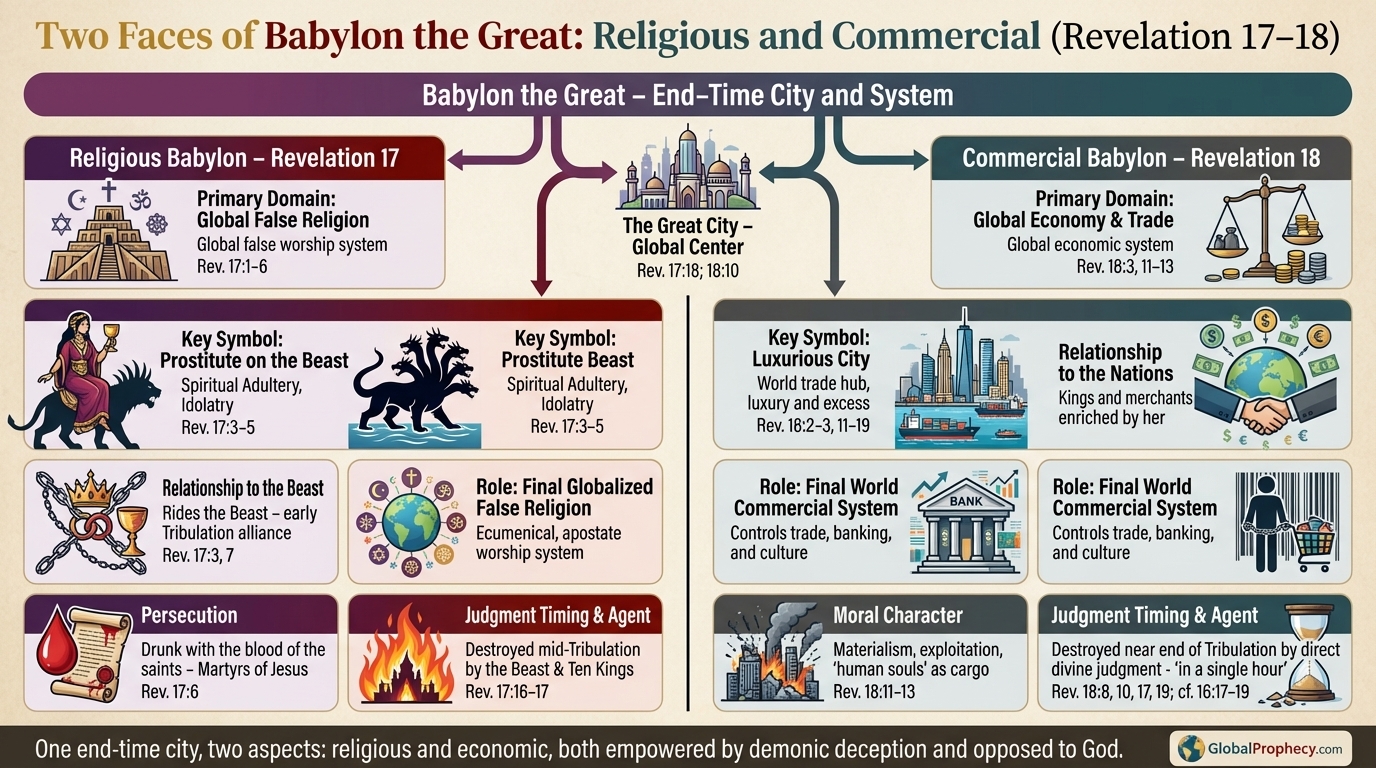
Revelation 17–18 present two closely-related aspects of the same Babylon: religious Babylon and commercial Babylon. Together they form the final expression of human rebellion before Christ’s return.
3.1 Religious Babylon (Revelation 17)
Revelation 17 emphasizes Babylon’s religious character.
3.1.1 A Corrupt Religious System
The woman is:
“arrayed in purple and scarlet, and adorned with gold and jewels and pearls, holding in her hand a golden cup full of abominations and the impurities of her sexual immorality.”
— Revelation 17:4
This imagery signals:
- Wealth and splendor masking deep spiritual corruption.
- Spiritual prostitution—a religious system that abandons the truth of God, mixing idolatry, power, and immorality.
- She is called the “mother” of prostitutes, meaning she is the source and fountainhead of false religion.
Babylon the Great thus represents the final, globalized form of false religion, an ecumenical, idolatrous system that intoxicates the nations.
3.1.2 Alliance with the Beast
The woman is seen:
“seated on a scarlet beast that was full of blasphemous names, and it had seven heads and ten horns.”
— Revelation 17:3
The beast is the Antichrist (cf. Revelation 13:1–8), the final world ruler. Their relationship is significant:
- The woman rides the beast, suggesting she initially exerts influence over him, or at least benefits from his power.
- This portrays an unholy partnership between political power and apostate religion during the first part of the Tribulation.
Religious Babylon will serve as the religious framework that helps the Antichrist consolidate global control.
3.1.3 Persecution of the Saints
John observes:
“I saw the woman, drunk with the blood of the saints, the blood of the martyrs of Jesus.”
— Revelation 17:6
Babylon the Great is:
- A persecutor of God’s people.
- Responsible for the martyrdom of believers during the Tribulation (and reflective of a long history of persecuting the faithful).
This marks her as deeply hostile to biblical faith, even while she presents herself as religious.
3.2 Commercial Babylon (Revelation 18)
Revelation 18 shifts the focus from religion to economics and commerce.
3.2.1 Center of World Trade and Luxury
A mighty angel announces:
“Fallen, fallen is Babylon the great! She has become a dwelling place for demons... For all nations have drunk the wine of the passion of her sexual immorality, and the kings of the earth have committed immorality with her, and the merchants of the earth have grown rich from the power of her luxurious living.”
— Revelation 18:2–3
Revelation 18 then lists a long catalog of goods, cargo, and luxury items (vv. 11–13), including gold, silver, precious stones, fine linens, exotic materials, spices, livestock, and even “human souls” (Revelation 18:13).
Key features:
- Babylon the Great is the nerve center of global commerce.
- It embodies materialism, greed, and luxury, indifferent to human suffering.
- Her economic system commodifies human life (note “slaves, that is, human souls”).
In the last days, Babylon the Great represents a world economic system and capital city that dominates trade, banking, and wealth.
3.2.2 A Demonic and Idolatrous System
Though chapter 18 stresses commerce, it still underscores spiritual corruption:
“She has become a dwelling place for demons, a haunt for every unclean spirit...”
— Revelation 18:2
Thus, commercial Babylon is:
- Not merely an economic hub, but a demonically energized world system.
- An economic empire that supports and amplifies the religious rebellion of chapter 17.
Religious Babylon and commercial Babylon are two faces of the same end-time city and system: one religious, one economic, both utterly opposed to God.
4. The Destruction of Babylon the Great
A core theme of Revelation 17–18 is not only what Babylon the Great is, but how God brings it to an end.
4.1 The Judgment of Religious Babylon
Religious Babylon’s destruction comes midway through the Tribulation, carried out by the very political powers that once supported her:
“And the ten horns that you saw, they and the beast will hate the prostitute. They will make her desolate and naked, and devour her flesh and burn her up with fire, for God has put it into their hearts to carry out his purpose...”
— Revelation 17:16–17
Key observations:
- The ten horns (ten kings) allied with the beast turn against the woman.
- They strip and burn her—imagery of complete exposure and destruction.
- This is God’s sovereign judgment, even though executed through human rulers (“God has put it into their hearts”).
Why does this happen?
- Once the Antichrist has consolidated power, a separate religious system becomes a rival and a restraint.
- He replaces this global religion with direct worship of himself and his image (cf. Revelation 13:14–15).
So religious Babylon, the worldwide false religion, is destroyed by the Antichrist’s coalition as part of God’s plan.
4.2 The Judgment of Commercial Babylon
Commercial Babylon is destroyed later, near the very end of the Tribulation, by direct divine judgment.
4.2.1 Sudden, Catastrophic Fall
Multiple verses stress the speed and finality of Babylon’s downfall:
“For this reason her plagues will come in a single day, death and mourning and famine, and she will be burned up with fire; for mighty is the Lord God who has judged her.”
— Revelation 18:8
“Alas! alas! the great city, Babylon, the mighty city! For in a single hour your judgment has come.”
— Revelation 18:10
Three repeated laments—by kings, merchants, and shipmasters—all mention her destruction “in a single hour” (Revelation 18:10, 17, 19).
This indicates:
- A swift, catastrophic judgment, likely connected to the final bowl of wrath and the last convulsions of the Tribulation (cf. Revelation 16:17–19).
- No gradual decline or slow collapse, but an instant, decisive act of God.
4.2.2 Economic and Cultural Silence
The finality of Babylon’s fall is described in striking terms:
“Then a mighty angel took up a stone like a great millstone and threw it into the sea, saying, ‘So will Babylon the great city be thrown down with violence, and will be found no more.’”
— Revelation 18:21
Following this, a series of “no more” statements:
- No more music (Revelation 18:22).
- No more craftsmen or industry (Revelation 18:22).
- No more sound of the mill (Revelation 18:22).
- No more light of a lamp (Revelation 18:23).
- No more voice of bridegroom and bride (Revelation 18:23).
These images convey:
- Total desolation of the city.
- The permanent end of its economic and cultural life.
- Babylon’s global influence is utterly extinguished.
4.2.3 Reasons for Her Judgment
Revelation 18 gives at least three major reasons for the destruction of Babylon the Great:
-
Pride and Luxury
“Since in her heart she says, ‘I sit as a queen, I am no widow, and mourning I shall never see’...”
— Revelation 18:7
Babylon is judged for arrogant self-confidence, presuming invulnerability. -
Economic Exploitation and Sorcery
“For your merchants were the great ones of the earth, and all nations were deceived by your sorcery.”
— Revelation 18:23
Her economic power is linked with deception and occult influence. -
Bloodguilt
“And in her was found the blood of prophets and of saints, and of all who have been slain on earth.”
— Revelation 18:24
Babylon is held responsible for the persecution and murder of God’s people, and ultimately aligned with all murderous opposition to God in history.
5. Theological Significance of Babylon the Great
5.1 The Final Expression of Human Rebellion
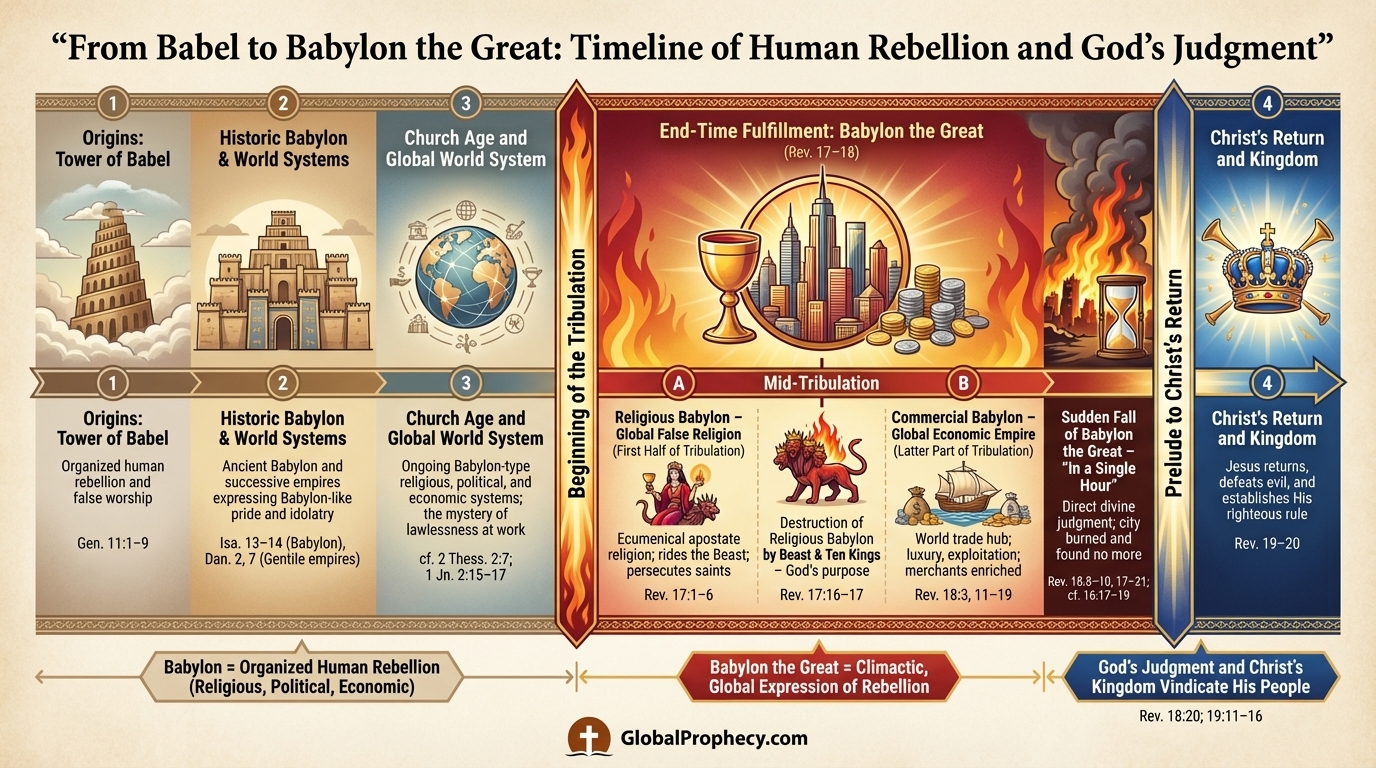
From the tower of Babel (Genesis 11) to the rebuilt Babylon of Revelation 17–18, Babylon symbolizes organized, corporate rebellion against God:
- Religious rebellion – human-made worship systems replacing God’s truth.
- Political rebellion – global empires exalting human authority above God.
- Economic rebellion – materialistic systems that idolize wealth and oppress people.
Babylon the Great is the climactic form of this rebellion: a last-days city and system embodying false worship, political arrogance, and economic idolatry on a worldwide scale.
5.2 A Call to Separation and Hope
God issues a solemn command to His people:
“Then I heard another voice from heaven saying, ‘Come out of her, my people, lest you take part in her sins, lest you share in her plagues...’”
— Revelation 18:4
Implications:
- Believers in that day are warned not to share in Babylon’s sins—spiritual compromise, materialism, and participation in its corrupt system.
- The passage calls all generations to avoid spiritual entanglement with the world’s idolatrous systems.
At the same time, heaven rejoices at Babylon’s fall:
“Rejoice over her, O heaven, and you saints and apostles and prophets, for God has given judgment for you against her!”
— Revelation 18:20
The destruction of Babylon the Great is:
- A vindication of God’s holiness and justice.
- A comfort to persecuted believers, showing that no evil system will stand against God forever.
- A prelude to Christ’s return in Revelation 19, when He establishes His righteous kingdom.
6. Conclusion
Babylon the Great in Revelation 17–18 is the Bible’s definitive picture of the end-time world system in its religious and economic dimensions, concentrated in a great city that dominates the nations.
It represents:
- A global apostate religion (religious Babylon) that unites the nations in spiritual rebellion and persecutes the saints.
- A world commercial empire (commercial Babylon) that controls trade, wealth, and culture, exalting luxury, greed, and human power above God.
Its destruction is:
- Swift, catastrophic, and final—“in a single hour” and “found no more.”
- Executed partly through the Antichrist and his allies (against religious Babylon) and ultimately through direct divine judgment (against commercial Babylon).
- A decisive end to human arrogance, idolatry, and persecution prior to Christ’s visible return.
Understanding Babylon the Great clarifies the prophetic picture of the last days: human civilization will reach a pinnacle of religious deception and economic power, only to be suddenly overthrown by the Lord. For believers, these chapters are both a warning against compromise and a promise that God will finally and fully judge the world’s rebellion and vindicate His people.
FAQ
Q: What is “Babylon the Great” in Revelation 17–18?
Babylon the Great is the end-time city and system described in Revelation 17–18 that combines a global false religion with a powerful world economic empire. It is portrayed as a prostitute and as “the great city” that rules over kings and nations, symbolizing the final, organized rebellion of humanity against God in religion, politics, and commerce.
Q: Does Babylon the Great represent a literal city or just a symbol?
Revelation clearly calls Babylon “the great city” (Revelation 17:18; 18:10, 16, 18, 19, 21), while also portraying her symbolically as a prostitute. From a literal, futurist perspective, it represents both: a real end-time city that serves as the capital of the Antichrist’s empire and the embodiment of a worldwide religious and commercial system opposed to God.
Q: How and when is Babylon the Great destroyed?
Religious Babylon (chapter 17) is destroyed mid-Tribulation by the ten-king coalition and the beast, who burn and strip her (Revelation 17:16–17). Commercial Babylon (chapter 18) is destroyed near the end of the Tribulation through direct divine judgment, in a sudden catastrophe described as happening “in a single hour” (Revelation 18:8–10, 17, 19).
Q: Why does God judge Babylon the Great so severely?
Babylon the Great is judged for spiritual idolatry, arrogant self-exaltation, economic exploitation, demonic deception, and the blood of prophets and saints (Revelation 18:5–7, 23–24). It is the culmination of centuries of rebellion, and God’s judgment demonstrates His justice and vindicates His persecuted people.
Q: What practical warning does Babylon the Great give to believers today?
God’s command, “Come out of her, my people” (Revelation 18:4), warns believers against participating in Babylon’s sins—spiritual compromise, materialism, and alliance with corrupt systems. Even before the final form of Babylon appears, Christians are called to spiritual separation from the world’s idolatrous values and to steadfast loyalty to Christ.
Frequently Asked Questions
What is “Babylon the Great” in Revelation 17–18?
Does Babylon the Great represent a literal city or just a symbol?
How and when is Babylon the Great destroyed?
Why does God judge Babylon the Great so severely?
What practical warning does Babylon the Great give to believers today?
L. A. C.
Theologian specializing in eschatology, committed to helping believers understand God's prophetic Word.
Related Articles
The Two Witnesses
The Two Witnesses in Revelation 11: discover who they are, their end-times ministry in the Tribulation, their death, resurrection, and ascension.
The 144,000 Sealed Israelites
144,000 sealed Israelites in Revelation identified and explained—their identity, purpose, and distinct role as preserved witnesses during the Tribulation.
What is the Battle of Armageddon?
Armageddon, the climactic end-times battle, is described in Revelation 16 and 19. Learn what this final conflict is and when it will occur.
What the Bible Says about Antichrist?
Antichrist in the Bible: discover what Scripture reveals about his identity, character, deceptive power, and end-time role in the Tribulation.