
The Betrothal of the Church, the Marriage of the Lamb, and the Banquet
1. Introduction
The New Testament presents the betrothal of the Church, the marriage of the Lamb, and the marriage supper (banquet) of the Lamb as a unified prophetic picture of Christ’s relationship with His redeemed people. Using the framework of ancient Jewish wedding customs, Scripture reveals a three-stage process that moves from present salvation to future glory:
- Betrothal of the Church to Christ
- The formal marriage ceremony in heaven
- The public marriage banquet associated with Christ’s kingdom
Understanding these three stages clarifies key eschatological events such as the rapture, the judgment seat of Christ, and the millennial kingdom, and shows how the Church’s story culminates in a bridal union with her Lord.
2. Christ and the Church as Bridegroom and Bride
The language of marriage is central to biblical eschatology.
- Jesus repeatedly referred to Himself as the bridegroom (Mt 9:15; 22:2–14; 25:1–13; Mk 2:19–20; Lk 5:34–35).
- Paul speaks of the Church as a virgin betrothed to Christ:
“I betrothed you to one husband, to present you as a pure virgin to Christ.”
— 2 Corinthians 11:2 - The relationship is developed in Ephesians 5:25–27, where Christ loves the Church as a husband loves his wife, cleansing and sanctifying her for a glorious presentation.
- The climactic vision is in Revelation 19:7–9:
“Let us rejoice and exult and give him the glory,
for the marriage of the Lamb has come,
and his Bride has made herself ready;
it was granted her to clothe herself with fine linen, bright and pure”—
for the fine linen is the righteous deeds of the saints.
And the angel said to me, “Write this: Blessed are those who are invited to the marriage supper of the Lamb.”
— Revelation 19:7–9
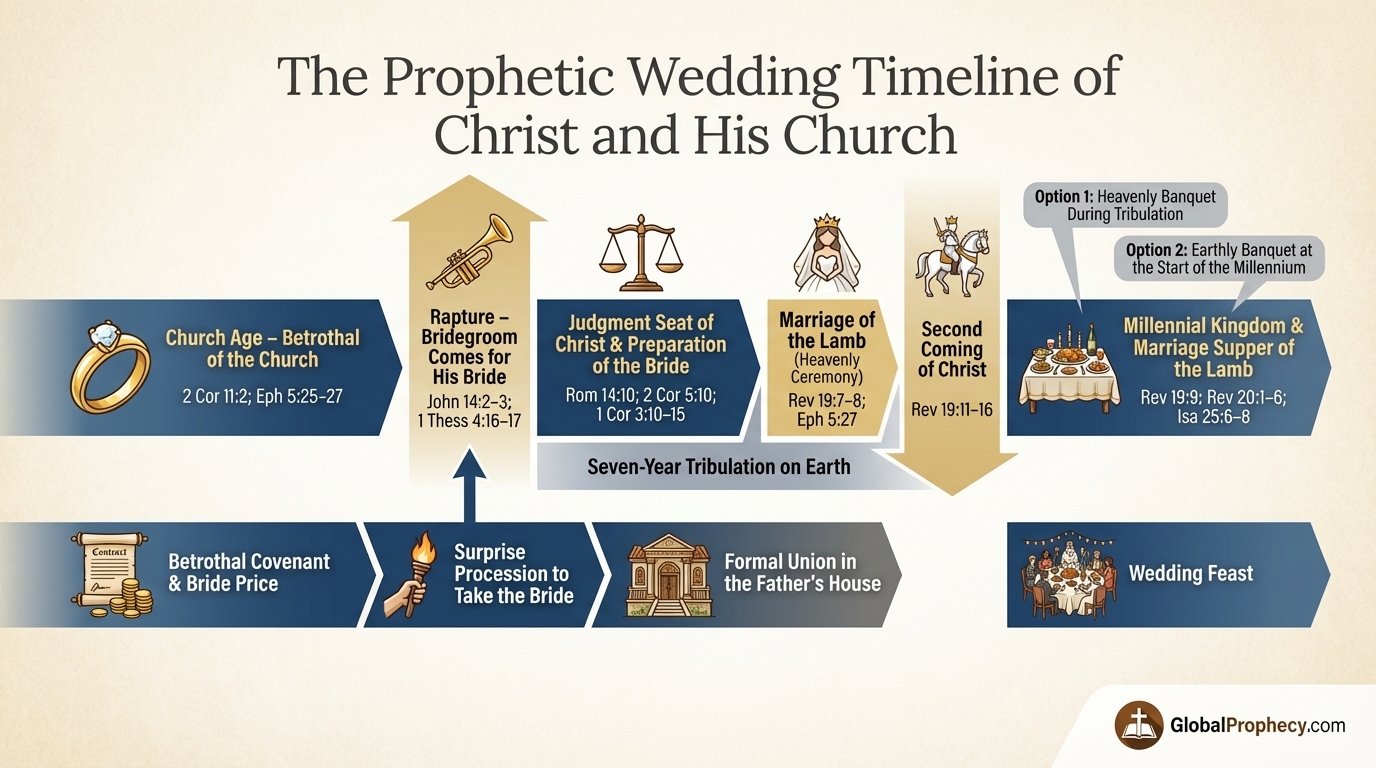
These texts, read in light of Jewish wedding customs, support a three-stage pattern: betrothal, coming of the bridegroom and marriage ceremony, and marriage feast.
3. Stage One: The Betrothal of the Church (Present Age and the Rapture)
3.1 Betrothal in Jewish Custom
In first‑century Judaism, betrothal was more than an engagement; it was a binding marriage covenant:
- A legal contract and bride price (dowry) were agreed upon (Mal 2:14; Mt 1:18–19).
- From that point on, the bride belonged exclusively to the groom, though the marriage was not yet consummated.
- A period of separation followed, usually about a year, during which:
- The groom prepared a dwelling in his father’s house.
- The bride prepared herself in purity for her future husband.
3.2 Betrothal Applied to Christ and the Church
The New Testament uses this background to describe the present betrothal of the Church to Christ:
- Covenant and purchase: Believers have been “bought with a price” (1 Cor 6:20)—the blood of Christ (1 Pet 1:18–19).
- Betrothal language: Paul “betroths” the church to one husband (2 Cor 11:2), and Ephesians 5:25–27 presents Christ’s self-giving love as the basis of this covenant relationship.
- Separation period: Christ has gone to the Father’s house, while the Church remains on earth:
“In my Father’s house are many rooms… I go to prepare a place for you. And if I go and prepare a place for you, I will come again and will take you to myself…”
— John 14:2–3
During this Church age:
- The betrothal is ongoing as people are saved and added to the Bride of Christ.
- The Church is called to live in purity and faithfulness, like a virgin bride keeping herself for her future husband (2 Cor 11:3; Jas 4:4).
3.3 The Rapture as the Climax of Betrothal
In Jewish weddings, the key moment of transition from betrothal to marriage was the surprise coming of the bridegroom to take the bride to his father’s house (cf. Mt 25:1–13). This finds its prophetic counterpart in the rapture of the Church:
“For the Lord himself will descend from heaven with a cry of command… And the dead in Christ will rise first. Then we who are alive… will be caught up together with them in the clouds to meet the Lord in the air…”
— 1 Thessalonians 4:16–17
At the rapture:
- The Bridegroom comes for His bride.
- The Church is removed from the earth and taken to the Father’s house in heaven (Jn 14:3).
- The betrothal stage gives way to the preparations for the marriage of the Lamb.
Thus, in a prophetic sense, betrothal covers the entire Church age, culminating in the rapture, when Christ formally claims His bride.
4. Stage Two: The Marriage of the Lamb (Heavenly Ceremony)
4.1 Timing of the Marriage Ceremony
The marriage of the Lamb is presented in Revelation 19:7–8 as a completed reality just before Christ’s second coming in glory (Rev 19:11–16). Several elements indicate its timing:
- The bride is already in heaven, clothed in “fine linen, bright and pure,” defined as “the righteous deeds of the saints” (Rev 19:8).
- This implies that the judgment seat of Christ (bema) has taken place, where believers’ works are evaluated and rewarded (Rom 14:10; 2 Cor 5:10; 1 Cor 3:10–15).
- The aorist tense in “the marriage of the Lamb has come” points to an event completed by the time the heavenly announcement is made.
From a dispensational, pretribulational reading:
- The rapture removes the Church to heaven before the Tribulation.
- In heaven, the Church appears before the judgment seat of Christ, resulting in the bride being prepared in “fine linen.”
- After this evaluation, but before Christ’s visible return, the marriage ceremony of the Lamb occurs in heaven.
4.2 Nature of the Marriage of the Lamb
In the Jewish pattern, the essence of the marriage was:
- The groom taking the bride to his father’s house.
- The formal union and presentation of the bride as fully his.
Applied to Christ and the Church:
- The marriage is the formal heavenly union of Christ and His betrothed Church, following her purification and reward.
- The Church is presented to Christ in spotless glory:
“…that he might present the church to himself in splendor, without spot or wrinkle… that she might be holy and without blemish.”
— Ephesians 5:27
At this point:
- The relationship promised in betrothal is consummated in a legal and spiritual sense.
- The Church now stands forever as the Bride of the Lamb, ready to share His reign (Rev 3:21; 19:14).
5. Stage Three: The Marriage Supper of the Lamb (The Banquet)
5.1 The Marriage Supper in Scripture
The marriage supper of the Lamb is explicitly mentioned in Revelation 19:9:
“Blessed are those who are invited to the marriage supper of the Lamb.”
— Revelation 19:9
This banquet imagery echoes:
- Old Testament kingdom feasts (Isa 25:6–8).
- Jesus’ parables of wedding banquets (Mt 22:1–14; 25:10; Lk 12:36–37; 14:16–24).
- The feasting and joy that followed Jewish weddings, often lasting seven days or more (Gen 29:21–28; Judg 14:10–12).
The marriage supper is distinct from the marriage ceremony:
- The marriage of the Lamb: Christ’s union with the Church in heaven.
- The marriage supper of the Lamb: a celebratory banquet with invited guests.
5.2 Location and Timing: Core Options
Within a premillennial, dispensational framework, two main views are held, both maintaining the same basic sequence (betrothal → rapture → marriage in heaven → banquet associated with the kingdom):
-
Heavenly banquet during the Tribulation (seven-year “wedding week”)
- The marriage ceremony and the marriage supper both occur in heaven between the rapture and the second coming.
- The seven-year Tribulation corresponds symbolically to the seven-day wedding feast.
- The Church celebrates with Christ in heaven, while judgment unfolds on earth.
-
Earthly banquet at the start of the Millennium
- The marriage ceremony occurs in heaven before the second coming (as above).
- The marriage supper is held on earth after Christ’s return, inaugurating the millennial kingdom.
- Israel and redeemed nations are viewed as invited guests, while the Church is the bride presented publicly to the Lord’s “friends” (cf. Mt 8:11; 22:1–14; 25:1–13; Lk 13:28–29).
- The banquet imagery then expands to cover the whole millennial age as an extended celebration of the King and His bride.
Both views agree on these essentials:
- The bride is the Church, not all believers of all ages (Rom 7:4; 2 Cor 11:2; Eph 5:25–32).
- The guests at the marriage supper are redeemed non-church saints (Old Testament and Tribulation believers), who are blessed to share in the celebration but are not part of the bride.
- The banquet marks the public honor of the Lamb and His wife in the presence of all redeemed.
5.3 Theological Significance of the Banquet
The marriage supper of the Lamb signifies:
- The public vindication and glorification of Christ as Bridegroom-King.
- The display of the Church’s beauty, which is derived entirely from His grace (“the fine linen is the righteous deeds of the saints,” Rev 19:8).
- The full enjoyment of kingdom fellowship—feasting, joy, and unbroken communion with Christ.
- The start (or early phase) of eternal life together in the manifested kingdom, leading ultimately into the new heaven and new earth where “the Bride, the wife of the Lamb” is seen forever (Rev 21:9–10).
6. Why the Three Stages Matter for Believers
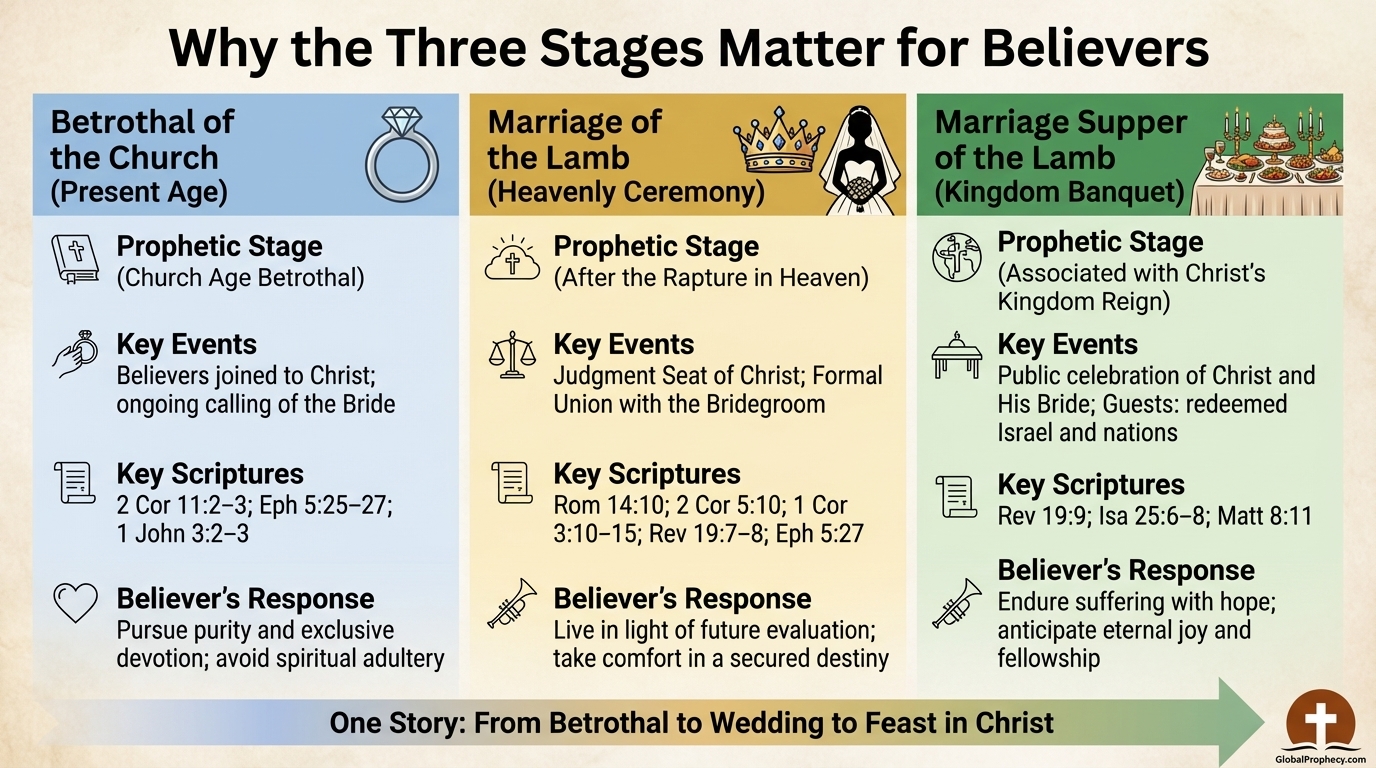
Understanding the betrothal–marriage–banquet pattern is not merely academic; it shapes Christian hope and holiness.
-
Betrothal motivates purity
- As a betrothed bride, the Church must guard her loyalty to Christ and reject spiritual adultery (2 Cor 11:2–3; Jas 4:4).
- Believers prepare now for their future presentation by pursuing holiness (1 Jn 3:2–3).
-
The coming marriage ceremony assures destiny
- The marriage of the Lamb guarantees that the Church’s future is not uncertain; it is a sealed covenant that will be consummated in glory.
- The judgment seat of Christ, though sobering, is part of His loving preparation of the bride.
-
The marriage supper sustains hope of joy
- The marriage supper of the Lamb promises a future of overflowing joy and celebration in the kingdom of God.
- Suffering now is temporary; the final word is feasting, fellowship, and glory with the Bridegroom.
7. Conclusion
Biblical eschatology presents the Church’s future in the language of a wedding:
- Betrothal: In this present age, all who trust Christ are joined to Him in a binding covenant and set apart as His betrothed bride, awaiting His return.
- Marriage of the Lamb: After the rapture and the judgment seat of Christ, the Church will be formally and gloriously united to Christ in heaven, clothed in the righteous deeds wrought by His grace.
- Marriage supper of the Lamb: That union will then be publicly celebrated in a great banquet of the kingdom, with redeemed Israel and the nations as honored guests, as Christ and His bride enter into their reign.
This three-stage pattern, rooted in Jewish wedding customs and unfolded in Scripture, shows that the end of the Church’s journey is not merely survival or escape, but a wedding, a union, and a feast. The Bridegroom has pledged Himself; the bride is being prepared; and the day is coming when heaven will resound: “Let us rejoice and exult and give him the glory, for the marriage of the Lamb has come” (Rev 19:7).
FAQ
Q: What is the “marriage of the Lamb” in Revelation 19?
The marriage of the Lamb is the formal, heavenly union of Jesus Christ (the Lamb) with His Church, described in Revelation 19:7–8. It takes place after the rapture and the judgment seat of Christ, when the Church, purified and rewarded, is presented to Christ as His spotless bride.
Q: How is the Church’s betrothal to Christ related to the rapture?
The Church is betrothed to Christ throughout the present age as people are saved and joined to Him (2 Cor 11:2). The rapture is the climactic moment when the heavenly Bridegroom comes to take His betrothed bride from earth to the Father’s house (Jn 14:1–3; 1 Thess 4:16–17), transitioning from betrothal toward the marriage ceremony in heaven.
Q: What is the marriage supper of the Lamb?
The marriage supper of the Lamb (Rev 19:9) is the great wedding banquet that celebrates the union of Christ and His Church. It includes invited guests—redeemed saints who are not part of the Church—and is associated with the inauguration of Christ’s kingdom. Depending on the specific view, it is placed either in heaven during the Tribulation or on earth at the beginning of the Millennium.
Q: Who are the “bride” and the “guests” at the marriage supper of the Lamb?
The bride is the Church, the collective body of believers from Pentecost to the rapture (Rom 7:4; Eph 5:25–27; Rev 19:7–8). The guests at the marriage supper are redeemed individuals who are not part of the Church—such as Old Testament and Tribulation saints—who are blessed to share in the celebration (Rev 19:9).
Q: Why is understanding the marriage of the Lamb important for Christians today?
This doctrine shows believers their identity (betrothed bride), their future (certain union with Christ), and their hope (a joyful kingdom feast). It encourages holiness, steadfastness, and anticipation, as Christians live now in light of the coming betrothal fulfilled, marriage consummated, and banquet celebrated with the Lamb.
Frequently Asked Questions
What is the “marriage of the Lamb” in Revelation 19?
How is the Church’s betrothal to Christ related to the rapture?
What is the marriage supper of the Lamb?
Who are the “bride” and the “guests” at the marriage supper of the Lamb?
Why is understanding the marriage of the Lamb important for Christians today?
L. A. C.
Theologian specializing in eschatology, committed to helping believers understand God's prophetic Word.
Related Articles
What are the Marriage of the Lamb?
Marriage of the Lamb reveals Christ’s union with His church in Revelation 19. Explore its meaning, timing, and eternal significance in God’s plan.
Amillennialism Examined: Is the Church the Millennial Kingdom?
Amillennialism examined: is the church the millennial kingdom? Explore its claims, symbols, and a biblical critique of this end-times view.
Jewish Wedding Customs and Biblical Prophecy
Jewish wedding customs and biblical prophecy reveal how the betrothal, bridal chamber, and wedding feast picture the rapture and marriage of the Lamb.
Understanding the New Covenant: Israel, the Church, or Both?
New Covenant in Jeremiah 31 explained: does it apply only to Israel, to the church, or to both? Explore how Scripture connects its promises and people.