
The Biblical Covenants: Framework for Understanding Prophecy
1. Introduction: Covenants as the Spine of Biblical Prophecy
Biblical eschatology is not a loose collection of predictions. It is structured around covenants—formal, oath‑bound commitments in which God binds Himself to stated purposes in history.
These biblical covenants (especially the Abrahamic, Mosaic, Land, Davidic, and New covenants) function as the framework for understanding prophecy:
- They define who God is dealing with (Israel, the nations, the church).
- They clarify what God has promised (land, kingship, blessing, spiritual renewal).
- They indicate when and how these promises will be brought to completion.
Without this covenantal framework, prophetic texts float unanchored. With it, they fall into a coherent, progressive plan that moves from promise to fulfillment in history and eternity.
“For the gifts and the calling of God are irrevocable.”
— Romans 11:29
2. The Abrahamic Covenant: Foundation of the Prophetic Program
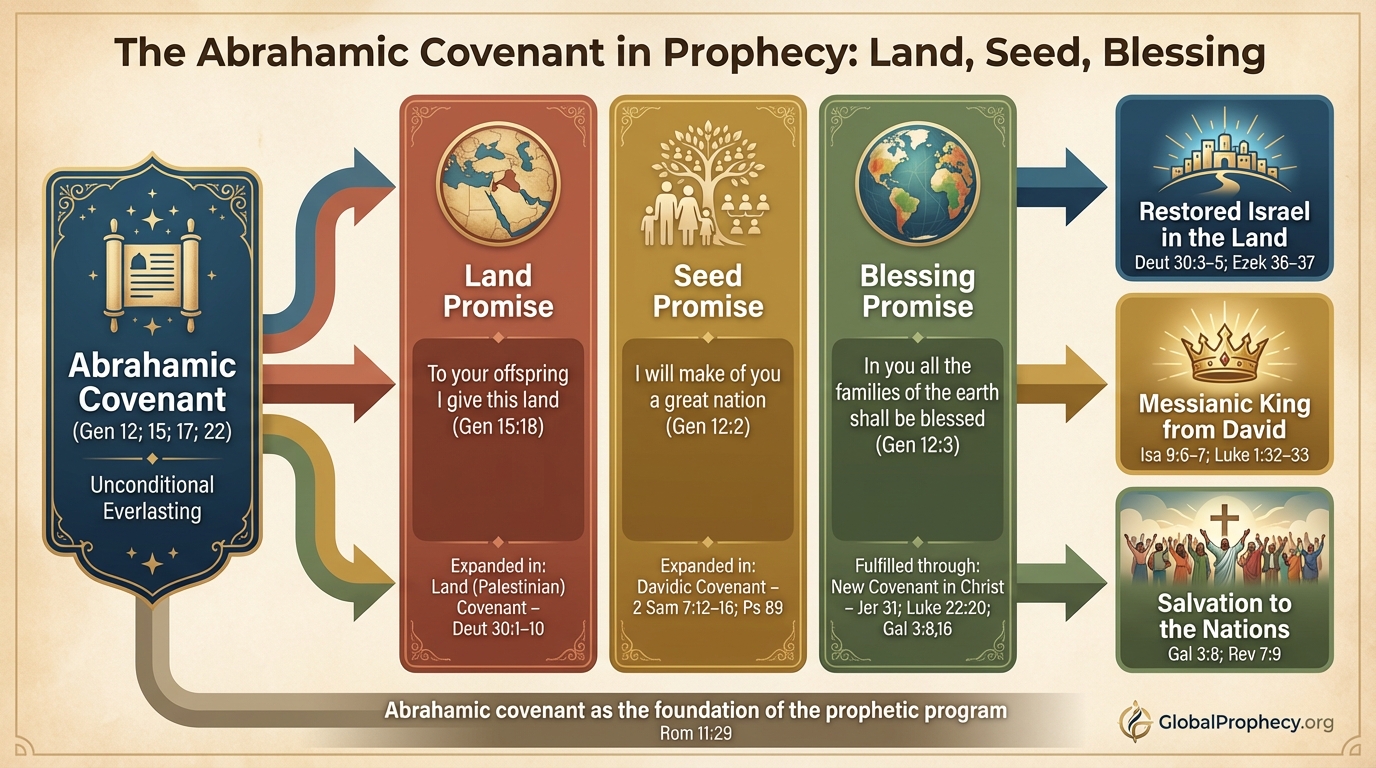
The Abrahamic covenant (Genesis 12; 15; 17; 22) is the fountainhead of God’s redemptive purposes in history. It contains three core promises to Abraham and his seed:
- Land – “To your offspring I give this land” (Gen 15:18).
- Seed – “I will make of you a great nation” (Gen 12:2).
- Blessing – “In you all the families of the earth shall be blessed” (Gen 12:3).
Several features make this covenant a cornerstone for prophecy:
2.1 Unconditional and Everlasting
In Genesis 15, God alone passes between the divided animals while Abram is in a “deep sleep” (Gen 15:12, 17). This is a unilateral oath: God obligates Himself, not Abraham.
The covenant is called “everlasting”:
“And I will establish my covenant between me and you and your offspring after you … for an everlasting covenant, to be God to you and to your offspring after you. And I will give … all the land of Canaan, for an everlasting possession.”
— Genesis 17:7–8
This means:
- The covenant cannot be annulled by Israel’s disobedience.
- Its promises must find historical, not merely spiritual, fulfillment.
2.2 Prophetic Implications
The Abrahamic covenant sets the baseline expectations for prophecy:
- There will be a real nation springing from Abraham (Israel).
- That nation will possess a specific territory indefinitely.
- Through Abraham’s seed, Gentile nations will receive salvation (Gal 3:8, 16).
Much of Old Testament prophecy—especially in Isaiah, Jeremiah, Ezekiel, and the Minor Prophets—is simply the elaboration of how and when God will fulfill Abrahamic promises, despite Israel’s failures and the opposition of the nations.
Thus, the Abrahamic covenant anchors eschatology in God’s sworn commitment to Abraham and his physical descendants, while also guaranteeing global blessing through Messiah.
3. The Mosaic Covenant: Temporal Overlay and Prophetic Judgments
The Mosaic covenant (Exodus 19–24; Deuteronomy) does not replace the Abrahamic covenant; it regulates Israel’s experience of Abrahamic blessings during a specific historical period.
“Now therefore, if you will indeed obey my voice and keep my covenant, you shall be my treasured possession among all peoples.”
— Exodus 19:5
Key characteristics:
- It is conditional (“if you obey … then I will …”).
- It is temporal, later called “obsolete” and “ready to vanish away” (Heb 8:13).
- It defines blessings and curses in the land (Deut 28).
3.1 Prophetic Function
The prophets constantly appeal back to the Mosaic covenant when explaining Israel’s history and future:
- Exile and dispersion are portrayed as covenant curses (Lev 26; Deut 28; cf. Jer 25:8–11).
- Restoration is promised not because the Mosaic covenant is permanent, but because God remains faithful to His Abrahamic oath (Lev 26:42; Jer 11:5).
The Mosaic covenant thus explains:
- Why Israel suffers judgment in history.
- Why exile is not the end: it does not cancel the underlying unconditional covenant with Abraham.
The termination of the Mosaic covenant at the cross (Rom 10:4; 2 Cor 3:7–11; Heb 8–10) paves the way for the New Covenant, yet the prophetic program tied to Abrahamic promises remains intact.
4. Land and Davidic Covenants: The Shape of the Messianic Kingdom
Two crucial “expansion” covenants spell out the geographical and political contours of future prophecy: the Land and Davidic covenants.
4.1 The Land (Palestinian) Covenant: Final Regathering and Restoration
Deuteronomy 30:1–10 formalizes a land covenant with Israel, amplifying the territorial aspect of the Abrahamic covenant.
Key themes:
- Israel will be scattered among the nations because of disobedience (Deut 30:1).
- In “the latter days” Israel will return to the LORD (Deut 4:30; 30:2, 6).
- God will regather them “from all the peoples” and “bring you into the land that your fathers possessed, that you may possess it” (Deut 30:3, 5).
This covenant is:
- Rooted in grace (“the LORD your God will restore your fortunes” – Deut 30:3).
- Unconditional in outcome, though the timing is linked to national repentance.
Prophetic texts like Isaiah 11:11–12; Ezekiel 36–37; Amos 9:14–15 build directly on this covenant—predicting a final, irreversible regathering of Israel to her land before and into the Messianic reign.
4.2 The Davidic Covenant: Eternal Kingship and the Messianic Throne
The Davidic covenant (2 Sam 7:12–16; Ps 89) clarifies how God will rule the promised land and nation.
Core elements:
- House – an enduring dynasty (“I will raise up your offspring after you … and I will establish his kingdom” – 2 Sam 7:12).
- Throne – the right to rule (“your throne shall be established forever” – 2 Sam 7:16).
- Kingdom – a real realm over which the king reigns (“he shall reign over the house of Jacob forever” – Luke 1:33).
The covenant is explicitly everlasting and irrevocable:
“I will not violate my covenant or alter the word that went forth from my lips … His offspring shall endure forever, his throne as long as the sun before me.”
— Psalm 89:34, 36
4.3 Prophetic Trajectory
Prophets and New Testament writers consistently project a future Davidic reign:
- Isaiah 9:6–7 – a Davidic ruler on the throne who governs in justice and peace.
- Jeremiah 23:5–6 – “a righteous Branch” from David who will “reign as king.”
- Ezekiel 37:24–25 – “my servant David shall be king over them … they shall dwell in the land … forever.”
Gabriel ties this directly to Jesus:
“The Lord God will give to him the throne of his father David, and he will reign over the house of Jacob forever, and of his kingdom there will be no end.”
— Luke 1:32–33
The Davidic covenant therefore gives prophetic shape to the coming kingdom: a Messianic reign, on David’s throne, over a restored Israel, in the promised land.
5. The New Covenant: Prophetic Promise of Spiritual Renewal
The New Covenant (primarily Jeremiah 31:31–34; Ezekiel 36:25–27; 37:26–28) addresses the spiritual transformation necessary for Israel to enjoy the blessings of the Abrahamic, Land, and Davidic covenants.
“I will make a new covenant with the house of Israel and the house of Judah, not like the covenant that I made with their fathers … my covenant that they broke.”
— Jeremiah 31:31–32
Key provisions:
- Internalization of God’s law – “I will put my law within them, and I will write it on their hearts” (Jer 31:33).
- Universal knowledge of God among Israel – “they shall all know me, from the least of them to the greatest” (Jer 31:34).
- Definitive forgiveness – “I will forgive their iniquity, and I will remember their sin no more” (Jer 31:34).
- Indwelling Spirit – “I will put my Spirit within you, and cause you to walk in my statutes” (Ezek 36:27).
This covenant is explicitly with “the house of Israel and the house of Judah” and is everlasting (Jer 32:40; Ezek 37:26).
5.1 Inauguration in Christ, Fulfillment in Israel’s Future
At the Last Supper, Jesus identifies His death as the ratification of this covenant:
“This cup that is poured out for you is the new covenant in my blood.”
— Luke 22:20
The New Testament teaches:
- The New Covenant has been inaugurated in Christ’s death and resurrection.
- Believers (Jews and Gentiles) now share its spiritual blessings—forgiveness, the indwelling Spirit, newness of life (2 Cor 3:6; Heb 8–10).
- Yet the covenant’s national and territorial dimensions—a fully converted Israel dwelling securely in the land under Messiah—remain future and await Christ’s return.
Paul explicitly ties Israel’s future national salvation to New Covenant language:
“And in this way all Israel will be saved … ‘And this will be my covenant with them when I take away their sins.’”
— Romans 11:26–27; cf. Isa 59:20–21
Thus the New Covenant provides the spiritual engine of prophecy: it guarantees that a hardened nation will one day be regenerated, enabling the fulfillment of the Abrahamic, Land, and Davidic promises in history.
6. Integrating the Covenants: A Coherent Prophetic Framework
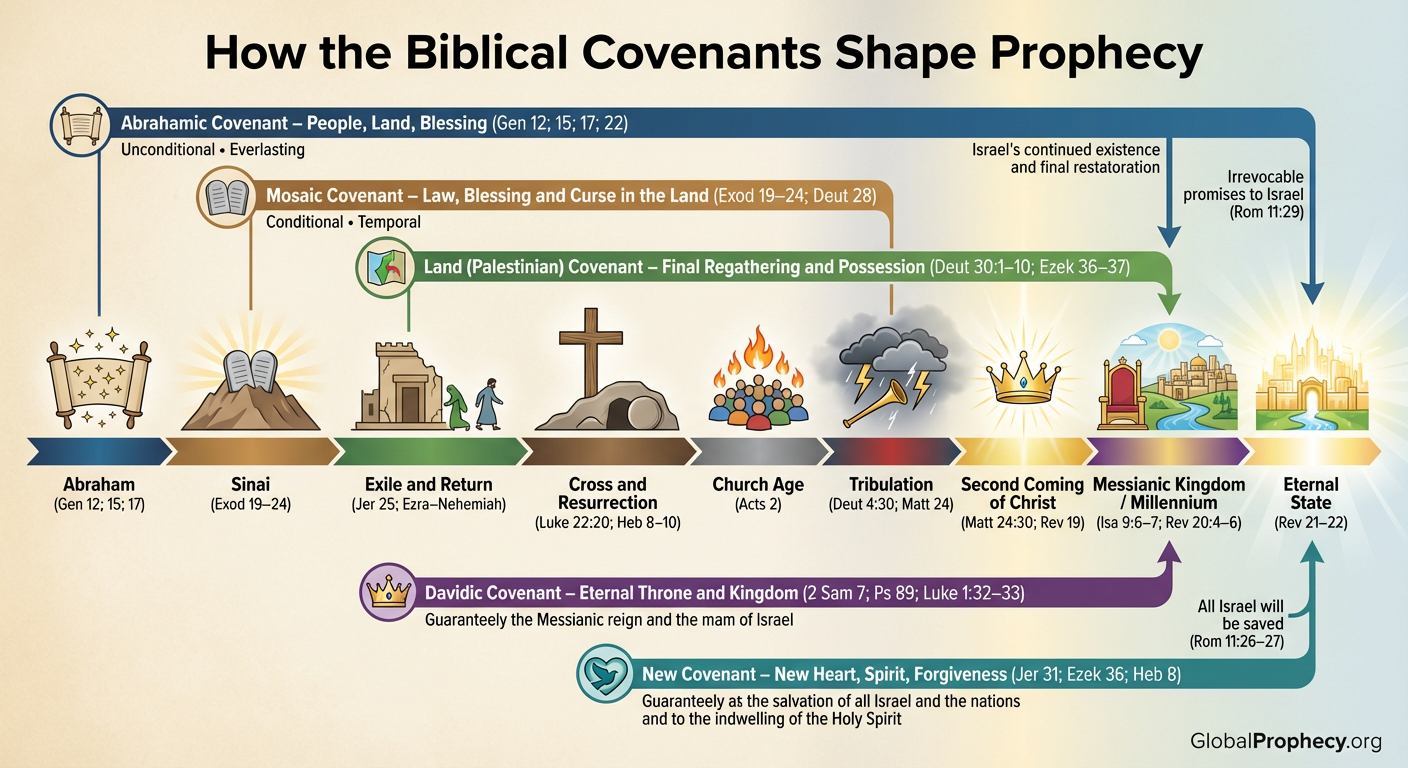
When the major biblical covenants are viewed together, a cohesive eschatological structure emerges:
-
Abrahamic Covenant – establishes God’s irreversible commitment to:
- A people (Israel),
- A land (Canaan with specified borders),
- A universal blessing (through Messiah).
-
Mosaic Covenant – defines Israel’s historical experience (blessing or curse in the land), explaining:
- The cycles of judgment and exile,
- The need for a New Covenant solution.
-
Land Covenant – guarantees final regathering and permanent possession of the land by a repentant and restored Israel.
-
Davidic Covenant – guarantees a Davidic Messiah who will rule from David’s throne over Israel and, by extension, the nations.
-
New Covenant – guarantees the internal transformation and forgiveness required for Israel and the nations to enjoy the blessings of the kingdom.
From this covenantal framework, key prophetic expectations follow:
- Israel’s continued existence as a distinct nation is not accidental; it is covenantal.
- The regathering of Israel and renewed presence in the land are steps toward prophesied restoration.
- A future period of intense tribulation and judgment prepares Israel for national repentance (Deut 4:30; Zech 12:10).
- Christ’s second coming brings:
- The salvation of “all Israel” (Rom 11:26),
- The establishment of His Davidic reign on earth (Matt 19:28; Rev 20:4–6),
- The outworking of New Covenant blessings on Israel and the nations.
In short, the covenants function like architectural blueprints. They do not supply every detail, but they set the parameters within which all prophetic detail must fit.
7. Conclusion
Biblical prophecy is covenant‑driven. The Abrahamic, Mosaic, Land, Davidic, and New covenants together form a structured, interlocking framework that:
- Grounds God’s promises in His unchanging character.
- Safeguards the future of Israel and clarifies the place of the nations.
- Centers eschatology on the Messiah, the true Seed of Abraham, Son of David, and Mediator of the New Covenant.
Understanding these covenants is therefore essential for any responsible reading of biblical prophecy. They assure us that the God who swore by Himself to Abraham will unfailingly bring His plan to completion in history and eternity.
“So when God desired to show more convincingly to the heirs of the promise the unchangeable character of his purpose, he guaranteed it with an oath.”
— Hebrews 6:17
FAQ
Q: How do the biblical covenants guide our interpretation of end‑times prophecy?
The covenants identify God’s long‑term commitments and the parties involved. They show that Israel’s existence, land, and future kingdom are rooted in unconditional promises, not temporary arrangements. This keeps prophecies of Israel’s regathering, tribulation, and restoration anchored in God’s sworn oaths, rather than reading them as vague symbols fulfilled only in the church.
Q: Has the church replaced Israel in the Abrahamic, Davidic, and New Covenants?
No. The church shares in the spiritual blessings of these covenants—especially the New Covenant—through union with Christ (Gal 3:14; Eph 2:11–13). But the specific national and territorial promises (land, throne of David, restored kingdom to Israel) are consistently addressed to ethnic Israel and remain to be fulfilled to that nation in history (Jer 31:35–37; Rom 11:1–2, 28–29).
Q: What is the role of the New Covenant in biblical eschatology?
The New Covenant provides the spiritual basis for the future kingdom. It guarantees that Israel will one day receive a new heart, the indwelling Spirit, and full forgiveness (Jer 31; Ezek 36). This transformation enables Israel to live under Messiah’s righteous rule and ensures that the Abrahamic and Davidic promises are not just externally imposed, but internally embraced in a redeemed, obedient nation.
Frequently Asked Questions
How do the biblical covenants guide our interpretation of end‑times prophecy?
Has the church replaced Israel in the Abrahamic, Davidic, and New Covenants?
What is the role of the New Covenant in biblical eschatology?
L. A. C.
Theologian specializing in eschatology, committed to helping believers understand God's prophetic Word.
Related Articles
What the Bible Says about Antichrist?
Antichrist in the Bible: discover what Scripture reveals about his identity, character, deceptive power, and end-time role in the Tribulation.
What the Bible Says about False Prophet?
False Prophet biblical identity and role in end times. Discover what Scripture reveals about this key figure in Revelation's tribulation prophecy.
Biblical Purposes of the Tribulation
Biblical purposes of the tribulation explained: why God sends this final period of judgment, purification, and restoration in His end-time plan.
Biblical Terms for the Tribulation
Discover the biblical terms for the Tribulation including Time of Jacob's Trouble, Day of the Lord, and Great Tribulation with their scriptural meanings.