
Biblical Terms for the Tribulation
1. Introduction
The future tribulation period stands as one of the most extensively detailed prophetic events in all of Scripture. Yet beyond simply describing the horrors and judgments that will characterize this seven-year period, the Bible employs a rich variety of terms and expressions to convey the nature, purpose, and scope of this unprecedented time. These biblical designations are not merely synonymous labels but rather distinct windows into different aspects of this climactic period in human history.
Understanding the various biblical terms for the tribulation provides crucial insight into its multifaceted purpose and character. From ancient Hebrew prophecies to the apocalyptic visions of Revelation, Scripture uses specific terminology that illuminates both the divine intentions behind this period and its devastating impact on Israel and the nations. Each term carries theological weight, revealing aspects of God's judgment, Israel's restoration, and the final preparation for Christ's millennial kingdom.
This article examines the comprehensive range of biblical terminology used to describe the tribulation period, organized by testament and thematic significance. By exploring these designations in their scriptural context, we gain a deeper appreciation for the gravity of this coming time and God's sovereign purposes in bringing it about.
2. Old Testament Terms for the Tribulation
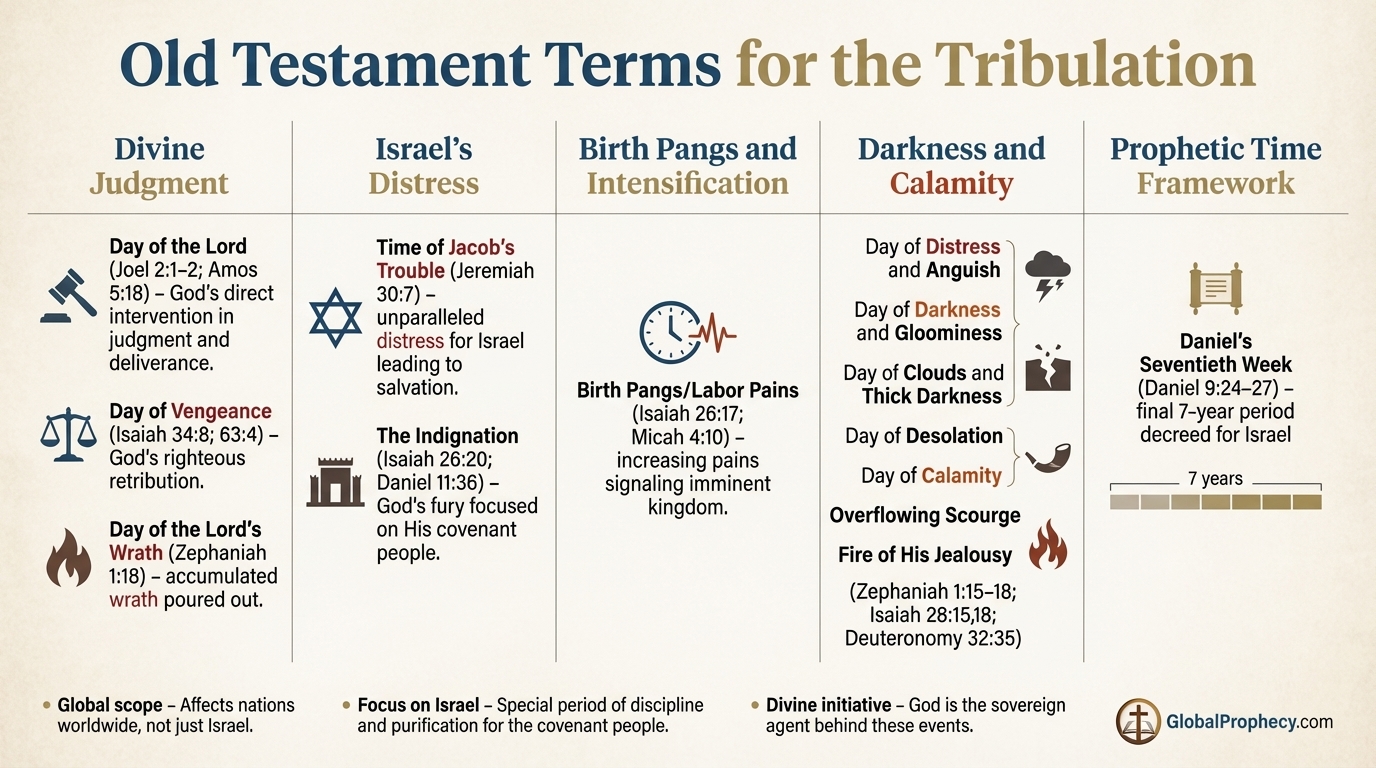
The Old Testament prophets employed numerous Hebrew expressions to describe the future period of unprecedented trouble that would come upon Israel and the world. These terms emphasize different aspects of the tribulation's character and purpose.
The Day of the Lord
Perhaps the most frequently used Old Testament term is "the day of the Lord" (Hebrew: yom Yahweh). This expression appears in multiple prophetic books including Joel, Amos, Obadiah, Zephaniah, and Isaiah. The phrase refers to a specific time when God will directly intervene in human history to judge sin and establish His kingdom. Joel describes it as "a day of darkness and gloom, a day of clouds and thick darkness" (Joel 2:2). The day of the Lord encompasses both judgment on the wicked and deliverance for the righteous remnant.
The Time of Jacob's Trouble
Jeremiah 30:7 introduces a uniquely Jewish designation: "the time of Jacob's trouble" (Hebrew: et-tsarah l'Ya'akov). This term specifically identifies the tribulation as a period of intense suffering for Israel (Jacob). The prophet writes, "Alas! That day is so great there is none like it; it is a time of distress for Jacob; yet he shall be saved out of it." This expression emphasizes God's corrective discipline upon His covenant people to bring them to national repentance and restoration.
Birth Pangs
Multiple Old Testament prophets employ the imagery of birth pangs or labor pains to describe the tribulation (Isaiah 21:3; 26:17-18; 66:7; Jeremiah 4:31; Micah 4:10). This metaphor conveys both the intensity of suffering and the certainty of what follows. Just as birth pangs signal that delivery is imminent and inevitable, these judgments indicate that God's kingdom purposes will soon be fulfilled. The imagery also suggests increasing intensity and frequency as the period progresses.
Day of Vengeance and Wrath
Isaiah repeatedly uses terms emphasizing divine retribution: "the day of vengeance" (Isaiah 34:8; 35:4; 61:2; 63:4) and "day of the Lord's wrath" (Zephaniah 1:18). These designations stress that the tribulation represents God's righteous judgment against accumulated sin. The vengeance is not vindictive but judicial—God settling accounts with a rebellious world that has rejected His authority and oppressed His people.
The Indignation
Daniel 11:36 and Isaiah 26:20 refer to "the indignation" (Hebrew: za'am). This term denotes God's fierce anger directed particularly at Israel for her centuries of rebellion. Isaiah 26:20 advises: "Come, my people, enter your chambers, and shut your doors behind you; hide yourselves for a little while until the fury has passed by." The indignation represents God's settled displeasure that must run its full course before Israel's restoration.
Daniel's Seventieth Week
Daniel 9:24-27 presents the prophetic framework of seventy "weeks" (Hebrew: shavu'im, meaning "sevens" of years) decreed for Israel. After sixty-nine weeks culminating in Messiah's first coming, a gap occurs before the final seventieth week—the seven-year tribulation period. Daniel 9:27 describes this: "And he shall make a strong covenant with many for one week, and for half of the week he shall put an end to sacrifice and offering."
Additional Descriptive Terms
The Old Testament prophets used numerous other expressions that paint a vivid picture of the tribulation's character:
- Day of distress and anguish (Zephaniah 1:15; Daniel 12:1)
- Day of darkness and gloominess (Zephaniah 1:15; Joel 2:2)
- Day of clouds and thick darkness (Zephaniah 1:15; Joel 2:2)
- Day of trumpet and alarm (Zephaniah 1:16)
- Day of desolation (Zephaniah 1:15)
- The overflowing scourge (Isaiah 28:15, 18)
- Day of calamity (Deuteronomy 32:35; Obadiah 12-14)
- The fire of His jealousy (Zephaniah 1:18)
Each of these terms contributes unique shading to our understanding of this future period, emphasizing its severity, comprehensive scope, and divine origin.
3. New Testament Terms for the Tribulation
The New Testament continues and expands upon Old Testament terminology while introducing additional designations for the tribulation period. These terms appear primarily in the teachings of Jesus and the apostolic writings, particularly in Matthew 24, the Thessalonian epistles, and the book of Revelation.
The Tribulation and Great Tribulation
Jesus Himself uses the specific term "tribulation" (Greek: thlipsis) in His Olivet Discourse. In Matthew 24:9, He warns, "Then they will deliver you up to tribulation." The word thlipsis literally means "to press" or "to press together," conveying the idea of being under intense pressure or affliction.
More significantly, Jesus distinguishes a period of escalated suffering: "the great tribulation" (Greek: he thlipsis he megale). Matthew 24:21 records: "For then there will be great tribulation, such as has not been from the beginning of the world until now, no, and never will be." This designation specifically refers to the intensified second half of the seven-year period, following the abomination of desolation at the midpoint (Matthew 24:15).
The Hour of Trial
In Revelation 3:10, Christ promises the church at Philadelphia: "Because you have kept my word about patient endurance, I will keep you from the hour of trial that is coming on the whole world, to try those who dwell on the earth." This designation emphasizes several key aspects: the tribulation's definite time limitation ("hour"), its testing purpose ("trial"), and its global scope ("whole world").
The Wrath
Multiple New Testament passages refer to the tribulation period simply as "the wrath" (Greek: orge). Paul writes of Jesus "who delivers us from the wrath to come" (1 Thessalonians 1:10) and assures believers "God has not destined us for wrath" (1 Thessalonians 5:9). Revelation frequently uses this terminology:
- "The great day of their wrath" (Revelation 6:17)
- "The wrath of God" (Revelation 14:10, 19; 15:1, 7; 16:1)
- "The wrath of the Lamb" (Revelation 6:16)
These expressions identify the tribulation as a period when God's accumulated anger against sin will be poured out in full measure. The wrath is both divine (from God the Father) and messianic (from the Lamb, Jesus Christ).
The Day of the Lord
The apostles continue using the Old Testament designation "the day of the Lord" (Greek: he hemera tou kyriou). Paul employs this term in 1 Thessalonians 5:2 and 2 Thessalonians 2:2, maintaining continuity with prophetic tradition. Peter also uses it when describing cosmic judgment: "But the day of the Lord will come like a thief, and then the heavens will pass away with a roar" (2 Peter 3:10).
The Hour of Judgment
Revelation 14:7 announces: "Fear God and give him glory, because the hour of his judgment has come." This designation emphasizes the judicial nature of the tribulation period—it is not arbitrary suffering but divine courtroom proceedings against a guilty world. The term underscores God's role as righteous judge executing sentence.
Birth Pangs
Jesus adopted the Old Testament imagery of birth pangs (Greek: odin) in His Olivet Discourse. After describing various preliminary signs—false messiahs, wars, famines, and earthquakes—Jesus declares, "All these are but the beginning of the birth pains" (Matthew 24:8). Paul uses the same metaphor: "When people say, 'There is peace and security,' then sudden destruction will come upon them as labor pains come upon a pregnant woman" (1 Thessalonians 5:3).
Additional New Testament Designations
The New Testament includes other expressions that characterize different aspects of the tribulation:
- "The day" (1 Thessalonians 5:4)
- "Those days" (Matthew 24:22; Mark 13:20)
- "Time of tribulation" (Mark 13:19)
These terms, though seemingly simple, carry the weight of prophetic fulfillment when understood in their eschatological context.
4. The Meaning and Significance of Tribulation Terminology
The various biblical terms for the tribulation are not arbitrary synonyms but carefully chosen expressions that reveal distinct aspects of this unprecedented period. Understanding why Scripture employs such diverse terminology enriches our comprehension of the tribulation's multifaceted nature and purposes.
Emphasis on Divine Initiative
Terms like "the day of the Lord," "the wrath of God," and "the indignation" all emphasize that the tribulation originates from God's sovereign will. This is not merely human conflict or natural disaster spiraling out of control, but divine judgment purposefully executed. The repeated use of "day" terminology (appearing in over twenty different expressions) indicates a definite period appointed and controlled by God. As Paul declares in Acts 17:31, God "has fixed a day on which he will judge the world."
The Judicial Nature of the Period
Expressions like "the hour of judgment," "day of vengeance," and "the wrath" underscore the judicial character of the tribulation. This period represents God's courtroom in session, with verdicts rendered and sentences executed. The accumulated guilt of humanity—centuries of rebellion, rejection of Christ, persecution of God's people—will be addressed. The tribulation is not divine cruelty but divine justice finally being satisfied.
Intensity Beyond All Historical Precedent
Jesus' designation "great tribulation" and His qualification "such as has not been from the beginning of the world until now, no, and never will be" (Matthew 24:21) establish this period as categorically unique. Terms like "distress," "anguish," "trouble," and "calamity" reinforce the unprecedented severity. Daniel similarly describes it as "a time of trouble, such as never has been since there was a nation till that time" (Daniel 12:1).
This emphasis on uniqueness distinguishes the future tribulation from general tribulation that Christians experience throughout history (John 16:33) and from localized historical judgments like the destruction of Jerusalem in AD 70.
Progressive Intensification
The "birth pangs" metaphor conveys crucial information about the tribulation's structure. Just as labor pains increase in frequency and intensity as delivery approaches, so the judgments of the tribulation will escalate. Revelation's structure—seven seals, seven trumpets, and seven bowls—reflects this progression, with each series more severe than the last. The judgments do not merely repeat but intensify as the period advances toward its climax at Christ's return.
Israel-Specific Purposes
Terms like "the time of Jacob's trouble" and references to Daniel's "seventieth week" identify the tribulation as particularly focused on Israel. While the entire world experiences judgment, God has special purposes for the Jewish people during this period. The tribulation will function as divine discipline to bring Israel to national repentance and recognition of Jesus as Messiah.
Global Scope
Expressions like "the hour of trial that is coming on the whole world" (Revelation 3:10) and "the fire of his jealousy" that will "consume all the earth" (Zephaniah 1:18) establish the worldwide scope of this judgment. Unlike localized historical judgments, the tribulation will be comprehensive and inescapable, affecting "those who dwell on the earth"—a repeated phrase in Revelation denoting humanity in rebellion against God.
Definite Time Limitations
The terminology consistently indicates that the tribulation will be temporally limited. References to "the hour," "those days," "one week" (seven years), and the promise that "for the sake of the elect those days will be cut short" (Matthew 24:22) all assure that this period, however terrible, will end. God has sovereignly determined its duration—seven years as prophesied in Daniel 9:27—and will not allow it to continue beyond His appointed time.
5. The Relationship Between Terms
While Scripture uses many different designations for the tribulation period, these terms are not disconnected labels but interconnected descriptions that together provide a comprehensive picture of this future time. Understanding how these terms relate to one another enhances our grasp of the tribulation's scope and sequence.
Overlapping and Inclusive Terms
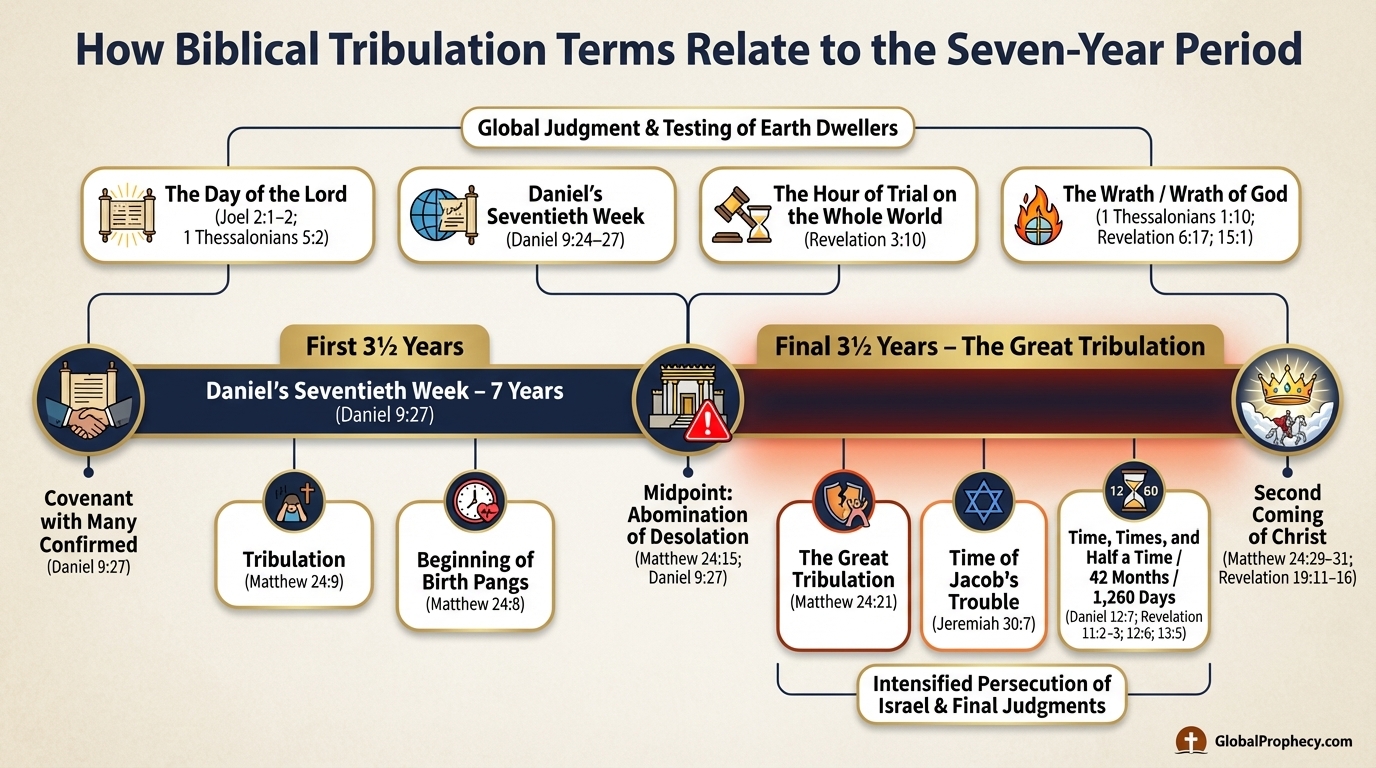
Several tribulation terms function as umbrella designations that encompass the entire seven-year period. "The day of the Lord" is perhaps the most comprehensive, referring not only to the tribulation but extending to include Christ's second coming and even aspects of the millennial kingdom. When prophets speak of "the day of the Lord," they envision the entire sequence of end-time events when God directly intervenes in history.
Similarly, Daniel's seventieth week provides the chronological framework that contains all other tribulation events. This seven-year period, divided into two halves of three and one-half years each, forms the structure within which all other designations find their place.
Whole vs. Part Designations
A crucial distinction exists between terms describing the entire seven-year period and those specifically referencing the intensified second half. Jesus' use of "tribulation" (Matthew 24:9) appears to encompass the full seven years, while "the great tribulation" (Matthew 24:21) specifically denotes the latter half following the abomination of desolation at the midpoint.
Likewise, "the time of Jacob's trouble" (Jeremiah 30:7) particularly emphasizes the second half when Israel faces its most severe persecution under the antichrist. This distinction helps explain why some passages describe conditions of relative peace and prosperity early in the period (facilitating the rebuilding of the temple and reinstitution of sacrifices), while others depict unparalleled suffering and devastation.
Sequential Development Within the Period
The "birth pangs" metaphor provides insight into the internal progression of the tribulation. Early signs—wars, famines, earthquakes—represent "the beginning of the birth pains" (Matthew 24:8). As the period advances, these afflictions intensify in both frequency and severity, just as labor contractions increase as delivery approaches. The seal, trumpet, and bowl judgments of Revelation demonstrate this escalating pattern.
Purpose-Specific Terminology
Different terms emphasize different divine purposes for the tribulation:
- "The time of Jacob's trouble" highlights God's purpose to bring Israel to repentance
- "Day of vengeance" emphasizes judgment on the ungodly nations
- "The indignation" stresses God's accumulated anger being finally expressed
- "The hour of trial" points to the testing of earth's inhabitants
These are not contradictory purposes but complementary aspects of God's comprehensive plan for this period.
Intensity Indicators
Certain terms serve primarily to emphasize the severity of the tribulation. Expressions like "distress," "anguish," "darkness," "desolation," and "wrath" function as intensity markers, warning that this will be no ordinary time of trouble. When combined with qualifiers like "great" or "such as has never been," they communicate the unprecedented nature of coming judgments.
The Covenant Framework
Daniel's seventieth week derives its significance from God's covenant relationship with Israel. The prophecy of seventy weeks (Daniel 9:24-27) directly addresses "your people and your holy city"—Israel and Jerusalem. This covenant framework explains why terms like "Jacob's trouble" specifically reference Israel while simultaneously acknowledging global judgment. The tribulation represents God's final dealing with Israel's long rebellion before establishing the new covenant promises in the millennial kingdom.
6. Prophetic Patterns and the Tribulation Terminology
The variety of biblical terms for the tribulation reflects deeper patterns in how God has historically dealt with sin and how He will consummate His redemptive purposes. These patterns, established in earlier biblical events, find their ultimate fulfillment in the tribulation period.
The Pattern of Progressive Revelation
God progressively revealed information about the tribulation throughout Scripture. Early references in the Pentateuch are general (Deuteronomy 4:30), while later prophets add specific details. Daniel provides the chronological framework of the seventy weeks, and Jesus clarifies the midpoint turning point. Revelation supplies comprehensive detail about the judgments. The multiplicity of terms across biblical books demonstrates this unfolding revelation, with each designation adding clarity to God's eschatological plan.
Typological Precedents
Several Old Testament events prefigure aspects of the tribulation, and the terminology sometimes reflects these connections:
The Egyptian Plagues: Many tribulation judgments parallel the plagues God sent on Egypt. The bowl judgments of Revelation 16 particularly echo the Exodus judgments—water turning to blood, darkness, painful sores, and hail. The terminology of "the day of the Lord" recalls God's dramatic intervention in Egypt, demonstrating His sovereignty over false gods and rebellious rulers.
The Babylonian Exile: Terms like "the indignation" and "time of Jacob's trouble" resonate with Israel's historical captivity in Babylon. Just as God used that exile to purge idolatry from Israel, the tribulation will purge Israel's ultimate rebellion—rejecting Messiah. Daniel, writing from Babylonian exile, received revelation about the future "time of distress" that would finally resolve Israel's covenant unfaithfulness.
The Flood: The global scope of the tribulation parallels the worldwide judgment of Noah's day. Jesus explicitly made this connection: "For as were the days of Noah, so will be the coming of the Son of Man" (Matthew 24:37). Both events represent comprehensive divine judgment on human wickedness, with a remnant preserved through faith.
The Dual Focus: Israel and the Nations
Biblical terminology consistently maintains dual purposes for the tribulation—judgment on the nations and purification of Israel. Terms like "the time of Jacob's trouble" emphasize the Jewish dimension, while "the day of the Lord" encompasses both Israel and the Gentile world. This dual focus reflects God's covenant relationship with Israel while acknowledging His sovereignty over all nations.
The tribulation will end "the times of the Gentiles" (Luke 21:24)—the long period of Gentile domination over Jerusalem that began with Babylon. Simultaneously, it will prepare Israel for spiritual restoration. These parallel purposes are not contradictory but complementary aspects of God's comprehensive plan.
Birth Pangs and New Creation
The "birth pangs" metaphor connects the tribulation to broader biblical themes of new creation. Just as creation itself "has been groaning together in the pains of childbirth" awaiting redemption (Romans 8:22), the tribulation represents the final labor pains before the "birth" of the messianic kingdom. The suffering is purposeful—it precedes the glorious renewal of all things under Christ's reign.
The Day of the Lord as Recurring Theme
The "day of the Lord" concept appears throughout Scripture with both near and far fulfillments. Historical "days of the Lord" included judgments on Babylon (Isaiah 13:6, 9), Egypt (Ezekiel 30:3), and Jerusalem (Joel 1:15). These past judgments served as types or previews of the ultimate eschatological day of the Lord—the tribulation period. This recurring pattern teaches that God consistently judges sin and that past judgments point toward the final, comprehensive judgment to come.
Warfare and Cosmic Conflict
Terms emphasizing battle—"day of alarm," "day of trumpet"—connect the tribulation to the biblical theme of spiritual warfare. The tribulation represents the climax of the cosmic conflict between God and Satan, good and evil, Christ and antichrist. Revelation depicts this spiritual dimension explicitly, showing Satan's desperate rage when "he knows that his time is short" (Revelation 12:12). The varied warfare terminology reflects the multifaceted nature of this conflict—military, spiritual, and cosmic.
7. Practical Implications of Understanding Tribulation Terms
While the tribulation remains a future event for the church, understanding its biblical terminology carries important theological and practical implications for believers today. The rich vocabulary Scripture employs to describe this period communicates truths relevant to Christian faith and practice.
Affirming Biblical Literalism
The specificity and variety of tribulation terminology support a literal interpretive approach to biblical prophecy. When Scripture employs such detailed, consistent language across multiple books and centuries, it signals that these prophecies describe actual future events, not merely symbolic spiritual realities. The precision of terms like "Daniel's seventieth week" with its exact seven-year timeframe argues for concrete historical fulfillment.
This has hermeneutical significance: if we interpret tribulation prophecies non-literally or as already fulfilled in church history (as preterism claims), we undermine the plain sense of prophetic language throughout Scripture. The terminology's specificity demands literal, future fulfillment.
Understanding Divine Justice
The judicial terminology—"day of judgment," "day of vengeance," "the wrath"—reveals crucial truth about God's character. God is not indifferent to sin. Every injustice, every act of rebellion, every instance of oppression and violence accumulates in the divine account books. The tribulation demonstrates that God will ultimately settle all accounts. His patience should not be mistaken for tolerance of evil.
For believers, this affirms God's righteousness. When we witness present injustice and wonder why God delays judgment, tribulation prophecy assures us that divine justice will be satisfied. God has appointed a "day" when all wrongs will be righted.
Appreciating Salvation's Urgency
The severity communicated by tribulation terms—"great tribulation such as never has been," "distress and anguish"—underscores the urgency of evangelism. If the tribulation represents God's final warning to humanity before Christ's return, and if its judgments will be unprecedented in severity, then now is "the day of salvation" (2 Corinthians 6:2). The horror awaiting the unbelieving world should motivate believers to share the gospel with compassion and urgency.
Distinguishing Church and Israel
Terms specific to Israel—"the time of Jacob's trouble," "Daniel's seventieth week"—help believers understand God's distinct programs for Israel and the church. The tribulation specifically addresses Israel's rejection of Messiah and prepares the nation for restoration. The church, having received Christ, will be delivered from the wrath to come (1 Thessalonians 1:10).
This distinction clarifies that promises of deliverance from tribulation (Revelation 3:10) apply to the church, while tribulation prophecies primarily concern Israel's future. Understanding this prevents confusion about the church's role in God's eschatological timeline.
Motivating Holiness and Watchfulness
Jesus used tribulation prophecy to exhort His disciples toward vigilance: "Stay awake, for you do not know on what day your Lord is coming" (Matthew 24:42). While believers will escape the tribulation through the rapture, the reality of coming judgment should motivate holy living and spiritual alertness. Peter makes this connection explicit: "Since all these things are thus to be dissolved, what sort of people ought you to be in lives of holiness and godliness" (2 Peter 3:11).
The tribulation's certainty transforms how believers live now. Knowing judgment is coming makes present priorities clearer—eternal matters take precedence over temporal concerns.
Providing Hope in Present Tribulation
While Christians face general tribulation now (John 16:33), understanding the specific nature of the coming tribulation provides comfort. Present suffering, however severe, does not represent God's final wrath. Believers can endure present trials knowing they will escape the ultimate tribulation and that current suffering has redemptive purposes rather than punitive purposes.
Additionally, comparing present difficulties with prophesied tribulation horrors cultivates perspective and gratitude. However challenging current circumstances may be, they do not compare to the unprecedented judgments awaiting an unbelieving world.
Clarifying God's Purposes
The diversity of tribulation terminology reveals that God has multiple purposes for this period—punishing the wicked, purifying Israel, demonstrating His power, revealing Satan's true character, and providing final opportunities for salvation. This multifaceted purpose demonstrates God's wisdom in orchestrating history toward redemptive ends.
For believers wrestling with theodicy questions—why does God allow suffering?—the tribulation's clearly stated purposes show that divine judgment is never arbitrary but always purposeful. Even in wrath, God remembers mercy, as evidenced by the multitudes saved during the tribulation (Revelation 7:9-14).
8. Conclusion
The biblical vocabulary for the tribulation period comprises dozens of distinct terms and expressions spanning both Testaments. Far from being redundant, this rich terminology provides multi-dimensional insight into this unprecedented time of divine judgment. Each designation—whether "the day of the Lord," "the time of Jacob's trouble," "the great tribulation," or "the wrath of the Lamb"—illuminates specific aspects of this seven-year period that will precede Christ's return and millennial reign.
The Old Testament prophets established foundational terminology emphasizing divine judgment, Israel's distress, and the period's connection to "the day of the Lord." Jesus clarified the timing and intensity of this period, introducing the crucial distinction between general tribulation and "the great tribulation" that will characterize the latter half of Daniel's seventieth week. The apostles, particularly in Revelation, expanded this vocabulary while maintaining continuity with prophetic tradition, adding detailed descriptions of the seal, trumpet, and bowl judgments that will unfold throughout this seven-year period.
Several key truths emerge from this comprehensive terminology. First, the tribulation will be a literal, future seven-year period of unprecedented global judgment—not merely spiritual metaphor or past historical events. Second, it will serve multiple divine purposes: judging rebellious humanity, purifying Israel for restoration, demonstrating God's power and Satan's evil character, and harvesting final souls before Christ's kingdom is established. Third, while encompassing the entire world, the tribulation has particular focus on Israel, functioning as "the time of Jacob's trouble" that will finally bring the nation to recognize Jesus as Messiah.
The varied terminology also reveals the tribulation's progressive intensification. Like birth pangs, the judgments will increase in frequency and severity, culminating in the "great tribulation" of the final three and one-half years. This escalating pattern—from seal judgments through trumpet judgments to bowl judgments—demonstrates that God's patience has limits and that accumulated human rebellion will eventually demand comprehensive divine response.
For the church, understanding tribulation terminology provides crucial doctrinal clarity. It supports pretribulational rapture theology by distinguishing between the church age and Israel's prophetic timetable. It motivates evangelism by emphasizing the urgency of salvation before this terrible period begins. It encourages holy living by reminding believers that God will ultimately judge all sin. And it provides comfort through the promise of deliverance—believers are "not destined for wrath" but for salvation through Jesus Christ (1 Thessalonians 5:9).
The diversity of biblical language describing the tribulation reflects both the period's complexity and God's desire to communicate clearly about this crucial phase of redemptive history. From "birth pangs" to "the hour of trial," from "Daniel's seventieth week" to "the day of the Lord's vengeance," Scripture employs precise terminology to ensure believers understand what is coming and why. This prophetic vocabulary serves as both warning to the unrepentant and assurance to the faithful that God remains sovereign over history's final chapters before Christ returns in glory to establish His kingdom on earth.
FAQ
Q: What is the difference between "tribulation" and "the great tribulation"?
The term "tribulation" generally refers to the entire seven-year period, while "the great tribulation" specifically designates the intensified second half of this period. Jesus uses this distinction in Matthew 24, where "great tribulation" follows the abomination of desolation that occurs at the midpoint of Daniel's seventieth week. The second half will be characterized by unprecedented persecution, particularly of Israel, and the most severe divine judgments.
Q: Why does the Bible use so many different terms for the tribulation period?
The variety of biblical terms reveals different aspects and purposes of the tribulation. Some terms emphasize its global scope ("hour of trial on the whole world"), others its focus on Israel ("time of Jacob's trouble"), and still others its judicial nature ("day of judgment"). Each designation adds clarity about this multifaceted period, showing it serves purposes related to Israel's restoration, judgment on nations, demonstration of God's power, and final opportunities for salvation.
Q: Is the "day of the Lord" the same as the tribulation period?
The "day of the Lord" is a broader term that includes but extends beyond the tribulation. It encompasses the entire seven-year tribulation period plus Christ's second coming and elements of His millennial kingdom. In prophetic literature, the day of the Lord represents any time when God directly intervenes in history to judge sin, with the tribulation being the ultimate and comprehensive fulfillment of this recurring biblical theme.
Q: How long will the tribulation period last according to biblical terminology?
The tribulation will last exactly seven years, based on Daniel's prophecy of the "seventieth week" in Daniel 9:27. Scripture divides this period into two halves of three and one-half years each, expressed variously as "time, times, and half a time" (Daniel 12:7), "forty-two months" (Revelation 11:2; 13:5), or "1,260 days" (Revelation 11:3; 12:6). These different expressions all refer to the same three-and-one-half-year periods using the ancient 360-day prophetic year.
Q: What does "birth pangs" terminology tell us about the tribulation's structure?
The "birth pangs" metaphor reveals that tribulation judgments will progressively intensify in both frequency and severity, just as labor contractions increase as delivery approaches. This explains the structure of Revelation's judgments—seals, trumpets, and bowls—each successive series being more devastating than the last. The metaphor also indicates certainty of outcome: just as birth pangs inevitably lead to delivery, the tribulation will certainly culminate in the "birth" of Christ's millennial kingdom.
Frequently Asked Questions
What is the difference between "tribulation" and "the great tribulation"?
Why does the Bible use so many different terms for the tribulation period?
Is the "day of the Lord" the same as the tribulation period?
How long will the tribulation period last according to biblical terminology?
What does "birth pangs" terminology tell us about the tribulation's structure?
L. A. C.
Theologian specializing in eschatology, committed to helping believers understand God's prophetic Word.
Related Articles
What the Bible Says about Antichrist?
Antichrist in the Bible: discover what Scripture reveals about his identity, character, deceptive power, and end-time role in the Tribulation.
What the Bible Says about False Prophet?
False Prophet biblical identity and role in end times. Discover what Scripture reveals about this key figure in Revelation's tribulation prophecy.
Biblical Purposes of the Tribulation
Biblical purposes of the tribulation explained: why God sends this final period of judgment, purification, and restoration in His end-time plan.
Babylon the Great
Babylon the Great in Revelation 17–18 reveals end-time religious and commercial rebellion against God and its sudden, final destruction in judgment.