
The Books Opened at the Great White Throne Judgment
1. Introduction
In the climactic scene of final judgment, John records that “books were opened” before the great white throne (Revelation 20:11–15). This brief but solemn statement raises crucial questions: What are these books? What is written in them? How do they determine the eternal judgment of the lost?
This article focuses exclusively on the books opened at the Great White Throne Judgment—their identity, content, and role in God’s final assize. Understanding these books clarifies both the certainty and the fairness of God’s judgment.
“And I saw the dead, great and small, standing before the throne, and books were opened. Then another book was opened, which is the book of life. And the dead were judged by what was written in the books, according to what they had done.” — Revelation 20:12
2. The Setting: Books in the Final Judgment
The core text for this doctrine is Revelation 20:11–15. In this passage we are told:
- The Judge sits on a “great white throne” (v. 11).
- “The dead, great and small” (all unsaved of all ages) stand before Him (v. 12).
- “Books were opened”, and then “another book… the book of life” is opened (v. 12).
- The dead are “judged by what was written in the books, according to what they had done” (vv. 12–13).
- Anyone not found written in the book of life is thrown into the lake of fire (v. 15).
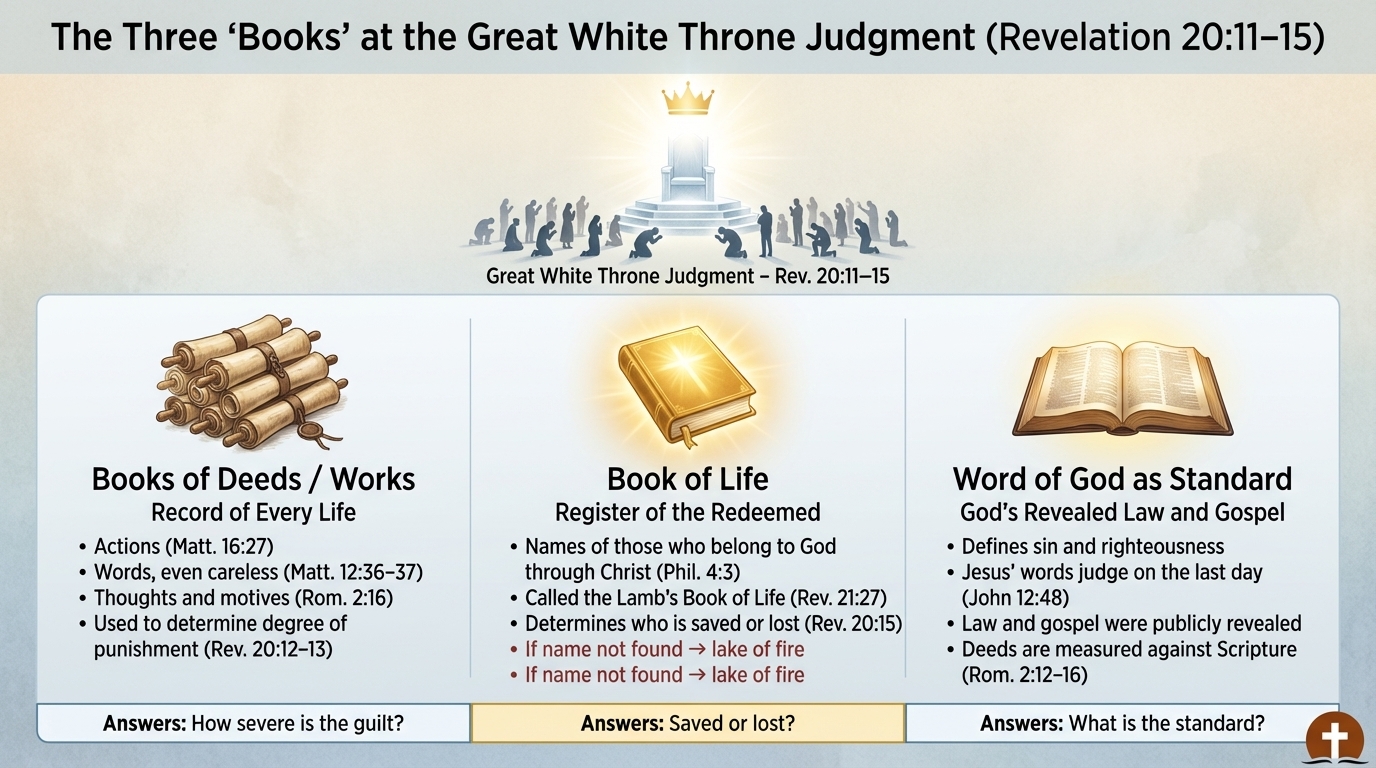
From this passage and related Scriptures, we can identify three primary categories:
| Book / Books | Primary Content | Main Function in Judgment |
|---|---|---|
| Books of deeds/works | Every thought, word, and action of each unbeliever | Establish guilt, determine degree of punishment |
| Book of Life | Names of all who belong to God through Christ | Confirm absence of the defendant’s name; basis of final destiny |
| Word of God (as a standard) | God’s revealed law and gospel (Scripture) | Provides the standard by which deeds are measured |
The Great White Throne Judgment is therefore a documented, evidence-based judgment. God does not judge on impulse; He judges by the written record.
3. The Books of Deeds: Record of Every Life
3.1 Identity and biblical basis
In Revelation 20:12–13, John writes:
“And the dead were judged by what was written in the books, according to what they had done.… And they were judged, each one of them, according to what they had done.”
These “books” (plural) are best understood as God’s exhaustive record of every unsaved person’s life. Other Scriptures support this concept:
- Ecclesiastes 12:14: “God will bring every deed into judgment, with every secret thing, whether good or evil.”
- Romans 2:16: God “judges the secrets of men by Christ Jesus.”
- Luke 8:17: “Nothing is hidden that will not be made manifest.”
From these texts, we infer that the books of deeds contain:
- Actions – external behavior and conduct (Matthew 16:27).
- Words – every spoken word, including “careless words” (Matthew 12:36–37).
- Thoughts and motives – inner attitudes and intentions (Romans 2:16).
3.2 Purpose: basis and degree of judgment
These books are not opened to decide whether a person is saved—that issue is determined solely by the Book of Life (see below). The books of deeds serve two tightly related purposes:
-
To vindicate the sentence of condemnation
The record will demonstrate that every person standing there has truly “fallen short of the glory of God” (Romans 3:23). God’s judgment will be seen to be perfectly just, based on an accurate, unaltered record. -
To determine the degree of punishment in hell
Scripture indicates degrees of punishment:- Jesus speaks of “more tolerable” judgment for some than for others (Matthew 11:20–24).
- He distinguishes between a “severe beating” and a “light beating” (Luke 12:47–48).
- Revelation 20:12–13 twice stresses that judgment is “according to what they had done.”
Thus, at the Great White Throne, the books of works will be opened not to see who goes to hell, but to determine how hell will be experienced by each individual. Those who sinned more grievously, or rejected greater light and privilege, will face correspondingly greater punishment.
3.3 The moral logic of the books of deeds
The books of deeds demonstrate several truths:
- No sin is forgotten – Every act, word, and motive is preserved before God (Daniel 7:10).
- No sinner is misjudged – The verdict rests on recorded evidence, not arbitrary divine whim.
- No excuse stands – Because the record is accurate and complete, no one can credibly protest, “I am being treated unfairly.”
In short, the books of deeds show what each person actually did in response to God’s revelation and law, and why God’s sentence is just.
4. The Book of Life: Register of the Redeemed
4.1 Definition and development in Scripture
In contrast to the plural “books” of deeds, Revelation 20:12 mentions “another book… which is the book of life.” This singular book is God’s heavenly registry of those who belong to Him.
Biblical references include:
- Exodus 32:32–33 – A “book” from which names can be blotted out.
- Psalm 69:28 – “Let them be blotted out of the book of the living.”
- Philippians 4:3 – Co-workers “whose names are in the book of life.”
- Revelation 3:5; 13:8; 17:8; 20:12, 15; 21:27 – Repeated references to the book of life, especially “the Lamb’s book of life” (Revelation 21:27).
In Revelation especially, the Book of Life is bound up with the Lamb (Christ) and His atoning work. It contains the names of all who are saved through Him.
4.2 Function at the Great White Throne
At the Great White Throne Judgment, the Book of Life has a crucial but narrowly defined role:
“And if anyone’s name was not found written in the book of life, he was thrown into the lake of fire.” — Revelation 20:15
Key implications:
- The decisive question of destiny is not, “How many good works did you do?” but “Is your name written in the Book of Life?”
- Everyone standing at this judgment is there because they are unsaved; still, the Book of Life is opened to publicly confirm that their names are absent.
- The lake of fire (the second death) is the inevitable outcome for all whose names are not in this book, regardless of how moral or religious they appeared in this life.
The Book of Life therefore answers who is condemned; the books of deeds answer how justly and to what degree they are condemned.
4.3 Book of Life vs. books of deeds
This relationship can be summarized:
| Question | Answered by | Result |
|---|---|---|
| Is this person saved or lost? | Book of Life | If not found, person is consigned to the lake of fire |
| How serious is this person’s guilt and what degree of punishment is just? | Books of deeds | Determines severity of eternal punishment |
In salvation, grace (through Christ) is everything; in final judgment, works determine the measure (not the fact) of condemnation.
5. The Word of God as the Standard of Judgment
While Revelation 20 does not explicitly call Scripture a “book” used at the Great White Throne, other passages indicate that God’s revealed Word is the standard by which the books of deeds are evaluated.
Jesus said:
“The one who rejects me and does not receive my words has a judge; the word that I have spoken will judge him on the last day.” — John 12:48
This implies:
- God does not judge according to a secret or arbitrary code.
- The same Word that offered salvation in this age becomes the standard of judgment in the next.
- The Ten Commandments, the moral law, and the gospel call all stand as published, knowable standards against which the recorded deeds will be measured.
In that sense, the Bible itself functions as a “book” of judgment: it defines sin, reveals God’s holiness, and proclaims the only way of salvation. At the Great White Throne, no one can credibly claim ignorance of God’s moral demands (Romans 1:18–20; 2:12–16).
6. How the Books Determine Judgment
Bringing these strands together, we can outline the logic of the Great White Throne Judgment in terms of the books opened:
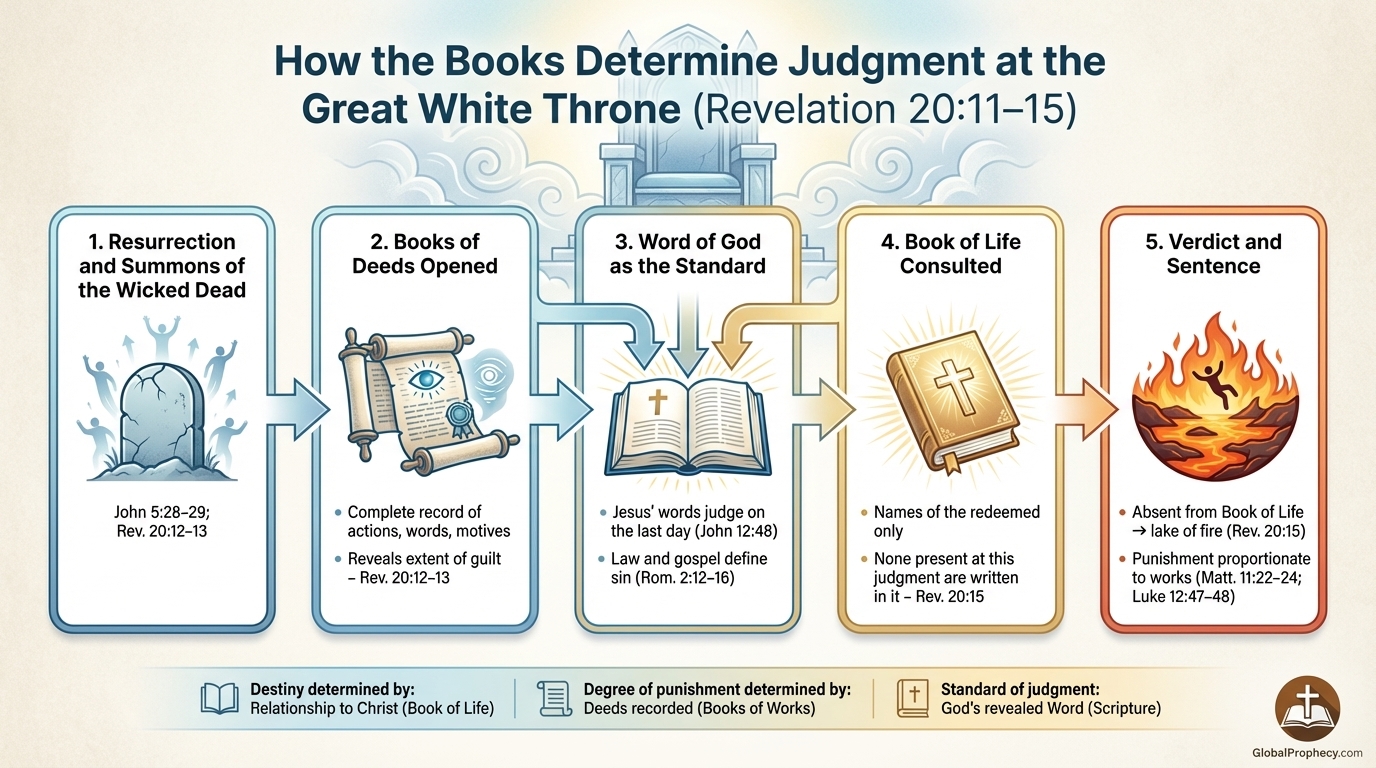
- The Judge (Christ) summons the wicked dead (Revelation 20:12–13; John 5:28–29).
- The books of deeds are opened
- They display a complete record of each person’s life—actions, words, motives.
- They establish the reality and extent of personal guilt.
- The Word of God functions as the standard
- It defines what is righteous and what is sin.
- Each deed is measured against this perfect standard.
- The Book of Life is consulted
- It reveals that no one present at this judgment has his or her name recorded there.
- This confirms that each individual remains in their sins, never having received Christ.
- The verdict is announced and the sentence executed
- Because their names are absent from the Book of Life, they are cast into the lake of fire (Revelation 20:15).
- Because their deeds have been weighed, they experience punishment proportionate to their guilt (Revelation 20:12–13; Matthew 11:22–24; Luke 12:47–48).
Thus, the books opened at the Great White Throne Judgment ensure that:
- Destiny is determined by relationship to Christ (presence or absence in the Book of Life).
- Degree of punishment is determined by recorded deeds (books of works).
- The standard is God’s revealed Word (no arbitrary or unknown law).
God’s justice is therefore transparent, documented, and perfectly righteous.
7. Conclusion
The image of books opened at the Great White Throne Judgment portrays more than a dramatic courtroom scene; it reveals the moral structure of God’s universe.
- The Book of Life shows that salvation is entirely by grace through Jesus Christ. Those whose names are written there never appear at this terrifying judgment.
- The books of deeds show that no sin is forgotten and no sinner is misjudged. They ensure that the punishment of hell is proportionate, not random.
- The Word of God as the standard of judgment shows that God’s requirements have been clearly revealed; mankind is without excuse.
For the believer, these truths magnify the grace of God in Christ, who bore our judgment and secured our place in the Lamb’s Book of Life. For the unbeliever, they are a sober warning: there is a perfect record, a holy standard, and an unavoidable day when the books will be opened.
Now is the only time when that record can be wiped clean—through repentance and faith in the Lord Jesus Christ, whose blood alone can blot out the charges written against us and secure our name forever in His Book of Life.
FAQ
Q: What are the “books” opened at the Great White Throne Judgment?
The “books” in Revelation 20:12 are God’s complete records of each unbeliever’s life—every action, word, thought, and motive. These books are opened to demonstrate each person’s guilt and to determine the degree of punishment in the lake of fire. They do not decide whether someone is saved, but how justly and severely they are judged.
Q: What is the Book of Life, and how does it affect the final judgment?
The Book of Life is God’s registry of all who belong to Him through faith in Jesus Christ (Philippians 4:3; Revelation 21:27). At the Great White Throne, anyone not found written in the Book of Life is thrown into the lake of fire (Revelation 20:15). Presence in this book determines eternal life; absence from it results in eternal separation from God.
Q: How do the books at the Great White Throne Judgment determine degrees of punishment?
Because the dead are judged “according to what they had done” (Revelation 20:12–13), the books of deeds provide the factual basis for graded punishment. Passages like Matthew 11:22–24 and Luke 12:47–48 indicate some will receive “more tolerable” judgment or a “severe” versus a “light” beating. Thus, the books ensure that hell is perfectly just, with punishment proportionate to a person’s sin and rejection of light.
Q: Are believers ever judged by these books?
Believers will never stand at the Great White Throne Judgment. Their sins were judged at the cross, and their names are written in the Lamb’s Book of Life. Christians will appear instead before the judgment seat of Christ (2 Corinthians 5:10), where their works are evaluated for reward, not condemnation.
Q: Is the Bible itself part of the books used in judgment?
While Revelation 20 does not name Scripture as one of the “books,” Jesus teaches that His Word will judge people “on the last day” (John 12:48). This means the Word of God functions as the standard of judgment: the books of deeds record what people did; Scripture defines whether those deeds were righteous or sinful.
Frequently Asked Questions
What are the “books” opened at the Great White Throne Judgment?
What is the Book of Life, and how does it affect the final judgment?
How do the books at the Great White Throne Judgment determine degrees of punishment?
Are believers ever judged by these books?
Is the Bible itself part of the books used in judgment?
L. A. C.
Theologian specializing in eschatology, committed to helping believers understand God's prophetic Word.
Related Articles
What is the Great White Throne Judgment?
Great White Throne Judgment: final judgment of all unbelievers in Revelation 20:11-15, when the dead are raised, judged by works, and cast into the lake of fire.
The Great White Throne vs. The Judgment Seat of Christ
Great White Throne vs. Judgment Seat of Christ: compare who is judged, when each occurs, and how their distinct purposes shape every believer’s eternal outlook.
The Lake of Fire Explained
The lake of fire is the final eternal destination for the unrighteous. Discover what Scripture reveals about this place of judgment and who will be cast there.
Who Will Be Judged at the Great White Throne?
Great White Throne judgment explained: discover who will stand before this final judgment and why it involves all resurrected unbelievers from every age.