
Building for Eternity: Gold, Silver, and Precious Stones
1. Introduction
To “build for eternity” is one of the central images Paul uses to describe the Christian life. In 1 Corinthians 3:10–15 he contrasts gold, silver, and precious stones with wood, hay, and straw, showing that not all Christian work is of equal value before God. This passage is foundational for understanding the Judgment Seat of Christ, the doctrine of eternal rewards, and the difference between what endures forever and what will be burned away.
This article explains 1 Corinthians 3:10–15 and explores what it means, in practical terms, to build your life and ministry with materials that last for eternity.
"Now if anyone builds on the foundation with gold, silver, precious stones, wood, hay, straw—each one's work will become manifest, for the Day will disclose it, because it will be revealed by fire, and the fire will test what sort of work each one has done."
— 1 Corinthians 3:12–13 (ESV)
2. The Context of 1 Corinthians 3:10–15
In 1 Corinthians 3, Paul addresses divisions in the church at Corinth and explains Christian ministry using the metaphor of a building.
2.1 The Foundation: Jesus Christ
Paul begins with a non‑negotiable truth:
"For no one can lay a foundation other than that which is laid, which is Jesus Christ."
— 1 Corinthians 3:11
The foundation is Christ Himself—His person and saving work. This means:
- Salvation is already settled for the believer.
- The issue in this passage is not whether someone is saved, but how they build after salvation.
- All true Christian service must rest on Christ alone, not on human wisdom, moralism, or religious tradition.
2.2 The Builders: All Believers
Paul first applies the image to himself and other leaders (1 Cor 3:10), but the principle clearly widens to each believer:
"Now if anyone builds on the foundation..." (v. 12)
"Each one's work will become manifest..." (v. 13)
Every Christian, not just pastors, is a builder. Through choices, priorities, words, relationships, ministries, and use of resources, each believer is constructing a life on the foundation of Christ.
3. The Two Categories of Building Materials
Paul lists two triads of materials:
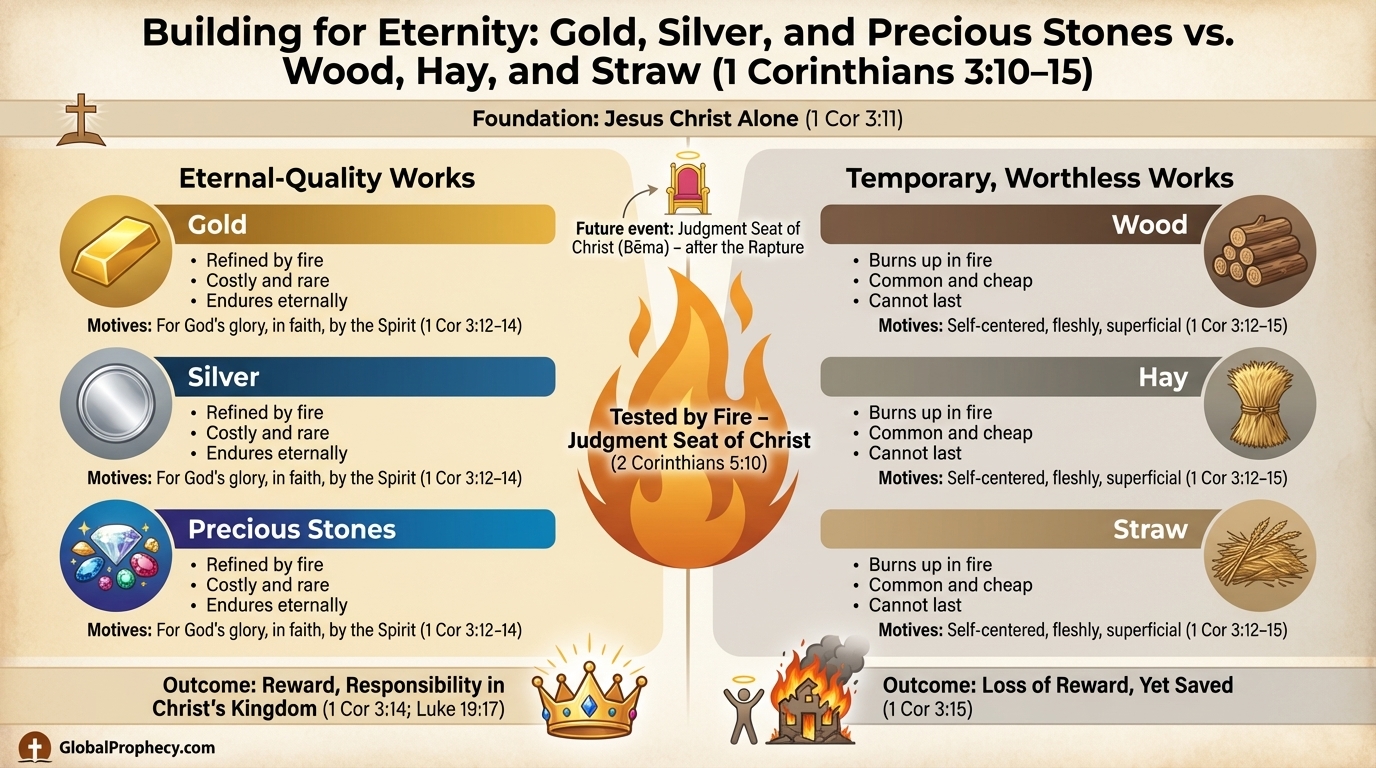
- Gold, silver, precious stones
- Wood, hay, straw
These represent two fundamentally different qualities of work, not different amounts of work.
3.1 Comparison of the Materials
| Feature | Gold, Silver, Precious Stones | Wood, Hay, Straw |
|---|---|---|
| Durability in fire | Indestructible, refined, improved by fire | Combustible, consumed by fire |
| Value | Intrinsically valuable, costly | Common, cheap, readily available |
| Symbolic of | Spirit‑empowered, Christ‑centered service | Fleshly, self‑centered, superficial work |
| Motives | God’s glory, love, obedience, faith | Self‑promotion, routine, wrong motives |
| Eternal outcome | Rewardable, remains forever | Unrewardable, lost forever |
Paul’s primary concern is quality, not visibility. A very public ministry can be wood and straw; a hidden act of faithfulness can be gold.
3.2 Gold, Silver, and Precious Stones: Eternal‑Quality Works
While Paul does not explicitly define each material, the wider context of Scripture suggests:
- Gold often symbolizes the glory of God and what is done for Him alone (cf. Exodus 25; 1 Cor 10:31).
- Silver is associated with redemption, pointing to evangelism and gospel‑centered service (cf. Leviticus 27).
- Precious stones suggest the rich variety of Spirit‑produced righteousness, “the righteous deeds of the saints” (Rev 19:8).
In essence, gold, silver, and precious stones represent:
- Works flowing from faith and dependence on the Holy Spirit.
- Actions grounded in sound doctrine and obedience to Scripture.
- Service done for Christ’s glory, not human applause.
- Ministry aligned with the gospel and the edification of the church.
3.3 Wood, Hay, and Straw: Temporary, Worthless Works
These cheaper, fragile materials picture Christian activity that may appear impressive but lacks eternal worth:
- Done in self‑effort, not dependence on the Spirit.
- Driven by pride, tradition, or pressure, not love for Christ.
- Focused on numbers, image, or comfort, rather than truth and holiness.
- Morally neutral or even “good” in human eyes, yet misdirected or wrongly motivated.
These are not necessarily gross outward sins; often they are “bad good works”—externally acceptable but internally corrupt (cf. 1 Cor 4:5; Heb 4:13).
4. The Fire Test: The Judgment Seat of Christ
Paul says:
"For the Day will disclose it, because it will be revealed by fire, and the fire will test what sort of work each one has done."
— 1 Corinthians 3:13
4.1 “The Day” and the Judgment Seat of Christ
“The Day” refers to the future moment when believers stand before Christ at His Judgment Seat (Greek bēma), as described in:
- 2 Corinthians 5:10 — “For we must all appear before the judgment seat of Christ…”
- Romans 14:10–12 — “each of us will give an account of himself to God.”
From an eschatological perspective, this judgment occurs after the Rapture, in heaven, and is only for believers. It is a judgment of works for reward, not of sin for condemnation (cf. John 5:24; Romans 8:1).
4.2 The Nature of the Fire
The “fire” in 1 Corinthians 3 is a vivid image of Christ’s holy and penetrating evaluation:
- It is not purgatorial fire paying for sin; Christ has already borne all punishment.
- It is a testing fire that exposes and reveals “what sort of work each one has done” (v. 13).
- It burns away all that is worthless, leaving only what aligns with God’s character and purposes.
In other words, the fire symbolizes the perfect scrutiny of Christ, who knows not only what we did, but why we did it (1 Cor 4:5; Rev 2:23).
5. Reward and Loss: Saved, Yet as Through Fire
Paul describes two distinct outcomes:
"If the work that anyone has built on the foundation survives, he will receive a reward."
— 1 Corinthians 3:14
"If anyone's work is burned up, he will suffer loss, though he himself will be saved, but only as through fire."
— 1 Corinthians 3:15
5.1 Receiving Reward
When gold, silver, and precious stones remain after the fire test:
- The believer “will receive a reward”.
- Rewards are portrayed elsewhere as crowns, inheritance, and responsibility in Christ’s kingdom (cf. 1 Cor 9:25; 2 Tim 4:8; Luke 19:11–27; Col 3:23–24).
Rewards are:
- Gracious, yet merit-based: they recognize what Christ accomplished through us as we walked by the Spirit.
- Eternal: they relate to our capacity for service, joy, and glory in the millennial and eternal kingdom.
5.2 Suffering Loss, Yet Saved
When a believer’s work is primarily wood, hay, and straw:
- “He will suffer loss” — loss of what could have been:
- Lost rewards, lost opportunities, diminished capacity to glorify God in the age to come.
- “But he himself will be saved” — salvation is not in question.
- “Yet so as through fire” — like someone escaping a burning building with nothing but his life.
This verse definitively separates justification (our standing in Christ) from reward (God’s evaluation of our service). A believer may enter heaven with no enduring fruit; he will be there by grace, but with little to present to Christ.
6. What It Means to Build for Eternity Today
To build with gold, silver, and precious stones is to live in such a way that your works are aligned with eternity. 1 Corinthians 3:10–15 gives several practical implications.
6.1 Build Carefully, Not Carelessly
Paul warns:
"But each one must be careful how he builds upon it."
— 1 Corinthians 3:10 (emphasis added)
Careful building involves:
- Doctrinal care: making sure our teaching and beliefs conform to Scripture, not to cultural trends or human wisdom.
- Ethical integrity: refusing ministry methods that compromise holiness for “success.”
- Intentional discipleship: focusing on spiritual maturity, not just activity or attendance.
6.2 Prioritize Motives, Not Mere Activity
Christ will “disclose the purposes of the heart” (1 Cor 4:5). Two believers can perform the same visible action, yet one builds with gold and the other with straw, depending on:
- Whether the action springs from love for Christ or from a desire for recognition.
- Whether it is done in dependence on the Spirit or in self‑reliance.
- Whether it aims at God’s glory and the good of others, or at self‑advancement.
Building for eternity requires constant heart examination in light of the gospel.
6.3 Invest in What Cannot Burn
Some aspects of Christian service have inherent eternal dimensions:
- God’s Word — “the word of the Lord remains forever” (1 Pet 1:25).
- People’s souls — evangelism, discipleship, and pastoral care.
- Christlike character — the fruit of the Spirit (Gal 5:22–23).
- Prayer, worship, and obedience — offerings pleasing to God (Heb 13:15–16).
When your time, energy, and resources are channeled into these, you are building with materials that cannot be consumed.
6.4 Serve with the Judgment Seat in View
Paul ties his whole ministry to this future evaluation:
"So whether we are at home or away, we make it our aim to please him. For we must all appear before the judgment seat of Christ..."
— 2 Corinthians 5:9–10
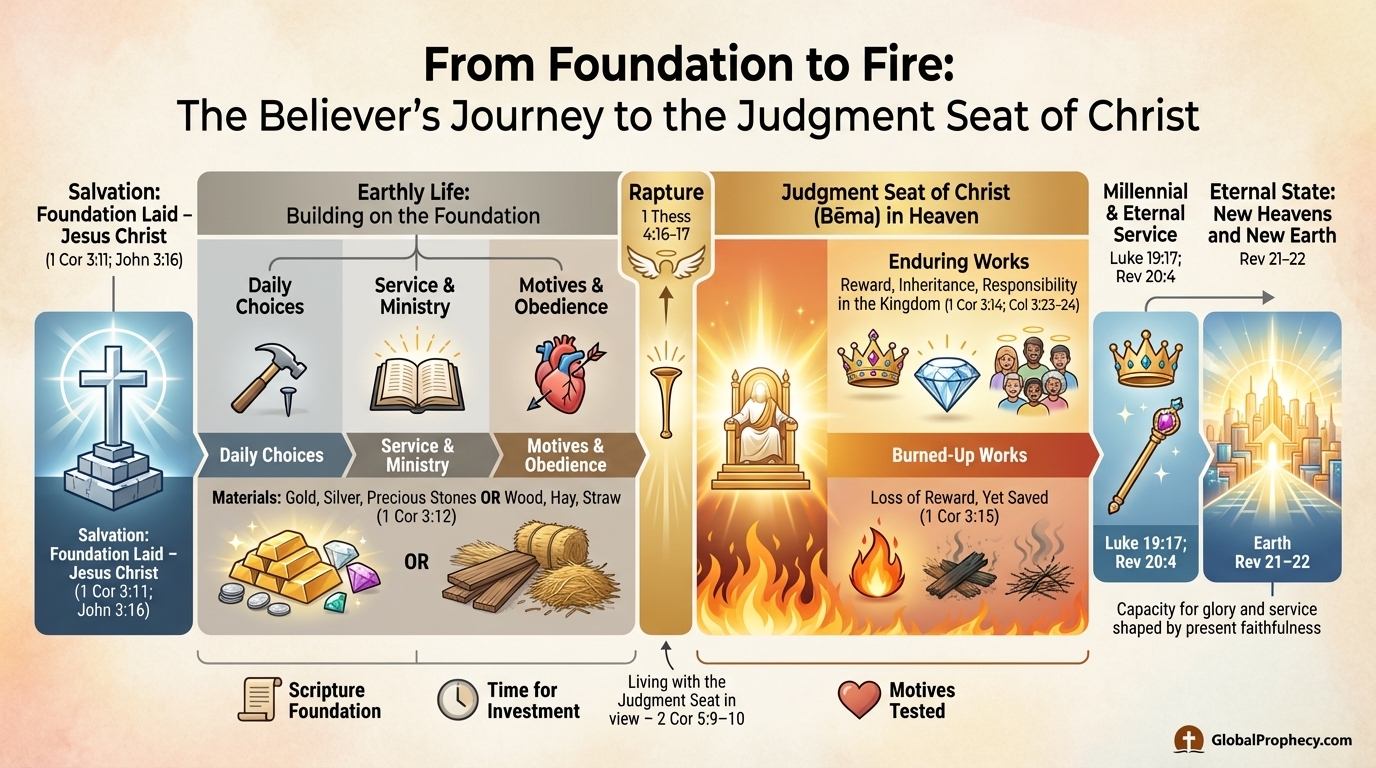
The certainty of the Judgment Seat of Christ should:
- Motivate holy ambition: “we make it our aim to please him.”
- Sober us: there will be real loss for wasted opportunities and misdirected service.
- Comfort us: nothing done for Christ in faith and love is ever forgotten.
Living coram Deo—before the face of God—means measuring success not by present applause but by future fire.
7. Conclusion
1 Corinthians 3:10–15 calls every believer to take seriously the way we build on the foundation of Jesus Christ. The contrast between gold, silver, and precious stones and wood, hay, and straw is not poetic decoration; it is a divine warning and invitation.
- The foundation (Christ) is secure for all who believe.
- The superstructure (our works) will be tested by Christ’s holy fire.
- Some works will remain and be richly rewarded; others will vanish in an instant.
To build for eternity is to labor, by the Spirit, in alignment with God’s Word, for God’s glory, with pure motives, focusing on what will still matter when all temporary things have burned away. One day, when your life’s work passes through the fire at the Judgment Seat of Christ, the question will not be how much you built, but what sort of work you built—and for whom.
FAQ
Q: What does it mean to build with “gold, silver, and precious stones” in 1 Corinthians 3?
It means to live and serve in ways that are Spirit‑empowered, Christ‑centered, and aligned with Scripture. These are works done in faith, love, and obedience for God’s glory, which will endure Christ’s testing fire and be rewarded eternally.
Q: Are “wood, hay, and straw” sinful works, or just wasted effort?
They primarily picture worthless or misdirected works—actions done in self‑effort, for wrong motives, or according to human wisdom rather than God’s Word. They may look good outwardly, but they lack eternal value and will be burned up at the Judgment Seat of Christ.
Q: Does 1 Corinthians 3:10–15 teach that a believer can lose salvation?
No. Paul explicitly says, “he himself will be saved, but only as through fire” (1 Cor 3:15). Salvation rests on the foundation, which is Jesus Christ. What can be lost is reward, not eternal life.
Q: How can I know if I’m building for eternity or just with “wood, hay, and straw”?
Ask: Am I acting according to God’s Word? Am I relying on the Holy Spirit, or on my own strength? Are my motives centered on Christ’s glory or on myself? Is my service focused on what God values eternally—His truth, His people, His gospel, His holiness?
Q: Why does building with gold, silver, and precious stones matter if I am already going to heaven?
Because Scripture teaches that your present obedience shapes your eternal reward, responsibility, and capacity for glory and service in Christ’s kingdom (2 Cor 5:10; Col 3:23–24). You cannot lose heaven if you are in Christ, but you can arrive with little to show for a redeemed life that could have counted much more for eternity.
Frequently Asked Questions
What does it mean to build with “gold, silver, and precious stones” in 1 Corinthians 3?
Are “wood, hay, and straw” sinful works, or just wasted effort?
Does 1 Corinthians 3:10–15 teach that a believer can lose salvation?
How can I know if I’m building for eternity or just with “wood, hay, and straw”?
Why does building with gold, silver, and precious stones matter if I am already going to heaven?
L. A. C.
Theologian specializing in eschatology, committed to helping believers understand God's prophetic Word.
Related Articles
Loss of Reward: Can Christians Lose Their Crowns?
Loss of reward in eschatology: explore if Christians can lose heavenly crowns while never losing salvation, and how faithful service impacts eternity.
The Crowns of Heaven: Eternal Rewards for Believers
Discover the five eternal crowns believers can receive as rewards in heaven. Learn what Scripture teaches about earning the imperishable, rejoicing, righteousness, glory, and life crowns.
What is the Judgment Seat of Christ?
Judgment Seat of Christ explained from 2 Corinthians 5:10 and Romans 14:10—when believers are evaluated for rewards, not condemned for sin.