
The Campaign of Armageddon
1. Introduction
The campaign of Armageddon is the climactic war at the end of the future seven‑year Tribulation, immediately preceding the second coming of Jesus Christ. Contrary to popular language about the “Battle of Armageddon,” Scripture portrays Armageddon as a military campaign—an extended war made up of several interrelated battles across the land of Israel.
The key texts include Daniel 11:40–45; Joel 3:9–17; Zechariah 12–14; Revelation 14:14–20; 16:12–16; 17–19. Together they describe how the armies of the world converge on Israel, ravage Jerusalem, threaten a Jewish remnant in the wilderness, and are finally destroyed by the returning Messiah.
This article traces the sequence of battles in the campaign of Armageddon, showing how the war unfolds geographically and chronologically.
2. Armageddon: War, Not a Single Battle
In Revelation 16:14, demonic spirits gather “the kings of the whole world… for battle on the great day of God the Almighty.” The Greek word for “battle” here is polemos, which usually means war or campaign, not a single skirmish. The word “Armageddon” appears in Revelation 16:16:
“And they assembled them at the place that in Hebrew is called Armageddon.” — Revelation 16:16
Armageddon (Har‑Megiddo) refers to the hill of Megiddo in northern Israel overlooking the Plain of Esdraelon (Valley of Jezreel). Yet the biblical data make clear that the fighting stretches far beyond Megiddo and occurs in multiple stages:
- from Megiddo in the north
- through Jerusalem in the center
- down to Bozrah/Edom (near Petra) in the south
This wide theater of operations, plus the variety of distinct military movements, supports understanding Armageddon as a multi‑phase campaign rather than a single decisive clash.
3. Geographic Scope and Main Battlefields
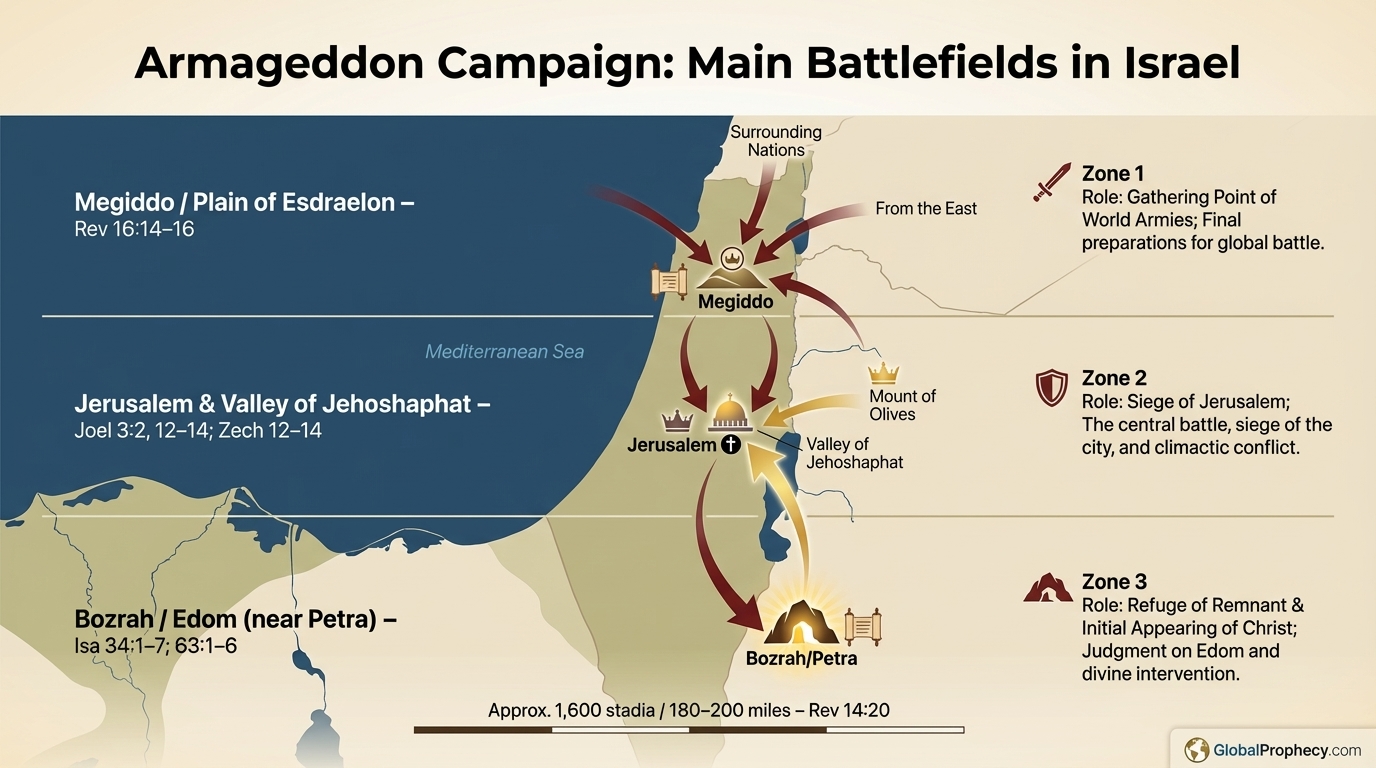
The campaign of Armageddon covers much of the land of Israel—roughly 180–200 miles (about 300 km) north to south. Scripture highlights three primary zones of conflict.
-
The Plain of Esdraelon / Valley of Megiddo (Rev 16:14–16)
- Gathering point for the world’s armies under the Antichrist
- Described as the place called “Armageddon”
- Historically a major battlefield (Judges 4; 7)
-
Jerusalem and the Valley of Jehoshaphat (Kidron Valley) (Joel 3:2, 12–14; Zech 12–14)
- Jerusalem becomes the focal point of the siege
- The “Valley of Jehoshaphat” (likely the Kidron Valley) is where God judges the nations:
“I will gather all the nations and bring them down to the Valley of Jehoshaphat. And I will enter into judgment with them there…”
— Joel 3:2
-
Bozrah / Edom (near Petra) (Isa 34:1–7; 63:1–6)
- Site in Edom (modern southern Jordan) where a Jewish remnant is sheltered
- Christ returns there to deliver them; His garments are stained with the blood of His enemies.
These locations are tied together in a single, escalating war that unfolds in identifiable phases.
4. The Phases of the Campaign of Armageddon
While Scripture does not give a single, unified narrative, comparing the relevant passages allows a synthetic chronology of Armageddon as a sequence of battles.
4.1 Overview Table: Phases of the Armageddon Campaign
| Phase | Main Event | Key Texts | Primary Location |
|---|---|---|---|
| 1 | Drying of Euphrates; global armies assemble | Rev 16:12–16 | From East toward Armageddon |
| 2 | Destruction of rebuilt Babylon | Jer 50–51; Isa 13; Rev 17–18 | Babylon (Mesopotamia) |
| 3 | Fall and ravaging of Jerusalem | Zech 12:1–3; 14:1–2; Mic 4:11–5:1 | Jerusalem |
| 4 | Antichrist advances against Jewish remnant in wilderness | Matt 24:15–21; Rev 12:6, 14; Mic 2:12 | Bozrah/Petra region |
| 5 | National repentance and regeneration of Israel | Hos 5:15–6:3; Zech 12:10–13:1; Rom 11:25–27 | Among the Jewish remnant |
| 6 | Second coming of Christ (appearing at Bozrah) | Isa 34:1–7; 63:1–6; Hab 3:3; Rev 19:11–16 | Bozrah/Edom |
| 7 | Destruction of Antichrist’s forces from Bozrah to Jerusalem / Armageddon | Joel 3:12–16; Zech 14:12–15; Rev 14:17–20; 19:17–21 | Edom, Judean wilderness, Jerusalem, Megiddo |
| 8 | Christ stands on the Mount of Olives; final seismic judgments | Zech 14:3–5; Rev 16:17–21 | Mount of Olives, global impact |
The following sections briefly explain each phase as part of the overall war of Armageddon.
4.2 Phase 1: The Euphrates Dries Up and the Armies Assemble
The campaign begins with a massive mobilization:
“The sixth angel poured out his bowl on the great river Euphrates, and its water was dried up, to prepare the way for the kings from the east.”
— Revelation 16:12
Demonic spirits go out from Satan, the Beast, and the False Prophet to “assemble them for battle on the great day of God the Almighty” (Rev 16:14). The armies move toward Armageddon (Megiddo) as a staging ground. This mobilization is global in scope: “the kings of the whole world” are drawn into the war.
The stated human objective at this point is the destruction of Israel, especially the Jews who have resisted the Antichrist. Spiritually, however, God is drawing the nations into His “winepress” of judgment.
4.3 Phase 2: The Destruction of Rebuilt Babylon
While the Antichrist’s coalition assembles, Scripture indicates a sudden judgment on his commercial-religious capital, Babylon (likely in Mesopotamia):
“Because of the wrath of the LORD she shall not be inhabited but shall be an utter desolation… As when God overthrew Sodom and Gomorrah… so no man shall dwell there.”
— Jeremiah 50:13, 40
Isaiah 13; Jeremiah 50–51; Revelation 17–18 together portray a final, catastrophic destruction of Babylon. Though this judgment is closely associated with the end of the Tribulation, it is best understood as one phase within the larger Armageddon campaign: while the Antichrist prepares to crush Israel, God strikes his city.
Yet this blow does not divert the Antichrist from his central war aim. Instead of turning back to save Babylon, he drives south toward Jerusalem.
4.4 Phase 3: The Fall and Ravaging of Jerusalem
The next major battlefront is Jerusalem:
“I will gather all the nations against Jerusalem to battle, and the city shall be taken and the houses plundered and the women raped. Half of the city shall go out into exile, but the rest of the people shall not be cut off from the city.”
— Zechariah 14:2
Armies gathered from across the world (Zech 12:3; 14:2) besiege Jerusalem. Although there is fierce Jewish resistance (cf. Micah 4:11–5:1), the city temporarily falls under Gentile control. This is a crucial battle in the Armageddon campaign, not the end of the war. Jerusalem is ravaged, but not annihilated; God preserves a remnant.
4.5 Phase 4: The Advance Against the Wilderness Remnant
Not all Jews are in Jerusalem during this siege. At the mid‑point of the Tribulation, when the Antichrist desecrates the temple, Jesus warned:
“Then let those who are in Judea flee to the mountains.”
— Matthew 24:16
Revelation 12:6, 14 describes “the woman” (Israel) fleeing into the wilderness to a God‑prepared place of protection for 1,260 days (three and a half years). Many interpreters locate this remnant in the rugged region of Bozrah/Petra in Edom.
After taking Jerusalem, the Antichrist pushes further south to crush this remaining pocket of Jewish resistance. This movement sets the stage for the southern front of the Armageddon campaign, where Christ will first intervene.
4.6 Phase 5: National Repentance of Israel
As the encircling forces of the Antichrist threaten annihilation, the Jewish remnant comes to the end of its own resources and finally turns to the true Messiah.
Hosea 5:15–6:3 anticipates this moment:
“Come, let us return to the LORD; for he has torn us, that he may heal us… After two days he will revive us; on the third day he will raise us up, that we may live before him.”
— Hosea 6:1–2
Zechariah 12:10 depicts Israel’s heartfelt repentance:
“I will pour out on the house of David and the inhabitants of Jerusalem a spirit of grace and pleas for mercy, so that, when they look on me, on him whom they have pierced, they shall mourn for him…”
At this point in the Armageddon campaign, Israel is spiritually transformed: the “partial hardening” of Israel (Rom 11:25) is lifted, and “all Israel will be saved” (Rom 11:26). This national turning to Christ is directly connected to the war setting—it occurs under the immediate threat of extermination at the hands of the world’s armies.
4.7 Phase 6: The Second Coming of Christ at Bozrah
Israel’s cry for deliverance is answered by the visible, bodily return of Jesus Christ in power and glory:
“Then will appear in heaven the sign of the Son of Man… and they will see the Son of Man coming on the clouds of heaven with power and great glory.”
— Matthew 24:30
Prophetic passages indicate that Christ first appears in the region of Bozrah/Edom, where the remnant is under siege:
“Who is this who comes from Edom, in crimsoned garments from Bozrah, he who is splendid in his apparel, marching in the greatness of his strength?
‘It is I, speaking in righteousness, mighty to save.’”
— Isaiah 63:1
In Isaiah 34:1–7 and 63:1–6, the Lord is pictured as trampling the nations in the “winepress” of His wrath in Edom, His garments stained with their blood. This is one theater of battle in the Armageddon war, and it marks the decisive turning point: the Messiah Himself enters the campaign as Warrior‑King.
4.8 Phase 7: The Destruction of the Armies from Bozrah to Jerusalem and Megiddo
From Bozrah, Christ’s triumph radiates northward through the land:
- He delivers the remnant in the wilderness.
- He moves toward Jerusalem, confronting the forces gathered there and in the surrounding valleys.
- The slaughter of the assembled armies extends across the land, including the Armageddon staging area near Megiddo.
Revelation 19:11–16 portrays the Messiah as the conquering rider on a white horse:
“From his mouth comes a sharp sword with which to strike down the nations, and he will rule them with a rod of iron. He will tread the winepress of the fury of the wrath of God the Almighty.”
— Revelation 19:15
The winepress imagery connects with Revelation 14:19–20:
“So the angel swung his sickle across the earth and gathered the grape harvest of the earth and threw it into the great winepress of the wrath of God. And the winepress was trodden outside the city, and blood flowed from the winepress, as high as a horse’s bridle, for 1,600 stadia.”
— Revelation 14:19–20
The distance of “1,600 stadia” (about 180–200 miles) corresponds to the length of Israel from Megiddo in the north to Edom/Bozrah in the south—again indicating a campaign, not a point‑battle.
At this stage in the Armageddon sequence:
- The Antichrist (Beast) and False Prophet are captured and thrown alive into the lake of fire (Rev 19:20).
- The armies of the nations are annihilated from Bozrah through Jerusalem to the northern assembly areas (cf. Joel 3:12–16; Zech 14:12–15; Rev 19:17–21).
4.9 Phase 8: The Victorious Ascent to the Mount of Olives and Final Seismic Judgments
The campaign of Armageddon concludes with Christ’s victorious arrival at the Mount of Olives, east of Jerusalem:
“On that day his feet shall stand on the Mount of Olives that lies before Jerusalem on the east, and the Mount of Olives shall be split in two from east to west by a very wide valley…”
— Zechariah 14:4
Simultaneously, the seventh bowl judgment is poured out:
“The seventh angel poured out his bowl into the air, and a loud voice came out of the temple, from the throne, saying, ‘It is done!’ And there were flashes of lightning, rumblings, peals of thunder, and a great earthquake such as there had never been… The great city was split into three parts… And great hailstones, about one hundred pounds each, fell from heaven on people…”
— Revelation 16:17–21
These cataclysmic events:
- Reshape the topography of the region.
- Mark the end of the Tribulation and the completion of the Armageddon war.
- Prepare the stage for the judgment of the nations (Matt 25:31–46) and the inauguration of Christ’s millennial kingdom.
5. Theological Significance of the Armageddon Campaign
Understanding the campaign of Armageddon as a sequence of battles clarifies several theological themes.
-
Judgment of the Nations
The dispersed battles—from Babylon to Bozrah to Jerusalem to Megiddo—demonstrate God’s comprehensive judgment on the rebellious world system. The nations are gathered into His “winepress” (Joel 3:13; Rev 14:19–20). -
Preservation and Salvation of Israel
The military pressure of the campaign is the backdrop for Israel’s national repentance and regeneration (Zech 12:10–13:1; Rom 11:25–27). The same war that threatens Israel with extinction becomes the means by which God finally restores her. -
Vindication of Christ’s Kingship
The Antichrist’s war-making (Rev 13:7; 19:19) is answered by the King of kings, who ends the campaign by the word of His mouth (2 Thess 2:8; Rev 19:15). The sequence of Armageddon battles climaxes in the visible enthronement of Christ as the rightful ruler of the earth. -
Transition to the Millennium
The end of the Armageddon campaign clears away the world’s military and political opposition, removes the Beast and False Prophet from the stage, and ushers in one thousand years of peace under Messiah’s rule (Rev 20:1–6).
6. Conclusion
The campaign of Armageddon is not a single, isolated clash, but a multi‑stage war that spans Israel and its surrounding regions during the closing days of the Tribulation. Beginning with the supernatural gathering of the world’s armies and culminating in Christ’s triumphant descent to the Mount of Olives, the sequence of battles includes:
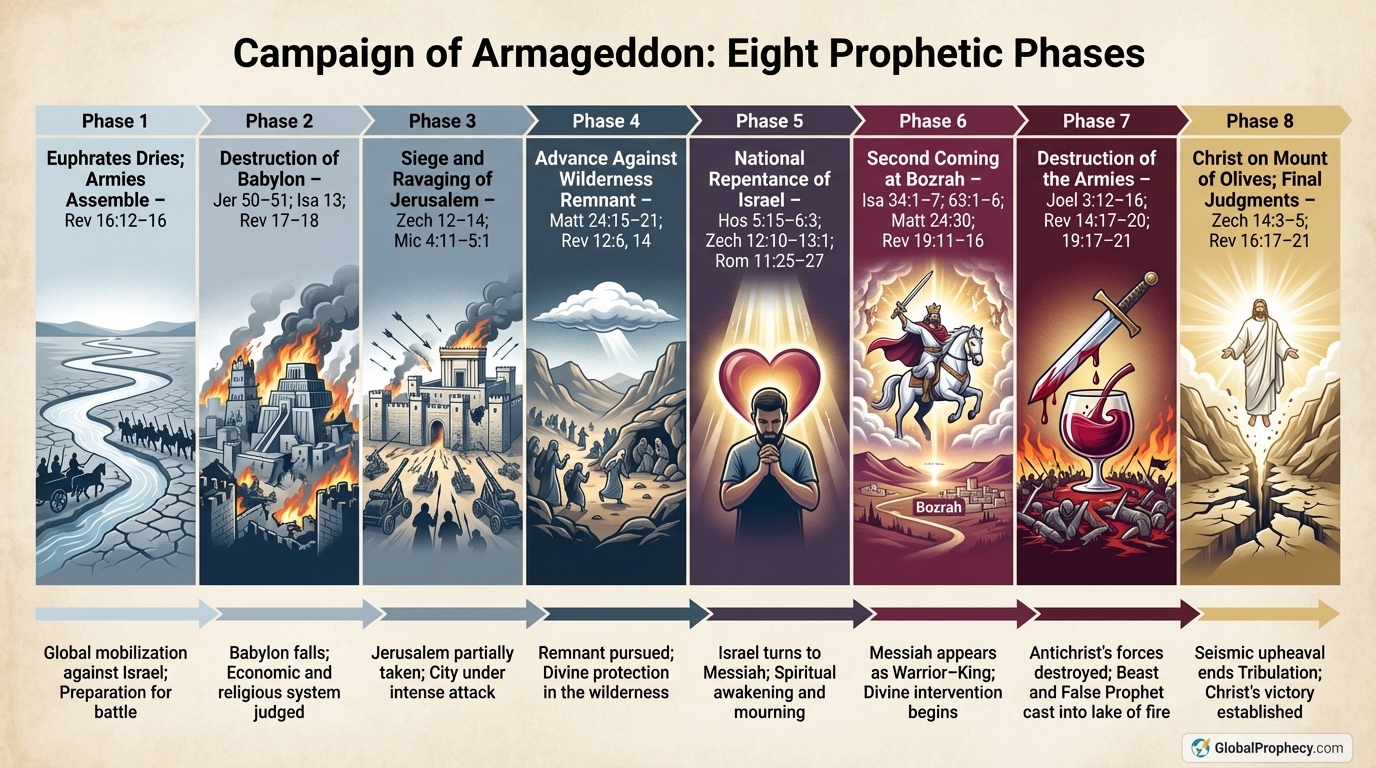
- the assembly of global forces at Armageddon,
- the destruction of Babylon,
- the siege and partial fall of Jerusalem,
- the pursuit of the Jewish remnant in the wilderness,
- Israel’s national repentance,
- the Messiah’s return to Bozrah,
- the annihilation of the Antichrist’s armies across the land,
- and the final seismic transformation accompanying Christ’s feet standing on the Mount of Olives.
Seen as a campaign, Armageddon is the final convergence of human rebellion, satanic opposition, and divine judgment—and the decisive revelation of Jesus Christ as Warrior, Deliverer, and King.
FAQ
Q: Is the Battle of Armageddon just one final battle?
No. The biblical Armageddon is a campaign—a war made up of multiple battles fought in different locations, including Megiddo, Jerusalem, and Bozrah. The Greek term polemos in Revelation 16:14 indicates a war or campaign, not a single skirmish.
Q: Where do the main battles of the Armageddon campaign take place?
The campaign of Armageddon centers in the land of Israel and nearby regions. Key battlefields include the Plain of Esdraelon (Armageddon/Megiddo), Jerusalem and the Valley of Jehoshaphat (Kidron Valley), and Bozrah/Edom near Petra in modern Jordan, where a Jewish remnant is delivered.
Q: How does the campaign of Armageddon end?
The Armageddon campaign ends with the second coming of Christ, who destroys the gathered armies with the word of His mouth and throws the Antichrist and False Prophet alive into the lake of fire (Revelation 19:19–21). He then stands on the Mount of Olives, triggering global seismic upheaval that closes the Tribulation.
Q: What is the role of Israel in the Armageddon war?
Israel is both the primary target and the primary beneficiary of the Armageddon campaign. The nations seek to eradicate the Jewish people, but under this pressure Israel finally repents, believes in Jesus as Messiah, and is delivered and restored (Zechariah 12:10; Romans 11:26).
Q: How does the campaign of Armageddon relate to the Millennium?
The campaign of Armageddon prepares the way for the millennial kingdom. By destroying the world’s military power and removing the Antichrist and False Prophet, Christ ends organized global rebellion and inaugurates a thousand‑year reign of peace and righteousness on earth (Revelation 20:1–6).
Frequently Asked Questions
Is the Battle of Armageddon just one final battle?
Where do the main battles of the Armageddon campaign take place?
How does the campaign of Armageddon end?
What is the role of Israel in the Armageddon war?
How does the campaign of Armageddon relate to the Millennium?
L. A. C.
Theologian specializing in eschatology, committed to helping believers understand God's prophetic Word.
Related Articles
What is the Battle of Armageddon?
Armageddon, the climactic end-times battle, is described in Revelation 16 and 19. Learn what this final conflict is and when it will occur.
The 144,000 Sealed Israelites
144,000 sealed Israelites in Revelation identified and explained—their identity, purpose, and distinct role as preserved witnesses during the Tribulation.
Babylon the Great
Babylon the Great in Revelation 17–18 reveals end-time religious and commercial rebellion against God and its sudden, final destruction in judgment.
What the Bible Says about Antichrist?
Antichrist in the Bible: discover what Scripture reveals about his identity, character, deceptive power, and end-time role in the Tribulation.