
The Campaign of Armageddon vs Gog and Magog
1. Introduction
Among students of biblical eschatology, few subjects generate more confusion than Armageddon vs Gog and Magog. Many assume Ezekiel 38–39 and Revelation 16, 19, and 20 all describe one climactic battle. Careful comparison, however, shows that Scripture presents distinct end-time war campaigns: the Campaign of Armageddon and two separate outbreaks titled Gog and Magog (Ezekiel 38–39; Revelation 20:7–10).
This article offers a focused, text-based comparison, showing why Armageddon and Gog and Magog cannot be collapsed into a single event, and how their differences fit into a coherent premillennial chronology.
2. The Campaign of Armageddon in Biblical Prophecy
2.1 Core Texts and Setting
Armageddon is grounded primarily in:
- Revelation 14:14–20
- Revelation 16:12–16
- Revelation 19:11–21
- With supporting OT passages: Psalm 2; Joel 3:9–17; Zechariah 12:1–9; 14:1–5; Isaiah 34:1–8; 63:1–6; Malachi 4:1–5.
The name “Armageddon” occurs once:
"And they assembled them at the place that in Hebrew is called Armageddon."
— Revelation 16:16
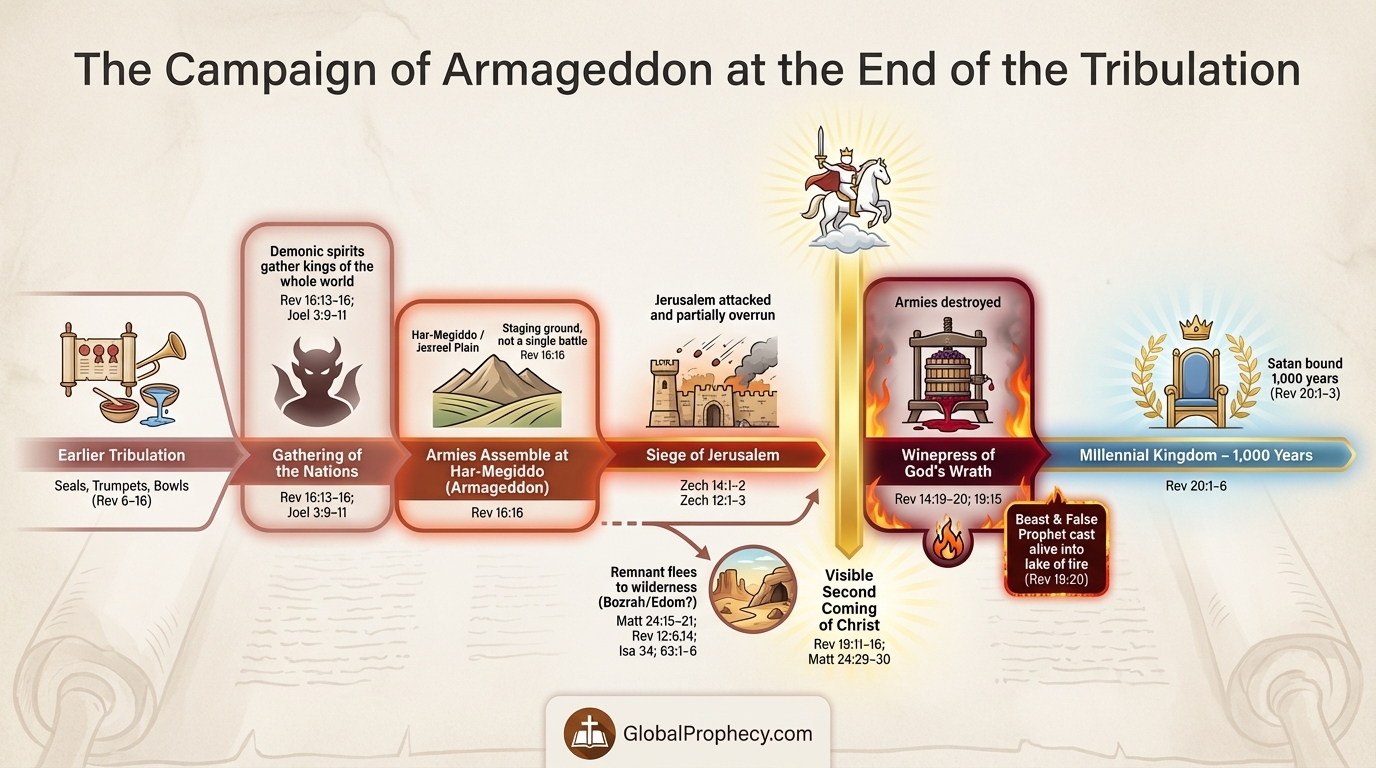
“Armageddon” (Hebrew Har-Megiddo, “Mount of Megiddo”) identifies the Megiddo / Jezreel plain in northern Israel, the staging ground for a campaign that spreads over Israel, not a single skirmish. The Greek word for “war” in Revelation 16:14 is polemos, indicating a war or campaign, not a single battle.
2.2 Essential Features of Armageddon
From the relevant passages, several defining features emerge:
-
Leader of the hostile forces
- The war is spearheaded by the Beast / Antichrist and his global coalition (Revelation 16:13–14; 19:19; cf. Daniel 11:40–45).
-
Object of the gathering
- Initially, the nations are gathered by demonic deception to wage “the war of the great day of God the Almighty” (Revelation 16:14).
- Their immediate earthly objective is Jerusalem and Israel, but as Christ appears, they turn to make war against the returning Christ Himself (Revelation 19:19).
-
Condition of Israel
- Israel is under intense siege and not at peace. Jerusalem is attacked and partially overrun (Zechariah 14:1–2).
- A Jewish remnant is fleeing and hiding, likely in the wilderness region of Bozrah/Edom, awaiting deliverance (Matthew 24:15–21; Revelation 12:6,14; Isaiah 34:1–7; 63:1–6).
-
Participants
- “All the nations of the earth” are gathered against Jerusalem (Zechariah 12:3; 14:2; Revelation 16:14).
- This is a global coalition—not a limited regional confederacy.
-
Time in the prophetic timetable
- Armageddon unfolds at the very end of the Tribulation, immediately preceding the visible second coming of Christ (Revelation 19:11–16; Matthew 24:29–30).
- It climaxes just before the inauguration of the millennial kingdom in Revelation 20:1–6.
-
Outcome and purpose
- Christ descends to rescue Israel and destroy the armies (imagery of treading the winepress of God’s wrath, Revelation 14:19–20; 19:15).
- The Beast and False Prophet are captured and thrown alive into the lake of fire (Revelation 19:20).
- Armageddon serves to judge the nations and prepare the earth for Christ’s 1,000‑year reign.
Crucially for our topic, several key scholars emphasize: Armageddon is not the same as Gog and Magog in Ezekiel 38–39, nor is it the final post‑millennial revolt of Revelation 20.
3. Gog and Magog in Ezekiel 38–39
3.1 Text and Terminology
Ezekiel devotes two full chapters to an invasion:
- Ezekiel 38–39
The leading figure is Gog, of the land of Magog, “the chief prince of Meshech and Tubal” (Ezekiel 38:2–3). He leads a specific northern coalition against Israel “in the latter days” (Ezekiel 38:8,16).
3.2 Essential Features of Gog–Magog in Ezekiel
Key descriptors distinguish this war from Armageddon:
-
Leader and coalition
- The invasion is “led by Gog”, not by the Beast/Antichrist.
- The allies are a limited regional confederation (e.g., Ezekiel 38:5–6), often associated with areas north of Israel and surrounding regions.
-
Condition of Israel
-
Israel is described as “living securely” and “at rest”:
"…the land of unwalled villages, … dwelling without walls and having no bars or gates."
— Ezekiel 38:11 -
This peaceful, unsuspecting state sharply contrasts with the besieged, ravaged Jerusalem of Armageddon.
-
-
Purpose of the invaders
-
Gog’s coalition comes to plunder and seize spoil:
"…you will come from your place out of the uttermost parts of the north… to seize spoil and carry off plunder…"
— Ezekiel 38:15, 12–13 -
The motive is economic and territorial, not explicitly anti‑Messianic as at Armageddon.
-
-
Divine purpose and result
-
God brings Gog against the land:
"I will bring you against my land, that the nations may know me..."
— Ezekiel 38:16 -
The outcome is a dramatic supernatural deliverance of Israel, with God’s name magnified among the nations (Ezekiel 38:23; 39:7).
-
There is detailed description of seven years of burning weapons and seven months of burying the dead (Ezekiel 39:9–12), suggesting a time of continued history on earth after the conflict.
-
-
Timing relative to the Tribulation and Millennium
Dispensational interpreters have differed on the exact placement, but consonant with the distinctions from Armageddon, many place Ezekiel’s Gog–Magog:
- Before the middle of the Tribulation or
- In the earlier part of the Tribulation, when Israel still enjoys a measure of covenantal “peace” (cf. Daniel 9:27)
In any case, Ezekiel 38–39 does not fit the picture of the final, global, Christ‑centered war at the end of the Tribulation.
4. Gog and Magog in Revelation 20: The Final Revolt
Revelation uses the names Gog and Magog a second time:
"And when the thousand years are ended, Satan will be released from his prison and will come out to deceive the nations that are at the four corners of the earth, Gog and Magog, to gather them for battle; their number is like the sand of the sea."
— Revelation 20:7–8
Here the label Gog and Magog functions typologically, evoking Ezekiel’s great northern enemy as a symbol for the final global rebellion after the millennium.
Key points:
-
Timing
- Occurs after the thousand years are ended (Revelation 20:7), one thousand years after Armageddon.
-
Scope and participants
- The revolt involves “the nations… at the four corners of the earth”, not a limited northern coalition.
-
Leader
- The instigator is Satan himself, newly loosed, not Gog or the Beast.
-
Objective and outcome
- The armies surround “the camp of the saints and the beloved city” (Revelation 20:9).
- There is no extended campaign: “fire came down from heaven and consumed them,” and Satan is then cast into the lake of fire (Revelation 20:10).
Revelation 20’s Gog–Magog is therefore not Armageddon extended, but a separate, final revolt after a long period of Christ’s righteous rule.
5. Key Differences: Armageddon vs Gog and Magog
The following table summarizes the core distinctions between the Campaign of Armageddon and Gog–Magog, focusing on Ezekiel 38–39 and Revelation 20:
| Feature | Gog–Magog (Ezekiel 38–39) | Armageddon (Rev 14; 16; 19) | Gog–Magog (Rev 20:7–10) |
|---|---|---|---|
| Leader | Gog of the land of Magog | Beast/Antichrist | Satan released from prison |
| Primary Texts | Ezekiel 38–39 | Revelation 14:14–20; 16:12–16; 19:11–21; Joel 3; Zech 12, 14 | Revelation 20:7–10 |
| Timing | Likely before or early in the Tribulation | End of the Tribulation, just before Christ’s return to reign | After the Millennium, 1,000 years after Armageddon |
| State of Israel | At peace, unwalled villages, secure (Ezek 38:8,11,14) | Under siege and ravaged, Jerusalem partly fallen (Zech 14:1–2) | Israel living in millennial blessing under Christ |
| Purpose of invaders | Plunder and spoil (Ezek 38:12–13) | Destroy Israel and then make war on the Lamb (Rev 19:19) | Final satanic rebellion against Christ’s rule |
| Participants | Regional northern coalition with allies | All nations gathered by demonic spirits (Rev 16:14; Zech 12:3) | All nations from “four corners of the earth” |
| Divine purpose | So nations “will know that I am the LORD” (Ezek 38:23; 39:7) | To judge the nations, end the Beast’s empire, usher in the kingdom | Final exposure and judgment of human rebellion |
| Aftermath | 7 months of burial; 7 years burning weapons (Ezek 39:9–12) | Beast & False Prophet cast alive into lake of fire; Satan bound 1,000 years (Rev 19:20; 20:1–3) | Satan cast into lake of fire (Rev 20:10); then final judgment (Rev 20:11–15) |
These contrasts make it exegetically and theologically untenable to identify Armageddon and Gog–Magog as the same event. They are related by theme (hostile coalitions judged by God) but are distinct in leader, timing, purpose, and outcome.
6. Theological and Chronological Implications
Recognizing the distinction between the Campaign of Armageddon and Gog and Magog clarifies several aspects of biblical eschatology:
-
Armageddon as the climax of the Tribulation, not of all history
- Armageddon is the climactic campaign of the Great Tribulation, not the final war ever. Scripture explicitly places another worldwide revolt, also called Gog and Magog, after the millennium (Revelation 20:7–10).
-
Multiple major wars in the last days
- Scripture portrays at least three major eschatological conflicts:
- The Gog–Magog invasion of Ezekiel 38–39 (pre‑ or mid‑Tribulational context)
- The Campaign of Armageddon (end of the Tribulation)
- The Gog–Magog revolt of Revelation 20 (end of the Millennium)
- Scripture portrays at least three major eschatological conflicts:
-
Different divine goals at each stage
- Ezekiel’s Gog–Magog highlights God’s self‑vindication among the nations and His protection of Israel.
- Armageddon centers on the direct intervention of the returning Christ, the overthrow of the Antichrist, and the establishment of the messianic kingdom.
- Revelation 20’s Gog–Magog demonstrates that even after 1,000 years of perfect rule, humanity apart from grace will still follow Satan, thus justifying the final judgment.
-
Protection of Israel across distinct crises
- In Ezekiel 38–39, God supernaturally destroys Gog’s coalition to protect an apparently secure Israel.
- At Armageddon, Christ Himself returns, delivering a besieged remnant and fulfilling promises of national regeneration (Zechariah 12:10; Romans 11:26–27).
- At the final Gog–Magog, the “beloved city” is again threatened, but quickly vindicated by divine fire.
By keeping Armageddon vs Gog and Magog clearly distinguished, students of prophecy can avoid chronological confusion and better see the ordered unfolding of God’s end-time program.
7. Conclusion
Biblical eschatology presents Armageddon and Gog and Magog as related but distinct events.
- The Campaign of Armageddon is a multi‑phase war at the end of the Tribulation, led by the Antichrist, involving all nations gathered against Israel and ultimately against the returning Christ, culminating in their destruction and the inauguration of the millennial kingdom.
- Gog and Magog in Ezekiel 38–39 describes a northern confederacy led by Gog attacking a secure Israel for plunder, with God’s supernatural intervention magnifying His name among the nations, likely before or in the early stages of the Tribulation.
- Gog and Magog in Revelation 20 is the last, short‑lived revolt of Satan and the nations after the millennium, extinguished by heavenly fire before the final judgment.
These distinctions are not academic trivia; they safeguard the integrity of the prophetic timeline, highlight the repeated faithfulness of God to Israel, and underline the ultimate truth that every hostile coalition—whether led by Gog, the Beast, or Satan himself—ends in defeat before the sovereign Lord and His Christ.
FAQ
Q: Are Armageddon and Gog and Magog the same battle in the Bible?
No. Armageddon is the end‑of‑Tribulation campaign led by the Antichrist against Israel and Christ (Revelation 16; 19), whereas Gog and Magog in Ezekiel 38–39 is a northern invasion for plunder against a secure Israel, and Gog and Magog in Revelation 20:7–10 is a distinct final revolt after the millennium. They differ in leader, timing, participants, purpose, and outcome.
Q: When does the war of Gog and Magog in Ezekiel 38–39 occur in relation to Armageddon?
From a premillennial perspective, Ezekiel’s Gog–Magog war occurs before the Campaign of Armageddon—either shortly before the Tribulation or in its earlier stages while Israel is still described as dwelling securely. Armageddon comes at the close of the seven‑year Tribulation, immediately preceding Christ’s visible return to reign.
Q: What is the difference between Gog and Magog in Ezekiel 38–39 and in Revelation 20?
Ezekiel 38–39 presents a specific northern coalition led by Gog attacking Israel, with long-term cleanup described (seven years burning weapons, seven months burying the dead). Revelation 20:7–10 uses “Gog and Magog” symbolically for a global revolt of all nations at the end of the millennium, instigated by Satan and ended instantly by fire from heaven.
Q: How does understanding Armageddon vs Gog and Magog help in studying Bible prophecy?
Distinguishing these events prevents compressing the entire end‑time program into a single battle and helps maintain the biblical order: an earlier Gog–Magog invasion, the climactic Armageddon campaign at Christ’s coming, and the final Gog–Magog revolt after the millennium. This in turn clarifies God’s repeated protection of Israel and the stages by which He brings history to its ordained conclusion.
Q: Is Armageddon the last war in human history?
Armageddon is the last war of the Tribulation age, but not the final war in all history. According to Revelation 20:7–10, the last war is the post‑millennial Gog and Magog revolt, which occurs after Christ’s 1,000‑year reign and is immediately crushed by divine judgment.
Frequently Asked Questions
Are Armageddon and Gog and Magog the same battle in the Bible?
When does the war of Gog and Magog in Ezekiel 38–39 occur in relation to Armageddon?
What is the difference between Gog and Magog in Ezekiel 38–39 and in Revelation 20?
How does understanding Armageddon vs Gog and Magog help in studying Bible prophecy?
Is Armageddon the last war in human history?
L. A. C.
Theologian specializing in eschatology, committed to helping believers understand God's prophetic Word.
Related Articles
What is the Battle of Armageddon?
Armageddon, the climactic end-times battle, is described in Revelation 16 and 19. Learn what this final conflict is and when it will occur.
The Campaign of Armageddon
Armageddon campaign explained as a prophetic sequence of end-time battles, tracing how the final conflicts unfold across the Tribulation’s climax.
Christ vs Antichrist
Christ vs Antichrist explores their sharp prophetic contrast, revealing how the true Messiah and his counterfeit enemy stand in total opposition.
The Great White Throne vs. The Judgment Seat of Christ
Great White Throne vs. Judgment Seat of Christ: compare who is judged, when each occurs, and how their distinct purposes shape every believer’s eternal outlook.