
Christ vs Antichrist
1. Introduction: Christ vs Antichrist in Biblical Eschatology
In biblical eschatology the climactic conflict of the end times is Christ vs Antichrist. Scripture presents Jesus Christ as the true, incarnate Son of God and the Antichrist as a final, satanically empowered world ruler who will both imitate Christ and oppose Him. Understanding this contrast is essential for grasping New Testament prophecy and the nature of end-time deception.
The New Testament presents the Antichrist as:
- A counterfeit Christ (a substitute messiah)
- A rival to Christ (the ultimate enemy of God’s kingdom)
This article will explore the key parallels and contrasts between Christ and the Antichrist, showing how Scripture frames the last days as a dramatic conflict between the true Messiah and His satanic counterfeit.
2. The Meaning of “Antichrist”: Against Christ and Instead of Christ
The Greek word antichristos carries a double nuance:
-
“Against Christ” – direct opposition
- The Antichrist is the climactic enemy of Christ.
- Paul calls him “the man of lawlessness” and “the son of destruction” who “opposes and exalts himself against every so‑called god or object of worship” (2 Thessalonians 2:3–4).
-
“Instead of Christ” – counterfeit replacement
- He presents himself as a substitute savior, usurping Christ’s place.
- He “takes his seat in the temple of God, proclaiming himself to be God” (2 Thessalonians 2:4).
John uses “antichrist” both for:
- Many antichrists (false teachers who deny Christ, 1 John 2:18, 22; 4:3; 2 John 7), and
- The Antichrist (a future individual: “you have heard that antichrist is coming,” 1 John 2:18).
In the final Antichrist, both meanings converge: he is totally opposed to Christ and yet presents himself as Christ’s replacement.
3. Christ and Antichrist as Opposites
3.1. Identity and Nature
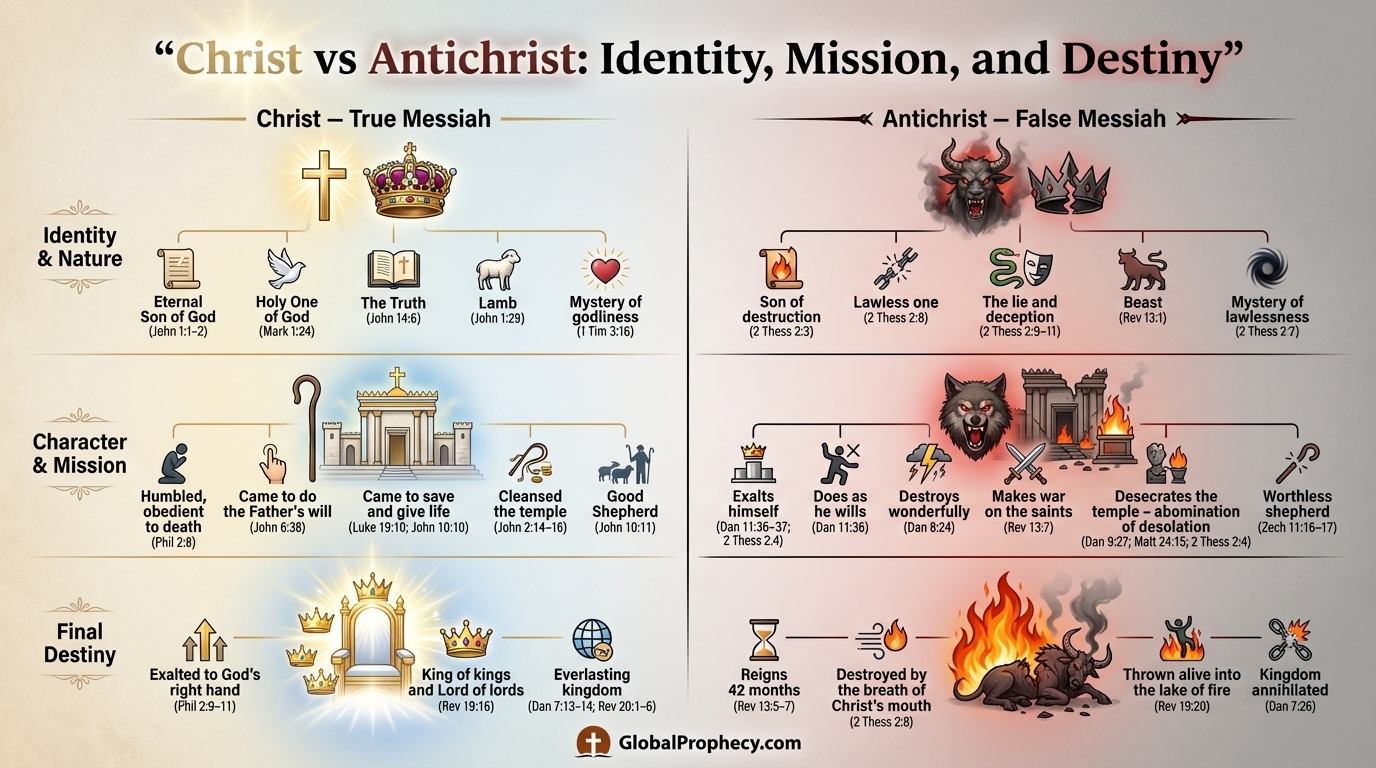
| Christ | Antichrist |
|---|---|
| Eternal Son of God (John 1:1–2; 1:34) | “Son of destruction” (2 Thessalonians 2:3) |
| Holy One of God (Mark 1:24) | “The lawless one”, “the man of lawlessness” (2 Thessalonians 2:3, 8) |
| The truth (John 14:6) | Associated with “the lie” and deception (2 Thessalonians 2:9–11) |
| Lamb (Isaiah 53:7; John 1:29) | Beast (Revelation 13:1) |
| Mystery of godliness (1 Timothy 3:16) | Mystery of lawlessness (2 Thessalonians 2:7) |
Christ reveals the Father and His holiness; the Antichrist embodies lawlessness, rebellion, and satanic deception.
“Every spirit that confesses that Jesus Christ has come in the flesh is from God… and every spirit that does not confess Jesus is not from God. This is the spirit of the antichrist…”
— 1 John 4:2–3
3.2. Character and Mission
| Christ | Antichrist |
|---|---|
| Came to do the Father’s will (John 6:38) | “The king shall do as he wills” (Daniel 11:36) |
| Humbled himself, obedient to death (Philippians 2:8) | Exalts himself above every god (Daniel 11:36–37; 2 Thessalonians 2:4) |
| Came to save and give life (Luke 19:10; John 10:10) | Comes to destroy: “shall destroy wonderfully” (Daniel 8:24); “it was allowed to make war on the saints and to conquer them” (Revelation 13:7) |
| Cleansed the temple (John 2:14–16) | Desecrates the temple (the “abomination of desolation,” Daniel 9:27; Matthew 24:15; 2 Thessalonians 2:4) |
| Good Shepherd who lays down His life for the sheep (John 10:11) | Worthless shepherd who devours the flock (Zechariah 11:16–17) |
Christ’s mission is redemptive and self‑sacrificial; the Antichrist’s mission is self‑exalting and destructive, aimed at opposing God and persecuting His people.
4. Christ and Antichrist as Counterfeits and Parallels
End‑time deception works not merely by denying Christ, but by imitating Him. The Antichrist is a deliberate parody of the true Messiah.
4.1. Empowerment and “Trinity” Structure
| True Trinity | False, satanic imitation |
|---|---|
| Father – sends the Son | Dragon (Satan) – gives power to the Beast (Revelation 13:2) |
| Son (Christ) – incarnate Savior | Beast (Antichrist) – satanic world ruler (Revelation 13:1–8) |
| Holy Spirit – glorifies Christ, bears witness (John 15:26) | False Prophet – glorifies the Beast, compels worship (Revelation 13:11–15) |
“And the beast that I saw was like a leopard; its feet were like a bear’s, and its mouth was like a lion’s. And to it the dragon gave his power and his throne and great authority.”
— Revelation 13:2
As the Holy Spirit exalts Christ, the False Prophet exalts the Antichrist, performing “great signs” to deceive (Revelation 13:13–14).
4.2. Miracles, Death, and Resurrection
Scripture deliberately parallels Christ and the Antichrist in relation to signs and resurrection:
| Christ | Antichrist |
|---|---|
| Performed true miracles, signs, and wonders (Mark 6:2; John 20:30–31) | Comes “with all power and false signs and wonders, and with all wicked deception” (2 Thessalonians 2:9–10) |
| Truly died and rose again (Matthew 28:6) | One of the Beast’s heads “seemed to have a mortal wound, but its mortal wound was healed. And the whole earth marveled as they followed the beast” (Revelation 13:3; cf. 13:14; 17:8) |
The Antichrist’s apparent resurrection is a satanic counterfeit of Christ’s true resurrection, designed to captivate “the whole earth” and secure worship.
4.3. Kingship, Crowns, and Conquest
| Christ | Antichrist |
|---|---|
| King of kings and Lord of lords (Revelation 19:16) | Called “the king” who exalts himself (Daniel 11:36) |
| Appears at His second coming riding a white horse (Revelation 19:11) | Appears at the beginning of the Tribulation riding a white horse (Revelation 6:2), a false peace‑bringer |
| Crowned with many diadems (Revelation 19:12) | Beast with ten horns and ten diadems (Revelation 13:1) |
| Rules the world in a righteous, everlasting kingdom (Daniel 7:13–14; Revelation 20:1–6) | Rules the world for 42 months (Revelation 13:5–7) – brief, blasphemous reign |
Christ’s rule is eternal and just; the Antichrist’s rule is global but temporary, ending in judgment.
4.4. People and Mark: Ownership and Loyalty
Both Christ and the Antichrist mark their followers, but with radically opposed meanings:
| Christ | Antichrist |
|---|---|
| God’s servants are sealed on their foreheads (Revelation 7:3–4; 14:1) – divine protection and ownership | All are forced to receive the mark of the beast on the right hand or forehead; without it no one can buy or sell (Revelation 13:16–17) |
| The Church is a pure bride for Christ (Ephesians 5:25–27; Revelation 19:7–9) | The Beast is linked to a great prostitute – a corrupt religious system (Revelation 17:3–5) |
What Christ receives by grace and faith, the Antichrist seizes by coercion and economic control.
5. Worship, Temple, and Ultimate Destiny
5.1. Worship and the Temple
The central conflict of Christ vs Antichrist is about worship.
Christ and worship:
- Leads people to worship the Father in spirit and truth (John 4:23–24).
- As the Lamb, receives worship together with the Father (Revelation 5:11–14).
- Cleansed the earthly temple, zealously honoring His Father’s house (John 2:14–17).
Antichrist and worship:
- Directs worship to Satan and to himself:
“And they worshiped the dragon, for he had given his authority to the beast, and they worshiped the beast…”
— Revelation 13:4 - Sits in the temple of God, proclaiming himself to be God (2 Thessalonians 2:4).
- Sets up the “abomination of desolation” in the holy place (Daniel 9:27; Matthew 24:15), an image of the Beast that all must worship (Revelation 13:14–15).
Christ purifies worship and sanctifies the temple; the Antichrist corrupts worship and desecrates the temple.
5.2. Final Victory and Judgment
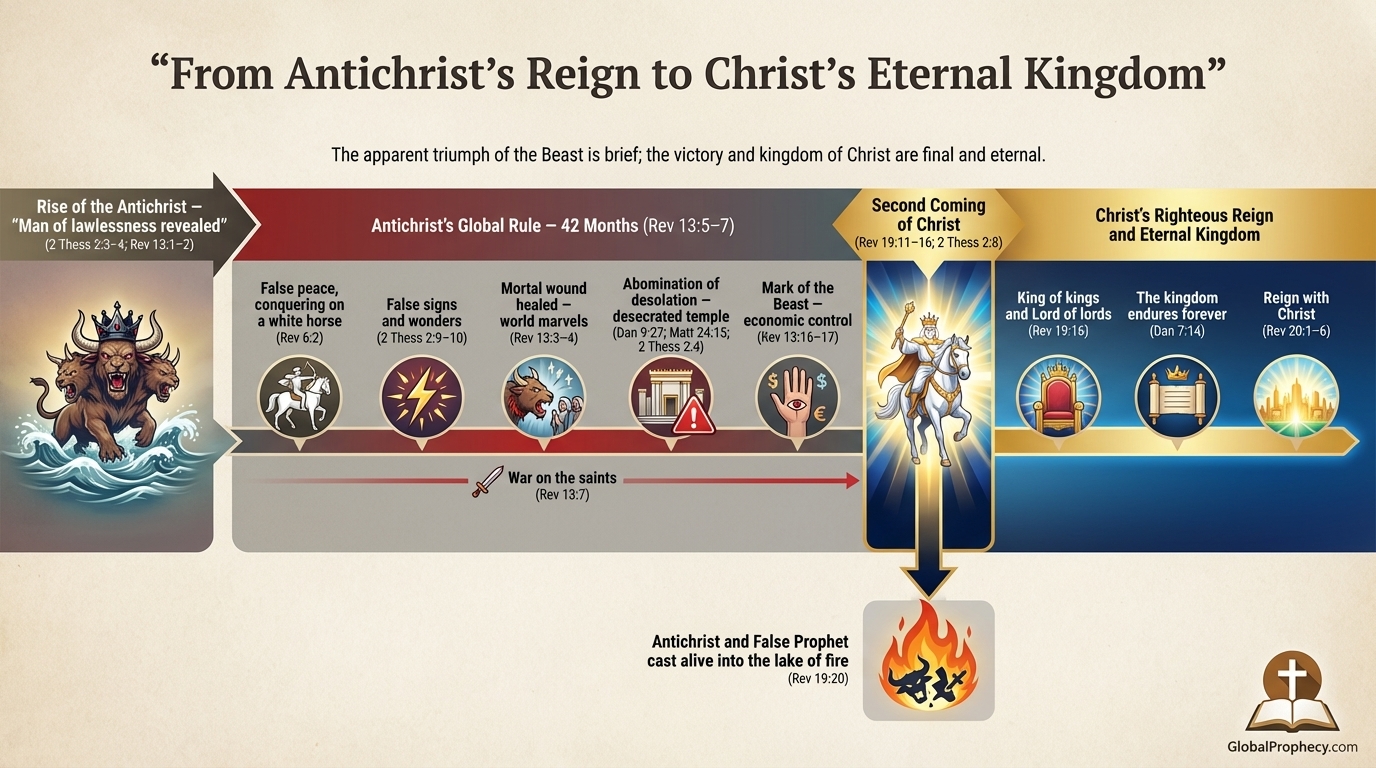
The Bible is explicit that the conflict Christ vs Antichrist ends in the total, effortless victory of Christ.
Christ’s destiny:
- Exalted to the right hand of God (Philippians 2:9–11; Acts 2:33).
- Returns in glory to judge and to reign (Revelation 19:11–16).
- His kingdom endures forever (Daniel 7:14).
Antichrist’s destiny:
- Destroyed directly by Christ at His coming:
“The lawless one will be revealed, whom the Lord Jesus will kill with the breath of his mouth and bring to nothing by the appearance of his coming.”
— 2 Thessalonians 2:8 - Seized and “thrown alive into the lake of fire that burns with sulfur” together with the false prophet (Revelation 19:20).
- His kingdom is permanently annihilated (Daniel 7:26).
The apparent triumph of the Antichrist is brief and illusory; the absolute triumph of Christ is final and eternal.
6. Practical Implications: Discernment in Light of Christ vs Antichrist
The New Testament links the future Antichrist with a present “spirit of antichrist” already at work:
“…this is the spirit of the antichrist, which you heard was coming and now is in the world already.”
— 1 John 4:3
Key implications:
-
Doctrinal discernment
- Any teaching that denies Jesus as the Christ, or denies His full deity or real humanity, reflects the spirit of antichrist (1 John 2:22; 2 John 7).
- Believers are commanded: “test the spirits” (1 John 4:1).
-
Worship discernment
- True worship centers on Christ alone; any person, system, or movement that seeks to replace Him as ultimate object of trust and devotion moves in an antichrist direction.
-
Hope and confidence
- However great the deception of the last days, Scripture assures that Christ’s victory is certain and the Antichrist’s defeat is guaranteed.
- Believers are not called to fear the Antichrist, but to fix their hope on Christ, the true King.
7. Conclusion
Biblical eschatology frames history’s climax as Christ vs Antichrist:
- Christ – the eternal Son of God, humble, holy, truth‑telling, life‑giving, the Lamb and Good Shepherd, crucified and risen, returning to reign.
- Antichrist – the man of lawlessness, proud, blasphemous, deceitful, murderous, the Beast and worthless shepherd, appearing to die and revive, ruling briefly before eternal judgment.
The Antichrist will be both a counterfeit Christ and the fiercest enemy of Christ, mimicking His works while denying His person. Yet Scripture leaves no doubt: the end of the story belongs not to the Beast, but to the Lamb.
For the student of biblical prophecy, the comparison between Christ and the Antichrist sharpens spiritual discernment and deepens confidence that “the kingdom of the world has become the kingdom of our Lord and of his Christ, and he shall reign forever and ever” (Revelation 11:15).
FAQ
Q: What does “Antichrist” mean in the Bible?
The term Antichrist (Greek antichristos) means both “against Christ” and “instead of Christ.” It refers to a future world ruler who will openly oppose Jesus Christ and also present himself as a counterfeit messiah, usurping Christ’s place (2 Thessalonians 2:3–4; 1 John 2:18). The same word also describes false teachers who deny the true Christ and thus share the “spirit of antichrist” (1 John 2:22; 4:3).
Q: How is the Antichrist different from Jesus Christ?
Jesus Christ is the eternal Son of God, holy, truthful, and self‑sacrificing, who came to save and give life (John 3:16; 10:11). The Antichrist is called the “man of lawlessness” and “son of destruction,” characterized by pride, blasphemy, deception, and violence (2 Thessalonians 2:3–10). Christ cleanses the temple and leads people to worship the Father; the Antichrist desecrates the temple and demands worship for himself (John 2:14–17; 2 Thessalonians 2:4).
Q: In what ways will the Antichrist imitate Christ?
The Antichrist will imitate Christ by performing miracle‑like signs, experiencing an apparent death and restoration, claiming divine status, and ruling globally (2 Thessalonians 2:9; Revelation 13:3–4, 7–8). He appears on a white horse like Christ, wears crowns, and has a worldwide kingdom, but his rule is brief, deceptive, and satanically empowered (Revelation 6:2; 13:1–8; 19:11–16).
Q: What is the outcome of the conflict between Christ and Antichrist?
According to Scripture, Jesus Christ will personally destroy the Antichrist at His second coming: “the Lord Jesus will kill [him] with the breath of his mouth and bring [him] to nothing by the appearance of his coming” (2 Thessalonians 2:8). The Beast (Antichrist) and the False Prophet will be thrown alive into the lake of fire (Revelation 19:20), while Christ establishes His righteous kingdom over all the earth (Revelation 20:1–6).
Q: What is the “spirit of antichrist,” and why does it matter today?
The spirit of antichrist is the ongoing influence of deception that denies Christ’s true identity and work (1 John 4:3). It operates through false doctrines, counterfeit christs, and systems that replace or oppose Jesus. Recognizing this spirit matters because believers are called to test the spirits and remain firmly anchored in the biblical Christ, rather than being swept away by persuasive but Christ‑denying ideas.
Frequently Asked Questions
What does “Antichrist” mean in the Bible?
How is the Antichrist different from Jesus Christ?
In what ways will the Antichrist imitate Christ?
What is the outcome of the conflict between Christ and Antichrist?
What is the “spirit of antichrist,” and why does it matter today?
L. A. C.
Theologian specializing in eschatology, committed to helping believers understand God's prophetic Word.
Related Articles
What the Bible Says about Antichrist?
Antichrist in the Bible: discover what Scripture reveals about his identity, character, deceptive power, and end-time role in the Tribulation.
The Campaign of Armageddon vs Gog and Magog
Armageddon vs Gog and Magog: explore key differences in timing, geography, and participants to see why these prophetic end-time battles are distinct.
The Great White Throne vs. The Judgment Seat of Christ
Great White Throne vs. Judgment Seat of Christ: compare who is judged, when each occurs, and how their distinct purposes shape every believer’s eternal outlook.
Heaven vs Hell: The Great Contrast
Heaven vs hell: explore the great contrast between eternal life and eternal punishment, highlighting destiny, judgment, joy, and separation from God.