
Comparing the Millennial Views: Which View Is Biblical?
1. Introduction
Among evangelical approaches to biblical eschatology, few debates are as central as the question of the millennium—the “thousand years” of Christ’s reign mentioned six times in Revelation 20:1‑7. Three major millennial views dominate the discussion:
- Premillennialism
- Amillennialism
- Postmillennialism
Each offers a different answer to three key questions:
- When will Christ reign?
- How and where will He reign?
- How should we read the “thousand years” of Revelation 20?
This article compares the three systems and then argues which most closely aligns with a grammatical‑historical reading of Scripture.
2. Defining the Three Millennial Views
2.1 Premillennialism
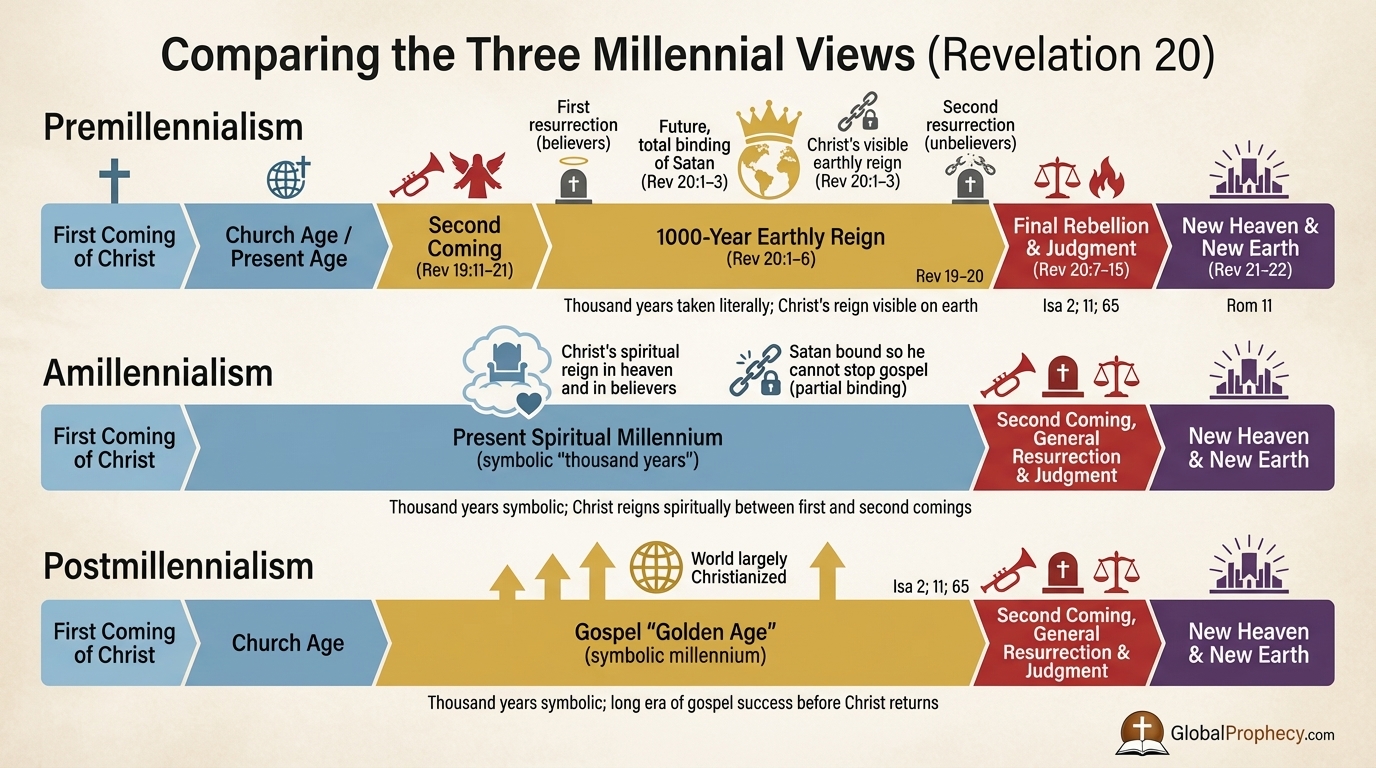
Premillennialism holds that Christ will return before the millennium and then personally rule on earth for a thousand years.
Core affirmations:
- Revelation 19:11‑21 describes the visible second coming.
- Revelation 20:1‑6 then describes a subsequent earthly reign of Christ for 1,000 literal years.
- Satan is literally bound in the abyss and unable to deceive the nations during this period.
- Two bodily resurrections occur: one of believers before the millennium, one of unbelievers after (Rev 20:4‑6).
Premillennialism exists in two main forms:
- Historic premillennialism: usually post‑tribulational, often blurs Israel–church distinctions.
- Dispensational premillennialism: maintains a clear distinction between Israel and the church and reads prophetic texts in a consistently literal, historical‑grammatical way.
2.2 Amillennialism
Amillennialism literally means “no millennium,” but in practice it denies only a future, earthly, thousand‑year kingdom, not the reign of Christ itself.
Core affirmations:
- The “millennium” is now, spanning the entire period between Christ’s first and second comings.
- The “thousand years” of Revelation 20 is a symbol for a long, complete period—not a literal duration.
- Christ reigns spiritually:
- in heaven over the souls of deceased believers, and/or
- in the hearts of believers on earth and through the church.
- Satan was “bound” at the cross in the sense that he cannot stop the worldwide spread of the gospel.
- There is one general resurrection and one general judgment at Christ’s return; no distinct millennial age follows.
This view dominates Roman Catholic, Eastern Orthodox, and much Reformed theology (e.g., Augustine, Luther, Calvin, Berkhof, Hoekema).
2.3 Postmillennialism
Postmillennialism teaches that Christ will return after a long “millennial” age of gospel‑produced peace and righteousness.
Core affirmations:
- The millennium is not necessarily 1,000 literal years, but a long “golden age” within the present church era.
- Through the preaching of the gospel and the work of the Spirit, most of the world will be converted; Christian ethics will shape culture, law, and institutions.
- Christ’s rule is present and spiritual, from heaven, mediated through the church’s influence.
- After this extended period of worldwide gospel success, Christ returns, there is a general resurrection and judgment, and then the eternal state.
Historically, this view flourished in optimistic eras (18th–19th centuries; e.g., Edwards, Warfield, Boettner) and has reappeared in some reconstructionist and theonomic circles.
3. Side‑by‑Side Comparison of the Millennial Views
3.1 Key Distinctions at a Glance
| Question / Category | Premillennialism | Amillennialism | Postmillennialism |
|---|---|---|---|
| Timing of Christ’s reign | After His second coming | Between first and second comings (now) | Between first and second comings (now, climaxing later) |
| Nature of reign | Literal, visible, earthly rule | Spiritual rule in heaven / hearts / church | Spiritual rule from heaven via a Christianized world |
| Location of millennium | Earth (centered in Jerusalem) | Present age; no distinct earthly millennial phase | Earth gradually transformed by the gospel |
| “Thousand years” (Rev 20) | Taken literally (1000 years) | Symbolic of long, complete period | Symbolic of long, complete period |
| Binding of Satan | Future, total incarceration in abyss | Present, partial—cannot stop gospel’s spread | Present, progressively reduced influence |
| Resurrections | Two bodily resurrections (Rev 20:4–6) | One general resurrection of all at the end | One general resurrection of all at the end |
| World conditions before Christ’s return | Increasing apostasy and tribulation | Mixed good and evil; often worsening | Overall improvement; world largely Christianized |
| Israel and the church | Distinct entities with distinct roles | One “people of God”; OT promises spiritualized in church | One “people of God”; OT promises spiritualized in church |
4. Exegetical Issues: How Each View Handles Revelation 20
Revelation 20:1‑6 is the only passage that explicitly mentions the “thousand years.” How it is interpreted largely determines one’s millennial view.
4.1 The Sequence of Revelation 19–20
- Revelation 19:11‑21 clearly describes the second coming: Christ appears in glory, destroys the beast and false prophet, and judges the armies of the nations.
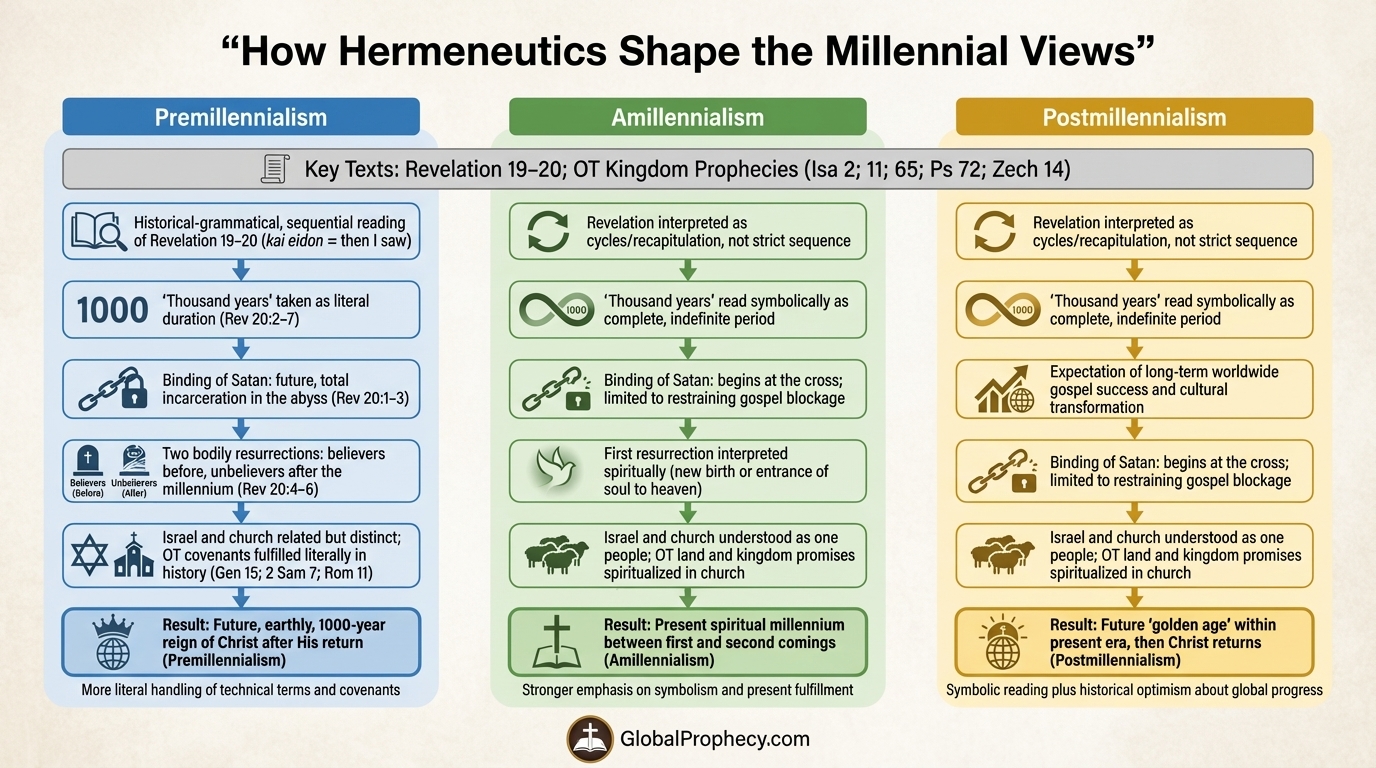
- Revelation 20:1‑6 then begins with “Then I saw” (Greek: kai eidon), a phrase repeated throughout 19:11–21:8, marking a chronological progression.
Premillennialism:
- Reads this sequence in its natural order:
- Second coming (Rev 19)
- Binding of Satan and beginning of millennium (Rev 20:1‑3)
- Reign of resurrected saints with Christ for 1000 years (Rev 20:4‑6)
- Final rebellion and Great White Throne judgment (Rev 20:7‑15)
- New heaven and new earth (Rev 21–22)
Amillennialism and postmillennialism:
- Typically use a recapitulation or “progressive parallelism” scheme:
- Revelation is seen as seven parallel sections that cover the church age from different angles.
- Revelation 20 “goes back” to the first coming and symbolically describes the present age.
- Therefore, they sever the chronological link between Revelation 19 and 20.
This is essentially a hermeneutical decision: either read the visions sequentially unless context forces otherwise (premillennial), or assume a non‑sequential structure and reassign Revelation 20 to the entire church age (a‑ and post‑).
4.2 The Binding of Satan (Rev 20:1‑3)
The text says Satan is:
- Seized
- Bound for a thousand years
- Thrown into the abyss
- The abyss is shut and sealed over him
- So that he might not deceive the nations any longer until the thousand years are ended
Premillennial reading:
- This language depicts a future, absolute incarceration with no active influence on earth.
- It has no parallel in history; Satan is presently “the god of this world” (2 Cor 4:4), “the ruler of this world” (John 12:31), and “prowls around like a roaring lion” (1 Pet 5:8).
- Thus this binding must be future, following Christ’s return.
Amillennial/postmillennial reading:
- Identify the binding with Christ’s victory at the cross and the church’s mission.
- Argue that Satan is “bound” only in the sense that he can no longer prevent the gospel reaching the nations.
- Maintain this is compatible with his ongoing activity in temptation, persecution, and deception on other fronts.
The difficulty for a‑ and post‑ is that Revelation 20:3 emphasizes total removal from the arena of deception, not mere limitation. The imagery of the abyss being locked and sealed does not fit a scenario in which Satan continues as an active deceiver of “the whole world” (Rev 12:9).
4.3 The Two Resurrections (Rev 20:4‑6)
The text speaks of:
- Martyrs who “came to life and reigned with Christ for a thousand years” (v.4).
- “The rest of the dead did not come to life until the thousand years were ended” (v.5).
- “This is the first resurrection” (v.5).
The key term ezēsan (“came to life”) appears in both verses.
Premillennial reading:
- Notes that ezēsan in Revelation always refers to literal bodily life (e.g., Rev 2:8; 13:14).
- Observes that “resurrection” (anastasis) in the New Testament almost always means bodily resurrection.
- Concludes that both uses of ezēsan in Revelation 20 speak of physical resurrections:
- First resurrection: believers raised to reign with Christ.
- Second resurrection: “the rest of the dead” (unbelievers) raised for judgment.
Amillennial/postmillennial reading:
- Typically say the first resurrection is spiritual:
- Either regeneration, or
- The soul’s entrance into heaven at death.
- Then take the second resurrection as bodily.
- Thus, the two resurrections are different in kind, not just in timing.
Yet the same verb and the explicit contrast (“the rest of the dead”) strongly indicate two events of the same nature, separated by the millennium. As Henry Alford famously remarked, if ezēsan can mean spiritual resurrection in verse 4 and bodily in verse 5 “then there is an end of all significance in language.”
5. Broader Biblical-Theological Considerations
5.1 Old Testament Prophecies: Where Do They Fit?
Numerous Old Testament texts portray:
- An age of worldwide peace and justice under the Messiah (Isa 9:6‑7; 11:1‑10; Ps 72).
- The Messiah ruling from David’s throne in Jerusalem (2 Sam 7:12‑16; Isa 11:1‑5).
- Restored Israel dwelling securely in the land, with nations streaming to Zion (Isa 2:2‑4; Mic 4:1‑4; Zech 14).
- Conditions better than today, yet not identical with the final, death‑free new creation.
Example: Isaiah 65:20 describes a time when:
“The young man shall die a hundred years old,
and the sinner a hundred years old shall be accursed.”
- Death still exists (unlike Rev 21:4), but lifespans are dramatically extended (unlike today).
- Sin is still possible (“the sinner… shall be accursed”), yet righteousness is the norm.
Premillennialism:
- Places such prophecies in an intermediate earthly kingdom—the millennium.
- This kingdom is:
- Future, following Christ’s return.
- Earthly, centered in Jerusalem.
- Better than the present age, but not yet the eternal state.
Amillennialism:
- Generally relocates these texts to:
- Either the present church age (spiritually fulfilled in Christ and the church), or
- The eternal state, heavily figurized.
But neither option sits naturally with texts that explicitly include death and sin while also describing dramatically transformed earthly conditions. Only a millennial age between this era and the final new earth accounts for them coherently.
5.2 Israel and the Church
A deeply shaping distinction among the views concerns Israel:
- Premillennialism: Israel and the church are related but distinct; specific, unconditional promises to ethnic/national Israel (land, throne, kingdom) must still be literally fulfilled (Gen 15; 17; 2 Sam 7; Rom 11:25‑29).
- Amillennialism/postmillennialism: Israel and the church are one people of God; OT promises are largely spiritualized and applied to the church as “new Israel.”
This affects millennial hopes:
- In premillennialism, the millennium is the stage on which God vindicates His covenants to Abraham and David in history through Christ’s reign in Zion.
- In a‑ and post‑, those covenants are typically redefined so that their “land” and “throne” aspects become heavenly or church‑centered realities, not future geopolitical realities.
6. Which Millennial View Is Most Biblical?
6.1 Hermeneutics: Literal vs. Spiritualizing
The decisive issue is how we interpret prophetic Scripture.
- Premillennialism applies the same historical‑grammatical principles to prophecy that we use for:
- Christ’s first coming,
- The cross and resurrection,
- Justification by faith, etc.
- Amillennialism and postmillennialism, while often literal elsewhere, shift to spiritualizing when dealing with many future‑oriented texts (especially those concerning Israel and the kingdom).
Given that:
- All messianic prophecies of Christ’s first coming were literally fulfilled (born in Bethlehem, Davidic lineage, pierced hands and feet, etc.),
- The book of Revelation itself regularly interprets symbols (e.g., lampstands = churches; Rev 1:20) but uses numbers literally unless context demands otherwise,
…it is consistent and safer to interpret Revelation 20 and related kingdom passages literally unless the text itself indicates symbolism. On that basis:
- A future, earthly, thousand‑year reign of Christ with resurrected saints is the plain sense of Revelation 19–20.
- Old Testament kingdom prophecies cohere naturally with such a millennium.
- The grammatical details of Revelation 20:1‑6 (binding, abyss, first resurrection, “the rest of the dead”) fall into place without forcing spiritual meanings onto technical terms.
6.2 The Test of Coherence
When we ask how each view handles all the relevant data:
-
Amillennialism:
- Must redefine the binding of Satan and the first resurrection.
- Must relocate many OT texts away from their natural sense.
- Must posit a “millennial” kingdom where sin and death coexist with Christ’s reign, but without clear biblical description of such a present system.
-
Postmillennialism:
- Adds an unwarranted optimism about global moral progress that contradicts texts predicting end‑time apostasy (Matt 24:10‑12; 2 Tim 3:1‑5; 2 Thess 2).
- Shares most of amillennialism’s spiritualizing of Israel’s promises.
- Does not fit the observable arc of church history.
-
Premillennialism:
- Honors the sequence of Revelation 19–20.
- Takes the binding of Satan and the two resurrections at face value.
- Provides a natural home for OT kingdom prophecies that describe an earth renewed but not yet perfected.
- Preserves God’s faithfulness in literally fulfilling His covenants to Israel through Christ.
For these reasons, a consistently grammatical‑historical reading of Scripture commends premillennialism as the most biblically grounded millennial view.
7. Conclusion
The millennium is not a marginal curiosity; it is the God‑ordained bridge between this fallen age and the eternal state. It is the stage on which:
- Christ is publicly vindicated as the Davidic King.
- Satan is decisively banished from earthly influence.
- The promises to Abraham and David find historical fulfillment.
- The nations experience the righteous rule of the Messiah.
While amillennialism and postmillennialism attempt to protect certain theological concerns, they do so at the cost of reworking the plain sense of key eschatological passages. Premillennialism, by contrast, allows Revelation 19–20 and the broader prophetic corpus to speak straightforwardly.
Interpreting Scripture by Scripture, without arbitrary spiritualization, leads to the conviction that Christ will return before the millennium to establish His literal kingdom on earth. That kingdom will endure for a thousand years, after which He will consummate all things in the new heaven and new earth.
FAQ
Q: What is the main difference between premillennialism, amillennialism, and postmillennialism?
The main difference is when and how Christ reigns. Premillennialism holds that Christ returns before a literal thousand‑year reign on earth. Amillennialism sees the millennium as the present age, a spiritual reign of Christ from heaven and in believers’ hearts. Postmillennialism believes the church will Christianize the world, bringing in a golden age, after which Christ returns.
Q: Why do premillennialists insist the “thousand years” in Revelation 20 is literal?
Premillennialists note that the term “thousand years” appears six times in Revelation 20:2‑7 with no internal signal of symbolism. In Revelation, when numbers are symbolic, context or explanation usually indicates it. Since other time indicators in Revelation (1,260 days; 42 months; etc.) are treated as literal, consistency argues that the “thousand years” should also be taken literally unless the text clearly says otherwise.
Q: How does each millennial view understand the binding of Satan?
Premillennialism sees the binding in Revelation 20:1‑3 as a future, total incarceration of Satan in the abyss, removing him from earthly activity. Amillennialism and postmillennialism interpret the binding as present and partial, beginning at Christ’s first coming; Satan is said to be bound only in the sense that he cannot prevent the global spread of the gospel, though he still actively deceives and persecutes.
Q: What role does Israel play in the millennial kingdom?
In premillennialism, ethnic/national Israel has a future role in God’s plan: promises of land, kingdom, and Davidic rule (e.g., Gen 15; 2 Sam 7; Rom 11:25‑29) will be literally fulfilled in the millennial kingdom under Christ. Amillennialism and postmillennialism usually see those promises as spiritually fulfilled in the church and do not expect a distinct, future national restoration of Israel in history.
Q: Why argue that premillennialism is the most biblical millennial view?
Premillennialism best satisfies three criteria: (1) it honors the plain, sequential reading of Revelation 19–20; (2) it takes the terms and numbers in prophetic texts in their normal sense unless context forces otherwise; and (3) it allows numerous Old Testament kingdom prophecies to be fulfilled without spiritualizing or redefining them. Taken together, these factors commend premillennialism as the view that most faithfully reflects the biblical data.
Frequently Asked Questions
What is the main difference between premillennialism, amillennialism, and postmillennialism?
Why do premillennialists insist the “thousand years” in Revelation 20 is literal?
How does each millennial view understand the binding of Satan?
What role does Israel play in the millennial kingdom?
Why argue that premillennialism is the most biblical millennial view?
L. A. C.
Theologian specializing in eschatology, committed to helping believers understand God's prophetic Word.
Related Articles
Amillennialism Examined: Is the Church the Millennial Kingdom?
Amillennialism examined: is the church the millennial kingdom? Explore its claims, symbols, and a biblical critique of this end-times view.
Postmillennialism Examined: Will the Church Christianize the World?
Postmillennialism examined and tested by Scripture: can the church truly Christianize the world before Christ returns and the millennium begins?
Premillennialism Examined: The Biblical Case for Christ's Earthly Reign
Premillennialism explored: a clear biblical case that Christ returns before the millennium to establish His literal earthly reign in fulfillment of prophecy.
The Campaign of Armageddon vs Gog and Magog
Armageddon vs Gog and Magog: explore key differences in timing, geography, and participants to see why these prophetic end-time battles are distinct.