
Comparing the Rapture Views
1. Introduction
The New Testament clearly teaches that a generation of believers will be “caught up…to meet the Lord in the air” (1 Thessalonians 4:17). The central debate in biblical eschatology is not whether this rapture occurs, but when it occurs in relation to the future seven-year Tribulation (Daniel’s seventieth week, Daniel 9:27).
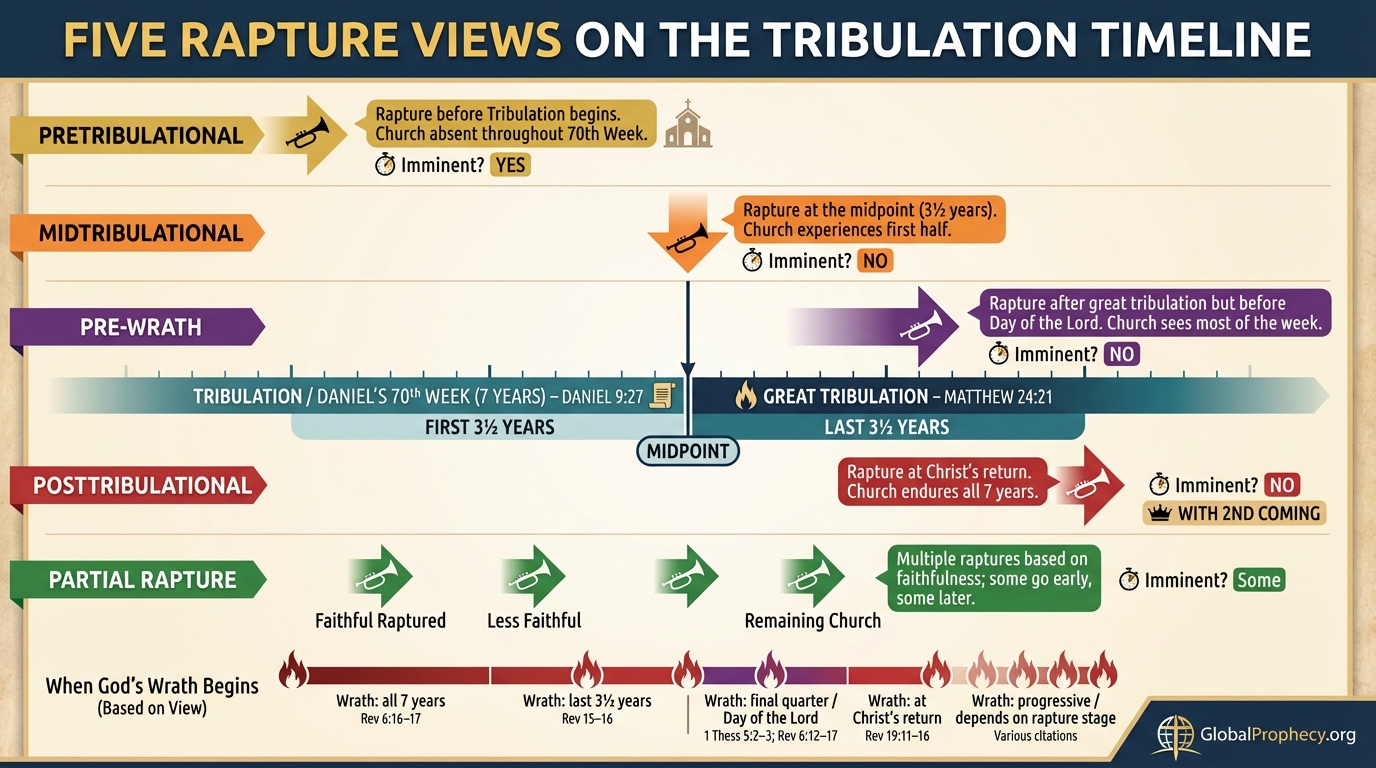
Five major rapture views have emerged:
- Pretribulational
- Midtribulational
- Posttribulational
- Partial rapture
- Pre‑wrath rapture
All claim biblical support, but they cannot all be correct. This article compares these rapture views side by side and argues that the pretribulational rapture best fits the totality of Scripture when interpreted consistently and literally.
2. Key Biblical Questions That Shape Rapture Timing
Before examining each view, several controlling biblical questions must be asked:
-
When does the wrath of God begin?
Is divine wrath limited to a short period at the end of the Tribulation, or does it characterize the whole seven years? -
Are church‑age believers exempt from God’s eschatological wrath?
Scripture says believers “wait for his Son from heaven…who delivers us from the wrath to come” (1 Thessalonians 1:10; cf. 5:9; Revelation 3:10). -
Is the rapture imminent?
Are believers commanded to look for Christ Himself at any moment, or for a series of Tribulation signs that must occur first? -
How does God distinguish Israel and the church?
Is the Tribulation primarily “a time of trouble for Jacob” (Jeremiah 30:7) or a period designed for the church?
These questions provide a framework for evaluating each rapture view.
3. Pretribulational Rapture
3.1 Definition
The pretribulational rapture view holds that:
- Christ will rapture His church before the seventieth week of Daniel (the seven‑year Tribulation) begins.
- After the church is removed, God resumes His specific dealings with Israel and the nations in fulfillment of Old Testament prophecy.
- At the end of the seven years, Christ returns in glory with His saints to establish His millennial kingdom (Revelation 19–20).
3.2 Key Biblical Supports
1. Church exempt from the coming wrath
“[Jesus] delivers us from the wrath to come.”
— 1 Thessalonians 1:10
“For God has not destined us for wrath, but to obtain salvation through our Lord Jesus Christ.”
— 1 Thessalonians 5:9
“I will keep you from the hour of trial that is coming on the whole world.”
— Revelation 3:10
The wrath in view is future, worldwide, and temporal (the “hour of trial”). The phrase “keep you from” (Greek tēreō ek) naturally means exemption from that period, not preservation while remaining in it.
2. The church is absent from Tribulation narrative
The word “church” (ekklēsia) appears 19 times in Revelation 1–3 and again in Revelation 22:16, but is completely absent in Revelation 4–18, where the seals, trumpets, and bowls are poured out. Instead we find Israel, the nations, and “saints” who come to faith during that period. This striking omission fits the idea that the church has already been raptured.
3. Tribulation judgments are clearly God’s wrath from the beginning
- The Lamb Himself opens the seven seals (Revelation 6:1).
- After the sixth seal, unbelievers cry out:
“Hide us from the face of him who is seated on the throne, and from the wrath of the Lamb, for the great day of their wrath has come.”
— Revelation 6:16–17
The aorist “has come” indicates that the wrath has already begun with the preceding seals, not only with later trumpets and bowls.
4. Distinction between rapture and second coming
Rapture passages (e.g. John 14:1–3; 1 Thessalonians 4:13–18; 1 Corinthians 15:51–52) differ significantly from second‑coming texts (e.g. Matthew 24:29–31; Revelation 19:11–21). For example:
- At the rapture Christ comes for His saints (1 Thessalonians 4:17); at the second coming He comes with His saints (Revelation 19:14).
- At the rapture believers go to the Father’s house (John 14:2–3); at the second coming Christ comes to the earth to judge and reign (Zechariah 14:4).
- The rapture is signless and imminent; the second coming is preceded by clearly defined Tribulation signs.
These contrasts are best explained by viewing the rapture as before the Tribulation, and the second coming after it.
5. Imminence
Believers are repeatedly told to “wait for” (1 Thessalonians 1:10), “eagerly wait for” (Philippians 3:20), and “look for” (Titus 2:13) Christ. No prerequisite Tribulation events are ever placed between the church and Christ’s coming. Only pretribulationalism consistently preserves this any‑moment hope.
4. Midtribulational Rapture
4.1 Definition
The midtribulational rapture view teaches that:
- The church will endure the first half of the Tribulation.
- The rapture occurs around the midpoint (after 3½ years), just before the period of “great tribulation” (Matthew 24:21).
4.2 Main Arguments
- “Last trumpet” (1 Corinthians 15:52; 1 Thessalonians 4:16) is identified with the seventh trumpet of Revelation 11:15, which sounds in the middle of the seventieth week.
- The first half is seen as man’s or Satan’s wrath (“beginning of sorrows,” Matthew 24:8), while only the second half is God’s wrath.
- Some identify the rapture with the ascension of the two witnesses in Revelation 11:11–12, taking them as symbolic of the church.
4.3 Biblical Difficulties
- The “last trumpet” in 1 Corinthians 15 is a trumpet of blessing and resurrection, sounded by God; the seventh trumpet is a trumpet of judgment sounded by an angel. Similarity of wording does not prove identity.
- As already noted, God’s wrath is present from the opening of the first seals and explicitly acknowledged by the world by the sixth (Revelation 6:16–17).
- The two witnesses are best taken as literal prophets (likely patterned after Moses and Elijah), not symbolic of the entire church.
- Midtribulationalism undermines imminence: at least the first half of the Tribulation and several specific signs must occur before Christ could return.
5. Posttribulational Rapture
5.1 Definition
The posttribulational rapture view holds that:
- The rapture and the second coming are two aspects of one event at the end of the Tribulation.
- The church will go through the entire seven‑year Tribulation.
- Believers are caught up to meet Christ in the air and immediately return with Him to the earth.
5.2 Main Arguments
- There is only “one second coming,” so rapture and return must be simultaneous.
- The church is the one people of God; therefore Tribulation saints are church saints.
- Matthew 24:29–31 and 1 Thessalonians 4:16–17 both mention angels, clouds, and a gathering, implying they are the same event.
- Pretribulationism is sometimes dismissed as “recent” in church history.
5.3 Biblical Difficulties
1. Church and wrath
Posttribulationism must either:
- Redefine “wrath” so that the church is somehow shielded from its effects while on earth, or
- Restrict God’s wrath only to a very brief period at the end of the Tribulation.
Both options strain the plain reading of texts like 1 Thessalonians 5:9 and Revelation 6:16–17.
2. Absence of the church in Revelation 6–18
If the church is central to those judgments, its total omission is inexplicable.
3. Logistical problems at the second coming
If all believers are raptured and glorified at Christ’s posttribulational coming, several issues arise:
- Who populates the millennial kingdom in natural bodies? Prophecies like Isaiah 65:20–23 envision people aging, bearing children, and dying in that era.
- Who are the “sheep” in the judgment of the nations (Matthew 25:31–46) who enter the kingdom as living believers? If all believers are just glorified, only unbelievers (“goats”) would remain on earth to be judged.
- When do the judgment seat of Christ and the marriage of the Lamb occur? These are both pictured as preceding the second coming in Revelation 19:7–10, yet there is no time for them if the church is raptured as Christ descends.
4. Loss of imminence
If the church must pass through the Tribulation, scores of prophesied events must occur before Christ’s return; His coming can no longer be “at any moment.”
6. Partial Rapture View
6.1 Definition
The partial rapture view teaches that:
- Only spiritually faithful, watchful believers will be raptured when Christ first comes for His church.
- Carnal or unprepared believers will be left to endure some or all of the Tribulation, being raptured later as they become worthy.
- The rapture is viewed as a reward for faithfulness, not a blessing of salvation guaranteed to all who are in Christ.
6.2 Main Arguments
Partial rapturists appeal to exhortations to watchfulness (e.g. Matthew 24:42–51; 25:1–13; Luke 21:36), warning passages (e.g. Hebrews 9:28), and crowns promised to those who “love his appearing” (2 Timothy 4:8).
6.3 Biblical Difficulties
- It confuses salvation by grace with reward for service. Translation and resurrection are presented in Scripture as part of the salvation given to all who are in Christ, not an optional reward.
- It divides the body of Christ. The church is one body indwelt by the Spirit (1 Corinthians 12:13). Scripture never speaks of the body being caught up in pieces.
- Paul declares, “We shall all be changed” (1 Corinthians 15:51), and that “whether we are awake or asleep we might live with him” (1 Thessalonians 5:10). The contrast in that context is between watchful and unwatchful believers, not between believers and unbelievers; yet all share the same destiny.
- It undermines assurance: no clear biblical standard is given by which a believer can know if he is “spiritual enough” to qualify for the first rapture.
7. Pre‑Wrath Rapture
7.1 Definition
The pre‑wrath rapture view is a modification of midtribulationalism. It teaches that:
- Daniel’s seventieth week is divided into three segments: the “beginning of birth pains,” the “great tribulation,” and then the “Day of the Lord.”
- The rapture occurs sometime in the second half, roughly ¾ of the way through the seven years, after the great tribulation but before the outpouring of God’s wrath in the Day of the Lord.
- Only the final segment (from about the sixth or seventh seal onward) is considered the divine wrath from which the church is exempt.
7.2 Main Arguments
- God’s people are promised deliverance from His wrath; therefore the church must be removed before the Day of the Lord.
- The term “tribulation” can refer to Satan’s or man’s wrath, not necessarily God’s.
- The sixth seal in Revelation 6:12–17 is interpreted as a sign that the Day of the Lord is about to begin; the rapture then occurs before the seventh seal.
7.3 Biblical Difficulties
- The seals are opened by the Lamb Himself; they constitute God’s judgments from the very beginning (Revelation 6:1; 8:1).
- Unbelievers at the sixth seal confess that “the great day of their wrath has come” (Revelation 6:17), indicating the preceding judgments are already expressions of divine wrath, not merely harbingers of it.
- Jesus places the “birth pains” at the start of the seventieth week (Matthew 24:4–8); Paul associates those same “birth pains” with the onset of the Day of the Lord (1 Thessalonians 5:2–3). This strongly suggests that the Day of the Lord – and thus divine wrath – begins with the entire seven‑year period, not only its last quarter.
- Like midtribulationism, the pre‑wrath view effectively denies classic imminence by requiring that much of the Tribulation unfold before Christ can come for His church.
8. Side‑by‑Side Comparison of the Five Rapture Views
| View | Basic Timing | When Does God’s Wrath Begin? | Is the Rapture Imminent? | Key Strength Claimed | Major Biblical Difficulty |
|---|---|---|---|---|---|
| Pretribulational | Before the 7‑year Tribulation | At start of the seventieth week (all 7 yrs) | Yes | Preserves imminence; exempts church from wrath; distinguishes Israel/church | Requires two‑stage second coming (yet biblically defensible) |
| Midtribulational | At midpoint (3½ years) | At midpoint (only last 3½ years) | No | Sees special intensity in last half | Wrath present in early seals; “last trumpet” identification forced |
| Posttribulational | At end of Tribulation with second coming | Often limited to very end | No | Simplicity (one second coming event) | Church in wrath; no time for Bema & marriage; no natural‑body saints for Millennium |
| Partial rapture | Multiple raptures; first before Tribulation | Varies; faithful exempt, carnal not | Only for some | Strong ethical emphasis | Divides body; undermines grace; contradicts “all will be changed” |
| Pre‑wrath | About ¾ through Tribulation | Final portion only (Day of the Lord) | No | Emphasizes deliverance from wrath | Seals already God’s wrath; complex, novel timeline; weak support for three‑part division |
9. Why Pretribulationalism Best Fits Scripture
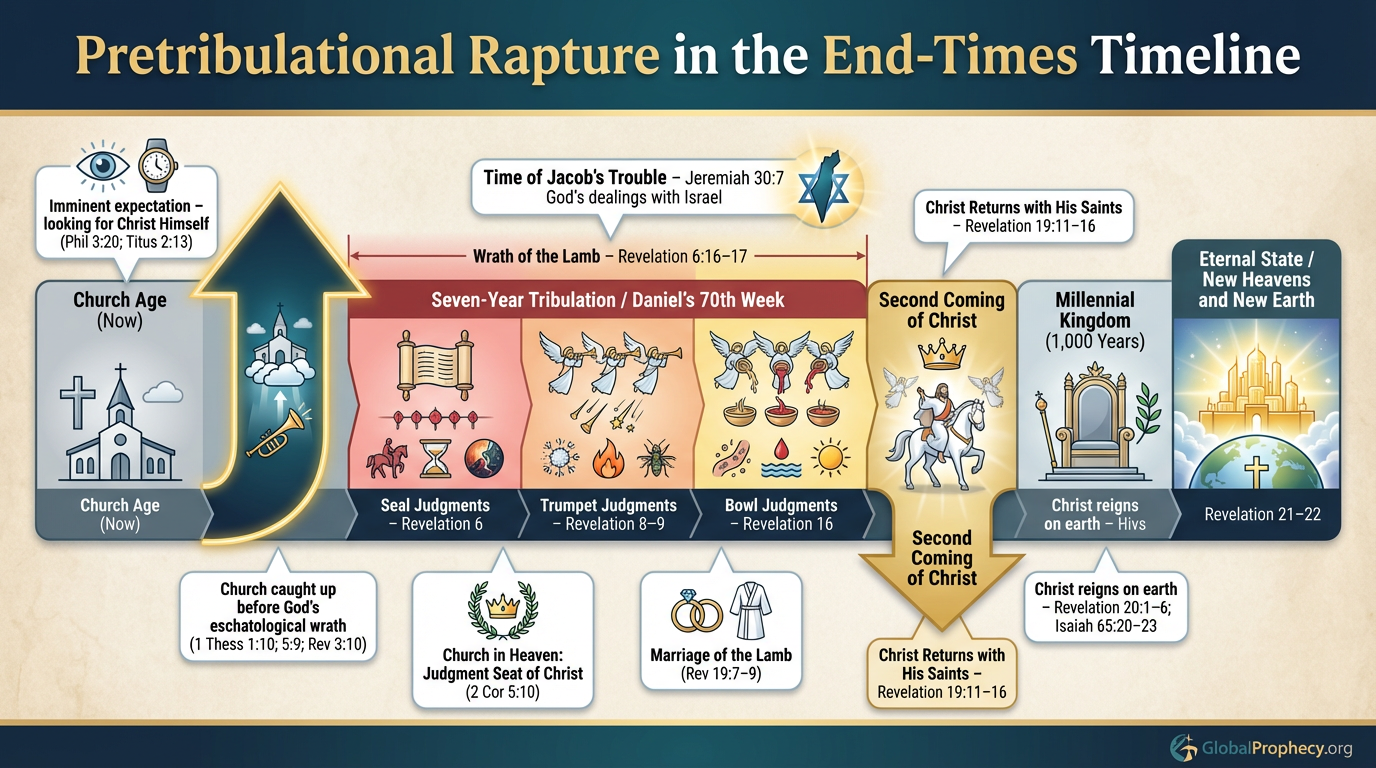
When the major questions are considered together, the pretribulational rapture emerges as the most coherent and biblically grounded view:
- It takes seriously all the relevant texts on wrath, showing that the entire seventieth week is characterized by the Lamb’s judgments.
- It preserves the church’s promised exemption from divine wrath (1 Thessalonians 1:10; 5:9; Revelation 3:10) by removing the church before that period begins.
- It maintains the imminence of Christ’s coming, enabling believers truly to “wait for his Son from heaven” without intervening prophetic events.
- It respects the distinction between Israel and the church, recognizing the Tribulation as the climactic “time of Jacob’s trouble” (Jeremiah 30:7) and the final fulfillment of God’s covenants with national Israel.
- It harmonizes the otherwise conflicting descriptions of Christ’s coming for His saints and with His saints by seeing the rapture and the second coming as two stages separated by the seven‑year Tribulation.
- It naturally explains the absence of the church in Revelation 6–18, while the twenty‑four elders in heaven (Revelation 4–5; 19) fit the church’s presence there, judged and rewarded.
From a grammatical‑historical reading of Scripture, these converging lines of evidence commend the pretribulational rapture as the rapture view that best fits the biblical data.
10. Conclusion
The timing of the rapture is not a peripheral curiosity; it directly touches the church’s hope, comfort, and expectations in the last days. All five major rapture views attempt to honor Scripture, but they diverge sharply on when Christ will catch up His bride.
When the nature and timing of God’s wrath, the promise of exemption, the distinction between Israel and the church, the doctrine of imminence, and the structure of Revelation are taken together, the pretribulational rapture most consistently aligns with the whole counsel of God. It upholds both the severity of the coming Tribulation and the blessed, any‑moment hope that Christ may come and take His church to be with Him before that day arrives.
“Therefore encourage one another with these words.”
— 1 Thessalonians 4:18
Frequently Asked Questions
What are the main differences between the rapture views?
Why do pretribulationists say the church will not go through the Tribulation?
Does believing in a pretribulational rapture make Christians “escapists”?
How do pretribulationists answer the claim that pretribulationalism is a recent doctrine?
Can sincere Christians disagree on rapture timing?
L. A. C.
Theologian specializing in eschatology, committed to helping believers understand God's prophetic Word.
Related Articles
Post-Tribulationalism Examined
Post-tribulationalism examined with a fair summary of the posttrib rapture view plus biblical critiques on imminence, the tribulation, and the millennium.
Pre-Tribulationalism Examined
Pretribulationalism examined: a detailed defense of the pre-trib rapture, Israel–Church distinction, exemption from wrath, and the doctrine of imminence.
Mid-Tribulationalism Examined
Mid-tribulationalism examined in depth: understand its last trumpet argument, compare rapture texts, and see biblical reasons the church misses all tribulation.
The Partial Rapture View Examined
Partial rapture view examined and refuted biblically, showing from New Testament texts that Christ will rapture all true believers, not only the watchful few.