
The Crowns of Heaven: Eternal Rewards for Believers
1. Introduction
The anticipation of eternal rewards stands as one of the most powerful motivations for faithful Christian living. While salvation itself is a free gift received by faith alone, Scripture consistently teaches that believers will be evaluated and rewarded for their service to Christ. This evaluation occurs at the judgment seat of Christ (Greek: bema), an event distinct from final judgment, where Christ Himself will assess the works of believers and distribute eternal rewards.
Among these rewards, Scripture describes several crowns that symbolize different spheres of faithful service and spiritual victory. These crowns are not mere decorative tokens but represent eternal recognition and increased capacity to glorify God throughout eternity. Understanding these crowns and how to earn them provides essential guidance for living a life that matters for eternity.
2. The Five Biblical Crowns
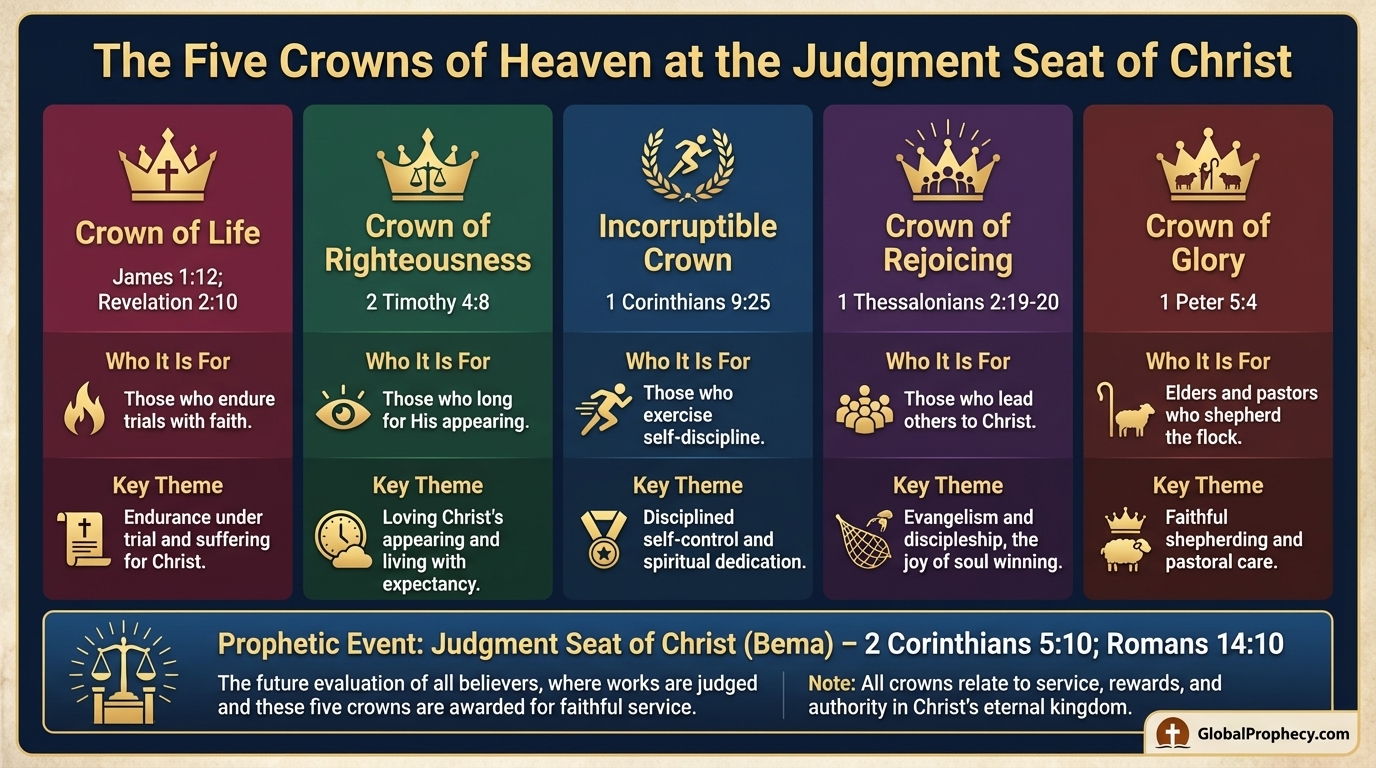
Scripture identifies five distinct crowns that believers may receive as rewards for faithful service. Each crown corresponds to a specific area of Christian devotion and obedience.
The Crown of Life
The crown of life is promised to those who endure trials and remain faithful under testing, especially those who suffer persecution or martyrdom for their faith.
"Blessed is the man who remains steadfast under trial, for when he has stood the test he will receive the crown of life, which God has promised to those who love him." — James 1:12
This crown is also mentioned in Revelation 2:10, where Christ tells the church in Smyrna: "Be faithful unto death, and I will give you the crown of life." This reward acknowledges believers who demonstrate perseverance under pressure, those who refuse to compromise their faith despite opposition, suffering, or even the threat of death. The crown of life celebrates spiritual endurance and unwavering loyalty to Christ when faith costs something.
The Crown of Righteousness
The crown of righteousness is reserved for those who live with an eager expectation of Christ's return and allow this hope to shape their daily conduct.
"Henceforth there is laid up for me the crown of righteousness, which the Lord, the righteous Judge, will award to me on that day, and not only to me but also to all who have loved his appearing." — 2 Timothy 4:8
Paul received this crown not because of his own righteousness but because he lived righteously in light of Christ's imminent return. Believers who love Christ's appearing demonstrate this love through holy living, maintaining purity, and keeping themselves ready for His return. This crown rewards those who live with an eternal perspective rather than becoming entangled in temporal pursuits.
The Incorruptible Crown
The incorruptible crown (also called the imperishable crown) is given to those who exercise self-discipline and self-control in their Christian walk.
"Everyone who competes in the games goes into strict training. They do it to get a crown that will not last, but we do it to get a crown that will last forever." — 1 Corinthians 9:25
Paul uses the imagery of athletic competition to describe this crown. Ancient athletes received wreaths of leaves that quickly withered, but believers compete for an eternal reward. This crown honors those who master their fleshly appetites, deny themselves for the sake of serving Christ more effectively, and maintain spiritual discipline. It requires bringing one's body under subjection and running the Christian race with purpose and determination.
The Crown of Rejoicing
The crown of rejoicing (also known as the soul winner's crown) is awarded to those who lead others to faith in Christ and invest in the spiritual growth of others.
"For what is our hope or joy or crown of boasting before our Lord Jesus at his coming? Is it not you? For you are our glory and joy." — 1 Thessalonians 2:19-20
This crown celebrates evangelism and discipleship. Paul refers to the Thessalonian believers themselves as his crown, indicating that those he led to Christ and nurtured in faith would be his eternal reward. This crown motivates believers to share the gospel, make disciples, and invest in the spiritual development of others. Every soul won for Christ through a believer's witness, prayers, or support becomes part of their eternal reward.
The Crown of Glory
The crown of glory is specifically promised to faithful pastors, elders, and spiritual leaders who shepherd God's people with right motives and godly example.
"And when the chief Shepherd appears, you will receive the unfading crown of glory." — 1 Peter 5:4
Peter addresses church leaders who serve willingly, not under compulsion; who serve eagerly, not for financial gain; and who lead by example rather than domineering over God's people. This crown rewards faithful pastoral ministry and spiritual leadership. It honors those who feed the flock, care for the weak, heal the wounded, and seek the lost—all while maintaining personal integrity and serving with pure motives.
3. Earning Eternal Rewards
Understanding how to earn these crowns requires recognizing both the biblical principles of reward and the specific actions that merit recognition.
The Foundation Principle
Before any crown can be earned, the foundation of salvation must be in place. No one can accumulate eternal rewards until they have accepted salvation through Jesus Christ. As Paul writes in 1 Corinthians 3:11, "For no one can lay a foundation other than that which is laid, which is Jesus Christ." Only after salvation can believers build works upon this foundation that will be evaluated and rewarded.
Quality Over Quantity
God evaluates the quality and motivation of our works, not merely their quantity or outward appearance. Paul describes this testing process using the metaphor of fire:
"Each one's work will become manifest, for the Day will disclose it, because it will be revealed by fire, and the fire itself will test what sort of work each one has done." — 1 Corinthians 3:13
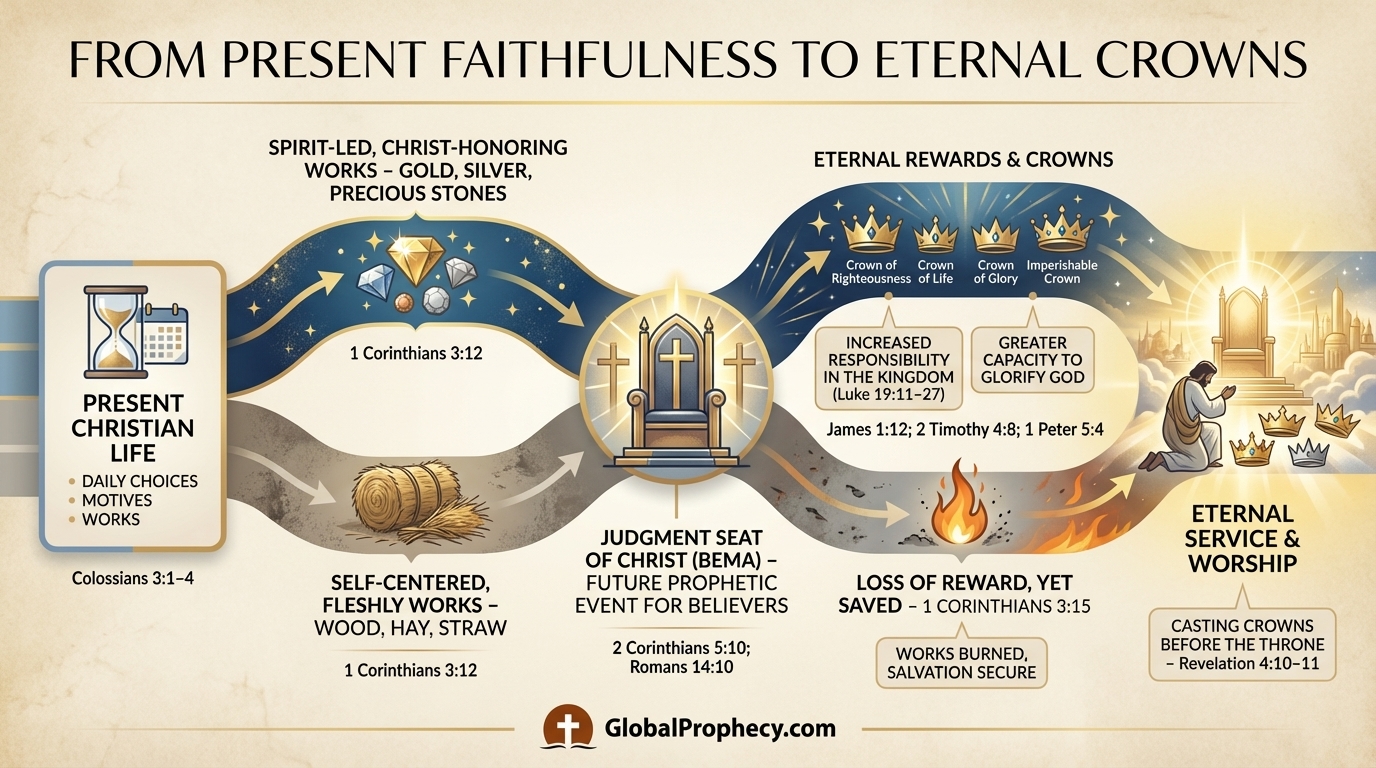
Works built with "gold, silver, and precious stones" represent service performed in the power of the Holy Spirit with Christ-honoring motives. These endure the fire of divine scrutiny. Works of "wood, hay, and straw" represent service performed in human strength, with impure motives, or for personal glory. These burn up, though the believer remains saved.
Specific Actions That Earn Rewards
Scripture identifies numerous activities that will be rewarded:
Endurance and Perseverance: Remaining faithful through trials (James 1:12), enduring persecution (Matthew 5:11-12), and suffering for righteousness (2 Timothy 2:12) all merit reward.
Evangelism and Discipleship: Leading others to Christ (1 Thessalonians 2:19), ministering to fellow believers (Hebrews 6:10), and making disciples all generate eternal rewards.
Faithful Service: Diligent use of spiritual gifts (Luke 19:11-27), faithful teaching of God's Word (1 Peter 5:4), and wholehearted service to Christ (John 12:26) are all rewarded.
Christlike Character: Exercising self-control (1 Corinthians 9:25-27), living righteously (2 Timothy 4:8), and maintaining close fellowship with Christ (1 John 2:28) lead to reward.
Generosity and Hospitality: Showing kindness to others (Matthew 10:40-42), caring for the poor (Luke 12:32-33), and practicing hospitality (Matthew 25:35-36) are remembered.
The Role of Motivation
Perhaps the most challenging aspect of earning crowns is the requirement of pure motivation. Jesus warned against performing righteous acts merely to be seen by others (Matthew 6:1-4). Works done for human applause receive their reward immediately—human recognition—but forfeit eternal reward.
God searches hearts and tests minds (1 Corinthians 4:5). He will bring to light hidden motives and purposes. Works performed out of genuine love for Christ, desire to glorify God, and compassion for others will be rewarded. Works done for selfish ambition, pride, or human recognition will be burned up at the judgment seat.
4. The Nature and Purpose of Crowns
Understanding what these crowns represent helps clarify their eternal significance and proper use.
Symbolic Meaning
The word translated "crown" in these passages is the Greek stephanos, which refers not to a royal crown (diadema) but to a victor's wreath. In ancient athletic competitions and military victories, wreaths made of leaves or flowers were placed on winners' heads. These crowns symbolized achievement, honor, and victory.
While believers' crowns may have some literal manifestation, they primarily represent increased capacity to glorify God throughout eternity. They signify varying degrees of authority, responsibility, and service in God's eternal kingdom. Greater rewards do not mean greater happiness (all believers will experience perfect joy) but rather enhanced ability to reflect Christ's glory and serve in His kingdom.
Casting Crowns Before the Throne
Revelation 4:10 portrays the twenty-four elders casting their crowns before God's throne in worship. Some have misunderstood this to mean believers give up their rewards permanently. However, the Greek indicates this is a repeated action—"whenever" they worship, they cast their crowns before Him. This demonstrates that:
- Crowns are ultimately for God's glory, not our own
- We retain our crowns to repeatedly offer them in worship
- Our greatest joy is honoring the One who made rewards possible
The capacity to glorify God more fully becomes itself the reward, as believers fulfill their created purpose of bringing glory to their Creator.
Proportional Responsibility
Several parables suggest that rewards include varying levels of authority and responsibility in Christ's kingdom. In Luke 19:11-27, faithful servants are given authority over cities in proportion to their faithfulness. This indicates that our service in eternity will correspond to our faithfulness now.
This is not about competition between believers but about each person receiving opportunities suited to their preparation. Just as different organs in a body have different functions yet all contribute to the body's health, believers will have different roles in the eternal kingdom, all working together for God's glory.
5. Living in Light of Eternal Rewards
The doctrine of eternal rewards should fundamentally shape how believers live today.
Balanced Motivation
Some criticize the emphasis on rewards as promoting selfish motivation. However, desiring rewards God promises is not selfishness but wisdom. Jesus Himself endured the cross "for the joy that was set before him" (Hebrews 12:2). The heroes of faith in Hebrews 11 were motivated by future reward.
The key is understanding that rewards are not the only motivation, but they are a legitimate one. We serve Christ primarily because we love Him, but the promise of reward encourages us to persevere when love alone seems insufficient to overcome our weakness.
Present Implications
Living for eternal rewards means:
Investing in Eternity: Prioritizing activities with eternal value over temporary pursuits (Matthew 6:19-21)
Faithful Stewardship: Recognizing that time, talents, resources, and opportunities are trusts from God for which we will give account (1 Corinthians 4:2)
Maintaining Purity: Avoiding sin and maintaining spiritual discipline to maximize our effectiveness for Christ (1 Corinthians 9:27)
Eternal Perspective: Making decisions based on their eternal significance rather than immediate gratification (Colossians 3:1-4)
Avoiding Loss of Reward
Scripture warns that believers can forfeit rewards through unfaithfulness (1 Corinthians 3:15), compromise (2 John 8), or living for worldly approval rather than God's approval (Matthew 6:1). The sobering reality is that some believers will stand before Christ with little or nothing to show for their earthly lives. They will be saved "as through fire," escaping eternal judgment but suffering the loss of potential rewards.
This should motivate believers to regular self-examination, repentance, and recommitment to faithful service.
6. Conclusion
The crowns of heaven represent God's gracious recognition of faithful service by His redeemed people. These five crowns—the crown of life, the crown of righteousness, the incorruptible crown, the crown of rejoicing, and the crown of glory—reward different aspects of Christian faithfulness: endurance under trial, righteous living in anticipation of Christ's return, self-discipline, evangelistic zeal, and faithful spiritual leadership.
Every believer can potentially earn all five crowns, as they represent different dimensions of obedient Christian living. The opportunity to receive these rewards is equal, though the capacity and opportunity may differ. What matters is faithful stewardship of what God has entrusted to each person.
The doctrine of eternal rewards should inspire believers to live with eternity in view, recognizing that present sacrifices for Christ's sake will be abundantly compensated in glory. These crowns are not for personal aggrandizement but represent increased capacity to glorify God throughout eternity. The greatest reward of all is not the crowns themselves but the Master's commendation: "Well done, good and faithful servant."
FAQ
Q: Can a believer lose their salvation if they don't earn any crowns?
No. Salvation and rewards are entirely separate. Salvation is a free gift received by faith alone, secured by Christ's finished work on the cross. Even if a believer's works are all burned up at the judgment seat of Christ, Scripture explicitly states "he himself will be saved, but only as through fire" (1 Corinthians 3:15). The judgment seat determines rewards, not eternal destiny—that was settled the moment one believed in Christ.
Q: Is it possible for one believer to earn all five crowns?
Yes, absolutely. The five crowns represent different aspects of faithful Christian living rather than mutually exclusive achievements. A believer who endures persecution (crown of life), lives in anticipation of Christ's return (crown of righteousness), exercises self-control (incorruptible crown), wins souls (crown of rejoicing), and faithfully teaches God's Word (crown of glory) could receive all five. The key is faithful service across multiple dimensions of Christian life.
Q: Will believers with more crowns have greater happiness in heaven than those with fewer crowns?
No. All believers will experience perfect joy and complete fulfillment in heaven; there will be no jealousy, regret that mars happiness, or sense of inferiority. The crowns represent different capacities to serve and glorify God, not different levels of happiness. Think of it this way: all cups will overflow with joy, but some cups will be larger than others, giving them greater capacity to reflect God's glory—which itself becomes the reward.
Frequently Asked Questions
Can a believer lose their salvation if they don't earn any crowns?
Is it possible for one believer to earn all five crowns?
Will believers with more crowns have greater happiness in heaven than those with fewer crowns?
L. A. C.
Theologian specializing in eschatology, committed to helping believers understand God's prophetic Word.
Related Articles
What is the Judgment Seat of Christ?
Judgment Seat of Christ explained from 2 Corinthians 5:10 and Romans 14:10—when believers are evaluated for rewards, not condemned for sin.
Loss of Reward: Can Christians Lose Their Crowns?
Loss of reward in eschatology: explore if Christians can lose heavenly crowns while never losing salvation, and how faithful service impacts eternity.
What Is Abraham's Bosom and Paradise?
Abraham's bosom and Paradise explain where believers go after death, describing the blessed intermediate state of the saved before the final resurrection.
The Nature of the Believer's Resurrection Body
Resurrection body of believers explained: explore 1 Corinthians 15 on the glorified, imperishable, Christlike nature of the believer’s future body.