
The Davidic Covenant and the Coming Messianic Kingdom
1. Introduction
The Davidic Covenant is a central pillar of biblical eschatology. It is God’s sworn promise to David that his dynasty, throne, and kingdom will be established forever, and that a royal Son from his line will rule in righteousness. The coming Messianic (millennial) kingdom—Christ’s thousand‑year reign on earth—is the stage on which this covenant is brought to visible fulfillment.
Understanding the Davidic Covenant clarifies:
- Why the Messiah must be a Son of David.
- Why there must be a future, earthly kingdom centered in Jerusalem.
- How God’s promises to Israel connect with His plan for all nations.
This article traces the biblical foundations, nature, and eschatological fulfillment of the Davidic Covenant in the coming Messianic kingdom.
2. The Biblical Text of the Davidic Covenant
The foundational text is 2 Samuel 7:11–16 (cf. 1 Chronicles 17:10–14). David desired to build a house (temple) for the Lord, but God reversed the initiative:
“The Lord declares to you that the Lord will make you a house. When your days are fulfilled and you lie down with your fathers, I will raise up your offspring after you, who shall come from your body, and I will establish his kingdom. He shall build a house for my name, and I will establish the throne of his kingdom forever…
…Your house and your kingdom shall be made sure forever before me. Your throne shall be established forever.”
— 2 Samuel 7:11–13, 16
Key elements:
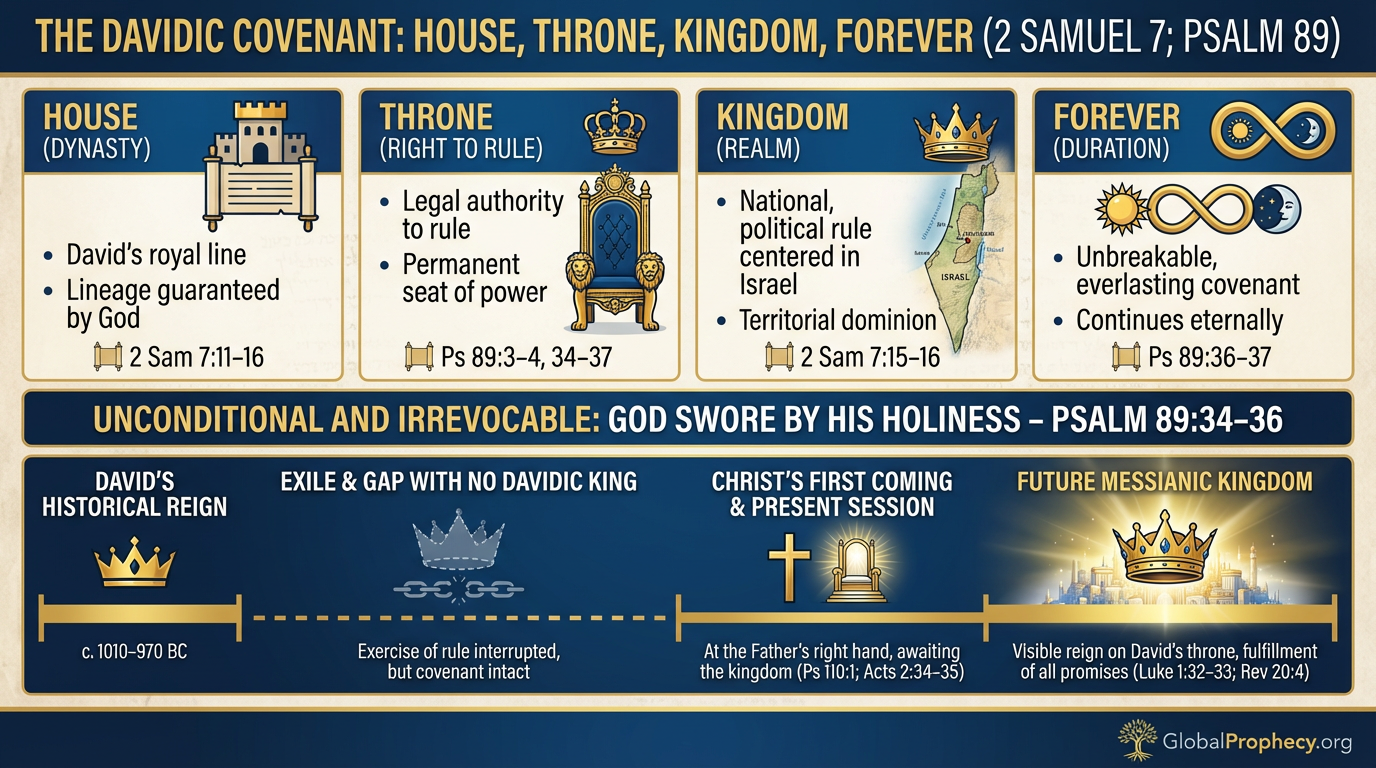
- “House” – David’s dynasty, his royal line.
- “Throne” – the right to rule, royal authority.
- “Kingdom” – the realm of rule, centered in Israel, but ultimately extending to the nations.
Immediate aspects apply to Solomon (he would build the temple and be disciplined if he sinned, v. 14), but the repeated term “forever” pushes beyond Solomon to a greater, enduring Son.
3. The Nature of the Davidic Covenant: House, Throne, Kingdom, Forever
3.1 Unconditional and Everlasting
Like the Abrahamic covenant, the Davidic covenant is presented as unconditional and irrevocable. God binds Himself with His own oath.
Psalm 89 interprets and applies the covenant:
“I will not violate my covenant or alter the word that went forth from my lips.
Once for all I have sworn by my holiness; I will not lie to David.
His offspring shall endure forever, his throne as long as the sun before me.”
— Psalm 89:34–36
Even if David’s descendants sin, God says:
“If his children forsake my law… then I will punish their transgression with the rod…
but I will not remove from him my steadfast love or be false to my faithfulness.”
— Psalm 89:30–33
The covenant guarantees:
- A perpetual royal line (“house”).
- A perpetual right to rule (“throne”).
- A perpetual kingdom tied to David.
Though the exercise of rule can be interrupted (e.g., the Babylonian exile, the long gap with no Davidic king on the throne), the right to rule is never transferred to another family.
3.2 Tied to Israel and an Earthly Kingdom
The covenant concerns a political, national kingdom rooted in Israel. David understood it that way:
“And now, O Lord God… You have spoken also of Your servant’s house for a great while to come… and with Your blessing shall the house of Your servant be blessed forever.”
— 2 Samuel 7:25–29, cf. 23:5
Later prophets consistently interpret it in literal, national terms, not as a mere spiritual metaphor.
4. Prophetic Development of the Davidic Covenant
After 2 Samuel 7, the rest of the Old Testament unfolds and enlarges the covenant.
4.1 Psalms
Psalm 2 pictures the Lord’s anointed King ruling the nations from Zion:
“As for me, I have set my King on Zion, my holy hill…
Ask of me, and I will make the nations your heritage, and the ends of the earth your possession.”
— Psalm 2:6, 8
Psalm 72 describes a royal Son ruling in righteousness, bringing global peace and prosperity.
Psalm 132 links Zion, David’s throne, and God’s choice:
“The Lord swore to David a sure oath… ‘One of the sons of your body I will set on your throne.’”
— Psalm 132:11
4.2 The Prophets
The major prophets embed the Davidic promise at the heart of future restoration:
-
Isaiah:
-
A Davidic child will rule with divine titles:
“To us a child is born… and the government shall be upon his shoulder…
Of the increase of his government and of peace there will be no end,
on the throne of David and over his kingdom,
to establish it and to uphold it with justice and with righteousness
from this time forth and forevermore.
The zeal of the Lord of hosts will do this.”
— Isaiah 9:6–7 -
A shoot from Jesse (David’s father) will judge in righteousness and fill the earth with the knowledge of the Lord (Isaiah 11:1–10).
-
-
Jeremiah:
“Behold, the days are coming, declares the Lord, when I will raise up for David a righteous Branch, and he shall reign as king and deal wisely, and shall execute justice and righteousness in the land. In his days Judah will be saved, and Israel will dwell securely.”
— Jeremiah 23:5–6God ties the unchangeability of this covenant to the fixed order of creation (Jeremiah 33:19–26).
-
Ezekiel:
In a future restoration of Israel, God promises:
“My servant David shall be king over them, and they shall all have one shepherd…
They shall dwell in the land that I gave to my servant Jacob… forever,
and David my servant shall be their prince forever.”
— Ezekiel 37:24–25
This appears in a context of regathered, united Israel, renewed by the Spirit and dwelling securely in their land (Ezekiel 36–37). The “David” here is best understood either as the resurrected David serving under Messiah, or as a royal title for the Messianic Son of David. In either case, it is literal rule over a restored nation.
5. Fulfillment in Christ the Son of David
5.1 The Davidic Line Leads to Jesus
The New Testament opens by rooting Jesus in David’s line:
“The book of the genealogy of Jesus Christ, the son of David, the son of Abraham.”
— Matthew 1:1
The angel Gabriel tells Mary:
“He will be great and will be called the Son of the Most High. And the Lord God will give to him the throne of his father David, and he will reign over the house of Jacob forever, and of his kingdom there will be no end.”
— Luke 1:32–33
Jesus is thus the promised Davidic heir who will inherit David’s throne and reign over “the house of Jacob” (national Israel) forever.
5.2 First Coming: Inauguration but Not Yet Enthronement on David’s Throne
At His first coming, Jesus authenticated His Messianic identity and offered the kingdom to Israel (Matthew 3:2; 4:17; 10:5–7). Many recognized Him as the “Son of David” (Matt 9:27; 21:9, 15).
But the nation’s leadership rejected Him, attributing His works to Satan (Matt 12:24), and ultimately crucified Him as “King of the Jews” (Matt 27:37). As a result, the visible Davidic kingdom was postponed, and Jesus spoke of a mystery form of the kingdom operating during the present age (parables of Matthew 13).
After His resurrection and ascension, Jesus took His seat at the right hand of the Father:
“Sit at my right hand until I make your enemies your footstool.”
— Psalm 110:1; applied in Acts 2:34–35; Heb 10:12–13
This session is on the Father’s throne, not explicitly called “the throne of David.” Christ now exercises universal, spiritual authority as Lord over the church and over all things (Eph 1:20–22), but this does not exhaust or cancel the specific promise of ruling on David’s throne in Jerusalem over Israel and the nations.
When the disciples asked after the resurrection, “Lord, will you at this time restore the kingdom to Israel?” (Acts 1:6), Jesus did not say the hope was mistaken or already fulfilled. He said:
“It is not for you to know times or seasons that the Father has fixed by his own authority.”
— Acts 1:7
The restoration of the Davidic kingdom to Israel remains future, with its timing hidden, not its reality denied.
5.3 Second Coming: Public Assumption of David’s Throne in the Millennial Kingdom
The public fulfillment of the Davidic Covenant awaits Christ’s second coming. At His return:
-
He will descend bodily to the Mount of Olives (Zechariah 14:4; Acts 1:11–12).
-
He will defeat hostile nations and judge the living (Matthew 25:31–46; Revelation 19:11–21).
-
He will sit on His glorious throne, with His apostles judging the twelve tribes of Israel:
“When the Son of Man will sit on his glorious throne, you who have followed me will also sit on twelve thrones, judging the twelve tribes of Israel.”
— Matthew 19:28
This “glorious throne” is the earthly manifestation of David’s throne, in keeping with Luke 1:32–33.
Revelation 20:1–6 describes a thousand‑year reign of Christ and His saints:
“They came to life and reigned with Christ for a thousand years.”
— Revelation 20:4
During this millennial kingdom:
- Satan is bound (Rev 20:1–3).
- The curse is substantially rolled back (Isaiah 11:6–9; 65:20–25).
- Israel is restored and exalted among the nations (Isaiah 2:1–4; Micah 4:1–8; Zech 8:20–23).
- Davidic promises are visibly realized: a Davidic King reigning from Zion, over Israel and all nations, in righteousness and peace.
Only such a future, earthly, political reign adequately fulfills the house–throne–kingdom–forever structure of the Davidic Covenant.
6. The Davidic Covenant in the Overall Messianic Kingdom Program
6.1 Relation to the Abrahamic and New Covenants
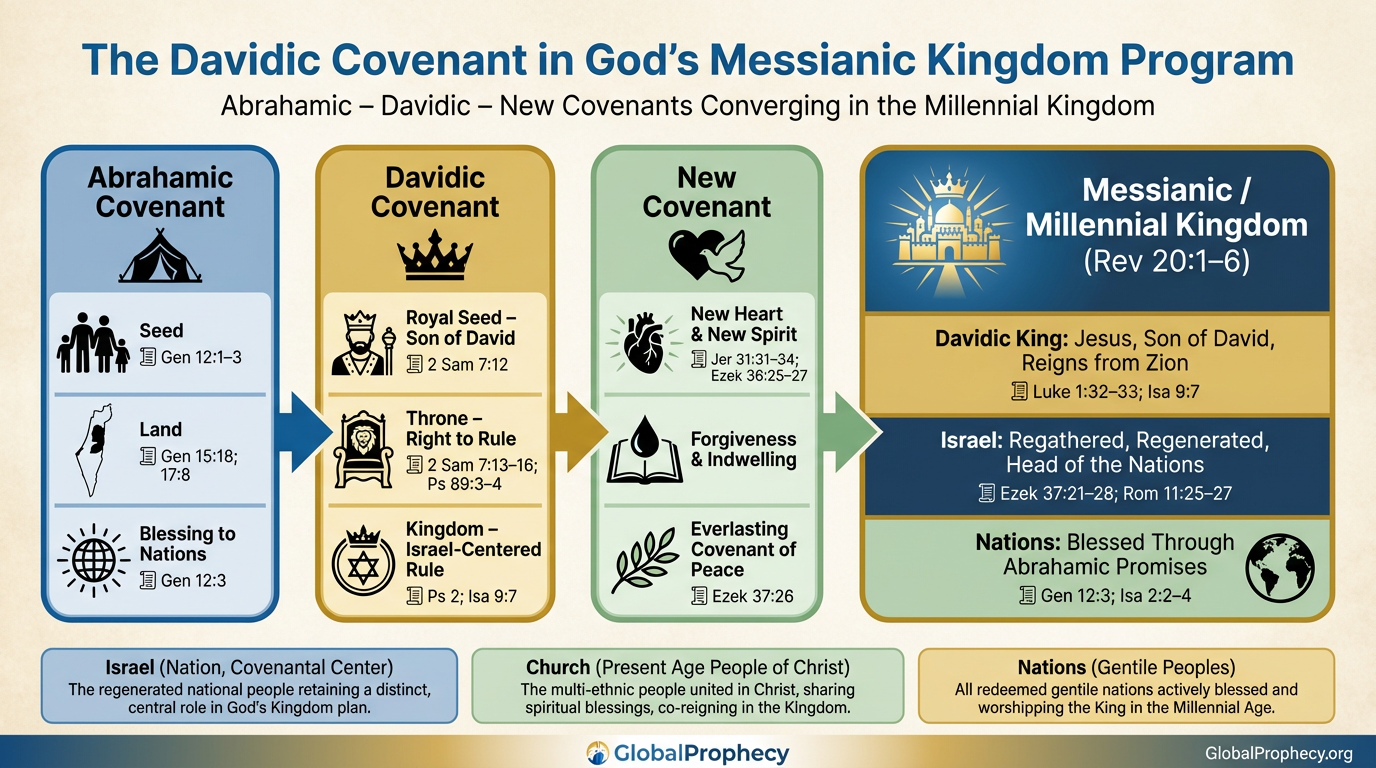
The Davidic Covenant is the royal outworking of the Abrahamic Covenant:
- Abraham was promised a seed, a land, and worldwide blessing (Gen 12:1–3; 17:6–8).
- The Davidic Covenant narrows the seed to a royal line and guarantees an everlasting throne and kingdom (2 Sam 7; Ps 89).
- The New Covenant ensures that Israel will be regenerated, forgiven, and indwelt by the Spirit so that they can live under their Davidic King (Jer 31:31–34; Ezek 36:25–27; 37:24–28).
Ezekiel 37 merges all three:
- Regathering and restoration to the land – Abrahamic and Land promises (Ezek 37:21–22).
- “One king over them… my servant David will be king over them” – Davidic Covenant (Ezek 37:24–25).
- “I will put my Spirit within you… I will make a covenant of peace with them; it shall be an everlasting covenant” – New Covenant (Ezek 37:26–27).
These converge in the millennial kingdom, when the Davidic King rules a spiritually renewed Israel in her land, with blessing flowing to the nations.
6.2 Israel, the Nations, and the Millennium
The Davidic Covenant requires:
- Israel’s continued existence as a nation (cf. Jer 31:35–37).
- Israel’s future restoration to favor and to the land (Rom 11:25–27).
- A distinction between ethnic Israel and the church, even while all redeemed share in salvation blessings.
In the millennium:
- Israel is the head of the nations, under her Davidic King (Deut 28:13; Isa 60).
- The nations stream to Jerusalem for instruction and worship (Isa 2:2–4; Zech 14:16–19).
- Christ’s rule is both universal and Israel‑centered, fulfilling both Abrahamic and Davidic promises.
The Davidic Covenant thus anchors a premillennial, earthly Messianic kingdom as the necessary stage in God’s redemptive plan.
7. Conclusion
The Davidic Covenant is not a marginal Old Testament promise; it is a structural backbone of biblical eschatology. God swore to David an everlasting house, throne, and kingdom. The prophets foresaw a righteous Davidic King reigning in Zion, ruling Israel and the nations in justice and peace.
Jesus, the Son of David, has already come, died, risen, and ascended. He now sits at the Father’s right hand, awaiting the time when His enemies will be made His footstool. At His second coming, He will take His rightful seat on David’s throne, establish His millennial kingdom, and bring the Davidic Covenant to full, visible realization.
Far from being spiritualized away or exhausted in the present age, the Davidic Covenant guarantees a future Messianic kingdom on earth—a kingdom in which God’s faithfulness to David, to Israel, and to all nations will be displayed in glory.
FAQ
Q: What is the Davidic Covenant in simple terms?
The Davidic Covenant is God’s sworn promise to King David that his family line will endure, that his throne (right to rule) will be established forever, and that a royal Son from his line will reign in righteousness. This finds its ultimate fulfillment in Jesus Christ, the Son of David, who will rule from Jerusalem in the coming Messianic kingdom.
Q: Has the Davidic Covenant already been fulfilled in the church?
No. While Christ now reigns at the right hand of the Father and the church shares in His spiritual blessings, the specific promises of the Davidic Covenant—an eternal throne and kingdom centered on Israel and ruled from David’s throne—require a future, earthly fulfillment in the millennial kingdom. The New Testament never calls Christ’s present session “David’s throne.”
Q: How does the Davidic Covenant relate to the millennial kingdom?
The millennial kingdom is the stage on which the Davidic Covenant is publicly fulfilled. During the thousand years described in Revelation 20, Christ as the Son of David rules from Jerusalem over Israel and the nations, fulfilling Old Testament prophecies about the Davidic King, Israel’s restoration, and worldwide peace and justice.
Q: Why must the Messiah rule from Jerusalem and not just from heaven?
The Davidic Covenant and the prophets repeatedly locate the Messianic reign in Zion/Jerusalem over Israel (e.g., 2 Sam 7; Isa 2:2–4; 9:7; Jer 23:5–6; Ezek 37:24–28). God promised David an earthly throne and kingdom. To maintain the integrity of His promises and the plain sense of Scripture, this rule must be manifested on earth, not only spiritually from heaven.
Q: Does the Davidic Covenant mean ethnic Israel still has a future in God’s plan?
Yes. The Davidic Covenant presupposes Israel’s ongoing existence as a nation and her future restoration under her Davidic King. Jeremiah 31:35–37 ties Israel’s permanence to the fixed order of creation. In Romans 11:25–27, Paul affirms that “all Israel will be saved” when the Deliverer comes from Zion, linking Israel’s salvation and restoration to the fulfillment of God’s covenant promises.
Frequently Asked Questions
What is the Davidic Covenant in simple terms?
Has the Davidic Covenant already been fulfilled in the church?
How does the Davidic Covenant relate to the millennial kingdom?
Why must the Messiah rule from Jerusalem and not just from heaven?
Does the Davidic Covenant mean ethnic Israel still has a future in God’s plan?
L. A. C.
Theologian specializing in eschatology, committed to helping believers understand God's prophetic Word.
Related Articles
The 70 Weeks of Daniel: Understanding Bible's Prophetic Timeline
The 70 weeks of Daniel explain God's prophetic timeline for Israel, Christ's first coming, and a future 70th week leading to the end-time climax.
Babylon the Great
Babylon the Great in Revelation 17–18 reveals end-time religious and commercial rebellion against God and its sudden, final destruction in judgment.
What the Bible Says about Antichrist?
Antichrist in the Bible: discover what Scripture reveals about his identity, character, deceptive power, and end-time role in the Tribulation.
What the Bible Says about False Prophet?
False Prophet biblical identity and role in end times. Discover what Scripture reveals about this key figure in Revelation's tribulation prophecy.