
Death and the Unbeliever
1. Introduction
Death and the unbeliever is one of the most solemn themes in biblical eschatology. Scripture teaches that every person will die once and then face judgment:
“It is appointed for man to die once, and after that comes judgment.”
— Hebrews 9:27
The Bible rejects both annihilation (the idea that the unbeliever ceases to exist) and universalism (the idea that all are finally saved). Instead, it presents a coherent sequence: spiritual death in this life, conscious existence after physical death, future resurrection, final judgment, and eternal separation from God in the “second death.”
This article explains, in a focused way, what happens to unbelievers at death and after death, tracing their destiny from the moment of death through eternity.
2. Death as Separation, Not Annihilation
2.1 Three kinds of death
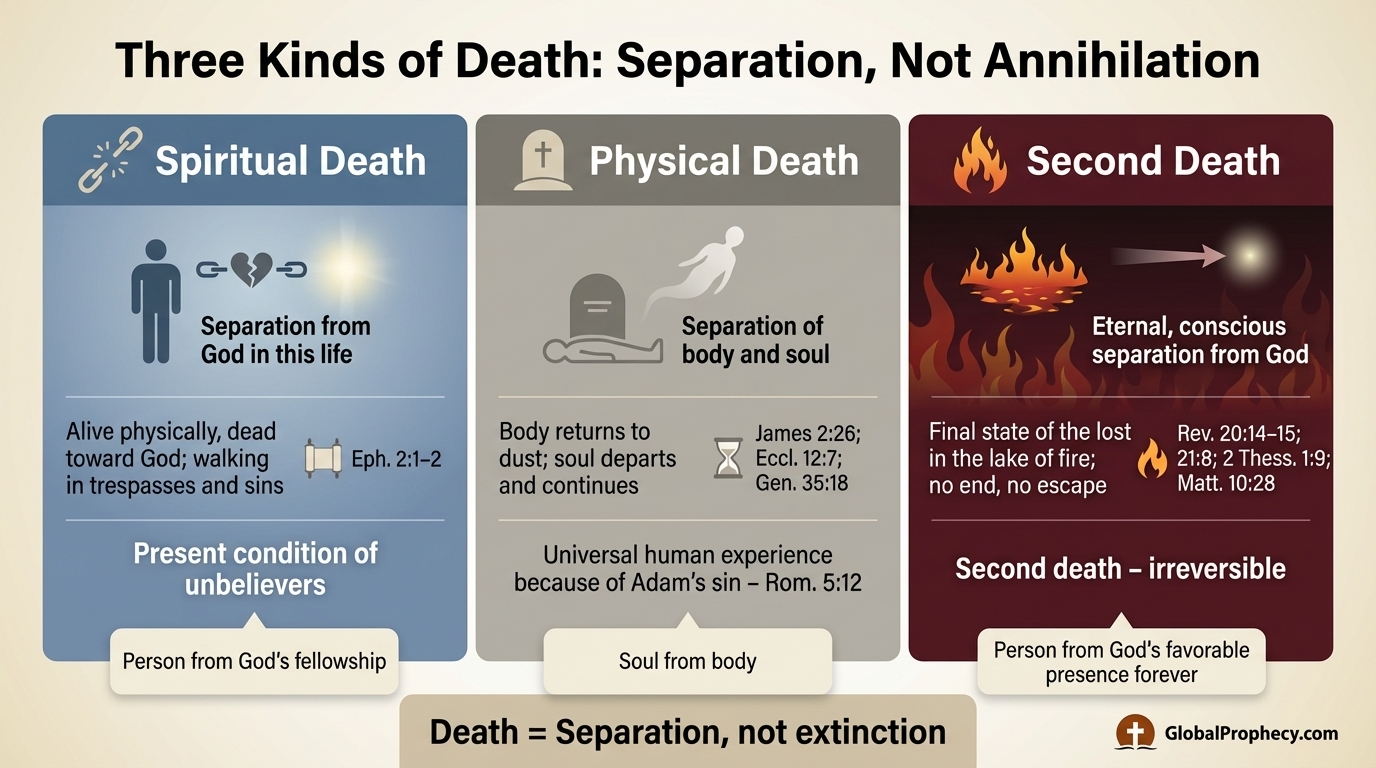
Biblical eschatology identifies three kinds of death, all especially relevant to the unbeliever:
- Spiritual death – present separation from God in this life (Eph. 2:1).
- Physical death – separation of body and soul/spirit (James 2:26; Eccl. 12:7).
- Second death – eternal, conscious separation from God in the lake of fire (Rev. 20:14–15).
In all three, the central idea is separation, not extinction. As Genesis says of Rachel, “her soul was departing (for she was dying)” (Gen. 35:18). Her soul continued to exist, although separated from her body.
2.2 The universal reality of death
Because of Adam’s sin, death is the universal human destiny:
“Sin came into the world through one man, and death through sin, and so death spread to all men because all sinned.”
— Romans 5:12
No unbeliever can escape physical death, unless living at a unique, eschatological moment (which Scripture reserves for certain believers, not unbelievers). Death is an enemy (1 Cor. 15:26), but for the unbeliever it remains an undefeated enemy, leading directly into divine judgment.
3. The State of the Unbeliever at the Moment of Death
3.1 Spiritual condition carried into eternity
All people without Christ are already spiritually dead:
“You were dead in the trespasses and sins in which you once walked.”
— Ephesians 2:1–2
If a person dies in this state of spiritual death, their condition is fixed forever. There is no biblical support for a postmortem second chance. On the contrary:
“When the wicked dies, his hope will perish.”
— Proverbs 11:7
Those who die in unbelief pass from temporary spiritual death into eternal death—the full and irreversible realization of their separation from God.
3.2 Immediate accountability before God
Death is not a neutral transition or peaceful oblivion. The unbeliever moves at once from earthly life into direct accountability before God. Hebrews links death and judgment closely (Heb. 9:27). Jesus warns:
“Fear him who can destroy both soul and body in hell.”
— Matthew 10:28
“Destroy” here does not mean annihilate; Jesus contrasts human ability to kill the body with God’s authority over both soul and body in hell, indicating continued existence under judgment.
4. The Intermediate State of the Unbeliever (Hades)
4.1 Conscious existence in Hades
When an unbeliever dies physically, their body returns to dust (Gen. 3:19), but their soul does not cease to exist. Jesus’ account of the rich man and Lazarus (Luke 16:19–31) is the clearest window into the intermediate state of the unbeliever.
“The rich man also died and was buried, and in Hades, being in torment, he lifted up his eyes…”
— Luke 16:22–23
Several essential truths emerge:
- The rich man remains conscious (“he lifted up his eyes”).
- He experiences torment (Luke 16:23–24).
- He retains memory, awareness, and concern (Luke 16:27–28).
- A fixed gulf separates the place of comfort from the place of torment (Luke 16:26), ruling out movement or escape.
Thus, after death and before the final judgment, unbelievers are kept in Hades, a temporary place of punishment and conscious misery. This is not yet the final lake of fire, but it is a place of real suffering and separation from God’s favorable presence.
4.2 No second chance, no purgatory
The rich man is given no opportunity to repent after death, only to recognize the justice of his condition and the need for his living brothers to heed the Word of God (Luke 16:27–31). Scripture nowhere teaches:
- Purgatory (a temporary postmortem purification), or
- Universal postmortem evangelization leading to salvation.
Instead, biblical eschatology insists that the destiny of the unbeliever is sealed at death. The intermediate state is a foretaste of final judgment, not a probationary period.
5. Resurrection, Judgment, and the Second Death
The intermediate state is not the end. Unbelievers, like believers, will experience bodily resurrection—but unto judgment.
5.1 Resurrection of the unbeliever
Jesus summarizes the dual outcome of resurrection:
“Those who have done good to the resurrection of life, and those who have done evil to the resurrection of judgment.”
— John 5:29
The unbelieving dead will be raised bodily at the conclusion of history to stand before God’s throne. Their resurrection does not bring blessing but provides the body suited for eternal punishment.
5.2 The great white throne judgment
Revelation 20 describes the climactic judgment of the lost:
“And I saw the dead, great and small, standing before the throne… And the dead were judged by what was written in the books, according to what they had done… And if anyone’s name was not found written in the book of life, he was thrown into the lake of fire.”
— Revelation 20:12, 15
Key elements for the unbeliever:
- Universality – “the dead, great and small” (all classes and statuses).
- Individual accountability – judged “according to what they had done.”
- Absence from the book of life – proof that they never belonged to Christ.
- Final sentence – consignment to “the lake of fire.”
5.3 The second death: eternal destiny of the unbeliever
Revelation is explicit:
“Then Death and Hades were thrown into the lake of fire. This is the second death, the lake of fire.”
— Revelation 20:14
And again:
“As for… the unbelieving… their portion will be in the lake that burns with fire and sulfur, which is the second death.”
— Revelation 21:8
The second death is:
- Eternal – no hint of an end or release.
- Conscious – “tormented day and night forever and ever” (Rev. 20:10, by analogy with Satan’s fate).
- Total in scope – involving both soul and body (Matt. 10:28).
- Relational – “away from the presence of the Lord and from the glory of his might” (2 Thess. 1:9), that is, eternally excluded from God’s loving and blessing presence.
This is the final and irreversible state of all who die in unbelief.
6. Sequence of the Unbeliever’s Experience
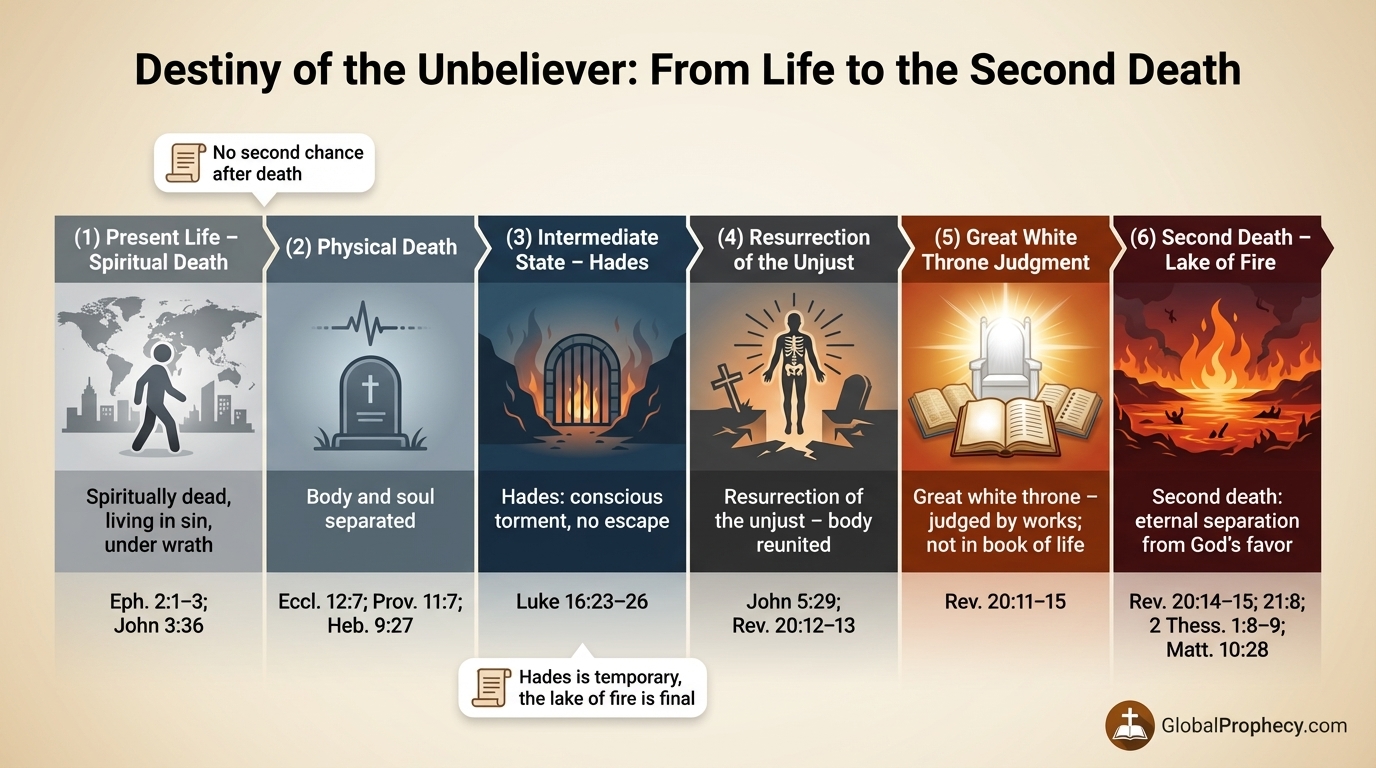
For clarity, the biblical data on the fate of the unbeliever can be summarized as a sequence:
| Stage | Description | Key Texts |
|---|---|---|
| 1. Present life | Spiritually dead, living in sin, under God’s wrath | Eph. 2:1–3; John 3:36 |
| 2. Physical death | Separation of body and soul; hope of the wicked perishes | Eccl. 12:7; Prov. 11:7 |
| 3. Intermediate state (Hades) | Conscious torment, no escape, awaiting final judgment | Luke 16:23–26 |
| 4. Resurrection of the unjust | Soul reunited with a body suited for eternal judgment | John 5:29; Rev. 20:12–13 |
| 5. Great white throne judgment | Personal evaluation according to works; absence from book of life | Rev. 20:11–15 |
| 6. Second death (lake of fire) | Eternal, conscious punishment; complete and final separation from God’s favor | Rev. 20:14–15; 21:8; 2 Thess. 1:8–9 |
This sequence shows that death does not end responsibility; it closes the door to mercy and opens fully the door to justice.
7. Theological and Practical Implications
7.1 The seriousness of unbelief
While unbelievers may enjoy common grace in this life—food, relationships, beauty, opportunities (Matt. 5:45; Rom. 2:4)—rejecting God’s kindness has consequences:
“Because of your hard and impenitent heart you are storing up wrath for yourself on the day of wrath when God’s righteous judgment will be revealed.”
— Romans 2:5
To live in persistent unbelief is to accumulate judgment, which will be disclosed fully in the final day.
7.2 No automatic heaven
Contrary to popular opinion, heaven is not the default destination of all who die. The normal and fearful pattern for the unbeliever is:
- Spiritual death now
- Physical death later
- Eternal death (second death) forever
Only those whose names are written in the book of life escape the second death (Rev. 20:15). Scripture consistently locates the unbeliever’s eternal destiny in hell, not heaven.
7.3 Eternal punishment fits the gravity of sin
From a biblical standpoint, the eternity of punishment corresponds to:
- The infinite holiness of the God offended.
- The fixed nature of the sinner’s state at death.
- The ongoing rebellion of the heart, which is never depicted as repenting in hell.
The fate of the unbeliever at death is therefore not arbitrary but the just outcome of a life persisted in apart from God and His saving provision in Christ.
8. Conclusion
Biblical eschatology paints a sober but coherent picture of death and the unbeliever:
- In this life, unbelievers are spiritually dead, separated from God by sin.
- At physical death, their soul is separated from their body, their hope perishes, and their destiny is fixed.
- In the intermediate state, they experience conscious torment in Hades, with no possibility of escape or repentance.
- At the end, they are raised bodily, judged according to their works, found outside the book of life, and cast into the lake of fire, which is the second death—eternal, conscious separation from God’s favorable presence.
Death, therefore, is not an exit from accountability but the solemn doorway into final judgment for the unbeliever. This doctrine underscores both the justice of God and the urgent necessity of responding to His grace in this life, “before the evil days come” (Eccl. 12:1). What happens to the unbeliever at death is fixed by what happens before death—whether one remains in unbelief or turns to God’s provision in Christ.
FAQ
Q: Do unbelievers go straight to hell when they die?
According to Scripture, unbelievers who die go immediately to Hades, a temporary place of conscious torment (Luke 16:23). Their final destination—the lake of fire, or the “second death”—comes after resurrection and judgment at the great white throne (Rev. 20:11–15).
Q: Is there a second chance for salvation after death for unbelievers?
No. The Bible consistently teaches that a person’s eternal destiny is sealed at death. Verses like Hebrews 9:27 and Proverbs 11:7 show that after death comes judgment and that the hope of the wicked perishes, with no indication of postmortem repentance or conversion.
Q: What is the “second death” for unbelievers?
The second death is the final, eternal state of the lost in the lake of fire (Rev. 20:14–15; 21:8). It is not annihilation, but everlasting, conscious separation from God’s favorable presence, involving both soul and resurrected body (Matt. 10:28).
Q: Are unbelievers conscious after death?
Yes. Jesus’ description of the rich man in Hades shows him fully conscious, aware, in torment, and able to remember (Luke 16:23–25). The Bible does not teach unconscious “soul sleep” for the unbeliever; it teaches ongoing conscious existence under judgment.
Q: Why is the fate of unbelievers after death eternal and not temporary?
The eternality of punishment reflects the holiness and justice of God, the fixed nature of the sinner’s state at death, and the absence of any biblical teaching about eventual release from hell. Passages like Matthew 25:46 (“eternal punishment”) and Revelation 20:10 (“forever and ever”) indicate that the fate of unbelievers is everlasting, not limited or remedial.
Frequently Asked Questions
Do unbelievers go straight to hell when they die?
Is there a second chance for salvation after death for unbelievers?
What is the “second death” for unbelievers?
Are unbelievers conscious after death?
Why is the fate of unbelievers after death eternal and not temporary?
L. A. C.
Theologian specializing in eschatology, committed to helping believers understand God's prophetic Word.
Related Articles
Heaven vs Hell: The Great Contrast
Heaven vs hell: explore the great contrast between eternal life and eternal punishment, highlighting destiny, judgment, joy, and separation from God.
The Books Opened at the Great White Throne Judgment
Great White Throne books opened: explore the book of life, books of works, and how these heavenly records determine final judgment in Revelation 20.
What is The Day of the Lord?
Day of the Lord: discover what Scripture means by this future time of divine judgment and restoration, its timing in prophecy, and key end-time events.
What Is Death According to the Bible?
Death in the Bible is more than dying physically. Explore its origin in sin, the meaning of physical and spiritual death, and God’s answer in Christ.