
Are There Degrees of Punishment in Hell?
1. Introduction
Among the most sobering questions in biblical eschatology is whether there are degrees of punishment in hell. Scripture clearly teaches that hell is real, conscious, and eternal. But does God judge all unbelievers in exactly the same way, or is there a graded, proportionate judgment?
From a careful reading of the Bible, the answer is that there are differing degrees or levels of punishment in hell. All who are finally lost face eternal separation from God, yet not all experience the same severity of retribution. This article surveys the main biblical evidence and clarifies how this fits with God’s justice and the doctrine of eternal punishment.
2. Hell as Just, Proportionate Retribution
Any discussion of degrees of punishment in hell must begin with the biblical principle that God’s judgment is perfectly just and proportionate.
Paul states this explicitly:
"But because of your hard and impenitent heart you are storing up wrath for yourself on the day of wrath when God's righteous judgment will be revealed. He will render to each one according to his works."
— Romans 2:5–6
Similarly, at the final judgment John sees:
"And the dead were judged by what was written in the books, according to what they had done.… and they were judged, each one of them, according to what they had done."
— Revelation 20:12–13
Two key points emerge:
- Judgment is individualized: “each one … according to what they had done.”
- Wrath can be “stored up” (Rom 2:5), suggesting accumulation and variation.
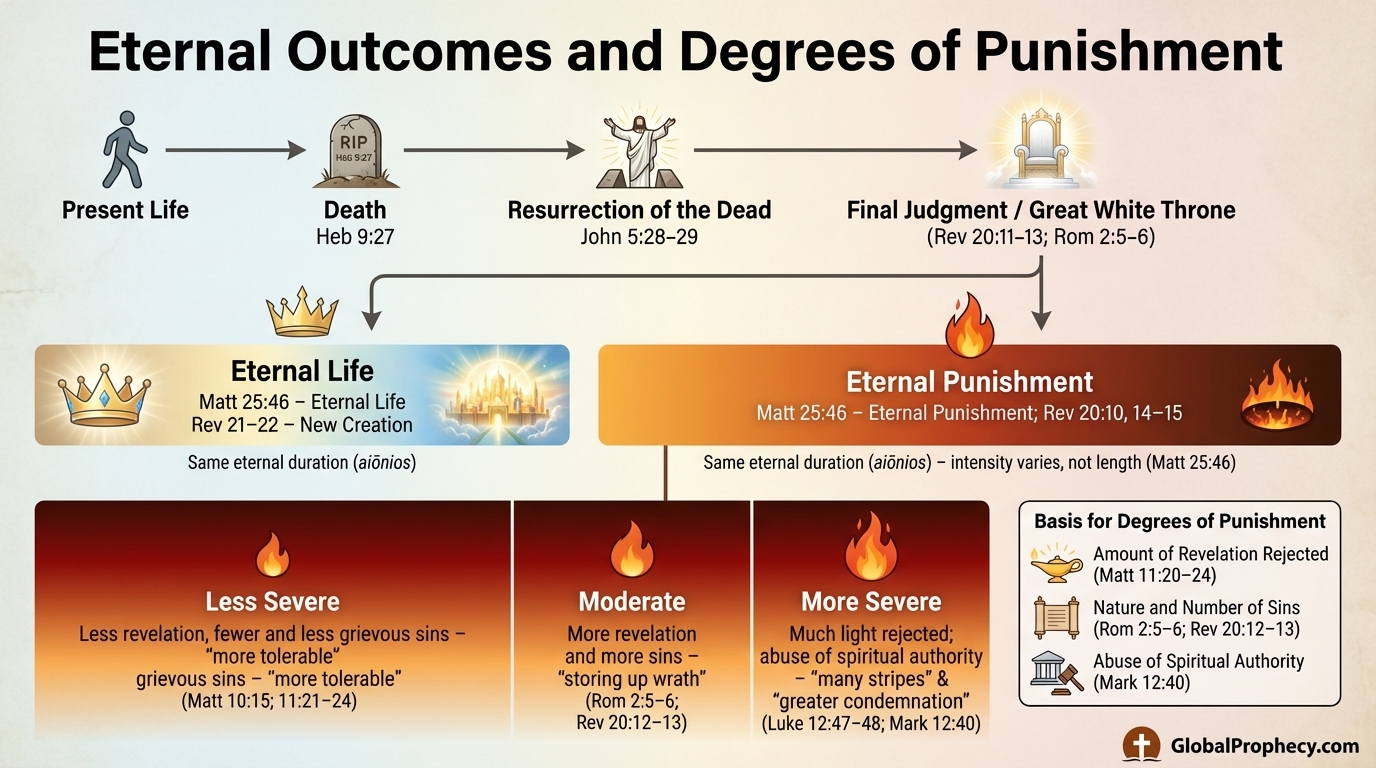
This does not deny that hell is eternal (Matthew 25:46), but it implies that the intensity or extent of suffering within that eternal state corresponds to one’s deeds and response to God’s revelation.
3. Jesus’ Teaching on Greater and Lesser Judgment
Jesus Himself gives the clearest support for different levels of punishment in hell. Several passages are especially important.
3.1 More Tolerable for Some Than for Others
In His denunciation of Galilean towns that rejected His miracles, Jesus says:
"Woe to you, Chorazin! Woe to you, Bethsaida! For if the mighty works done in you had been done in Tyre and Sidon, they would have repented long ago in sackcloth and ashes. But I tell you, it will be more bearable on the day of judgment for Tyre and Sidon than for you.…
… it will be more tolerable on the day of judgment for the land of Sodom than for you."
— Matthew 11:21–22, 24 (cf. Matthew 10:15)
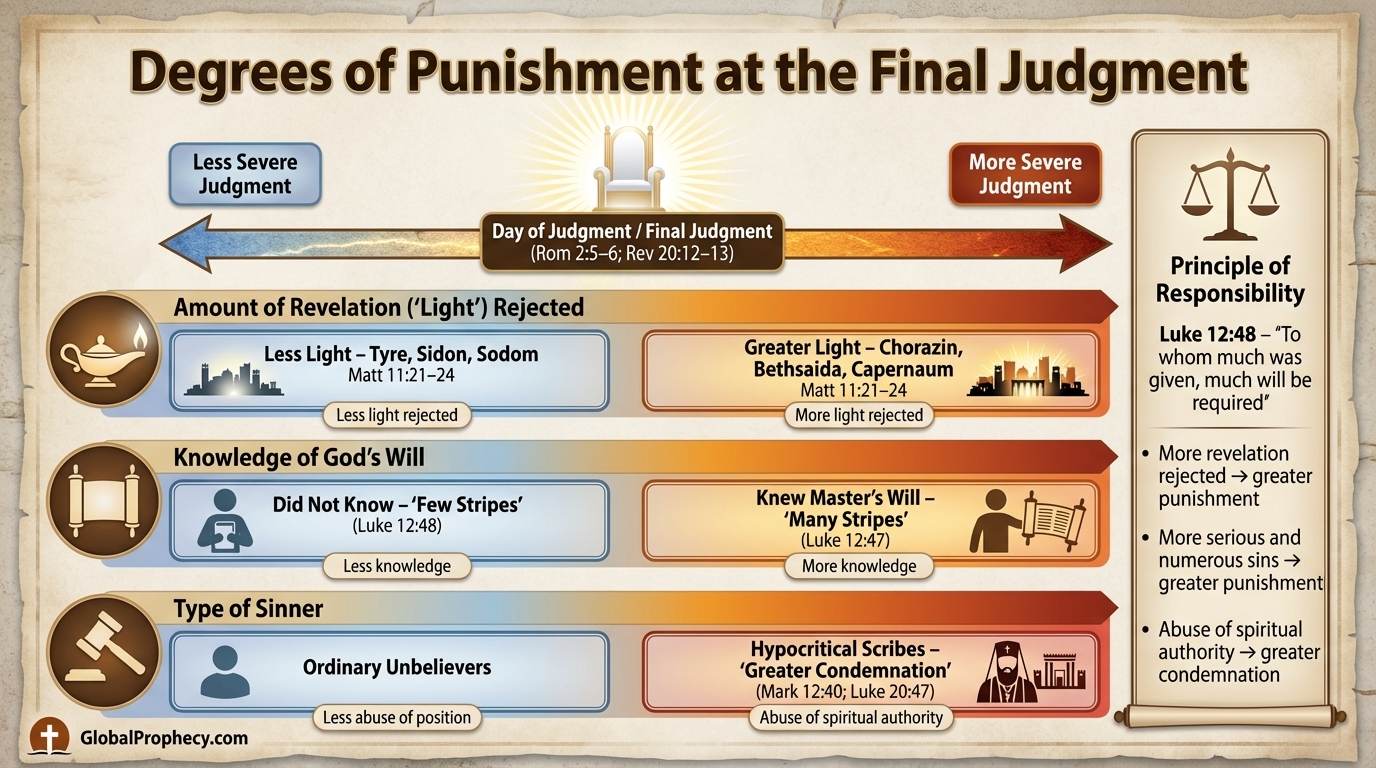
The phrase “more bearable” or “more tolerable” assumes comparative severity. All these cities face divine judgment, but some will endure a more tolerable outcome than others.
The decisive factor is the amount of light rejected:
- Chorazin, Bethsaida, and Capernaum saw Christ’s miracles and heard His preaching.
- Tyre, Sidon, and Sodom did not receive that same level of revelation.
Greater light rejected brings greater judgment.
3.2 Many Stripes and Few Stripes
Jesus’ parable of the servant in Luke 12 makes the same point in another way:
"And that servant who knew his master's will but did not get ready or act according to his will, will receive a severe beating. But the one who did not know, and did what deserved a beating, will receive a light beating. Everyone to whom much was given, of him much will be required, and from him to whom they entrusted much, they will demand the more."
— Luke 12:47–48
The imagery of “many lashes” and “few lashes” is a figure for degrees of punishment. The principle is explicit:
- Knowledge increases responsibility: “who knew his master’s will.”
- Ignorance lessens, but does not remove, guilt: the ignorant servant still “did what deserved a beating,” but his punishment is lighter.
Jesus applies this with the general maxim: “Everyone to whom much was given, of him much will be required.” This is foundational for the doctrine of degrees of punishment in hell.
3.3 Greater Condemnation for Religious Hypocrisy
Jesus also warned that religious leaders who exploit their position will face greater condemnation:
"[The scribes] who devour widows’ houses and for a pretense make long prayers. They will receive the greater condemnation."
— Mark 12:40 (cf. Luke 20:47)
If there is a “greater” condemnation, there is necessarily a “lesser” one. Again, all unbelievers are condemned (John 3:18), but some bear a heavier sentence because of the gravity and hypocrisy of their sins.
4. Criteria for Degrees of Punishment
From these passages, we can identify at least two major biblical criteria that affect the degree of punishment in hell.
4.1 Amount of Revelation (Light) Rejected
Passages: Matthew 10:15; 11:20–24; Luke 12:47–48.
Those who have received greater spiritual privilege—clearer revelation of God’s truth—will face stricter judgment if they reject it.
Examples of “greater light” include:
- Direct exposure to Christ’s teaching and miracles (first-century Israel).
- Long-term access to Scripture and faithful preaching.
- Persistent conviction by the Holy Spirit.
By contrast, those with less access to special revelation are still guilty (cf. Romans 1:18–20; 2:12–16), but Jesus indicates their final judgment will be less severe than for those who resisted much more light.
4.2 Nature and Number of Sins
Passages: Romans 2:5–6; Revelation 20:12–13; Luke 12:47–48.
Scripture also stresses that people “store up wrath” by what they do (Rom 2:5), and are judged “according to what they had done” (Rev 20:12–13). This suggests a careful, comprehensive evaluation of each person’s life.
We can summarize these biblical criteria in a simple way:
| Factor | Effect on Severity of Punishment | Key Texts |
|---|---|---|
| Amount of revelation rejected | More revelation rejected → greater punishment | Matt 10:15; 11:21–24; Lk 12:47 |
| Number and gravity of sins | More and more serious sins → greater punishment | Rom 2:5–6; Rev 20:12–13 |
| Abuse of spiritual authority | Hypocritical leaders → “greater condemnation” | Mark 12:40 |
These distinctions do not diminish the horror of hell; they show that even within eternal punishment, God’s justice remains precise and proportionate.
5. Degrees of Punishment and the Eternity of Hell
Some object that if there are degrees of punishment in hell, this might imply that hell is temporary or that some will eventually “pay off” their debt and be released. Scripture does not allow this conclusion.
5.1 Eternal Duration for Both Saved and Lost
Jesus explicitly parallels the duration of heaven and hell:
"And these will go away into eternal punishment, but the righteous into eternal life."
— Matthew 25:46
The same Greek adjective (aiōnios) describes both “eternal punishment” and “eternal life.” To make one “everlasting” and the other merely “temporary” or “age-long” is exegetically inconsistent.
Revelation likewise describes the fate of the devil, the beast, and the false prophet:
"They will be tormented day and night forever and ever."
— Revelation 20:10
Those whose names are not in the book of life share the same “lake of fire” (Rev 20:14–15; 21:8). The duration is eternal; the degree of torment within that eternity varies according to God’s perfect judgment.
5.2 Degrees Do Not Soften the Reality of Hell
Recognizing degrees of punishment does not make hell mild for anyone. Even those under the “least” punishment are:
- Under eternal destruction and banishment from God’s presence (2 Thessalonians 1:9).
- In a realm of outer darkness with “weeping and gnashing of teeth” (Matthew 8:12).
- Experiencing God’s undiluted wrath (Revelation 14:10–11).
The doctrine of degrees of punishment simply affirms that no injustice exists in God’s final judgment. No one will suffer more—or less—than is perfectly fitting to their knowledge and their sin.
6. The Practical and Theological Significance
Why does it matter that there are degrees of punishment in hell if hell is eternal for all who are lost?
6.1 Vindication of God’s Justice
The doctrine guards the biblical truth that God is righteous in all His ways. It rebuts the charge that eternal punishment must be arbitrary or disproportionate. Because:
- The holiness of the God offended is infinite.
- The guilt of the sinner increases with greater light rejected.
- The record of each life is perfectly known and weighed.
Therefore, eternal punishment, with degrees of severity, is a coherent expression of divine justice, not a denial of God’s love or righteousness.
6.2 Greater Responsibility for Greater Privilege
Christ’s warning—“Everyone to whom much was given, of him much will be required” (Luke 12:48)—lands with particular weight on:
- Those raised under gospel preaching.
- Those with extensive theological knowledge.
- Spiritual leaders and teachers.
Such people cannot plead ignorance. Their responsibility—and potential condemnation if they reject the truth—is greater, not lesser.
6.3 Motivation for Evangelism and Holiness
Understanding that:
- All who die without Christ face eternal punishment, and
- Within that eternity, judgment will be exactly proportioned to each person’s light and sin,
should deepen:
- Our urgency in evangelism: people are “storing up wrath” every day without Christ (Rom 2:5).
- Our sobriety about rejecting or neglecting biblical truth.
- Our gratitude for salvation by grace alone through faith alone in Christ alone, who bore the wrath our sins deserved.
7. Conclusion
The Bible affirms both the eternity of hell and the degrees of punishment within it. Jesus’ warnings about things being “more tolerable” for some than for others, His parable of “many” and “few” stripes, Paul’s insistence that God will render to each according to his works, and the final judgment “according to what they had done” all converge on a clear conclusion:
- Hell is equally eternal for all who are lost.
- Hell is not equally severe for all who are lost.
This truth magnifies the justice, holiness, and precision of God’s judgment, while in no way lessening the terror of being eternally separated from Him. It should move us to tremble at His Word, flee to Christ for refuge, and plead earnestly with others to be reconciled to God before it is too late.
FAQ
Q: Does the Bible clearly teach that there are degrees of punishment in hell?
Yes. Jesus speaks of it being “more tolerable” for some cities than others in the day of judgment (Matthew 10:15; 11:22, 24), of servants receiving “many” versus “few” stripes based on knowledge (Luke 12:47–48), and of certain scribes receiving “greater condemnation” (Mark 12:40). Paul and John add that people are judged “according to what they had done” (Romans 2:6; Revelation 20:12–13).
Q: If there are different degrees of punishment in hell, is hell still eternal?
Yes. Degrees of punishment concern the intensity or extent of suffering, not the duration. Jesus teaches “eternal punishment” and “eternal life” in parallel (Matthew 25:46), using the same word for “eternal” in both cases. Revelation 14:11 and 20:10 describe torment that continues “forever and ever.”
Q: On what basis does God determine the degree of punishment in hell?
Biblically, two main factors are emphasized: (1) the amount of revelation or spiritual light a person received and rejected (Matthew 11:20–24; Luke 12:47–48), and (2) the nature and number of sins committed (Romans 2:5–6; Revelation 20:12–13). Abuse of spiritual authority also incurs a “greater condemnation” (Mark 12:40).
Q: Does the doctrine of degrees of punishment in hell make hell less serious?
No. Even the “least” degree of punishment in hell involves eternal separation from God, outer darkness, and weeping and gnashing of teeth (Matthew 8:12; 2 Thessalonians 1:9). Degrees of punishment underscore God’s precise justice; they do not in any way soften the reality or horror of hell.
Q: How should the teaching on degrees of punishment in hell affect Christians today?
It should deepen our sense of responsibility for the light we have received, intensify our urgency in evangelism, and strengthen our confidence in God’s justice. Knowing that God will judge every person perfectly “according to his works” (Romans 2:6) assures us that no sin will be overlooked and no punishment will be unfair.
Frequently Asked Questions
Does the Bible clearly teach that there are degrees of punishment in hell?
If there are different degrees of punishment in hell, is hell still eternal?
On what basis does God determine the degree of punishment in hell?
Does the doctrine of degrees of punishment in hell make hell less serious?
How should the teaching on degrees of punishment in hell affect Christians today?
L. A. C.
Theologian specializing in eschatology, committed to helping believers understand God's prophetic Word.
Related Articles
Degrees of Punishment in Hell
Degrees of punishment in hell, based on works and knowledge, explained from Scripture. Explore how divine justice varies in eternal judgment.
What Is Hell?
Hell is the eternal place of punishment for the unrighteous. Discover what the Bible teaches about hell's nature, purpose, and who goes there.
Is Hell's Punishment Eternal?
Is hell's punishment eternal or temporary? Explore key Bible texts, assess alternative views, and see why Scripture teaches conscious, everlasting judgment.
What is The Day of the Lord?
Day of the Lord: discover what Scripture means by this future time of divine judgment and restoration, its timing in prophecy, and key end-time events.