
The Environment of the New Earth
1. Introduction
Biblical eschatology teaches that the destiny of redeemed humanity is not an immaterial existence in a vague “heaven,” but embodied life on a new earth under a new heaven. The climactic vision of Revelation 21–22 describes the environment of this renewed creation: its physical structure, its atmosphere, its light, its ecology, and its central city, the New Jerusalem.
This article focuses exclusively on the environment of the new earth—what it is like as a place—and how it relates to the new heaven in the eternal state.
2. The New Heaven and New Earth as a Renewed Cosmos
2.1 A New Created Order
John writes:
“Then I saw a new heaven and a new earth, for the first heaven and the first earth had passed away”
— Revelation 21:1
This “new heaven and new earth” (cf. Isaiah 65:17; 66:22; 2 Peter 3:13) denotes a renewed created order, distinct from the present fallen cosmos. Peter speaks of the current heavens and earth being destroyed by fire, so that “the heavens will be set on fire and dissolved, and the heavenly bodies will melt as they burn” (2 Peter 3:12). Whether one emphasizes total re‑creation or radical transformation, the result is a qualitatively different environment:
- The old order “passes away” (Rev 21:1,4)
- The new order is characterized as “where righteousness dwells” (2 Pet 3:13)
The term “heaven” in Revelation 21:1 refers to the cosmic heavens—the sky and starry space above the earth—not to the dwelling of God. The vision describes a new spatial environment above and around a renewed earth, forming a unified, harmonious universe.
2.2 A World Without Sea
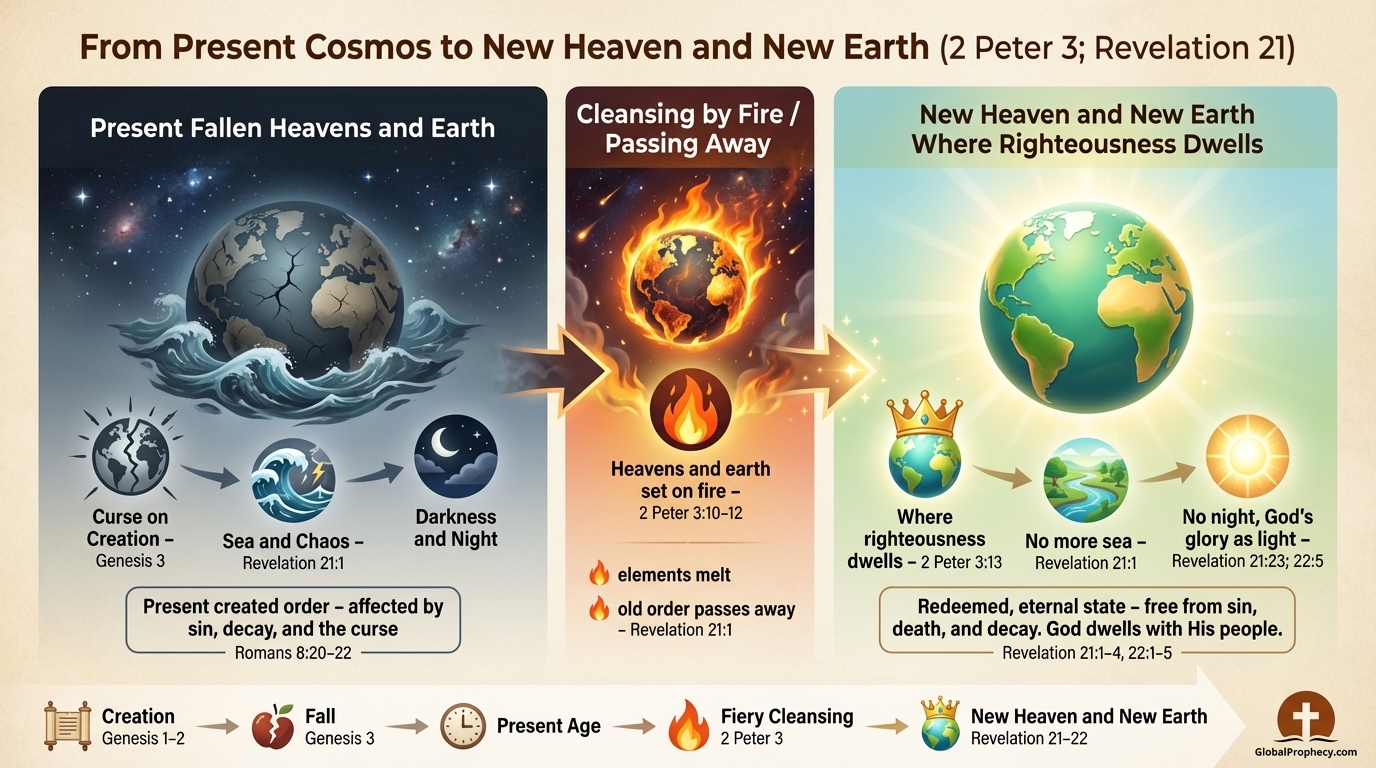
A striking geophysical statement appears immediately:
“and the sea was no more.”
— Revelation 21:1
The absence of the sea marks a fundamental environmental difference from the present earth, which is largely ocean-covered.
This likely indicates:
- No vast, separating oceans dominating the surface
- No chaotic, dangerous waters (in biblical imagery, the sea often symbolizes threat, restlessness, and division)
The new earth is therefore pictured as a fully habitable, unified land environment, without vast marine barriers dividing peoples and lands.
3. The Atmosphere and Light of the New Earth
3.1 The End of Night and Darkness
In the eternal state, darkness and night are permanently banished:
“And there will be no night there.”
— Revelation 21:25; cf. 22:5
The new earth’s environment is perpetually illuminated. Night, with its associations of danger, fear, and limitation, is completely removed from the human experience. This does not negate the existence of time (there are “months” in Rev 22:2), but it does remove the cycle of darkness as we know it.
3.2 No Need of Sun or Moon
John adds:
“And the city has no need of sun or moon to shine on it, for the glory of God gives it light, and its lamp is the Lamb.”
— Revelation 21:23
This does not necessarily deny the existence of astronomical bodies in the new heaven, but states that the primary functional source of light and glory is God Himself:
- The glory of God is the pervasive luminous environment
- The Lamb (Christ) is the lamp—He mediates and manifests that glory
Thus, the atmosphere of the new earth is saturated with divine radiance, perfectly clear and unobstructed. The repeated emphasis on transparency (gold “like clear glass,” jasper “clear as crystal,” Rev 21:11,18,21) underscores that the whole environment is designed to transmit God’s light without hindrance.
3.3 A World Without Curse
The spiritual and physical environment are inseparably connected:
“No longer will there be any curse.”
— Revelation 22:3
The curse pronounced in Genesis 3 affected the ground, the environment, and the whole created order. On the new earth:
- No decay
- No futility or frustration in nature
- No disordered ecosystems or hostile creation
The abolition of the curse means a perfectly ordered, life‑supporting, harmonious environment, fully aligned with God’s intent.
4. The New Jerusalem: Capital City of the New Earth
4.1 Descent from Heaven to Earth
The central feature of the new earth’s environment is the New Jerusalem:
“I saw the holy city, new Jerusalem, coming down out of heaven from God…”
— Revelation 21:2; cf. 21:10
This is not a mere symbol of the redeemed; it is repeatedly described as a city with measurable dimensions, walls, gates, foundations, streets, and internal structures (Rev 21:10–21). It descends from the present heaven (God’s dwelling) to the new earth, becoming:
- The capital city of the new creation
- The central locus of God’s manifest presence in the eternal state
Heaven and earth are thus united: God’s throne and dwelling move down to the new earth, rather than redeemed humanity remaining in a distant realm.
4.2 Dimensions and Shape
The city’s dimensions are staggering:
“The city lies foursquare… its length and width and height are equal… 12,000 stadia.”
— Revelation 21:16
12,000 stadia is roughly 1,400–1,500 miles in each direction. The city is therefore:
- Immense in footprint (over 2 million square miles)
- Immense in vertical dimension (a perfect cube or possibly a pyramid)
This three‑dimensional extent implies:
- A multi‑level, fully three‑dimensional environment, not a thin, one‑level city
- Massive capacity for inhabitants, structures, and activities
The shape—with all sides equal—echoes the cubical Holy of Holies in the Old Testament temple (1 Kings 6:20), symbolizing that the entire city is a sanctuary‑environment where God dwells openly with His people.
4.3 Materials and Transparency
The environmental aesthetic of the New Jerusalem is marked by purity, radiance, and transparency:
- Wall: “built of jasper” (Rev 21:18)
- City: “pure gold, like clear glass” (21:18)
- Street: “pure gold, transparent as glass” (21:21)
- Foundations: adorned with twelve precious stones in varied colors (21:19–20)
- Gates: each made of a single pearl (21:21)
This description highlights:
- A visually breathtaking environment: multi‑colored crystalline structures reflecting divine light
- A maximally light‑transmitting architecture: transparency allows the glory of God to permeate the city from every angle
- A permanently durable, incorruptible construction: no decay, erosion, or structural failure
The New Jerusalem thus shapes the urban environment of the new earth as a mega‑sanctuary city of light, designed explicitly to display and transmit the glory of God.
5. The Ecology of the New Earth: River and Tree of Life
5.1 The River of the Water of Life
At the heart of the New Jerusalem’s environment is a river:
“Then the angel showed me the river of the water of life, bright as crystal, flowing from the throne of God and of the Lamb through the middle of the street of the city.”
— Revelation 22:1–2
Key environmental features:
- Source: the throne of God and of the Lamb—life flows from God’s ruling presence
- Clarity: “bright as crystal”—absolute purity, no pollution or turbidity
- Course: “through the middle of the street of the city”—integrated into the very design of the city
This river is literal and symbolic: a tangible watercourse that also signifies the perpetual outflow of life, refreshment, and blessing throughout the new earth. It is the central hydrological feature of the New Jerusalem and, by extension, of the new earth.
5.2 The Tree of Life and Perpetual Fruitfulness
John continues:
“On either side of the river, the tree of life with its twelve kinds of fruit, yielding its fruit each month.”
— Revelation 22:2
The Tree of Life, barred to humanity after the Fall (Gen 3:22–24), reappears as a restored ecological center:
- Located “on either side of the river”—either a vast tree spanning the river or a grove of such trees
- Produces “twelve kinds of fruit”—extraordinary diversity and richness
- Bears fruit “each month”—continuous, rhythmic productivity
This depicts an eternal environment of abundance, where:
- Food and enjoyment are superabundant and varied
- Time exists in a perfected cycle (the mention of “month” assumes ongoing temporal markers)
The leaves of the tree are said to be:
“for the healing of the nations.”
— Revelation 22:2
Given that Revelation 21:4 excludes sickness, death, and pain, “healing” here (Greek therapeia) is best understood as health‑giving, life‑enhancing, not curative of existing disease. The ecological picture, then, is of:
- A life‑sustaining biosphere without decay or disease
- Humanity and nations continually nourished by God’s provision through the created environment
6. Social and Spatial Structure of the New Earth
6.1 Nations and Kings in a Transformed Environment
The new earth is not an abstract, undifferentiated realm. John notes:
“By its light will the nations walk, and the kings of the earth will bring their glory into it.”
— Revelation 21:24; cf. 21:26
Environmentally, this implies:
- Nations still exist as recognizable corporate entities
- There is geographical and cultural diversity on the new earth
- These nations move in and out of the New Jerusalem, bringing their best (“glory and honor”) into the city
Thus, beyond the city lies a broader planetary environment:
- Populated, organized, and active
- Perfectly integrated with the New Jerusalem as the spiritual and political center
6.2 Open Gates and Total Security
We are told:
“Its gates will never be shut by day—and there will be no night there.”
— Revelation 21:25
Environmental-security implications:
- No external threats: no enemies, no predators, no danger
- No need for defense infrastructure: gates never closed, angels positioned not as wardens against danger but as attendants to glory
- Unrestricted movement: the flow between city and wider earth is permanent and unhindered
The social‑spatial environment of the new earth is therefore one of absolute safety, openness, and free access, in contrast to today’s world of locks, walls, and borders.
7. The Relationship Between the New Heaven and the New Earth
7.1 Spatial Union of Realms
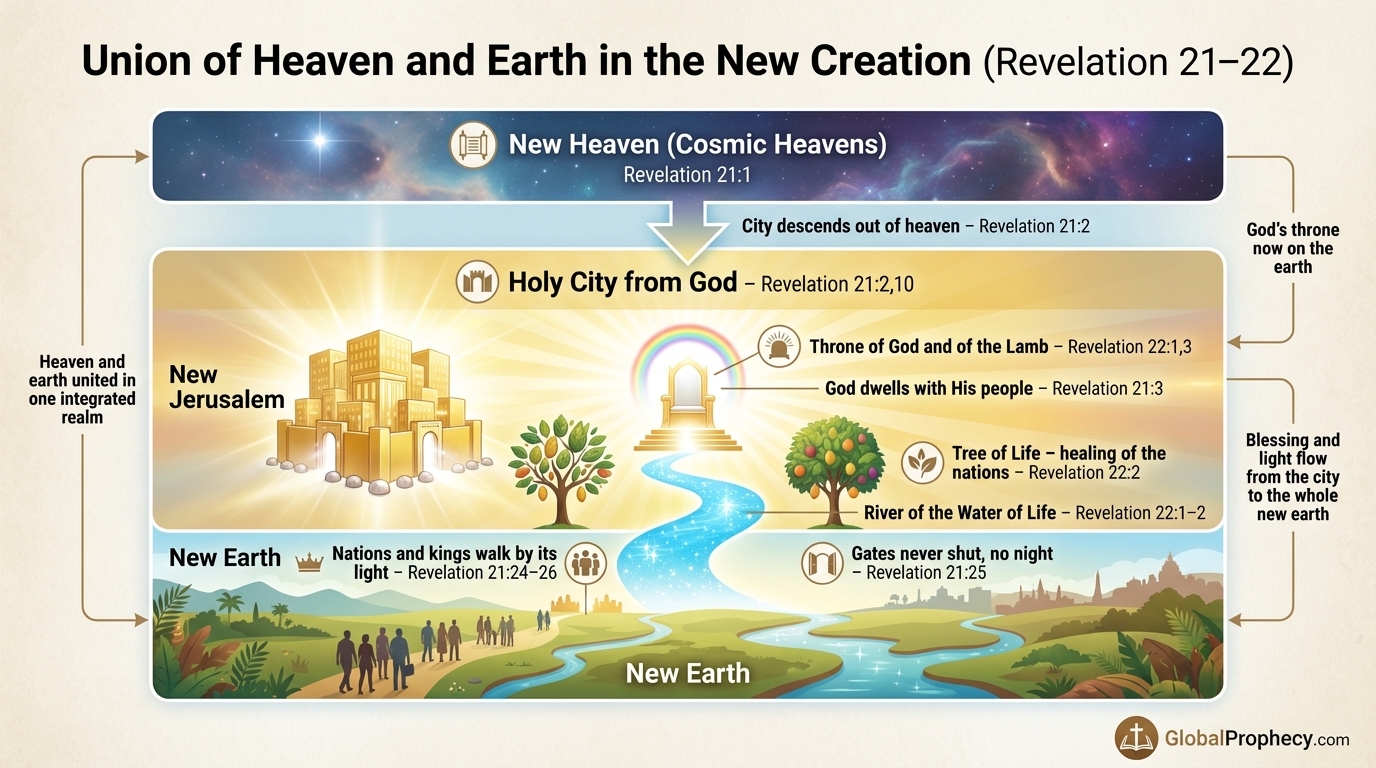
In the eternal state, the distinction between “heaven” and “earth” is transformed. John hears:
“Behold, the dwelling place of God is with man. He will dwell with them, and they will be his people.”
— Revelation 21:3
The New Jerusalem descends “out of heaven from God” (21:2,10) and rests in relation to the new earth as its capital. This means:
- The present “third heaven,” the abode of God, intersects permanently with the new earth
- God’s throne is now located in the city on the new earth (Rev 22:1,3)
- The “new heaven” (cosmic environment above) and the “new earth” are one integrated theater of God’s presence
7.2 God’s Throne and the Environmental Center
At the core of this unified cosmos stands:
“the throne of God and of the Lamb… in the city.”
— Revelation 22:3
From that throne:
- The river of life flows (environmental blessing)
- Light issues forth (environmental illumination)
- Rule is exercised (“they will reign forever and ever,” 22:5)
The environment of the new earth is thus not autonomous; it is structured around, sustained by, and suffused with the immediate presence and rule of God in Christ.
8. Conclusion
The environment of the new earth, as portrayed in Revelation 21–22, is a fully real, physical, ordered creation, radically different from the present world:
- No sea dominating the surface
- No night, no darkness, and no curse
- A cosmos illuminated by the glory of God and the Lamb
- A colossal, radiant capital city—the New Jerusalem—descending from heaven
- An inner ecology of a crystal river and the Tree of Life, symbolizing endless life and abundance
- Nations and kings inhabiting a secure, open, and harmonious planetary society
- God’s throne and dwelling permanently located with humanity
In the eternal state, heaven and earth are united: the dwelling of God becomes the environment of man, and the environment of man is perfectly adapted to display the glory of God. The new earth is, in every sense, creation consummated—a world wholly filled with light, life, and righteousness.
FAQ
Q: Will the new earth be a physical place or purely spiritual?
The new earth will be a real, physical environment. Revelation describes measurable distances, walls, foundations, gates, a river, and trees (Rev 21–22). Believers are raised in glorified bodies, suited to inhabit this renewed creation. The environment is transformed and perfected, but it remains truly material and spatial.
Q: What does it mean that there will be “no more sea” on the new earth?
Revelation 21:1 says “the sea was no more,” indicating that vast oceans as we know them will be absent. This likely points both to geophysical change (no global oceans dominating the surface) and to the removal of what the sea often symbolizes in Scripture—chaos, danger, and separation. The new earth is portrayed as a fully unified, habitable realm without such divisions.
Q: How is the New Jerusalem related to the new earth?
The New Jerusalem is a real city that “comes down out of heaven from God” to the new earth (Rev 21:2,10). It functions as the capital of the new creation, housing the throne of God and of the Lamb. While nations dwell on the wider new earth, they walk by the city’s light and bring their glory into it (Rev 21:24–26), showing an ongoing relationship between the city and the surrounding world.
Q: Will there be time on the new earth?
Yes. The Tree of Life “yields its fruit each month” (Revelation 22:2), which implies ongoing temporal sequence. What disappears is not time itself but night, decay, and death. Time on the new earth will be endless and unthreatened, marking the rhythms of unending life rather than the approach of mortality.
Q: Why does the Bible say there is no need of sun or moon in the New Jerusalem?
Revelation 21:23 explains that the city “has no need of sun or moon… for the glory of God gives it light, and its lamp is the Lamb.” This means the primary and sufficient source of illumination in the city is the revealed glory of God in Christ. It does not necessarily deny the existence of heavenly bodies, but it declares that in the new earth’s central environment, God’s own radiance completely fulfills the function of light.
Frequently Asked Questions
Will the new earth be a physical place or purely spiritual?
What does it mean that there will be “no more sea” on the new earth?
How is the New Jerusalem related to the new earth?
Will there be time on the new earth?
Why does the Bible say there is no need of sun or moon in the New Jerusalem?
L. A. C.
Theologian specializing in eschatology, committed to helping believers understand God's prophetic Word.
Related Articles
The New Jerusalem
New Jerusalem, the eternal dwelling place of believers, revealed in Revelation 21–22: explore its glory, structure, and promise of life with God.
The 144,000 Sealed Israelites
144,000 sealed Israelites in Revelation identified and explained—their identity, purpose, and distinct role as preserved witnesses during the Tribulation.
Babylon the Great
Babylon the Great in Revelation 17–18 reveals end-time religious and commercial rebellion against God and its sudden, final destruction in judgment.
What is the Battle of Armageddon?
Armageddon, the climactic end-times battle, is described in Revelation 16 and 19. Learn what this final conflict is and when it will occur.