
The Gap Between the 69th and 70th Week: Why the Church Age Interrupts Daniel's Prophecy
1. Introduction: Daniel’s Prophetic Clock and the Mystery Gap
The prophecy of the seventy weeks in Daniel 9:24–27 is often called the “backbone of Bible prophecy.” It provides a precise timetable for God’s program for Israel and Jerusalem, stretching from the Persian period to the future tribulation and the return of Christ.
Yet the text itself shows that the prophetic clock does not run straight through. There is a deliberate gap between the 69th and 70th week—a pause in Israel’s prophetic timetable during which God is doing something new and distinct: the church age.
This article explains why there is a gap, what Scripture says about it, and what happens during this interval between the 69th and 70th week of Daniel’s prophecy.
2. The Seventy Weeks Prophecy: Framework for Israel, Not the Church
Daniel 9:24 opens by defining the scope of the seventy weeks:
“Seventy weeks are decreed about your people and your holy city…”
— Daniel 9:24
Two points are foundational for understanding the gap:
-
The prophecy is explicitly for Israel and Jerusalem.
- “Your people” = Daniel’s people = ethnic Israel.
- “Your holy city” = Jerusalem.
- Nothing in the text suggests that “your people” has become the church or that “your holy city” has become a symbol for heaven or the universal church.
-
The time units are “sevens” of years, not days.
- The term literally means “seventy sevens.” In this context, it refers to sevens of years, yielding 70 × 7 = 490 years.
- Daniel has just been reading Jeremiah’s prophecy about 70 years of captivity (Dan 9:1–2; Jer 25:11–12; 29:10), so he is already thinking in years.
- Israel’s calendar recognized “sevens” of years in the sabbatical cycles (Lev 25:1–9).
Thus Daniel 9:24–27 outlines 490 prophetic years in which God will accomplish six great purposes for Israel, culminating in their spiritual restoration and the establishment of Messiah’s kingdom.
3. The First 69 Weeks: From the Decree to the Messiah’s Presentation
3.1 Start Point: The Decree to Rebuild Jerusalem
Daniel 9:25 gives the starting point:
“From the going out of the word to restore and build Jerusalem…”
— Daniel 9:25
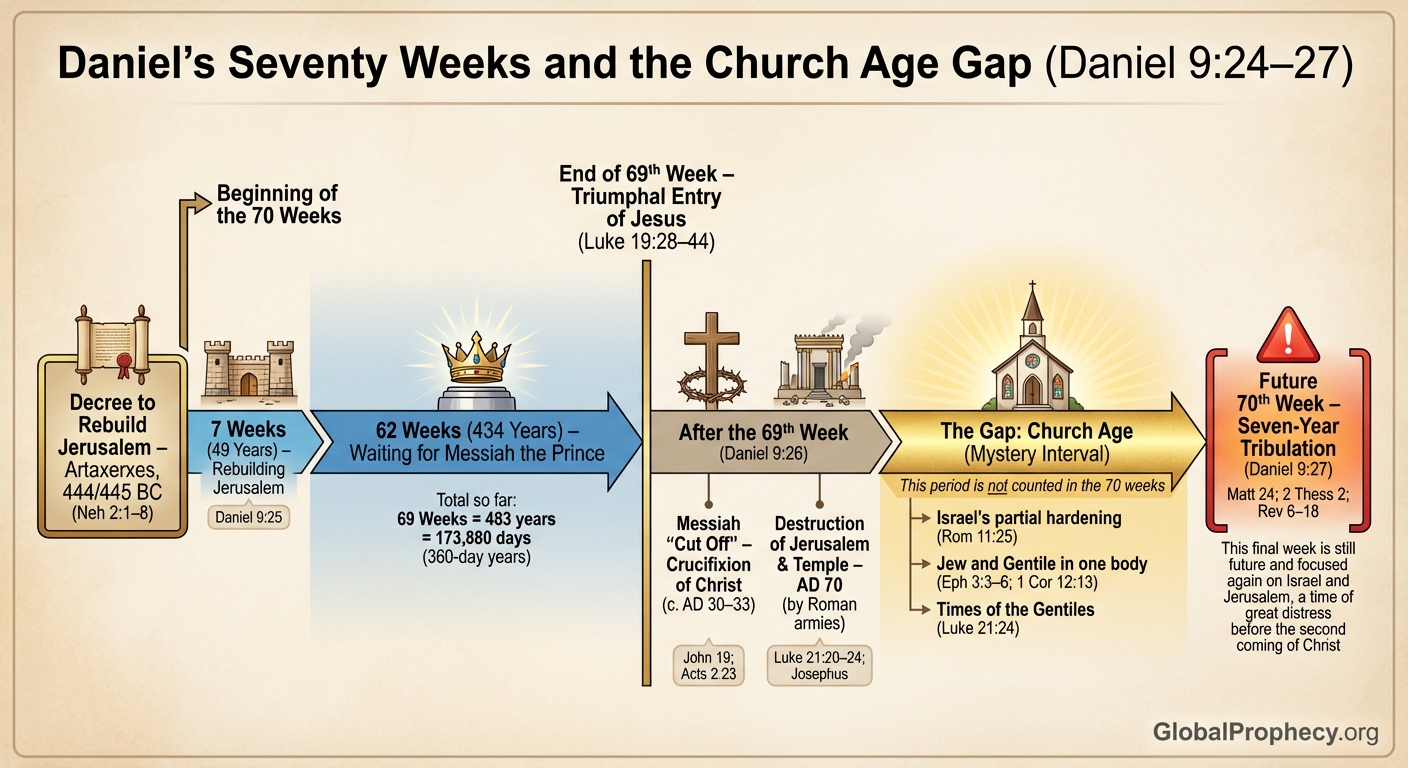
Among the Persian decrees recorded in Scripture, only the decree of Artaxerxes in 444/445 BC (Neh 2:1–8) explicitly authorizes the rebuilding of the city and its walls, not just the temple. This matches Daniel’s wording.
3.2 The 69 Weeks (7 + 62): 483 Years to Messiah the Prince
Daniel continues:
“…to the coming of an anointed one, a prince, there shall be seven weeks. Then for sixty-two weeks it shall be built again…”
— Daniel 9:25
- The prophecy divides the first 69 weeks into 7 weeks (49 years) plus 62 weeks (434 years), a total of 483 years.
- Using a 360‑day prophetic year, 483 years = 173,880 days.
- From the decree (444/445 BC) this period extends to the public presentation of Messiah the Prince—fulfilled in Jesus’ triumphal entry into Jerusalem (often dated to AD 30 or 33).
At that moment, Jesus openly presents Himself as Israel’s King (Luke 19:28–44), precisely at the close of the 69th week.
3.3 After the 69th Week: Messiah Cut Off and Jerusalem Destroyed
Daniel 9:26 is crucial for seeing the gap:
“After the sixty-two weeks, an anointed one shall be cut off and shall have nothing. And the people of the prince who is to come shall destroy the city and the sanctuary…”
— Daniel 9:26
Notice carefully:
- These events occur “after” the 69 weeks, not during the 70th week and not at the boundary of the 69th.
- Two major historical events are predicted:
- Messiah is “cut off” — Christ’s crucifixion.
- “The city and the sanctuary” are destroyed — the destruction of Jerusalem and the temple by the Romans in AD 70.
Both events occurred decades before any future seven-year tribulation and decades after the end of the 69th week. This already implies a time interval between the 69th and 70th weeks.
4. Evidence for a Gap Between the 69th and 70th Week
The idea of a “gap” is not an artificial addition; it emerges from the text and from later Scripture.
4.1 The Word “After” in Daniel 9:26
Daniel explicitly places Messiah’s death and the destruction of Jerusalem “after the sixty-two weeks” (i.e., after the full 69 weeks).
- The Messiah is cut off not in the 70th week, but after the 69th.
- The city and sanctuary are destroyed not within the 70th week, but also after the 69th, historically around AD 70.
If the 70th week followed immediately with no interruption, the destruction of Jerusalem would have occurred within a few years of the crucifixion. Instead, it happened almost 40 years later. Only a time gap between the 69th and 70th weeks can account for this.
4.2 The 70th Week Is Still Future in the New Testament
Daniel 9:27 describes the 70th week:
“And he shall make a strong covenant with many for one week, and for half of the week he shall put an end to sacrifice and offering. And on the wing of abominations shall come one who makes desolate…”
— Daniel 9:27
Key observations:
- The “he” of verse 27 links back to “the people of the prince who is to come” in verse 26—a future ruler from the same people who destroyed the temple, i.e., a Roman-origin world leader, not Christ.
- This ruler makes a seven-year covenant with “many” in Israel, breaks it halfway through, and commits an abomination that causes desolation in the temple.
Jesus, however, speaks of this abomination as future in His Olivet Discourse:
“So when you see the abomination of desolation spoken of by the prophet Daniel, standing in the holy place…”
— Matthew 24:15
Writing decades after the crucifixion and shortly before AD 70, Jesus still treats Daniel’s abomination (Dan 9:27; 11:31; 12:11) as yet future and connects it with the great tribulation (Matt 24:21, 29–31).
Later, Paul likewise speaks of a man of lawlessness who will sit in a future temple, proclaiming himself to be God (2 Thess 2:3–4), echoing Daniel 9:27 and 11:36–37.
The book of Revelation, written around AD 95, describes a 42‑month (three-and-a-half-year) period of intense persecution (Rev 11:2–3; 12:6; 13:5), matching Daniel’s “half of the week.” John clearly treats this as still future.
If Daniel’s 70th week had already run consecutively after the 69th in the first century, these New Testament passages would not present its key events as future.
4.3 Prophetic Gaps Are Common in Scripture
The concept of a prophetic gap between closely linked events is not unusual.
- Zechariah 9:9–10 moves from Messiah’s humble entry on a donkey (fulfilled at the first coming) to His worldwide reign of peace (fulfilled at the second coming), with the entire church age between two verses.
- Isaiah 61:1–2 is partially quoted by Jesus in Luke 4:18–19. He stops mid-sentence and does not read “the day of vengeance of our God,” because that part awaits His second coming.
If the Old Testament often telescopes the two comings of Christ, it is fully consistent to see Daniel 9:26–27 spanning from the first coming to the end-times tribulation, with a long, unspecified interval in between.
5. Why the Gap? Israel Set Aside and the Church Brought In
5.1 The 70 Weeks Are for Israel; the Church Is Distinct
Gabriel states:
“Seventy weeks are decreed for your people and your holy city…”
— Daniel 9:24
The 70-week program concerns Israel’s national restoration, not the formation of the church. In the New Testament:
- Israel and the church are distinct entities. The church is one new man in Christ, composed of Jews and Gentiles on equal footing (Eph 2:11–16; 3:4–6).
- The church is formed by Spirit baptism beginning at Pentecost (Acts 2; 1 Cor 12:13), long after the 69th week closed.
- The church is called “the church of God”, but Old Testament Israel never is (cf. 1 Cor 10:32).
God’s 70-week clock measures His special dealings with Israel. The church is a distinct program, not counted within this prophetic period.
5.2 Israel’s Rejection and Temporary Hardening
At the end of the 69th week, Israel, as a nation, rejects her Messiah. The King comes on schedule but is “cut off and shall have nothing” (Dan 9:26).
Paul explains the consequence:
“Israel experienced a partial hardening, until the fullness of the Gentiles has come in. And in this way all Israel will be saved…”
— Romans 11:25–26
Key truths:
- Israel’s hardening is partial (not all Jews) and temporary (“until…”).
- God has not rejected His people permanently (Rom 11:1–2).
- During this period of hardening, God is gathering in the Gentiles into the church.
This is exactly what we observe during the gap:
- Israel is largely in unbelief and dispersed among the nations.
- The gospel goes out to all nations, forming the church, the body and bride of Christ.
- Meanwhile, Jerusalem is “trampled underfoot by the Gentiles, until the times of the Gentiles are fulfilled” (Luke 21:24).
5.3 The Church Age: The Interval Between Week 69 and Week 70
Putting the pieces together:
- The 69th week ends with Christ’s triumphal entry.
- “After” that week Messiah is crucified and Jerusalem is destroyed.
- God then begins something not revealed in the Old Testament in full detail—the mystery of the church, Jew and Gentile united in one body (Eph 3:3–6; Col 1:26–27).
- This entire church age—from Pentecost to the rapture—fits in the gap between the 69th and 70th week.
During this time:
- God’s 70-week clock for Israel is paused.
- God’s primary visible work in the world is through the church, not the nation of Israel.
- Israel remains under a partial hardening until “the fullness of the Gentiles” is complete.
When the church is complete and removed (at the rapture), God will resume His 70-week program and start the 70th week, the seven-year tribulation focused again on Israel and Jerusalem.
6. What Happens After the Gap? The 70th Week Resumes
Though our focus is the gap itself, we must briefly note its end-point to see its purpose clearly.
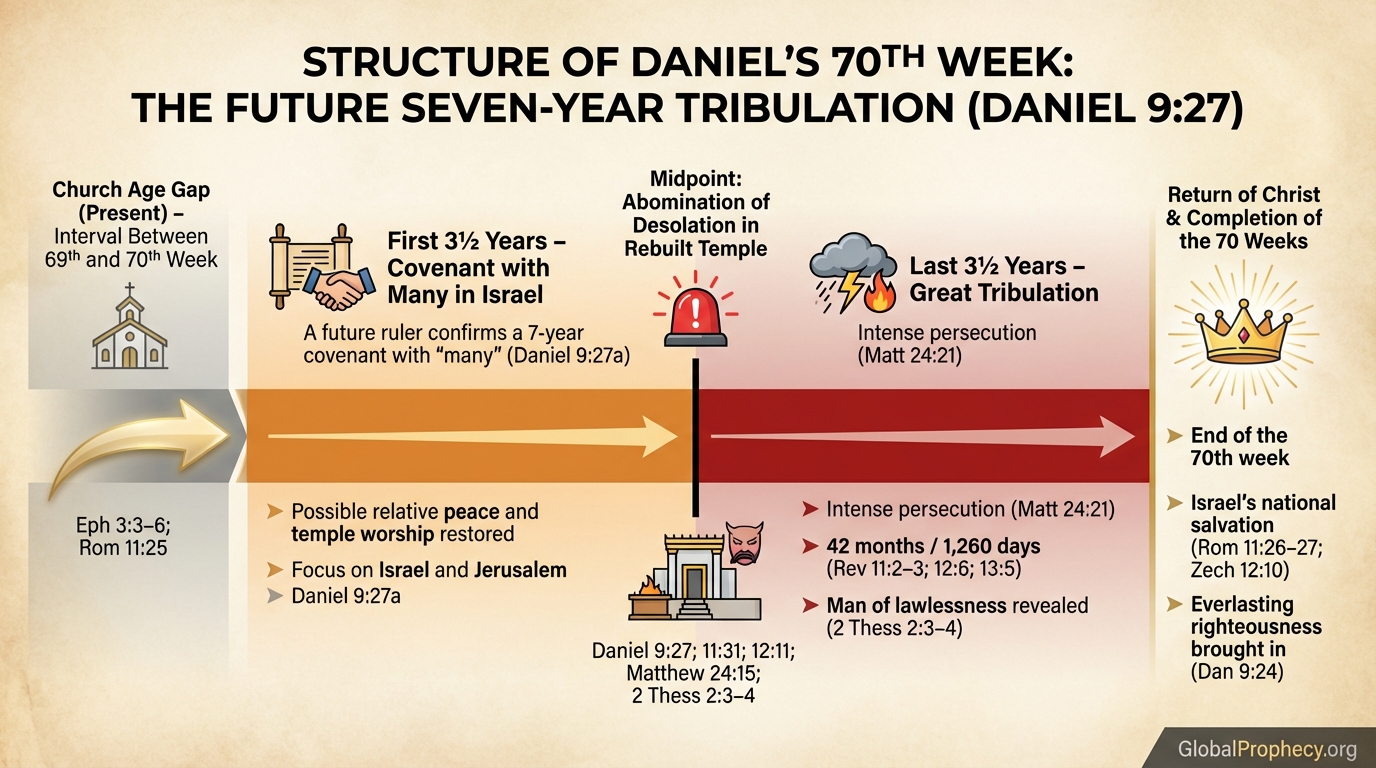
- The 70th week begins when a future ruler (the “prince who is to come”) confirms a covenant with many in Israel for one week (Dan 9:27).
- This seven-year period is the final segment of the 490 years and corresponds to the future tribulation described in Matthew 24, 2 Thessalonians 2, and Revelation 6–18.
- Midway through this week, the ruler breaks the covenant, stops sacrifice, and sets up the abomination of desolation in a rebuilt temple.
- At the end of the week, Christ returns, destroys this evil ruler, and completes the six goals of Daniel 9:24—ending Israel’s sin, bringing in everlasting righteousness, fulfilling vision and prophecy, and anointing the most holy.
The existence of the church age gap safeguards two truths simultaneously:
- God’s promises to Israel will be literally fulfilled in history.
- God’s present work in the church is a real, distinct, and revealed mystery program, not a mere redefinition of Israel.
7. Conclusion
The gap between the 69th and 70th week of Daniel is not a dispensable detail but an essential feature of biblical eschatology:
- The text of Daniel 9 demands it by placing Messiah’s death and Jerusalem’s destruction after the 69th week but before the 70th.
- Jesus, Paul, and John all treat the key events of the 70th week—the abomination of desolation, the man of lawlessness, the 42 months of tribulation—as still future, long after the first coming.
- The prophecy is explicitly for Israel and Jerusalem, while the church, formed at Pentecost, is a distinct entity and program.
The gap, therefore, is the divinely intended interval of the church age—the time when God is calling out a people for His name from all nations and when Israel remains partially hardened until the fullness of the Gentiles comes in.
When this gap closes, God will restart the prophetic clock for Israel, bringing the 70th week to pass and fulfilling every promise made to His ancient people.
FAQ
Q: Where in the Bible does it actually say there is a gap between the 69th and 70th week?
The gap is inferred from Daniel 9:26–27. The text explicitly says that Messiah is cut off and Jerusalem is destroyed “after” the 69 weeks, yet the events of the 70th week (the covenant and abomination of desolation) are still future in verse 27 and in the New Testament. The historical spacing of these events forces a time interval between the 69th and 70th week.
Q: What is happening during the gap between the 69th and 70th week?
This interval corresponds to the church age. During this time God is forming the body of Christ—Jew and Gentile together in one new man—through the gospel. Israel, as a nation, is under partial hardening (Rom 11:25), and Jerusalem is under Gentile domination (Luke 21:24). The 70-week program for Israel is paused until the future 70th week begins.
Q: Why isn’t the church included in the seventy weeks of Daniel?
Because Daniel 9:24 states that the seventy weeks are “decreed about your people and your holy city”, referring to Israel and Jerusalem, not the church. The church began at Pentecost (Acts 2) through Spirit baptism (1 Cor 12:13) and is a mystery not revealed in the Old Testament in the way it is in the New (Eph 3:3–6). God’s 70-week clock tracks His special dealings with Israel, not His separate program for the church.
Q: Does the gap view mean God is finished with Israel?
No. The gap view affirms the opposite: God’s program for Israel is only paused, not canceled. Paul insists that “God has not rejected his people whom he foreknew” (Rom 11:2). After the church age, God will resume the 70-week program, leading to Israel’s national repentance and salvation (Rom 11:26–27; Zech 12:10).
Q: How does the gap between the 69th and 70th week relate to the tribulation?
The 70th week of Daniel is the seven-year tribulation. The gap is the intervening church age between the 69th week (ending with Christ’s first coming) and this final seven-year period. When the gap ends and the 70th week begins, the events described in Daniel 9:27, Matthew 24, 2 Thessalonians 2, and Revelation 6–18 will unfold, culminating in Christ’s return and the completion of God’s purposes for Israel.
Frequently Asked Questions
Where in the Bible does it actually say there is a gap between the 69th and 70th week?
What is happening during the gap between the 69th and 70th week?
Why isn’t the church included in the seventy weeks of Daniel?
Does the gap view mean God is finished with Israel?
How does the gap between the 69th and 70th week relate to the tribulation?
L. A. C.
Theologian specializing in eschatology, committed to helping believers understand God's prophetic Word.
Related Articles
The 70 Weeks of Daniel: Understanding Bible's Prophetic Timeline
The 70 weeks of Daniel explain God's prophetic timeline for Israel, Christ's first coming, and a future 70th week leading to the end-time climax.
What is the Tribulation Period?
Tribulation period explained: discover the biblical definition, seven-year duration, and God’s prophetic purpose for this intense future time.