
The Gog and Magog Invasion: When Will It Happen?
1. Introduction
The Gog and Magog invasion of Ezekiel 38–39 is one of the most debated events in biblical eschatology. The central question is not only who invades Israel, but when this invasion occurs in relation to the rapture, the seven‑year tribulation, and the millennial kingdom. This article will focus exclusively on the timing of the Gog and Magog invasion, weighing the main views and presenting a coherent, text‑based conclusion.
Understanding the timing matters because it connects Ezekiel’s prophecy to the broader sequence of end‑time events: Israel’s regathering, the rise of Antichrist, the tribulation judgments, Armageddon, and the millennium.
2. Textual Time Markers in Ezekiel 38–39
Any discussion of the timing of Gog and Magog must begin with the explicit chronological clues in Ezekiel’s prophecy.
2.1. “Latter Years” and “Last Days”
Twice Ezekiel dates this invasion to the end‑time period:
“After many days you will be mustered. In the latter years you will go against the land…”
— Ezekiel 38:8
“…It shall come about in the latter days that I will bring you against my land…”
— Ezekiel 38:16
In Old Testament prophetic usage, “latter years” and “last days” for Israel point to the end‑time crisis surrounding the tribulation and the kingdom, not to events earlier in Israel’s history. This moves the Gog and Magog invasion firmly into the eschatological future, not the past.
2.2. Israel Regathered from “Many Nations”
Ezekiel is equally clear that this invasion occurs after a worldwide regathering of the Jewish people:
“…the land that is restored from war, the land whose people were gathered from many peoples… Its people were brought out from the peoples and now dwell securely…”
— Ezekiel 38:8, 12
Historically, Israel’s returns from Egypt, Assyria, and Babylon were from single empires, not from “many nations.” A global regathering fits the modern return of Jews to Israel since 1948 and anticipates a still more complete return in the end times. This requires that the Gog and Magog invasion be future to us and post‑diaspora.
2.3. Israel “Dwelling Securely”
A critical condition for the timing is Israel’s sense of security:
“…they are living securely, all of them.”
— Ezekiel 38:8
“I will go up against the land of unwalled villages. I will go against those who are at rest, that live securely, all of them living without walls and having no bars or gates.”
— Ezekiel 38:11
Whatever date is proposed for Gog and Magog, it must explain how and when Israel enjoys this unusual state of security.
3. Israel’s Security and Its Impact on the Timing
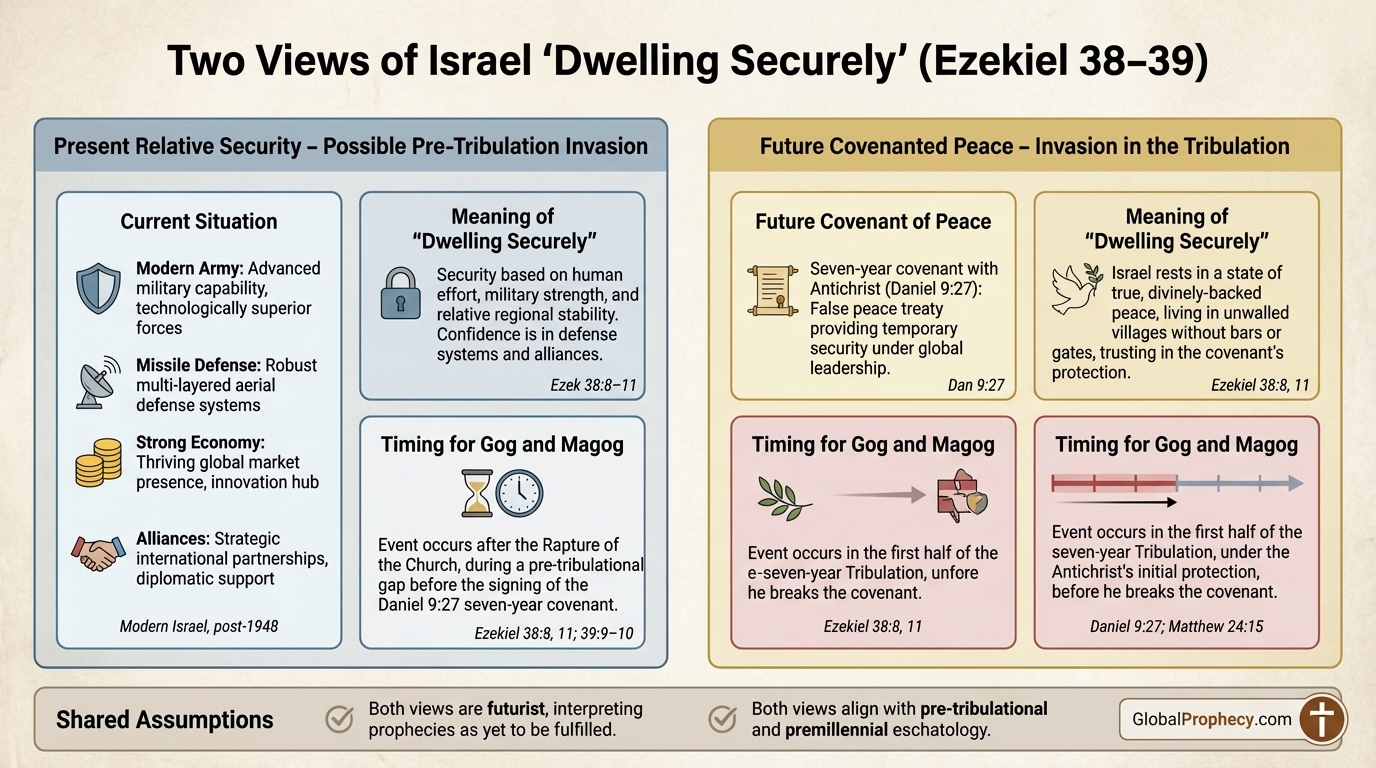
Two main interpretations of Israel’s “dwelling securely” dominate evangelical eschatology, and each has implications for when Gog and Magog occurs.
3.1. Present Relative Security (Allowing a Pre‑Tribulation Invasion)
Some scholars argue that Israel already fulfills the “dwelling securely” condition in a relative sense. They point to:
- A strong, modern Israeli Defense Force and advanced air force
- Sophisticated missile‑defense systems
- A robust economy and technological edge
- Strategic alliances, especially with Western powers
On this reading, “dwelling securely” describes confidence in military strength, not the absence of hostility. If this is correct, the Gog and Magog invasion could occur before the formal start of the tribulation, possibly even in a gap between the rapture and the signing of the seven‑year covenant of Daniel 9:27.
Advocates of this view often suggest:
- The rapture devastates key pro‑Israel nations (especially the U.S.), creating a moment of chaos.
- Russia and its Islamic allies see a unique window to strike Israel.
- God’s supernatural destruction of the invaders before the tribulation clears the way for:
- The rise of Antichrist as an uncontested European super‑leader
- A peace treaty with Israel (Dan 9:27)
- A political environment favorable to building the third temple
- The seven years of burning weapons (Ezekiel 39:9–10) fit neatly if the invasion occurs at least 3½ years before the midpoint of the tribulation, when Israel must flee (cf. Matthew 24:15–21).
This places Gog and Magog after the rapture but before the official beginning of the tribulation—within the pre‑tribulational period.
3.2. Future Covenanted Peace (Placing the Invasion in the Tribulation)
A second major interpretation holds that the security described by Ezekiel is not yet realized. Israel today remains under constant threat; far from being “at rest,” the nation is an armed camp.
This view connects Israel’s true security to the future covenant made by the coming world ruler:
“And he shall make a strong covenant with many for one week…”
— Daniel 9:27
Under this scenario:
- The seven‑year treaty signed by the Antichrist inaugurates the tribulation.
- Backed by the military and political clout of a revived Roman Empire, Israel will feel genuinely secure for the first half of the tribulation.
- This is precisely the window in which Ezekiel’s description of unwalled villages, rest, and security fits best.
On this understanding, the Gog and Magog invasion occurs during the first half of the tribulation, after the covenant of Daniel 9:27 has been signed but before the Antichrist breaks it at the midpoint (cf. Matt 24:15; 2 Thess 2:3–4).
4. Evaluating the Major Timing Views
In light of Ezekiel’s text and the larger end‑time framework, here is how the principal timing positions compare.
4.1. Not in the Past
Some have attempted to locate Gog and Magog in ancient history. This is untenable because:
- No historical invasion matches the specific multinational coalition listed in Ezekiel 38:1–6.
- Israel was never regathered from many nations before A.D. times.
- The prophecy is explicitly set in the “latter years” and “last days” (Ezekiel 38:8, 16).
Therefore, the invasion is still future.
4.2. Not at Armageddon (End of the Tribulation)
Others equate Gog and Magog with Armageddon (Revelation 19:11–21). Despite surface similarities (a vast army, divine intervention, birds feasting on corpses), there are crucial differences:
| Feature | Gog and Magog (Ezek 38–39) | Armageddon (Rev 16, 19) |
|---|---|---|
| Leader | Gog, prince of Rosh/Meshech/Tubal | Beast/Antichrist; no Gog mentioned |
| Coalition | A limited northern-Islamic alliance | All nations of the earth |
| Israel’s condition | Dwelling securely | Under severe persecution (Great Tribulation) |
| Objective | Plunder Israel (Ezek 38:12–13) | Fight against Christ (Rev 19:19) |
| Outcome | God destroys Gog on Israel’s mountains; world still continues | Christ returns, ends Gentile dominion, and begins the millennium |
These contrasts indicate two distinct campaigns, not one.
4.3. Not at the End of the Millennium (Rev 20:7–10)
Revelation 20:8 also uses the terms “Gog and Magog” for a final rebellion at the end of the thousand years. This is not the same event as Ezekiel 38–39:
- In Ezekiel, Israel buries the dead for seven months and burns weapons for seven years (Ezek 39:9–16), implying ongoing history and an earthly kingdom.
- In Revelation 20, the rebels are devoured by fire from heaven, followed by the final judgment and the eternal state, with no time for prolonged cleanup.
- In Ezekiel, Gog is a human leader; in Revelation, the rebellion is directly led by Satan.
The best explanation is that John uses “Gog and Magog” in Revelation 20 as a typological label for a final massive, God‑opposing coalition—much like “Waterloo” can be used generically for a decisive defeat.
Thus, Ezekiel’s Gog and Magog is pre‑millennial, not post‑millennial.
5. A Coherent Chronological Placement
Bringing together the textual data and prophetic framework, the most coherent timing of the Gog and Magog invasion is:
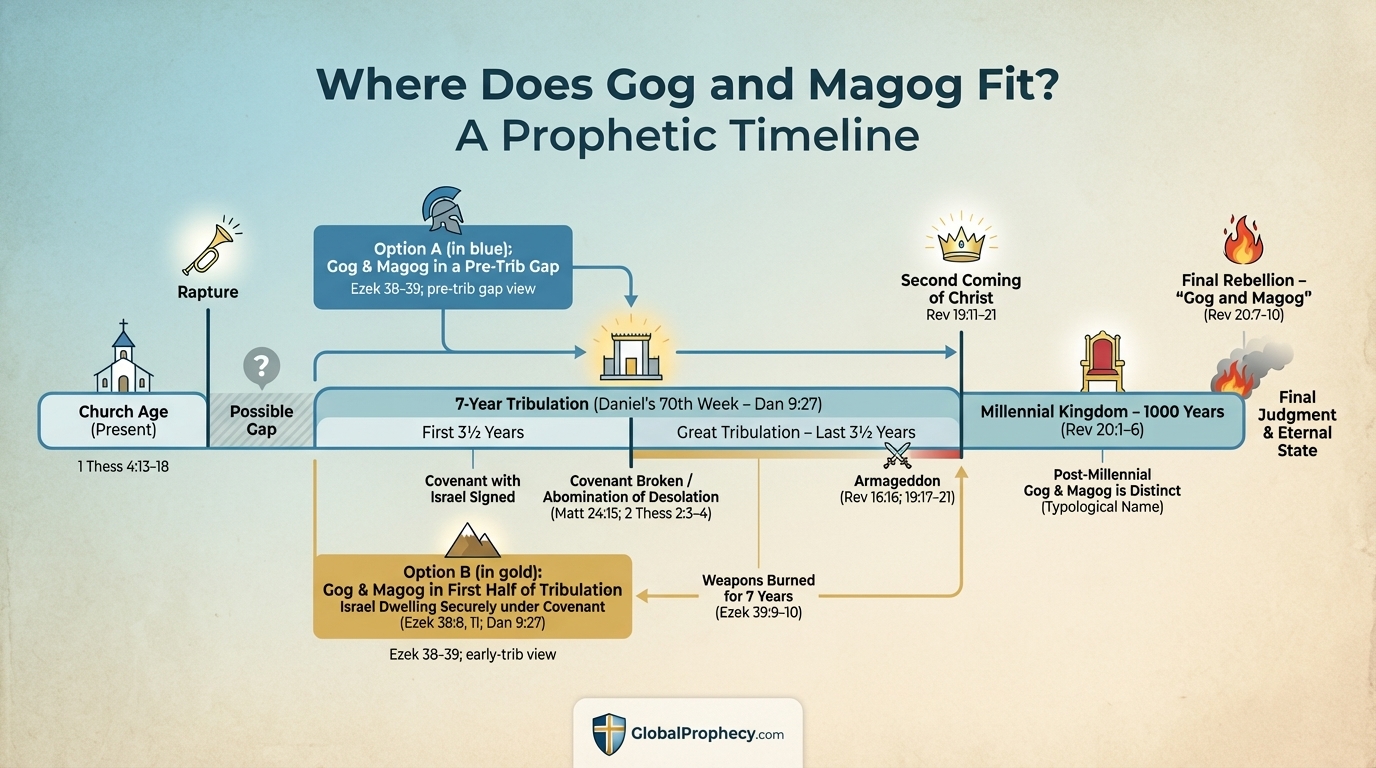
During the first half of the tribulation, after the rapture and after Israel has entered a covenant of security with the Antichrist.
5.1. Step‑by‑Step Sequence
-
Rapture of the Church
- Removes the restraining influence of the church and likely plunges the world into spiritual and political instability.
- A gap of days, months, or even a few years between the rapture and the tribulation is possible.
-
Rise of the Antichrist in a Revived Roman Empire
- He consolidates power over a European‑centered confederation.
-
Seven‑Year Covenant with Israel (Dan 9:27)
- Marks the official start of the tribulation.
- Provides Israel with guaranteed security, fulfilling Ezekiel’s “dwelling securely” language in its strongest sense.
-
Gog and Magog Invasion During the First Half of the Tribulation
- Russia and its allies see Israel’s wealth and strategic location and challenge both Israel and the Western Antichrist bloc.
- They invade a seemingly relaxed, unfortified Israel.
- God supernaturally destroys the coalition through earthquake, internal strife, plagues, and torrential judgment (Ezek 38:19–22).
-
Consequences of the Invasion
- Power vacuum in the East: the major northern and Islamic military powers are crippled or destroyed.
- This makes it far easier for the Antichrist to become a true world ruler in the second half of the tribulation.
- Israel spends seven months burying the dead and seven years burning weapons, a timeline that can easily extend from early in the tribulation to its end and possibly into the early millennium, if needed.
This placement best:
- Respects the “last days” context
- Honours the security condition stated by Ezekiel
- Keeps Gog and Magog distinct from Armageddon and the post‑millennial revolt
- Fits the seven‑year weapons‑burning period in a realistic way
5.2. Alternative but Related Pre‑Tribulation View
A closely related view, also held by many conservative interpreters, places Gog and Magog after the rapture but before the signing of the covenant, in a pre‑tribulational gap. This view:
- Interprets “dwelling securely” as present or near‑future relative security
- Uses the seven‑year burning as an argument for an invasion at least 3½ years before Israel’s mid‑tribulation flight
- Views the destruction of Russia and its allies as a pre‑tribulational reset that sets the stage for a Euro‑centered tribulation
Both positions are futurist, pre‑tribulational, and premillennial; they only differ on whether Gog and Magog is slightly before or within the first half of the tribulation. In either case, it is not after the tribulation.
6. Conclusion
The Gog and Magog invasion of Ezekiel 38–39 is a future, end‑time assault on a regathered, seemingly secure Israel. Careful comparison with other prophetic passages shows that it:
- Cannot be located in the ancient past
- Is distinct from both Armageddon (end of the tribulation) and the post‑millennial revolt of Revelation 20
- Fits best after the rapture and before the second coming, most likely in the first half of the tribulation under the umbrella of a deceptive peace covenant.
In God’s sovereign plan, this invasion becomes the catalyst for a dramatic shift in global power, the vindication of God’s name among the nations, and the spiritual awakening of Israel in preparation for the coming kingdom of Christ.
FAQ
Q: Will the Gog and Magog invasion happen before or during the tribulation?
From a futurist, premillennial perspective, the Gog and Magog invasion will occur after the rapture and in close connection with the tribulation, most likely during the first half of the seven‑year period, when Israel is living under the apparent security of the Antichrist’s covenant. A closely related view places it in a pre‑tribulational gap between the rapture and the start of the tribulation.
Q: Is the Gog and Magog invasion the same as the battle of Armageddon?
No. Gog and Magog (Ezekiel 38–39) and Armageddon (Revelation 16; 19) differ in their leaders, coalitions, objectives, Israel’s condition, and outcomes. Gog’s invasion is a limited northern coalition seeking plunder, while Armageddon is a global gathering of all nations against Christ at His second coming.
Q: How does the “dwelling securely” condition affect the timing of Gog and Magog?
Ezekiel’s repeated emphasis that Israel is “dwelling securely” requires either a future period of covenant‑backed peace (first half of the tribulation) or, in a looser sense, the current or near‑future military confidence of modern Israel. Which of these you adopt will tend to place the invasion either early in the tribulation or in a brief gap before it begins.
Q: Does Gog and Magog in Revelation 20 refer to the same event as in Ezekiel 38–39?
No. Revelation 20:7–10 describes a post‑millennial rebellion led directly by Satan against Christ’s reign, ending in immediate destruction and final judgment. Ezekiel’s Gog and Magog is pre‑millennial, involves a different leader and sequence, and is followed by months and years of burial and cleanup, indicating continuing history.
Q: Why does Ezekiel mention seven years of burning weapons, and how does that fit the end‑time timeline?
The seven‑year burning of weapons (Ezekiel 39:9–10) underscores the sheer scale of the invading force and implies a lengthy post‑invasion cleanup. If Gog and Magog occurs early in the tribulation or shortly before it, these seven years can span the remainder of the tribulation and possibly into the opening years of the millennium, harmonizing with the broader prophetic timeline.
Frequently Asked Questions
Will the Gog and Magog invasion happen before or during the tribulation?
Is the Gog and Magog invasion the same as the battle of Armageddon?
How does the “dwelling securely” condition affect the timing of Gog and Magog?
Does Gog and Magog in Revelation 20 refer to the same event as in Ezekiel 38–39?
Why does Ezekiel mention seven years of burning weapons, and how does that fit the end‑time timeline?
L. A. C.
Theologian specializing in eschatology, committed to helping believers understand God's prophetic Word.
Related Articles
Who is Gog in Ezekiel 38-39?
Gog in Ezekiel 38-39: explore Gog’s identity, the specific nations allied with him, and when this end-times invasion of Israel will be fulfilled.
Gog and Magog
Gog and Magog prophecy explained: explore Ezekiel 38–39, the northern invasion of Israel, key nations, timing, and end-times significance.
The 70 Weeks of Daniel: Understanding Bible's Prophetic Timeline
The 70 weeks of Daniel explain God's prophetic timeline for Israel, Christ's first coming, and a future 70th week leading to the end-time climax.
Babylon the Great
Babylon the Great in Revelation 17–18 reveals end-time religious and commercial rebellion against God and its sudden, final destruction in judgment.