
Gog and Magog
1. Introduction
The prophecy of Gog and Magog in Ezekiel 38–39 is one of the most detailed and strategically important texts in biblical eschatology. It describes a massive, future invasion of Israel by a northern confederation of nations, led by a mysterious figure called Gog, and God’s supernatural destruction of that force. Understanding this prophecy requires careful attention to its key actors, geography, timing, motives, and theological purpose.
This article offers a focused, essential overview of the Gog and Magog prophecy in Ezekiel 38–39, drawing together the core biblical data and major interpretive conclusions.
2. Who Are Gog and Magog?
2.1 Gog: The Leader
In Ezekiel 38–39, Gog is not a nation but a person or title—the leader of the end-times coalition that attacks Israel:
"Son of man, set your face toward Gog, of the land of Magog, the chief prince of Meshech and Tubal…"
— Ezekiel 38:2
Key points:
- Gog is called “prince” (Ezek 38:2, 3; 39:1), indicating a political-military ruler.
- The name likely functions as a title, comparable to “Pharaoh” or “Caesar,” rather than a personal name.
- Gog is explicitly not the Antichrist. Gog leads a northern, largely non-Western coalition; the Antichrist leads a revived Roman (Western) empire.
The Hebrew root behind “Gog” carries the idea of “height” or “exalted,” implying a proud, dominant leader who commands global attention when he moves against Israel.
2.2 Magog and the Northern Bloc
Gog is said to be “of the land of Magog” and “chief prince of Rosh, Meshech, and Tubal” (Ezek 38:2–3). These names refer to geographical regions known in Ezekiel’s day.
From historical, linguistic, and geographical data, most conservative interpreters understand the core coalition as follows:
| Ancient Name (Ezekiel 38–39) | Probable Modern Area |
|---|---|
| Magog | Central Asia north of Israel (southern former USSR) |
| Rosh | Russia (in the “uttermost parts of the north,” 39:2) |
| Meshech, Tubal | Modern Turkey (and possibly adjacent areas) |
| Persia | Modern Iran |
| Cush (Ethiopia) | Sudan (south of Egypt) |
| Put (Libya) | Libya (possibly including parts of Algeria/Tunisia) |
| Gomer, Beth-togarmah | Turkey / Armenia / eastern Anatolia |
The repeated emphasis that Gog comes from “the uttermost parts of the north” (Ezek 38:6, 15; 39:2) is decisive. On a map centered on Israel, the most distant northern landmass is Russia, making it the natural focal point of this northern confederation.
3. The Nations in the Gog and Magog Coalition
Ezekiel lists Gog’s main allies in Ezekiel 38:5–6:
"Persia, Cush, and Put are with them, all of them with shield and helmet; Gomer and all his hordes; Beth-togarmah from the uttermost parts of the north with all his hordes—many peoples are with you."
— Ezekiel 38:5–6
Essential points about these coalition nations:
- Persia: Clearly modern Iran, renamed in 1935.
- Cush (Ethiopia): In Ezekiel’s day, the region south of Egypt, corresponding to modern Sudan, a strongly Islamic state.
- Put (Libya): West of Egypt; Libya in the ancient sense, likely including parts of Algeria and Tunisia.
- Gomer & Beth-togarmah: Associated with ancient Cimmerian and Anatolian peoples; geographically aligned with modern Turkey and the surrounding region.
Several features stand out:
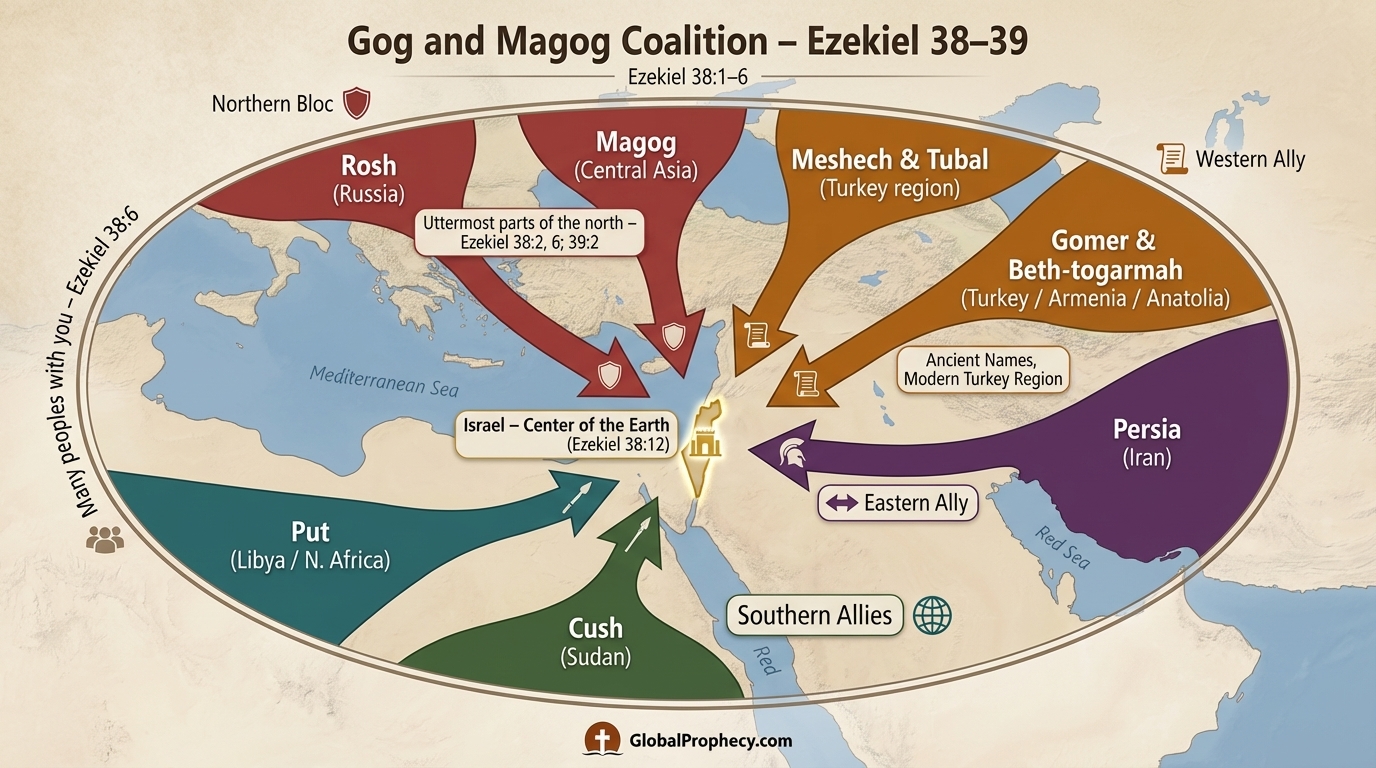
- These nations encircle Israel from every direction—north (Russia/Turkey), east (Iran), west (Libya), and south (Sudan).
- In our own era they are predominantly Muslim, sharing a deep ideological and religious hostility toward Israel.
- Ezekiel adds the phrase “and many peoples with you” (38:6, 9, 15), allowing for additional, unnamed participants.
Significantly, some of Israel’s nearer Arab neighbors (e.g., Egypt, Jordan, Syria) are not explicitly named, suggesting they may be neutral, bound in other political arrangements, or included under the “many peoples”.
4. When Does the Gog and Magog Invasion Occur?
4.1 Time Markers in Ezekiel 38–39
Ezekiel gives several key chronological indicators:
-
“After many days… in the latter years”
“…after many days you will be mustered. In the latter years you will go against the land that is restored from war, the land whose people were gathered from many peoples…”
— Ezekiel 38:8 -
“In the latter days”
“…you will come up against my people Israel… It shall come to pass in the latter days that I will bring you against my land…”
— Ezekiel 38:16
These expressions point to the end-times phase of Israel’s history, not an event already fulfilled in antiquity.
-
Israel regathered from many nations
Israel is said to be:- “gathered from many peoples” (38:8, 12)
- back in “the mountains of Israel, which had been a continual waste” (38:8).
This fits only the modern regathering of Jews from around the world, especially since 1948, rather than earlier returns from single empires like Babylon.
-
Israel dwelling securely
Gog attacks:
“…a land of unwalled villages… those who are at rest, who dwell securely, all of them dwelling without walls, and having no bars or gates…”
— Ezekiel 38:11Israel is pictured as confident and relatively unguarded, not in a constant state of siege.
4.2 Best Placement in the End-Times Framework
Within a premillennial, futurist reading, the most coherent placement for the Gog and Magog war of Ezekiel 38–39 is:
- After the modern regathering of Israel (already in motion),
- After the rapture of the church,
- During the early phase of Daniel’s 70th week (the Tribulation)—most likely in the first half, when Israel enjoys a heightened sense of security under a covenant with the future Antichrist (cf. Daniel 9:27).
This placement best integrates:
- Israel’s secure condition,
- The complete future burial and burning periods (seven months of burial, seven years of burning weapons; Ezek 39:9–14),
- And the geopolitical vacuum created for the rise of a global Antichrist after Russia and its Islamic allies are suddenly removed.
The Gog and Magog of Revelation 20:7–9 occurs after the Millennium and differs in scope, leader (Satan directly), and outcome. The shared names function typologically—later “Gog and Magog” is like saying “a new Waterloo”: a final, archetypal rebellion doomed to catastrophic defeat.
5. Why Gog and Magog Attack Israel
The motives of Gog and his coalition are both human and divine.
5.1 Human Motives
Ezekiel lists several explicit reasons:
-
Greed and plunder
“…to seize spoil and carry off plunder, to turn your hand against the waste places that are now inhabited, and the people who were gathered from the nations, who have acquired livestock and goods…”
— Ezekiel 38:12Israel will possess significant wealth—agricultural, industrial, mineral (notably the Dead Sea’s vast mineral reserves), and possibly energy resources. The coalition covets this wealth.
-
Hatred of Israel
Gog devises an “evil plan” (38:10), targeting God’s covenant people:
“You will come up against my people Israel…”
— Ezekiel 38:16This reflects a deep anti-Semitic, anti-Zionist impulse, intensified in the end times by religious and political ideologies.
-
Strategic power play
Israel lies at the “center of the earth” (Ezek 38:12, lit. “navel of the earth”), a land bridge between continents. Controlling Israel means controlling the land routes and much of the political configuration of the Middle East, including nearby energy corridors.
-
Challenge to other world powers
The move against Israel also functions as a geopolitical challenge to whatever Western or revived Roman power structure is backing Israel at that time, setting up a clash of major blocs.
5.2 Divine Motive
Behind human strategy stands God’s sovereign purpose:
“I will bring you against my land, that the nations may know me, when through you, O Gog, I vindicate my holiness before their eyes.”
— Ezekiel 38:16
God draws Gog out (“I will put hooks in your jaws,” 38:4) in order to:
- Display His holiness, power, and faithfulness,
- Vindicate His name among Israel and the nations,
- Move Israel toward spiritual awakening.
6. How God Destroys Gog and Magog
The destruction of Gog’s army is totally supernatural and unilateral—Israel does not win by its own strength. God acts directly in a fourfold judgment (Ezek 38:18–39:6):
6.1 A Massive Earthquake
“There shall be a great earthquake in the land of Israel… the mountains shall be thrown down, and the cliffs shall fall, and every wall shall tumble to the ground.”
— Ezekiel 38:19–20
This cripples the invading forces, shatters infrastructure, and induces chaos across the entire region and beyond.
6.2 Infighting Among the Invaders
“Every man’s sword will be against his brother.”
— Ezekiel 38:21
In the confusion, coalition armies turn on each other, possibly due to:
- Language barriers and miscommunication,
- Suspicion of betrayal among diverse allies,
- Panic after the earthquake and subsequent judgments.
6.3 Pestilence
“With pestilence and bloodshed I will enter into judgment with him…”
— Ezekiel 38:22a
Unburied bodies, disrupted logistics, and environmental collapse lead to deadly outbreaks of disease, further decimating the armies.
6.4 Torrential Rain, Hail, Fire, and Burning Sulfur
“I will rain upon him and his hordes and the many peoples who are with him torrential rains and hailstones, fire and sulfur.”
— Ezekiel 38:22b
This final phase may include:
- Catastrophic storms and floods,
- Hailstones devastating troops and equipment,
- Fire and sulfur, suggestive of volcanic or other geophysical upheavals—possibly also involving human weaponry under divine direction.
Additionally, God sends fire on Magog and on the coastlands of its allies (Ezek 39:6), striking homeland targets and ensuring there will be no immediate capability for renewed aggression.
7. Aftermath: Burial, Burning, and Spiritual Impact
7.1 Burial of the Dead
The slaughter is so vast that:
- It takes seven months to bury the dead (Ezek 39:12).
- A specific valley, “the Valley of Hamon-gog” (“multitude of Gog”), becomes a mass grave in Israel (39:11, 15).
- Special teams are appointed to search for and mark bones, which grave-diggers then bury (39:14–15).
This extended burial process “cleanses the land” ceremonially and visibly proclaims the completeness of God’s victory.
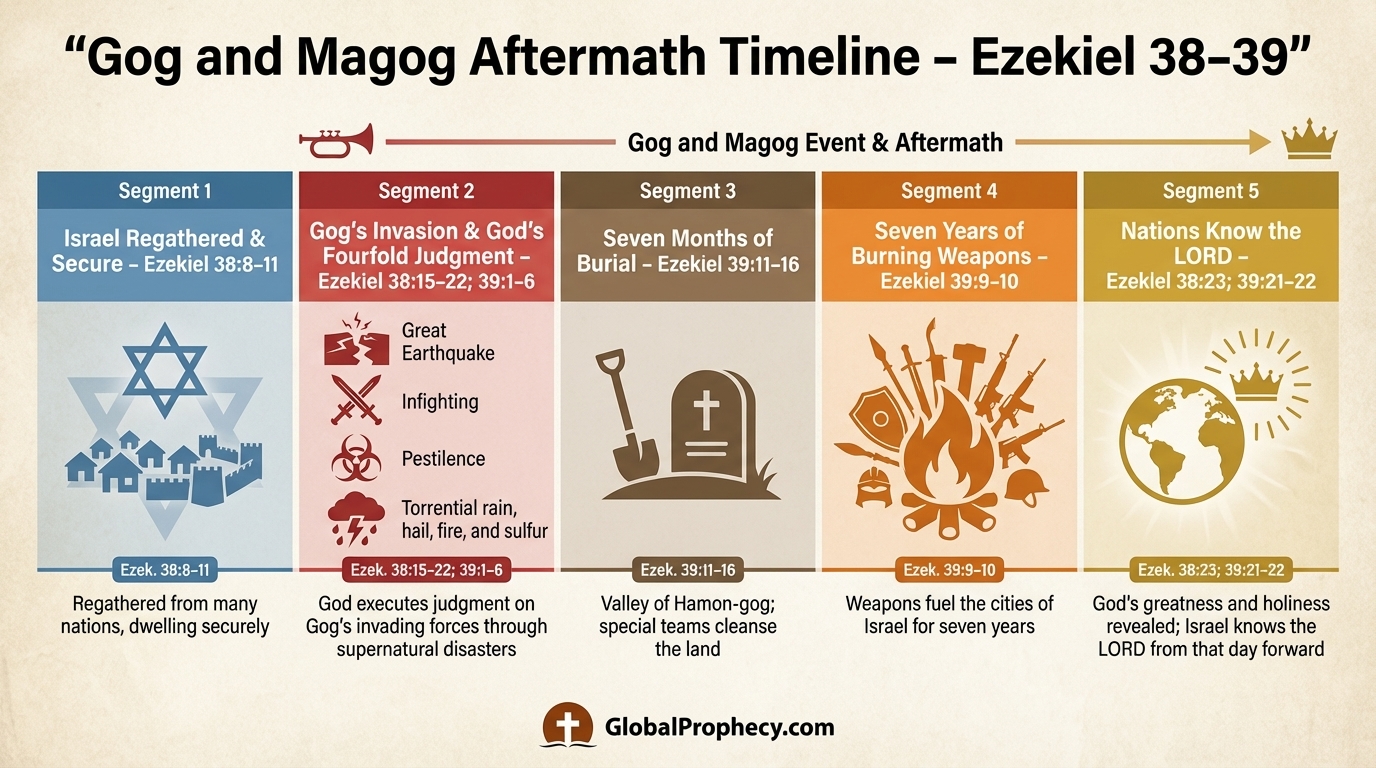
7.2 Burning of the Weapons
“Then those who dwell in the cities of Israel will go out and make fires of the weapons… they will make fires of them for seven years…”
— Ezekiel 39:9–10
For seven years, Israel will use captured weapons as fuel, further highlighting the scale of the defeated army and God’s providential provision. This seven-year period strongly supports a time placement such that:
- The burning begins before or early in the Tribulation,
- And continues through the period without contradicting the mid-tribulation flight of Israel (cf. Matthew 24:15–21).
7.3 Worldwide Recognition of God
The divine purpose of the Gog and Magog catastrophe is explicit:
“I will show my greatness and my holiness and make myself known in the eyes of many nations. Then they will know that I am the LORD.”
— Ezekiel 38:23
“I will set my glory among the nations, and all the nations shall see my judgment that I have executed… The house of Israel shall know that I am the LORD their God, from that day forward.”
— Ezekiel 39:21–22
Results include:
- Global awareness that Israel’s survival is due to the God of Scripture, not human alliances.
- A powerful impetus toward spiritual awakening in Israel, as God begins to remove their spiritual blindness and prepares them for the full national restoration promised in later chapters (Ezek 40–48).
8. Conclusion
The Gog and Magog prophecy in Ezekiel 38–39 presents a coherent, future scenario in which:
- A Russian-led, Muslim-heavy northern coalition launches a massive invasion of a regathered, secure Israel.
- God Himself intervenes with unparalleled judgment—earthquake, confusion, pestilence, and destructive storms—to annihilate the invaders.
- The aftermath—seven months of burial and seven years of burning weapons—visibly displays the scale of divine victory.
- The ultimate goal is not merely Israel’s survival but the vindication of God’s name, the shifting of global power structures, and the advance of His redemptive plan toward the Messianic kingdom.
For students of biblical eschatology, Gog and Magog in Ezekiel 38–39 stands as a vivid reminder that history is moving toward a divinely ordained climax in which God’s purposes for Israel and the nations will be unmistakably fulfilled.
FAQ
Q: Is the Gog and Magog war in Ezekiel 38–39 the same as the battle in Revelation 20?
No. While both use the terms “Gog and Magog,” they differ in timing, scope, and leadership. Ezekiel’s war occurs in the end-times before the Millennium, led by a human ruler called Gog. Revelation 20 describes a final rebellion after the Millennium, led directly by Satan. The shared names function typologically, like calling a later defeat “another Waterloo.”
Q: How do we know Gog and Magog refers to Russia and its allies?
The identification rests on several lines of evidence: the phrase “uttermost parts of the north” relative to Israel, historical references to peoples like Magog and Rosh in the regions north of the Black and Caspian Seas, and the modern geopolitical alignment of the nations Ezekiel names. When plotted on a modern map, they correspond closely to Russia, Turkey, Iran, Libya, Sudan, and Central Asian states.
Q: Has the Gog and Magog prophecy already been fulfilled in history?
No. There has never been a historical invasion of Israel that matches all the features of Ezekiel 38–39: the specific listed nations, Israel’s condition of being regathered from many countries, its secure dwelling, and the unique supernatural judgments God uses. The prophecy remains future.
Q: What is the main purpose of the Gog and Magog prophecy?
The primary purpose is theological: to vindicate God’s holiness, display His power, and make His name known among Israel and the nations (Ezek 38:16, 23; 39:7, 21–22). The destruction of Gog and Magog demonstrates that no coalition—however vast—can thwart God’s covenant purposes for Israel.
Q: How should Christians today respond to the Gog and Magog prophecy?
The Gog and Magog prophecy should lead believers to trust God’s sovereignty, recognize the reliability of biblical prophecy, and view current Middle Eastern alignments through a biblical lens without date-setting. It underscores that God controls history and will ultimately vindicate His Word, His people, and His Son before all nations.
Frequently Asked Questions
Is the Gog and Magog war in Ezekiel 38–39 the same as the battle in Revelation 20?
How do we know Gog and Magog refers to Russia and its allies?
Has the Gog and Magog prophecy already been fulfilled in history?
What is the main purpose of the Gog and Magog prophecy?
How should Christians today respond to the Gog and Magog prophecy?
L. A. C.
Theologian specializing in eschatology, committed to helping believers understand God's prophetic Word.
Related Articles
Who is Gog in Ezekiel 38-39?
Gog in Ezekiel 38-39: explore Gog’s identity, the specific nations allied with him, and when this end-times invasion of Israel will be fulfilled.
The Gog and Magog Invasion: When Will It Happen?
Gog and Magog timing explained: will Ezekiel 38–39 occur before, during, or after the Tribulation, and how does it align with other end-time events?
The 70 Weeks of Daniel: Understanding Bible's Prophetic Timeline
The 70 weeks of Daniel explain God's prophetic timeline for Israel, Christ's first coming, and a future 70th week leading to the end-time climax.
Babylon the Great
Babylon the Great in Revelation 17–18 reveals end-time religious and commercial rebellion against God and its sudden, final destruction in judgment.