
The Government of the Millennial Kingdom
1. Introduction
The millennial kingdom is the prophesied thousand‑year reign of Jesus Christ on earth following His second coming (Rev. 20:1–6). While Scripture describes many aspects of this era, a central theme is how this kingdom will be governed: who rules, from where, over whom, and by what structures of authority.
This article focuses exclusively on the government of the millennial kingdom—its form, capital, ruling hierarchy, subjects, and the integration of civil and religious rule.
2. The Form of Government: A Universal Theocratic Monarchy
2.1 A Theocracy Ruled by the Messiah
The government of the Millennium is best described as a theocratic monarchy—God’s direct rule over the nations through His Messianic King, Jesus Christ. Unlike all previous human governments, this regime is perfectly righteous, benevolent, and absolute.
"And to him was given dominion and glory and a kingdom, that all peoples, nations, and languages should serve him; his dominion is an everlasting dominion, which shall not pass away, and his kingdom one that shall not be destroyed."
— Daniel 7:14 (ESV)
Christ is not merely a spiritual ruler; He is a literal political King administering justice on earth (Isa. 9:6–7; Ps. 2:6–9). His reign fulfills the Davidic covenant (2 Sam. 7:12–16)—a promise of an eternal dynasty, throne, and kingdom centered in David’s royal line.
2.2 A Benevolent but Absolute Rule
Christ’s rule is:
- Universal – over “all the earth” (Zech. 14:9; Ps. 72:8).
- Righteous and just – “with righteousness he shall judge the poor” (Isa. 11:4).
- Firm and unbreakable – He rules “with a rod of iron” (Ps. 2:9; Rev. 19:15), swiftly restraining and punishing open rebellion.
This is not democratic, constitutional, or consultative government; it is Messiah’s direct kingship. Yet it is not tyrannical, because the King is perfectly holy, wise, and loving.
3. The Capital and Seat of Government: Jerusalem
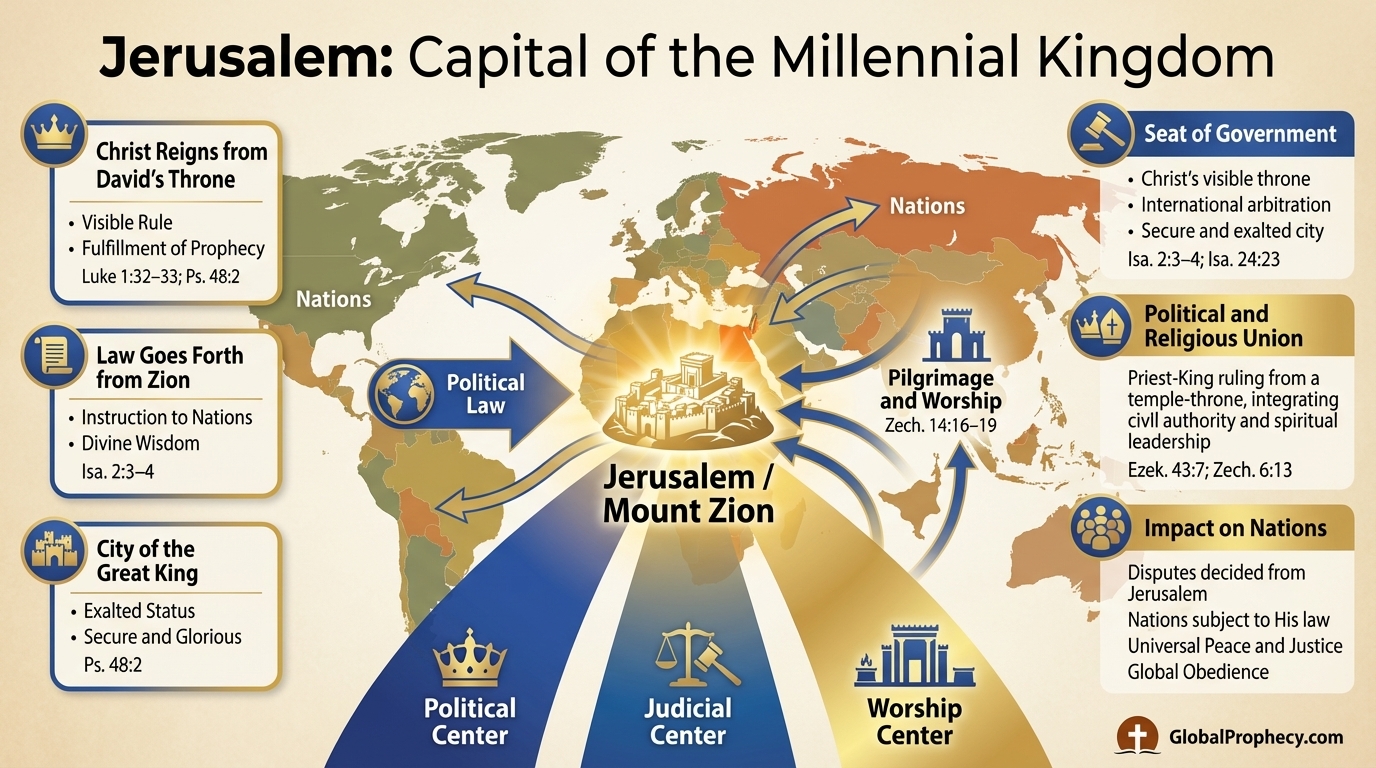
3.1 Jerusalem as the Political Center
The capital city of the millennial kingdom is Jerusalem, specifically Mount Zion:
"For out of Zion shall go the law, and the word of the LORD from Jerusalem. He shall judge between the nations, and shall decide disputes for many peoples."
— Isaiah 2:3–4
Key features of Jerusalem’s governmental role:
- It is called “the city of the great King” (Ps. 48:2).
- It becomes the center of international arbitration; Christ judges disputes among nations.
- It is permanently secure and exalted in status (Zech. 14:10–11; Isa. 24:23).
3.2 The Temple as the Royal–Religious Complex
Ezekiel 40–48 describes a millennial temple complex in or near Jerusalem, functioning as both:
- Religious center – place of worship, sacrifices (memorial/ceremonial), and priestly ministry.
- Symbolic royal center – the place of God’s visible presence and throne:
"This is the place of my throne and the place of the soles of my feet, where I will dwell in the midst of the people of Israel forever."
— Ezekiel 43:7
Thus the seat of government is both political and religious—Christ is Priest‑King (Zech. 6:13).
4. The Supreme King and His Co‑Regents
4.1 Christ on David’s Throne
At the heart of millennial government stands Jesus Christ personally reigning on David’s throne:
"The Lord God will give to him the throne of his father David, and he will reign over the house of Jacob forever, and of his kingdom there will be no end."
— Luke 1:32–33
Key points:
- His throne is Davidic (Jewish, royal, earthly) yet universal in scope.
- His rule is personal and visible—He is physically present in the capital.
- His kingship is mediatorial—He rules the earth on behalf of God the Father and will ultimately deliver up the kingdom to Him (1 Cor. 15:24–28).
4.2 The Church as Co‑Regent with Christ
Resurrected and glorified church‑age believers (the bride of Christ) share in His royal authority:
"They will be priests of God and of Christ, and they will reign with him for a thousand years."
— Revelation 20:6
"And you have made them a kingdom and priests to our God, and they shall reign on the earth."
— Revelation 5:10
Implications:
- The church forms a royal aristocracy—the “wife” of the King, co‑enthroned with Him (Rev. 3:21).
- Rewards given at the Judgment Seat of Christ determine degrees of administrative responsibility (Luke 19:11–27; 2 Cor. 5:10).
- Glorified saints do not marry or reproduce; they serve in governing and priestly functions, not in the mortal population.
5. The Administrative Hierarchy of the Kingdom
Scripture presents a multi‑layered administrative structure under Christ’s universal kingship. This can be summarized in four main levels.
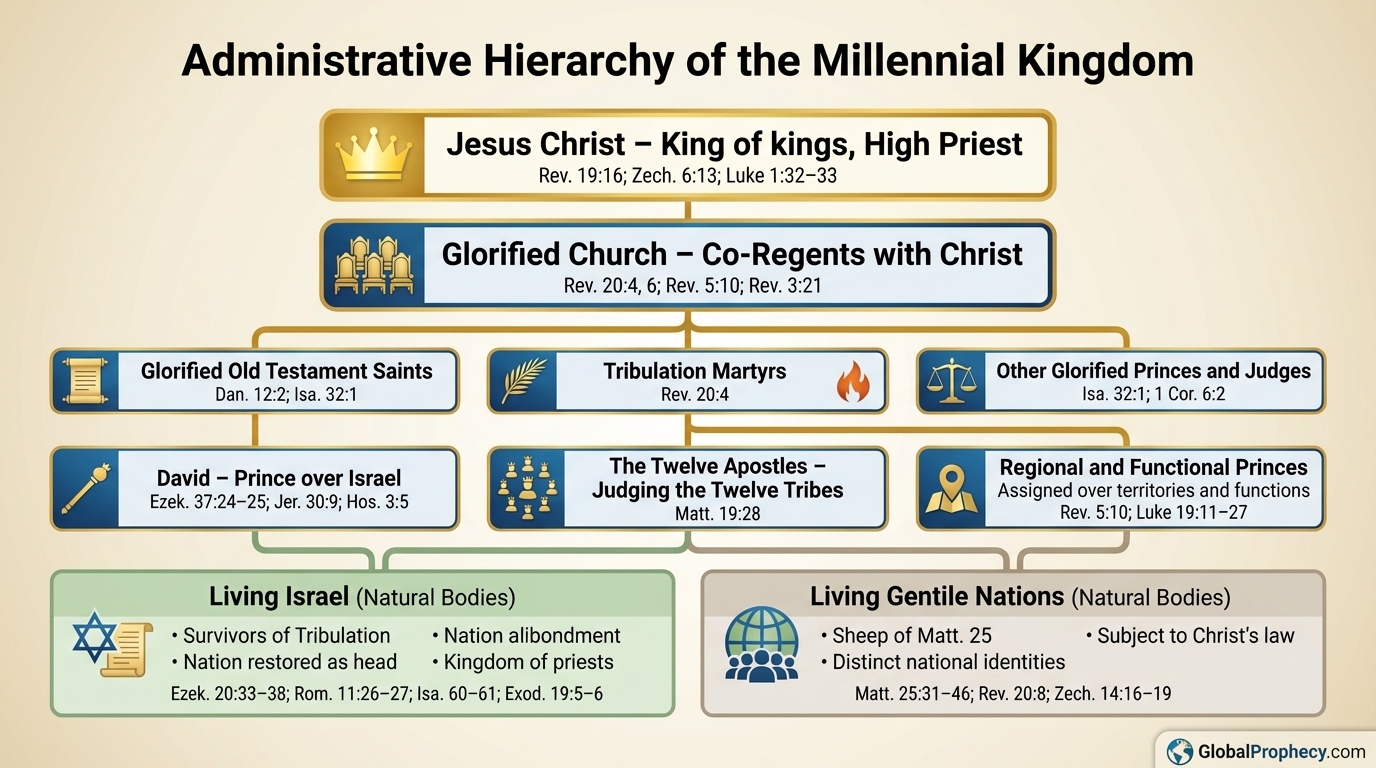
5.1 Level 1: Christ and His Bride (the Church)
- Christ – absolute sovereign, King of kings and Lord of lords (Rev. 19:16).
- The glorified church – co‑regent body sharing in His rule, seated on thrones (Rev. 20:4).
This level functions as the highest imperial government, overseeing the entire earth.
5.2 Level 2: Glorified Old Testament Saints and Tribulation Martyrs
A second tier includes resurrected believers from other eras who are not part of the church:
- Old Testament saints – resurrected at the beginning of the kingdom (Dan. 12:2).
- Tribulation martyrs – raised to reign with Christ (Rev. 20:4).
Within this group Scripture highlights certain individuals with special governmental roles:
David as Prince over Israel
"My servant David shall be king over them… and David my servant shall be their prince forever."
— Ezekiel 37:24–25; cf. Jer. 30:9; Hos. 3:5
David, resurrected, functions as a vice‑regent over Israel, under Christ’s supreme kingship—akin to a national ruler or “crown prince” for the Jewish nation.
The Twelve Apostles over the Twelve Tribes
"You who have followed me will also sit on twelve thrones, judging the twelve tribes of Israel."
— Matthew 19:28
The twelve apostles will have jurisdiction over restored Israel, probably supervising tribal administration.
Other “Princes Who Rule Justly”
"Behold, a king will reign in righteousness, and princes will rule in justice."
— Isaiah 32:1 (cf. v. 2)
These “princes” likely include various faithful saints from Old and New Testament eras who are appointed to positions of regional or functional authority.
5.3 Level 3: Living Israel in Natural Bodies
Those Jews who survive the Tribulation as believers enter the kingdom in mortal bodies (Ezek. 20:33–38; Rom. 11:26–27). They, and their believing descendants, form the nation Israel in its restored role.
Governance implications:
- Israel regains national primacy among earth’s nations (Isa. 60–61).
- Gentile nations serve and assist Israel administratively and economically (Isa. 60:3, 10–12; 61:5–6).
- Israel functions as a “kingdom of priests” to the world, mediating spiritual truth (Exod. 19:5–6; Isa. 61:6).
This level represents the national civil structure of the Jewish people, under David, the apostles, and Christ.
5.4 Level 4: Living Gentile Nations in Natural Bodies
Saved Gentiles—the “sheep” of Matthew 25:31–46—enter the kingdom in mortal bodies and form the Gentile nations of the millennial earth. Their governmental position:
- They retain distinct national identities (“nations… at the four corners of the earth,” Rev. 20:8).
- They are subject to Christ and His law and are obligated to come to Jerusalem for worship (Zech. 14:16–19).
- Many rulership roles over Gentile territories are apparently assigned to glorified saints (Rev. 5:10; 1 Cor. 6:2).
Thus the kingdom’s civil order retains real nations, borders, and societies, but all are harmonized under one global King.
6. Law, Justice, and Civil Order
6.1 Only Believers Enter the Kingdom
At the inauguration of the Millennium, every adult entering is a believer:
- Unsaved Gentiles are excluded at the judgment of the nations (Matt. 25:31–46).
- Jewish rebels are purged before restoration to the land (Ezek. 20:33–38).
This means the initial population is spiritually regenerate—though their children will still need personal faith in Christ.
6.2 The Role of Law and Immediate Justice
From Jerusalem, Christ issues law and policy for the nations (Isa. 2:3). His judicial system is characterized by:
- Perfect knowledge – “He shall not judge by what his eyes see” (Isa. 11:3).
- Impartial righteousness – He defends the poor and strikes the wicked (Isa. 11:4–5).
- Swift, visible punishment – those who openly rebel (e.g., nations refusing to worship at the Feast of Booths) are judged immediately with drought or plague (Zech. 14:16–19).
This produces a global context of external obedience and public order, even where inward rebellion persists in some hearts.
6.3 Discipline of Nations and Individuals
Because mortals still possess a sin nature:
- Nations can be sanctioned (e.g., withheld rain, Zech. 14:17).
- Individuals who rebel flagrantly may die prematurely (Isa. 65:20).
Yet the prevailing climate is righteousness, peace, and justice (Isa. 32:1, 17–18); crime, oppression, and corruption are systematically suppressed by Messiah’s perfect government.
7. The Union of Church and State: Priest‑King and Temple Administration
7.1 Christ as Priest‑King
In the Millennium, religion and government are fully integrated under one Person:
"He shall sit and rule on his throne. And there shall be a priest on his throne."
— Zechariah 6:13
Christ is:
- King – legislator, judge, and executive.
- Priest – mediator of worship and spiritual life.
There is no secular sphere independent of God; all governance is explicitly theocratic.
7.2 Temple, Priesthood, and Religious Law
Ezekiel 40–48 presents a detailed religious–administrative system:
- A rebuilt temple as global worship center.
- A functioning priesthood (especially sons of Zadok, Ezek. 44:15–31).
- Regular festivals (e.g., Passover, Feast of Booths, Ezek. 45:21–25; Zech. 14:16–19).
- Sacrifices that serve as memorial and ceremonial purification, not salvific atonement.
This system is not a return to Mosaic Judaism, but an adapted kingdom law fitting a world where:
- Christ’s once‑for‑all sacrifice is accomplished.
- God dwells bodily in the midst of His people.
- Yet unglorified, still‑sinful humans approach a holy God in a visible sanctuary.
The ecclesiastical and civil structures are therefore intertwined: the same King establishes civil statutes and religious ordinances.
8. Conclusion
The government of the millennial kingdom is a divinely designed, multi‑level system in which:
- Jesus Christ reigns personally as universal King and High Priest from Jerusalem.
- The glorified church co‑reigns with Him as royal administrators.
- Old Testament saints, David, the apostles, and other glorified believers hold defined offices as princes, judges, and overseers.
- Israel is restored as head of the nations, and the Gentiles live as subject peoples under righteous global rule.
- Law, worship, and civil administration are unified under the perfect theocratic monarchy of the Messiah.
In this kingdom, the failure of all human political experiments is finally answered: God Himself governs the earth through His Son in visible power and glory.
FAQ
Q: Who will be the main ruler in the millennial kingdom?
The primary ruler is Jesus Christ, the promised Son of David. He will sit on David’s throne in Jerusalem and exercise universal authority over all nations (Luke 1:32–33; Zech. 14:9; Rev. 19:15). All other rulers serve under His supreme kingship.
Q: How will the government of the millennial kingdom be structured?
The millennial kingdom will be a theocratic monarchy with multiple levels of administration. Christ reigns at the top, co‑regent with His glorified church. Under Him, glorified saints such as David and the apostles govern Israel and the nations, while believing Jews and Gentiles in natural bodies live as citizens within their respective nations.
Q: What role will Israel have in the government of the millennial kingdom?
Israel will be restored as a nation and placed in a position of headship among the nations (Isa. 60–61). David will serve as prince over them, the apostles will judge the twelve tribes, and Israel will function as a “kingdom of priests” mediating God’s truth to the world (Exod. 19:6; Ezek. 37:24–25; Matt. 19:28).
Q: Will there still be national governments during the millennium?
Yes. Distinct nations (both Israel and Gentile nations) will continue to exist. They will have their own populations and territories, but all are subject to Christ’s central government from Jerusalem. Nations must obey His laws and come up to Jerusalem for worship, or face disciplinary judgments (Isa. 2:2–4; Zech. 14:16–19).
Q: How will law and justice work in the government of the millennial kingdom?
Law and justice will be personally administered by Christ. He will issue law from Zion, judge cases with perfect knowledge, reward righteousness, and swiftly punish overt rebellion (Isa. 11:3–5; 2:3–4). This results in a world marked by peace, order, and righteousness, even though some mortals may harbor inward unbelief.
Frequently Asked Questions
Who will be the main ruler in the millennial kingdom?
How will the government of the millennial kingdom be structured?
What role will Israel have in the government of the millennial kingdom?
Will there still be national governments during the millennium?
How will law and justice work in the government of the millennial kingdom?
L. A. C.
Theologian specializing in eschatology, committed to helping believers understand God's prophetic Word.
Related Articles
Life in the Millennium: Physical and Spiritual Blessings
Millennium life brings profound physical and spiritual blessings under Christ’s reign—peace, righteousness, healing, and restored creation in the kingdom.
What is the Millennium? The 1000-Year Reign of Christ
Millennium: the 1000-year reign of Christ explained. Discover its duration, nature, and prophetic significance in God’s future kingdom plan.
Amillennialism Examined: Is the Church the Millennial Kingdom?
Amillennialism examined: is the church the millennial kingdom? Explore its claims, symbols, and a biblical critique of this end-times view.
The Millennial Temple and Worship
Millennial temple and worship in Ezekiel 40–48 explained: layout, priestly service, sacrifices, and how kingdom-age worship centers on Messiah’s reign.