
What is the Great White Throne Judgment?
1. Introduction
The Great White Throne Judgment is the final, climactic judgment described in Scripture, recorded in Revelation 20:11–15. It is the last judicial act of God before the eternal state of the new heaven and new earth. This judgment is not a general review of all humanity, but a specific, final assize in which all the unsaved dead are raised, tried, and consigned to their eternal destiny.
Understanding what the Great White Throne Judgment is, and when it occurs in God’s prophetic program, is essential to biblical eschatology and to a sober, accurate view of eternity.
2. What Is the Great White Throne Judgment? (Revelation 20:11–15)
John describes the scene:
"Then I saw a great white throne and him who was seated on it. From his presence earth and sky fled away, and no place was found for them.
And I saw the dead, great and small, standing before the throne, and books were opened. Then another book was opened, which is the book of life.
And the dead were judged by what was written in the books, according to what they had done.
And the sea gave up the dead who were in it, Death and Hades gave up the dead who were in them, and they were judged, each one of them, according to what they had done.
Then Death and Hades were thrown into the lake of fire. This is the second death, the lake of fire.
And if anyone’s name was not found written in the book of life, he was thrown into the lake of fire."
— Revelation 20:11–15
From this passage we can define the Great White Throne Judgment as:
The final, universal resurrection and judgment of all the unsaved dead, presided over by Christ, in which they are judged according to their deeds, shown to be absent from the Book of Life, and cast into the lake of fire, the “second death.”
Key features from the text:
- “Great” – it is the supreme court of the universe, final and absolute.
- “White” – symbolizes the perfect holiness, purity, and righteousness of the Judge and of His verdicts.
- “Throne” – emphasizes royal authority and judicial sovereignty.
This judgment is not about determining who will be saved; everyone appearing there is already lost. Rather, it publicly confirms their condemnation and determines the degree of their punishment.
3. When Does the Great White Throne Judgment Occur?
The timing of the Great White Throne Judgment is given by its placement in the book of Revelation.
3.1 After the Millennium
Revelation 20 first describes Christ’s thousand‑year reign:
- Satan is bound for 1,000 years (Revelation 20:1–3).
- The martyrs and other saints reign with Christ for 1,000 years (Revelation 20:4–6).
- After the thousand years, Satan is released, leads a final rebellion, and is then cast into the lake of fire (Revelation 20:7–10).
Only after this entire millennial sequence does John write:
"Then I saw a great white throne and him who was seated on it…"
— Revelation 20:11
This “then” (Greek kai eidon) marks a new, subsequent vision in chronological order. Therefore:
- The Great White Throne Judgment takes place after Christ’s 1,000‑year reign on earth.
- It follows the final defeat and punishment of Satan (Revelation 20:10).
3.2 Before the New Heaven and New Earth
Immediately after the Great White Throne Judgment, John records:
"Then I saw a new heaven and a new earth, for the first heaven and the first earth had passed away…"
— Revelation 21:1
Thus, the Great White Throne Judgment is:
- The last event of history in the present created order, and
- The gateway into eternity, after which the eternal state of the new heaven, new earth, and New Jerusalem unfolds (Revelation 21–22).
In summary, the chronological placement is:
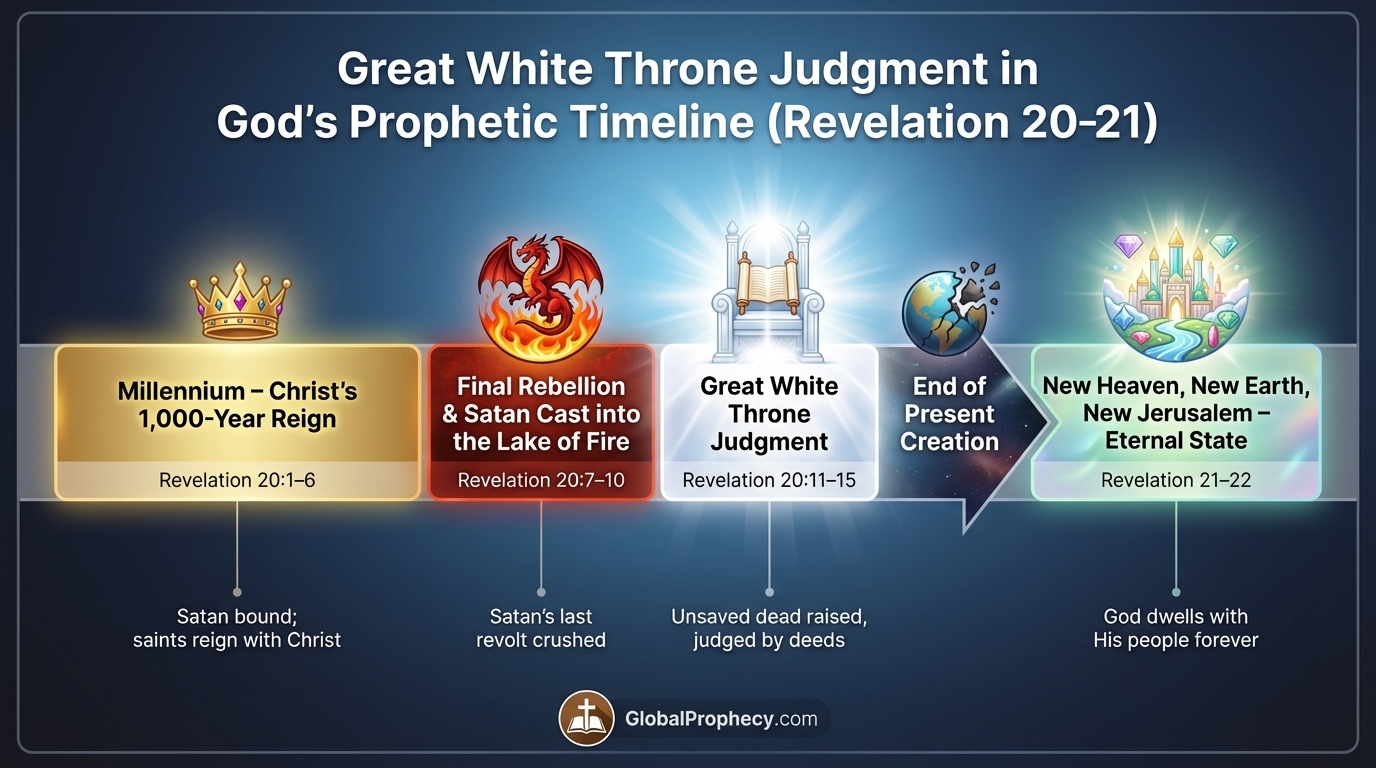
| Event | Reference |
|---|---|
| Christ’s 1,000‑year reign (Millennium) | Revelation 20:1–6 |
| Final rebellion; Satan cast into fire | Revelation 20:7–10 |
| Great White Throne Judgment | Revelation 20:11–15 |
| New heaven and new earth | Revelation 21–22 |
4. Who Judges and Who Is Judged?
4.1 The Judge on the Great White Throne
Revelation 20:11 simply says John saw “him who was seated on it,” but the broader New Testament makes clear that this Judge is Jesus Christ.
- "The Father judges no one, but has given all judgment to the Son" (John 5:22).
- God "has fixed a day on which he will judge the world in righteousness by a man whom he has appointed; and of this he has given assurance… by raising him from the dead" (Acts 17:31).
- Jesus is the One "who is to judge the living and the dead" (2 Timothy 4:1).
The “white” throne reflects His absolute holiness; the “great” throne reflects His supreme authority. The same Christ who once offered salvation now executes final judgment on those who refused Him.
4.2 The Judged: “The Dead, Great and Small”
John writes:
"And I saw the dead, great and small, standing before the throne…"
— Revelation 20:12
Several observations clarify who these “dead” are:
-
They are physically resurrected for this judgment:
"The sea gave up the dead who were in it, Death and Hades gave up the dead who were in them…" (Revelation 20:13).
Every realm that holds the bodies and souls of the unsaved dead releases them. -
They correspond to the “resurrection of judgment” in John 5:28–29:
"Those who have done evil to the resurrection of judgment."
-
They are contrasted with the redeemed who took part in the “first resurrection” (Revelation 20:4–6). The first resurrection is the resurrection of the righteous; this is the second resurrection, of the wicked.
-
No believer appears here. Those who are saved:
- Have already been resurrected in stages prior to or during the Millennium (the “first resurrection”).
- Have already stood before the judgment seat of Christ for rewards (2 Corinthians 5:10), a different judgment.
Thus, the Great White Throne Judgment is exclusively for:
- The unsaved of all ages,
- “Great and small” – from the most notorious tyrant to the most obscure unbeliever,
- All of whom are raised, body and soul, to stand before Christ’s tribunal.
5. The Books, the Book of Life, and the Basis of Judgment
Revelation 20:12–13 emphasizes that books are opened:
"And the books were opened. Then another book was opened, which is the book of life.
And the dead were judged by what was written in the books, according to what they had done."
— Revelation 20:12
5.1 The “Books” of Deeds
The plural “books” contain a complete, infallible record of every unsaved person’s life. Scripture teaches that:
- "God will bring every deed into judgment, with every secret thing, whether good or evil" (Ecclesiastes 12:14).
- God "will render to each one according to his works" (Romans 2:6).
These books include:
- Actions (external behavior – Matthew 16:27),
- Words (spoken sins and blasphemies – Matthew 12:36–37),
- Thoughts and motives (the inner life – Romans 2:16).
Being "judged according to what they had done" (Revelation 20:12–13) does not mean people are saved by works; rather:
- Their deeds demonstrate their unbelief and rebellion.
- Their works provide the basis for the degree of punishment they will experience in the lake of fire (cf. Luke 12:47–48; Matthew 11:21–24).
5.2 The Book of Life
John also sees “another book… the book of life” (Revelation 20:12). Elsewhere it is called "the Lamb’s book of life" (Revelation 21:27), belonging to Christ.
- It contains the names of all who belong to God through faith in Christ (Philippians 4:3; Revelation 3:5).
- It is the register of the redeemed.
At the Great White Throne Judgment it serves a single purpose:
"If anyone’s name was not found written in the book of life, he was thrown into the lake of fire."
— Revelation 20:15
Critically:
- No one present at this judgment is found in the Book of Life.
- Their appearance at this tribunal already signals their lost condition.
- The checking of the Book of Life publicly confirms that they have no saving relationship with Christ, "the source of life" (cf. John 14:6).
5.3 Why “According to Their Works”?
The text twice stresses that "they were judged, each one of them, according to what they had done" (Revelation 20:12–13). This has several purposes:
- To vindicate God’s justice – His judgment is not arbitrary; it is based on clear evidence.
- To expose sin in its true light – every thought, word, and deed is seen against His holiness.
- To establish degrees of punishment – some will suffer more severely than others, in exact proportion to their guilt and light rejected.
In every case, the ultimate reason for condemnation is not the quantity of sins but the absence of saving faith in Christ, as evidenced by the missing name in the Book of Life (Revelation 20:15).
6. The Outcome: Lake of Fire and the Second Death
The Great White Throne Judgment leads directly to the final, irreversible sentence:
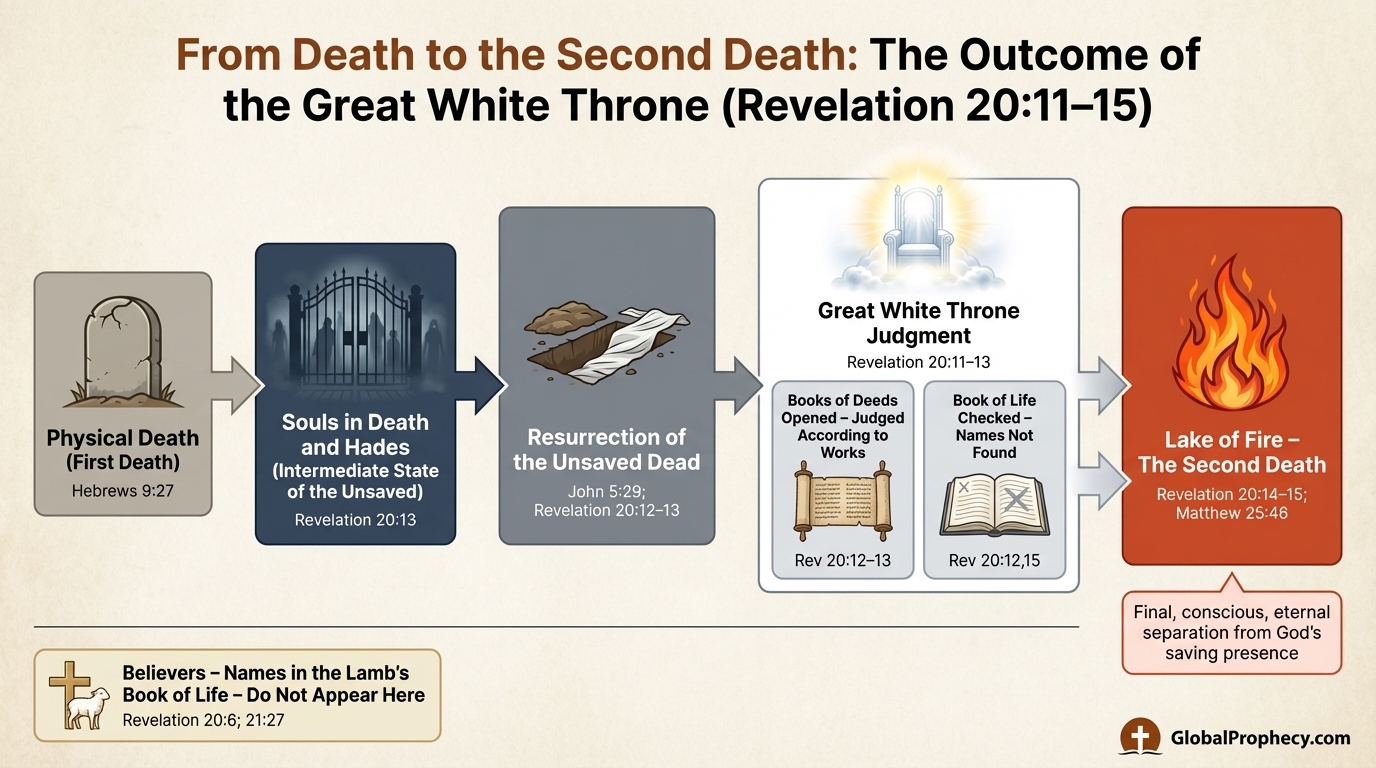
"Then Death and Hades were thrown into the lake of fire. This is the second death, the lake of fire.
And if anyone’s name was not found written in the book of life, he was thrown into the lake of fire."
— Revelation 20:14–15
6.1 Death and Hades Destroyed
- “Death and Hades” personify the entire realm of physical death and the intermediate state of the unsaved.
- Their being "thrown into the lake of fire" means:
- Physical death is abolished.
- The temporary holding place of the lost is emptied and terminated.
- Paul’s statement that "the last enemy to be destroyed is death" (1 Corinthians 15:26) is fulfilled here.
6.2 The Lake of Fire and the Second Death
The lake of fire is the final, eternal place of punishment:
- Called "the second death" (Revelation 20:14),
- Distinguished from the first (spiritual and physical) death all humanity experiences in Adam.
The second death is:
- Final separation from God’s saving presence,
- Conscious, eternal punishment (cf. Matthew 25:46),
- The same place where the devil, the beast, and the false prophet are tormented "forever and ever" (Revelation 20:10).
Those judged at the Great White Throne:
- Are cast into this lake of fire.
- Enter an eternal state from which there is no appeal, no parole, and no reversal.
7. Theological and Practical Significance
Though Revelation 20:11–15 is brief, its teaching on the Great White Throne Judgment is weighty and central to biblical eschatology.
7.1 Final Resolution of Evil
The Great White Throne Judgment marks:
- The final removal of sin, death, and all rebellion from God’s universe.
- The necessary moral cleansing before the new heaven and new earth are revealed (Revelation 21:1).
Only after this judgment can God dwell with His people in perfect righteousness (Revelation 21:3–4).
7.2 God’s Justice and Human Responsibility
The scene underscores:
- God’s perfect justice – every case is judged individually, according to infallible records.
- Human responsibility – people face judgment because they rejected the only provision for salvation in Christ.
The presence of the Book of Life at this judgment silently proclaims: salvation was offered; it was refused.
7.3 Distinction of Judgments
In biblical eschatology it is important to distinguish:
- The judgment seat of Christ (for believers’ rewards – 2 Corinthians 5:10; Romans 14:10–12),
- From the Great White Throne Judgment (for the unsaved dead – Revelation 20:11–15).
Believers will never appear at the Great White Throne, because their judgment fell on Christ at the cross, and their names are secure in the Lamb’s Book of Life.
8. Conclusion
The Great White Throne Judgment, as revealed in Revelation 20:11–15, is the final, solemn tribunal of God:
- What it is: the ultimate judgment of all the unsaved dead, before a holy Christ seated on a great white throne.
- When it occurs: after the 1,000‑year reign of Christ and the final defeat of Satan, but before the unveiling of the new heaven and new earth.
- Who presides: the Lord Jesus Christ, to whom the Father has entrusted all judgment.
- Who appears: the resurrected wicked of all ages, “the dead, great and small,” whose names are absent from the Book of Life.
- On what basis: judged according to their deeds, as recorded in God’s books, confirming their guilt and determining their punishment.
- With what result: they, together with Death and Hades, are cast into the lake of fire, the second death, and evil is forever banished from God’s renewed creation.
This judgment stands as Scripture’s most sobering portrayal of divine justice and the finality of rejecting God’s grace in Christ.
FAQ
Q: What is the Great White Throne Judgment?
The Great White Throne Judgment is the final judgment described in Revelation 20:11–15, where Jesus Christ sits on a great white throne and judges all the unsaved dead of all ages. They are resurrected, judged according to their deeds, shown to be absent from the Book of Life, and cast into the lake of fire, the “second death.”
Q: When does the Great White Throne Judgment occur in relation to the Millennium?
According to Revelation 20, the Great White Throne Judgment takes place after Christ’s 1,000‑year reign on earth and the final rebellion led by Satan, and before the creation of the new heaven and new earth (Revelation 21:1). It is the last event in the present created order before the eternal state.
Q: Who will be judged at the Great White Throne?
Only the unsaved dead appear at the Great White Throne. John calls them "the dead, great and small" (Revelation 20:12). They are resurrected from Death and Hades and from the sea. No believer is judged here, because the redeemed have already been raised in the “first resurrection” and have stood before the judgment seat of Christ.
Q: What are the “books” and the “book of life” opened at this judgment?
The “books” contain a complete record of each person’s thoughts, words, and deeds and form the basis for judging them "according to what they had done" (Revelation 20:12–13). The Book of Life is the register of those who belong to Christ; at the Great White Throne it confirms that no one present is saved, since anyone not found written in it is thrown into the lake of fire (Revelation 20:15).
Q: Is the Great White Throne Judgment the same as the judgment seat of Christ?
No. The judgment seat of Christ (often called the Bema) is a judgment of believers’ works for the purpose of reward (2 Corinthians 5:10; 1 Corinthians 3:11–15). The Great White Throne Judgment is a judgment of the unsaved dead for condemnation and assignment to the lake of fire (Revelation 20:11–15).
Frequently Asked Questions
What is the Great White Throne Judgment?
When does the Great White Throne Judgment occur in relation to the Millennium?
Who will be judged at the Great White Throne?
What are the “books” and the “book of life” opened at this judgment?
Is the Great White Throne Judgment the same as the judgment seat of Christ?
L. A. C.
Theologian specializing in eschatology, committed to helping believers understand God's prophetic Word.
Related Articles
The Books Opened at the Great White Throne Judgment
Great White Throne books opened: explore the book of life, books of works, and how these heavenly records determine final judgment in Revelation 20.
Who Will Be Judged at the Great White Throne?
Great White Throne judgment explained: discover who will stand before this final judgment and why it involves all resurrected unbelievers from every age.
The Great White Throne vs. The Judgment Seat of Christ
Great White Throne vs. Judgment Seat of Christ: compare who is judged, when each occurs, and how their distinct purposes shape every believer’s eternal outlook.
The Lake of Fire Explained
The lake of fire is the final eternal destination for the unrighteous. Discover what Scripture reveals about this place of judgment and who will be cast there.