
The Great White Throne vs. The Judgment Seat of Christ
1. Introduction
Within biblical eschatology, few topics are more frequently confused than the Great White Throne Judgment and the Judgment Seat of Christ. Popular preaching and general “judgment day” language often merge these into one event, but the New Testament clearly distinguishes them.
This article will offer a focused, essential comparison between these two future judgments: who is judged, when they occur, their purpose, and their eternal outcomes. Clarifying this distinction is crucial for understanding end-times prophecy, salvation, rewards, and the final destiny of believers and unbelievers.
2. Biblical Foundations for Two Distinct Judgments
2.1 The Great White Throne Judgment
The primary text is Revelation 20:11–15:
"Then I saw a great white throne and him who was seated on it. From his presence earth and sky fled away, and no place was found for them.
And I saw the dead, great and small, standing before the throne, and books were opened. Then another book was opened, which is the book of life.
And the dead were judged by what was written in the books, according to what they had done…
And if anyone’s name was not found written in the book of life, he was thrown into the lake of fire."
— Revelation 20:11–12, 15
Key features:
- A “great white throne” symbolic of divine majesty, holiness, and perfect justice.
- “The dead, great and small” appear—this contextually refers to unbelievers of all ages.
- Books are opened, including the book of life.
- Final destiny: the lake of fire, “the second death” (Rev 20:14).
2.2 The Judgment Seat of Christ (Bema)
The Judgment Seat of Christ is described in several New Testament passages, most directly:
"For we must all appear before the judgment seat of Christ, so that each one may receive what is due for what he has done in the body, whether good or evil."
— 2 Corinthians 5:10
"For no one can lay a foundation other than that which is laid, which is Jesus Christ.
Now if anyone builds on the foundation with gold, silver, precious stones, wood, hay, straw—each one’s work will become manifest, for the Day will disclose it…
If the work that anyone has built… survives, he will receive a reward. If anyone’s work is burned up, he will suffer loss, though he himself will be saved, but only as through fire."
— 1 Corinthians 3:11–15
Key features:
- Addressed explicitly to believers (“we… anyone” who builds on Christ as foundation).
- Focuses on evaluation of works, not salvation.
- Results in reward or loss of reward, but the person “himself will be saved.”
3. Who Is Judged? Participants at Each Judgment
The most essential distinction is who stands before each judgment.
3.1 The Great White Throne: Unbelievers Only
Revelation 20 consistently refers to those judged here as “the dead” in contrast to “the dead in Christ.” All who appear at the Great White Throne:
- Have died without saving faith in Christ.
- Are raised in what Jesus called the “resurrection of judgment” (John 5:28–29).
- Have no name in the book of life (Rev 20:15).
This judgment does not separate believers from unbelievers. It is a judgment of the wicked dead only. The fact that their names are absent from the book of life shows they are already lost; the trial reveals and confirms the righteousness of their condemnation.
3.2 The Judgment Seat of Christ: Believers Only
By contrast, the Judgment Seat of Christ (often called the bema) is exclusively for believers:
- 2 Corinthians 5:10 – “we… must all appear” refers to Christians Paul is addressing.
- Romans 14:10–12 – believers “will all stand before the judgment seat of God” to “give an account”.
- 1 Corinthians 3:11–15 – only those who have Christ as their foundation are in view.
Everyone at the bema is:
- Already saved by grace through faith (Eph 2:8–9).
- Already secure in Christ and written in the book of life.
- Being evaluated as servants and stewards, not as defendants on trial for salvation.
No unbeliever appears at the Judgment Seat of Christ; no believer appears at the Great White Throne.
4. When Do These Judgments Occur?
4.1 The Timing of the Great White Throne Judgment
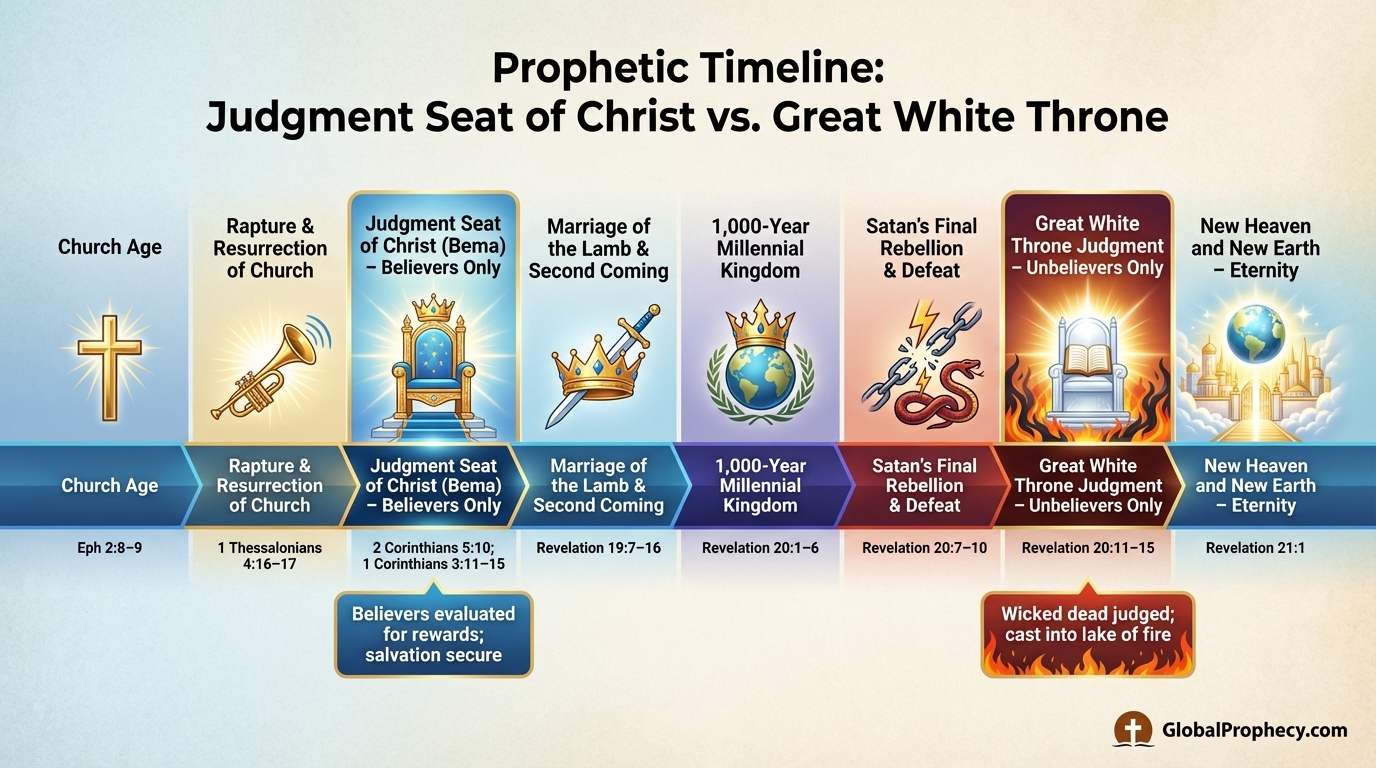
Revelation 20 places the Great White Throne after:
- The Second Coming of Christ (Rev 19).
- The 1,000-year millennial kingdom (Rev 20:1–6).
- Satan’s final rebellion and defeat (Rev 20:7–10).
Then John writes:
"Then I saw a great white throne and him who was seated on it…"
— Revelation 20:11
This temporal “then” shows:
- The Great White Throne occurs after the Millennium.
- It is the final judgment in time before the new heaven and new earth (Rev 21:1).
4.2 The Timing of the Judgment Seat of Christ
The bema judgment for believers occurs earlier in the prophetic program:
- Believers are resurrected and raptured to meet Christ (1 Thessalonians 4:16–17).
- In heaven, they stand before the judgment seat of Christ (2 Corinthians 5:10).
- They are rewarded before the public return to earth in glory (Revelation 19:7–8 shows the bride already arrayed in “righteous deeds of the saints”).
Therefore:
- The Judgment Seat of Christ takes place after the rapture and before or in connection with Christ’s return to establish His millennial kingdom.
- The Great White Throne takes place after the Millennium, just before eternity begins.
5. Purpose: Why These Judgments Occur
5.1 Purpose of the Judgment Seat of Christ
The purpose of the bema is not to determine salvation, but to evaluate and reward the believer’s service:
-
Assessment of Works and Motives
- “Each one may receive what is due for what he has done in the body” (2 Cor 5:10).
- Works are tested as “gold, silver, precious stones, wood, hay, straw” (1 Cor 3:12), revealing quality and motive.
-
Distribution of Rewards
- Faithful believers “will receive a reward” (1 Cor 3:14).
- Others “will suffer loss,” yet “he himself will be saved” (1 Cor 3:15).
- This includes crowns, authority in the kingdom, and other eternal privileges.
-
Display of Christ’s Justice and Grace
- Christ fairly recognizes differing levels of faithfulness among His people.
- The bema reveals God’s perfect equity among the redeemed.
In short, the Judgment Seat of Christ is a family evaluation, not a criminal trial.
5.2 Purpose of the Great White Throne Judgment
The Great White Throne has a very different focus:
-
Final Condemnation of the Unsaved
- All present are already spiritually dead and unsaved.
- Their judgment results in being “thrown into the lake of fire” (Rev 20:15).
-
Public Vindication of God’s Justice
- “Books were opened” and “the dead were judged… according to what they had done” (Rev 20:12–13).
- Their works, words, and motives (cf. Matt 12:36–37; Rom 2:16) provide a full record that justifies the sentence.
-
Determination of Degrees of Punishment
- Their deeds are examined to determine the degree of punishment (cf. Matt 11:20–24; Luke 12:47–48; Rev 20:12–13).
- All are lost, but not all are punished with equal severity.
-
Purging Sin from the Universe
- With Satan, death, Hades, and the lost cast into the lake of fire (Rev 20:14), the universe is purged of evil.
- Only then does God reveal “a new heaven and a new earth” (Rev 21:1).
So while the bema is about rewards for the saved, the Great White Throne is about retribution for the unsaved and the final removal of evil.
6. Outcome: Eternal Results of Each Judgment
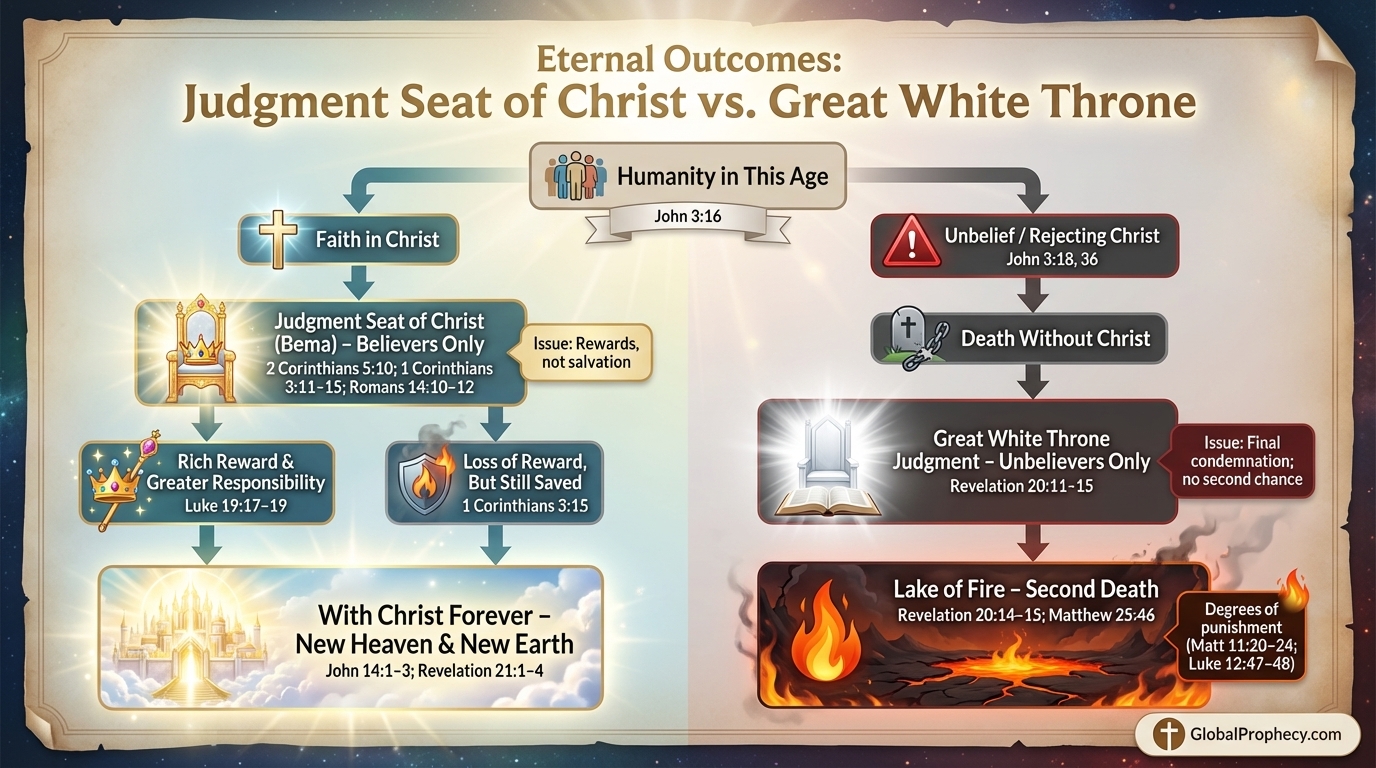
A side-by-side overview makes the contrast especially clear:
| Aspect | Judgment Seat of Christ | Great White Throne Judgment |
|---|---|---|
| Who is judged? | Believers only (those in Christ) | Unbelievers only (the wicked dead) |
| When? | After the rapture; before/with Christ’s visible return and kingdom | After the 1,000-year Millennium; just before the new heaven and new earth |
| Purpose? | Evaluate works; grant or withhold rewards | Confirm guilt; assign degrees of punishment; purge sin |
| Books consulted? | Implicitly, record of works for rewards | Books of deeds; Book of Life explicitly opened |
| Issue at stake? | Reward vs. loss of reward | Eternal destiny already fixed as lost; degree of punishment |
| Outcome for those present? | All are saved; some richly rewarded, some suffer loss of reward | All are condemned; all cast into the lake of fire (the second death) |
| Relation to salvation | Salvation presupposed and secure | Salvation absent and finally rejected |
6.1 Outcome of the Judgment Seat of Christ
For believers:
- No loss of salvation: “he himself will be saved” (1 Cor 3:15).
- Some will receive greater reward, honor, and responsibility in the kingdom (Luke 19:17–19).
- Others will experience shame and loss at Christ’s coming (cf. 1 John 2:28), having little to show for their Christian life.
But every believer’s eternal home is the same: with Christ forever (John 14:1–3). The issue is not where they will spend eternity, but how they will spend it — with what capacity for service, joy, and reward.
6.2 Outcome of the Great White Throne Judgment
For unbelievers:
- All are found guilty; none are written in the book of life (Rev 20:15).
- All are cast into the lake of fire, described as:
- The second death (Rev 20:14).
- Eternal punishment (Matt 25:46).
- Separation from God’s favorable presence (2 Thess 1:8–9).
- There are degrees of punishment, but the common reality is eternal conscious judgment.
Their eternal destiny is fixed; there is no appeal, no second chance, and no annihilation. The Great White Throne is the final, irreversible verdict for all who die without Christ.
7. Why the Distinction Matters
Understanding the difference between these two judgments has several important implications:
-
Assurance for Believers
Believers need not fear the Great White Throne Judgment. Christ has already borne their condemnation (Rom 8:1). Their future appearance before Christ is for evaluation and reward, not for determining heaven or hell. -
Sobriety about Christian Accountability
The Judgment Seat of Christ warns that how believers live now matters eternally. Salvation is by grace alone, but rewards are according to faithfulness. -
Urgency of Evangelism
The Great White Throne Judgment underscores the eternal peril of unbelief. Those who reject Christ in this life will face Him as Judge in the next, with no possibility of redemption then. -
Confidence in God’s Justice
Both judgments demonstrate that God is perfectly just—rewarding righteous service among His people and fairly punishing sin among the lost, with full knowledge of every deed and every opportunity to respond to Him.
8. Conclusion
The Judgment Seat of Christ and the Great White Throne Judgment are not two descriptions of the same event, but two distinct, complementary components of God’s final plan.
- The Judgment Seat of Christ is a heavenly tribunal for believers, following the rapture, focusing on works, faithfulness, and rewards, with salvation already secure.
- The Great White Throne Judgment is the final assize for unbelievers, following the Millennium, focusing on guilt, degrees of punishment, and the eternal removal of evil, with all present cast into the lake of fire.
Recognizing this biblical distinction clarifies the hope and responsibility of the believer and the solemn destiny of the unbeliever. It magnifies both the grace of God in salvation and the holiness of God in judgment.
FAQ
Q: Are the Great White Throne Judgment and the Judgment Seat of Christ the same event?
No. The Judgment Seat of Christ is for believers only, to evaluate their works and grant rewards, whereas the Great White Throne Judgment is for unbelievers only, to confirm their guilt and consign them to the lake of fire. They occur at different times in God’s prophetic program and have different purposes and outcomes.
Q: Will Christians appear at the Great White Throne Judgment?
No. Christians will not appear at the Great White Throne Judgment. Their sins were judged at the cross, their names are in the book of life, and they will have already stood before the Judgment Seat of Christ to receive rewards. The Great White Throne is exclusively for the wicked dead whose names are not in the book of life.
Q: Can a believer lose salvation at the Judgment Seat of Christ?
No. Salvation is never at risk at the Judgment Seat of Christ. According to 1 Corinthians 3:15, a believer whose works are burned up “will suffer loss, though he himself will be saved.” The bema concerns rewards and loss of reward, not entrance into heaven.
Q: What is the main purpose of the Great White Throne Judgment in biblical eschatology?
The main purpose of the Great White Throne Judgment is to finalize God’s just condemnation of all unbelievers, reveal the full record of their deeds, assign appropriate degrees of punishment, and purge the universe of sin before the new heaven and new earth are revealed.
Q: Why does God judge believers’ works if they are already saved?
Believers are judged for rewards to demonstrate God’s fairness and to honor faithfulness in service. While salvation is a free gift received by faith, rewards are given according to works. The Judgment Seat of Christ shows that how Christians live after conversion has eternal significance.
Frequently Asked Questions
Are the Great White Throne Judgment and the Judgment Seat of Christ the same event?
Will Christians appear at the Great White Throne Judgment?
Can a believer lose salvation at the Judgment Seat of Christ?
What is the main purpose of the Great White Throne Judgment in biblical eschatology?
Why does God judge believers’ works if they are already saved?
L. A. C.
Theologian specializing in eschatology, committed to helping believers understand God's prophetic Word.
Related Articles
The Books Opened at the Great White Throne Judgment
Great White Throne books opened: explore the book of life, books of works, and how these heavenly records determine final judgment in Revelation 20.
What is the Great White Throne Judgment?
Great White Throne Judgment: final judgment of all unbelievers in Revelation 20:11-15, when the dead are raised, judged by works, and cast into the lake of fire.
Who Will Be Judged at the Great White Throne?
Great White Throne judgment explained: discover who will stand before this final judgment and why it involves all resurrected unbelievers from every age.
The Campaign of Armageddon vs Gog and Magog
Armageddon vs Gog and Magog: explore key differences in timing, geography, and participants to see why these prophetic end-time battles are distinct.