
Heaven vs Hell: The Great Contrast
1. Introduction
The Bible sets before humanity a stark, ultimate alternative: heaven vs hell. These are not vague religious symbols but concrete, eternal destinies. Heaven is described as the dwelling place of God and the redeemed in resurrection glory; hell as the place of conscious, unending punishment for the unrepentant.
Understanding the contrast between heaven and hell is central to biblical eschatology. Scripture consistently presents them together—eternal life vs eternal punishment, joy vs judgment, the New Jerusalem vs the lake of fire—so that we feel the full weight of God’s promises and God’s warnings.
This article surveys key biblical teaching on heaven and hell, highlighting their great contrast in five main areas: nature, inhabitants, experience, permanence, and the way that leads to each.
2. Heaven and Hell as Real, Eternal Places
2.1 Heaven: New Heaven, New Earth, New Jerusalem
Biblically, heaven is both:
- a state (perfect fellowship with God), and
- a place (a real, created order in which that fellowship is enjoyed).
After the millennial kingdom, Scripture reveals a new heaven and a new earth:
"Then I saw a new heaven and a new earth, for the first heaven and the first earth had passed away."
— Revelation 21:1
The center of this eternal order is “the holy city, new Jerusalem” (Rev 21:2), a vast, radiant city described as:
- “having the glory of God” (Rev 21:11)
- built of “pure gold, like clear glass” (Rev 21:18)
- illumined directly by the Lord:
"The city has no need of sun or moon to shine on it, for the glory of God gives it light, and its lamp is the Lamb."
— Revelation 21:23
Heaven, in its eternal form, is God’s kingdom fully manifested in a renewed creation where righteousness permanently dwells (2 Pet 3:13).
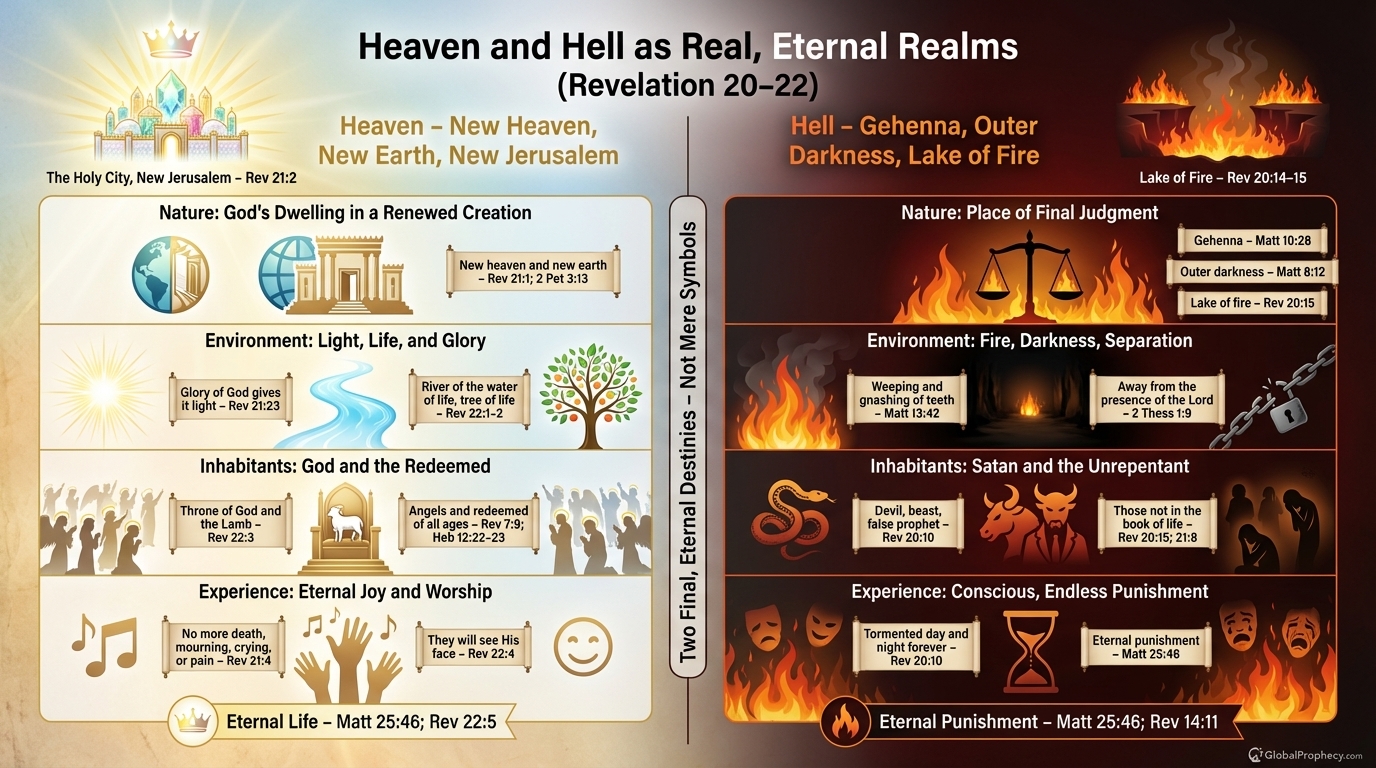
2.2 Hell: Gehenna, Outer Darkness, Lake of Fire
In direct contrast, the Bible presents hell as a real place of judgment. Several terms describe this reality:
- Gehenna – the word Jesus often uses (e.g., Matt 10:28), evoking the burning refuse valley outside Jerusalem.
- Outer darkness – a realm of exclusion from God’s kingdom, “in that place there will be weeping and gnashing of teeth” (Matt 8:12).
- The lake of fire – the final destination of Satan, demons, death, and all whose names are not in the book of life:
"And if anyone’s name was not found written in the book of life, he was thrown into the lake of fire."
— Revelation 20:15
Where the New Jerusalem is pictured with light, jewels, and life-giving water, hell is portrayed with fire, darkness, and separation. Both are concrete, eschatological realities, not mere symbols of psychological states.
3. Contrasting Inhabitants and Destinies
3.1 Who Will Be in Heaven?
The eternal heaven—new heaven and new earth with the New Jerusalem—will be populated by:
- The triune God: “the throne of God and of the Lamb will be in it” (Rev 22:3).
- The Lamb, Jesus Christ, in His glorified body (Rev 5:6; Phil 3:21).
- The Holy Spirit, actively present (Rev 22:17).
- Holy angels in joyful assembly (Heb 12:22; Rev 5:11).
- The redeemed of all ages:
- “A great multitude that no one could number, from every nation” (Rev 7:9).
- “The church of the firstborn who are enrolled in heaven … and the spirits of the righteous made perfect” (Heb 12:23).
Heaven is explicitly exclusive to those who belong to Christ:
"Truly, truly, I say to you, unless one is born again he cannot see the kingdom of God."
— John 3:3
"Nothing unclean will ever enter it … but only those who are written in the Lamb’s book of life."
— Revelation 21:27
3.2 Who Will Be in Hell?
Hell is equally exclusive—but in the opposite direction. Its final form, the lake of fire, is prepared for:
- Satan and his angels (Matt 25:41; Rev 20:10).
- The beast and the false prophet (Rev 19:20; 20:10).
- All unrepentant unbelievers whose names are absent from the book of life (Rev 20:15).
Jesus describes those consigned to hell as:
"…the goats… 'Depart from me, you cursed, into the eternal fire prepared for the devil and his angels.'"
— Matthew 25:41
And Scripture lists representative patterns of life that evidence an unregenerate heart:
"…the cowardly, the faithless, the detestable, as for murderers, the sexually immoral, sorcerers, idolaters, and all liars…their portion will be in the lake that burns with fire and sulfur, which is the second death."
— Revelation 21:8
In sum, heaven is the eternal home of the forgiven; hell is the eternal home of the unforgiven.
4. The Experience of Heaven vs Hell
The experiential contrast between heaven and hell could not be sharper. Scripture uses parallel language to underline this: eternal life vs eternal punishment (Matt 25:46).
4.1 Heaven: Joy, Rest, Life, and Worship
Heaven is characterized by unmixed blessing—physically, emotionally, and spiritually.
No sorrow or pain
"He will wipe away every tear from their eyes, and death shall be no more, neither shall there be mourning, nor crying, nor pain anymore, for the former things have passed away."
— Revelation 21:4
No curse, no death, no night
"No longer will there be anything accursed, but the throne of God and of the Lamb will be in it, and his servants will worship him."
— Revelation 22:3
"They will need no light of lamp or sun, for the Lord God will be their light."
— Revelation 22:5
Perfect resurrection life
Believers will receive glorified, incorruptible bodies (1 Cor 15:42–54; Phil 3:21). There will be:
- no sickness (Rev 22:2),
- no aging,
- no death (Rev 21:4).
Unending fellowship and worship
"They will see his face, and his name will be on their foreheads."
— Revelation 22:4
Heaven is God-centered. Its chief joy is beholding and serving God:
- “His servants will worship him” (Rev 22:3).
- The redeemed sing, serve, and learn forever, continually discovering the unsearchable riches of God.
4.2 Hell: Conscious, Just, Endless Punishment
In radical contrast, hell is described as the place where God’s holy wrath is manifested against sin.
Conscious torment
"…and they will be tormented day and night forever and ever."
— Revelation 20:10
Jesus speaks of:
- “weeping and gnashing of teeth” (Matt 13:42),
- “where their worm does not die and the fire is not quenched” (Mark 9:48).
Separation from God’s favorable presence
"Away from the presence of the Lord and from the glory of his might."
— 2 Thessalonians 1:9
The lost do not cease to exist; rather, they exist away from the blessing of God, under His righteous judgment.
No relief, no hope, no end
In Luke 16:19–31, the rich man in Hades is:
- in anguish in flame,
- unable to cross the “great chasm”,
- denied even a drop of water for relief.
Where heaven is the fulfillment of all godly desire, hell is the fixed, conscious experience of divine judgment, with no possibility of reversal.
5. The Moral and Spiritual Contrast
5.1 Heaven: Holiness, Love, and Fulfilled Righteousness
Heaven is a holy city:
"Nothing unclean will ever enter it… but only those who are written in the Lamb’s book of life."
— Revelation 21:27
The eternal order is described as:
- “a new earth in which righteousness dwells” (2 Pet 3:13).
- A realm where the curse is reversed (Rev 22:3).
There is perfect, sinless love:
- toward God: the greatest commandment fulfilled without hindrance (Matt 22:37),
- toward others: no jealousy, envy, or broken relationships; perfect unity of the redeemed (Heb 12:23).
5.2 Hell: The Finality of Sin and Judgment
Hell is the outcome of unrepentant sin and the vindication of God’s justice:
"For the wages of sin is death, but the free gift of God is eternal life in Christ Jesus our Lord."
— Romans 6:23
Those in hell are not morally neutral victims. They are those who:
- refused God’s authority,
- rejected His Son, and
- persisted in unbelief and rebellion.
Hell displays:
- the seriousness of sin (against an infinitely holy God),
- the righteousness of divine retribution (Rom 2:5–8),
- the unchangeable moral order of God’s universe.
While heaven manifests the riches of His grace, hell manifests the severity of His justice (Rom 11:22).
6. Permanence: Eternal Life vs Eternal Punishment
The Bible places heaven and hell side by side in terms of duration:
"And these will go away into eternal punishment, but the righteous into eternal life."
— Matthew 25:46
The same Greek word for “eternal” (aiōnios) is applied to both:
- God Himself (Rom 16:26),
- eternal life, and
- eternal punishment.
6.1 Heaven’s Eternal Security
The redeemed will:
- “reign forever and ever” (Rev 22:5),
- never again be exposed to sin, death, or curse (Rev 21:4; 22:3),
- dwell in a city whose foundations “cannot be shaken” (Heb 12:28; 11:10).
Heaven is unlosable because:
- Christ’s work is finished and perfect (Heb 10:14),
- the saints are kept by God’s power (1 Pet 1:3–5).
6.2 Hell’s Eternal Irreversibility
By the same token, hell’s sentences are:
- final – “it is appointed for man to die once, and after that comes judgment” (Heb 9:27),
- irrevocable – no second chances, no postmortem repentance, no escape (Luke 16:26),
- everlasting – “the smoke of their torment goes up forever and ever” (Rev 14:11).
Any view that softens hell into temporary correction or annihilation undermines Jesus’ own explicit teaching and the parallel with eternal life. The great contrast is not between eternal life and temporary discomfort, but between eternal joy and eternal judgment.
7. The Way to Heaven vs the Way to Hell
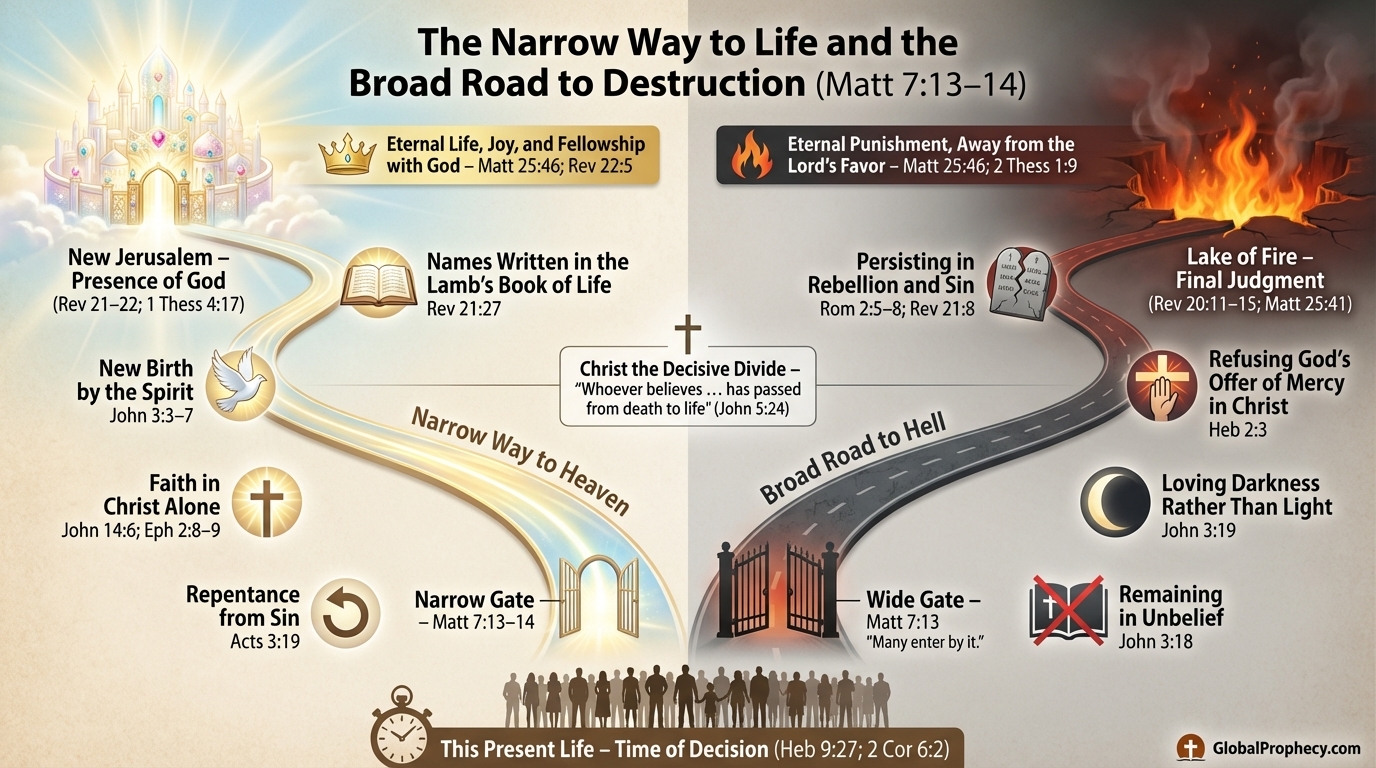
7.1 The Narrow Way to Heaven
Entrance to heaven is by grace alone, through faith alone, in Christ alone.
"I am the way, and the truth, and the life. No one comes to the Father except through me."
— John 14:6
"For by grace you have been saved through faith. And this is not your own doing; it is the gift of God."
— Ephesians 2:8
Heaven is a prepared place for a prepared people (John 14:2–3). Preparation is not moral self-improvement but:
- repentance from sin,
- trusting in Christ’s atoning death and resurrection,
- being born again by the Spirit (John 3:3–7).
Those thus united to Christ have their names written in the Lamb’s book of life (Rev 21:27).
7.2 The Broad Road to Hell
No one “earns” hell in the sense of desiring punishment; yet we all, by nature, follow the path that leads there:
"Enter by the narrow gate. For the gate is wide and the way is easy that leads to destruction, and those who enter by it are many."
— Matthew 7:13
The “way to hell” is:
- remaining in unbelief (John 3:18),
- loving darkness rather than light (John 3:19),
- refusing God’s offer of mercy in Christ.
God “desires all people to be saved” (1 Tim 2:4), yet does not coerce love. The eternal bifurcation of humanity into heaven and hell is ultimately the outworking of how people respond to His Son.
8. Summary Table: Heaven vs Hell in the Bible
| Category | Heaven (New Heaven & Earth) | Hell (Lake of Fire / Gehenna) |
|---|---|---|
| Nature | Renewed creation, holy city, God’s dwelling (Rev 21–22) | Place of judgment, outer darkness, lake of fire (Matt 25; Rev 20) |
| Inhabitants | God, Lamb, Spirit, angels, redeemed from all ages | Satan, demons, beast, false prophet, unbelievers |
| Experience | Joy, worship, rest, service, knowledge, love, glory | Weeping, gnashing of teeth, torment, exclusion, regret |
| Environment | Light, life, river of life, tree of life, no curse, no death | Fire, darkness, no relief, no exit, presence of wrath |
| Duration | Eternal life, eternal reign (Rev 22:5; Matt 25:46) | Eternal punishment, eternal destruction (Matt 25:46; 2 Thess 1:9) |
| Access | Through Christ alone; by grace through faith; book of life | By remaining in unbelief and impenitence; names not in book of life |
| Moral character | Perfect holiness and righteousness, no sin | Final confirmation of rebellion; just retribution for sin |
9. Conclusion
Biblical eschatology confronts us with an unavoidable reality: every human being is moving toward either heaven or hell. Scripture presents them together—the New Jerusalem or the lake of fire, eternal life or eternal punishment, the presence of God’s face or separation from His favor—so that we feel both the wonder of grace and the seriousness of sin.
Heaven is the eternal home of God’s people, a renewed creation where they see His face, serve Him perfectly, and share His joy forever. Hell is the eternal prison of God’s enemies, a place of conscious, just retribution, where the door of mercy—so wide open in this age—is finally and forever closed.
The decisive issue is not religious performance but relationship to Jesus Christ. Those who trust Him share His destiny; those who reject Him share the destiny of the devil and his angels.
The great contrast between heaven and hell is ultimately a great invitation:
"Whoever is thirsty, let him come; whoever desires, let him take the water of life without price."
— Revelation 22:17
FAQ
Q: Are heaven and hell literal places or just symbols?
The Bible presents both heaven and hell as real, objective realms. Heaven is a new heaven and new earth with a real city, the New Jerusalem (Rev 21–22). Hell is described as the lake of fire, outer darkness, and a place of weeping and gnashing of teeth (Matt 25; Rev 20). The imagery is vivid, but it points to concrete, eternal realities, not mere states of mind.
Q: How does the Bible define the main difference between heaven and hell?
At the deepest level, the difference is relationship to God through Christ. Heaven is to be with the Lord in joy and glory forever (1 Thess 4:17); hell is to be away from the presence of the Lord and the glory of His might under judgment (2 Thess 1:9). This relational divide expresses itself in radically different environments, experiences, and destinies.
Q: Is hell eternal, or will it eventually end?
Jesus directly parallels “eternal punishment” and “eternal life” in Matthew 25:46. The same word for “eternal” is used for both. Revelation also speaks of torment “day and night forever and ever” (Rev 20:10; 14:11). Biblically, hell is everlasting, not temporary or annihilating.
Q: Can someone move from hell to heaven after death?
No. Scripture gives no indication of postmortem repentance or transfer. Jesus’ account of the rich man and Lazarus shows a “great chasm” fixed, so that none can cross from one side to the other (Luke 16:26). Hebrews 9:27 states that after death comes judgment, not another chance. The time of decision is this life.
Q: How can I be sure I will go to heaven and not hell?
According to the Bible, assurance comes by turning from sin and trusting Jesus Christ alone as Lord and Savior. He said, “Whoever hears my word and believes him who sent me has eternal life. He does not come into judgment, but has passed from death to life” (John 5:24). Those who are born again by the Spirit, justified by faith, and kept by God’s power (John 3; Rom 5; 1 Pet 1:3–5) can have confident hope of heaven and freedom from the fear of hell.
Frequently Asked Questions
Are heaven and hell literal places or just symbols?
How does the Bible define the main difference between heaven and hell?
Is hell eternal, or will it eventually end?
Can someone move from hell to heaven after death?
How can I be sure I will go to heaven and not hell?
L. A. C.
Theologian specializing in eschatology, committed to helping believers understand God's prophetic Word.
Related Articles
Death and the Unbeliever
Death and the unbeliever explores what happens at death, conscious judgment, and the eternal destiny of those who die without saving faith in Christ.
Are There Degrees of Punishment in Hell?
Hell degrees of punishment: explore Bible passages where Jesus and other texts teach varying levels of judgment and accountability in eternal torment.
Degrees of Punishment in Hell
Degrees of punishment in hell, based on works and knowledge, explained from Scripture. Explore how divine justice varies in eternal judgment.
Will We Eat and Drink in Heaven?
Will we eat and drink in heaven? Explore what Scripture reveals about dining in eternity, the marriage supper of the Lamb, and our resurrected bodies.