
How to Interpret Bible Prophecies
1. Introduction
Bible prophecy is not an encrypted codebook reserved for experts; it is God’s revealed Word, given to be understood and obeyed. The apostle Peter says:
"We have the prophetic word more fully confirmed, to which you will do well to pay attention…" — 2 Peter 1:19
And John begins Revelation by calling it an “unveiling” (Greek apokalypsis) of Jesus Christ (Revelation 1:1), not a concealing.
Yet Christians often disagree sharply about end-times passages. The main reason is not that Scripture is unclear, but that different methods of interpretation are being used. This article offers a practical guide to interpreting Bible prophecies correctly, using a consistent, grammatical-historical, literal approach.
2. Begin with a Literal, Grammatical-Historical Method
2.1 What “literal” interpretation really means
To interpret Bible prophecy literally is to read it in its normal, plain sense, as we read any other serious writing or ordinary conversation. The classic principle is:
When the plain sense makes good sense, seek no other sense, lest you end up with nonsense.
“Literal” does not mean rigid or wooden. It means:
- Grammatical – pay attention to words, syntax, and grammar.
- Historical – read the text in its original time, culture, and situation.
- Normal – use the ordinary rules of language and communication.
If I say, “I saw three brown dogs in the alley,” you naturally assume three (not five) real dogs, brown (not black), in an alley (not a park). You do not hunt for a secret allegorical meaning. We must give prophetic texts the same courtesy unless the context clearly indicates figurative language.
Why this matters for prophecy
If “a thousand years” (Revelation 20:1–6) is interpreted as a real measurable period, you will reach one kind of eschatological conclusion. If you treat it as a vague symbol with no defined length, you can make it mean almost anything. Literal interpretation anchors prophecy to objective meaning and guards against speculation.
2.2 Literal does not exclude figures of speech
Literal interpretation fully embraces metaphors, symbols, and parables—as figures of speech that communicate literal truth.
- Jesus said, “I am the door” (John 10:9). No one imagines He is made of wood and hinges. We recognize a metaphor, conveying the literal truth that He is the only entrance to salvation.
- God is called a “rock” (Psalm 18:2). This does not mean He is a geological formation; it affirms His stability and protection.
The question is not “Is this passage figurative or literal?” but rather:
“Is this word or phrase being used in a plain-literal way or a figurative-literal way?”
In both cases, there is one real, objective meaning intended by the author.
2.3 Why avoiding allegorization is crucial
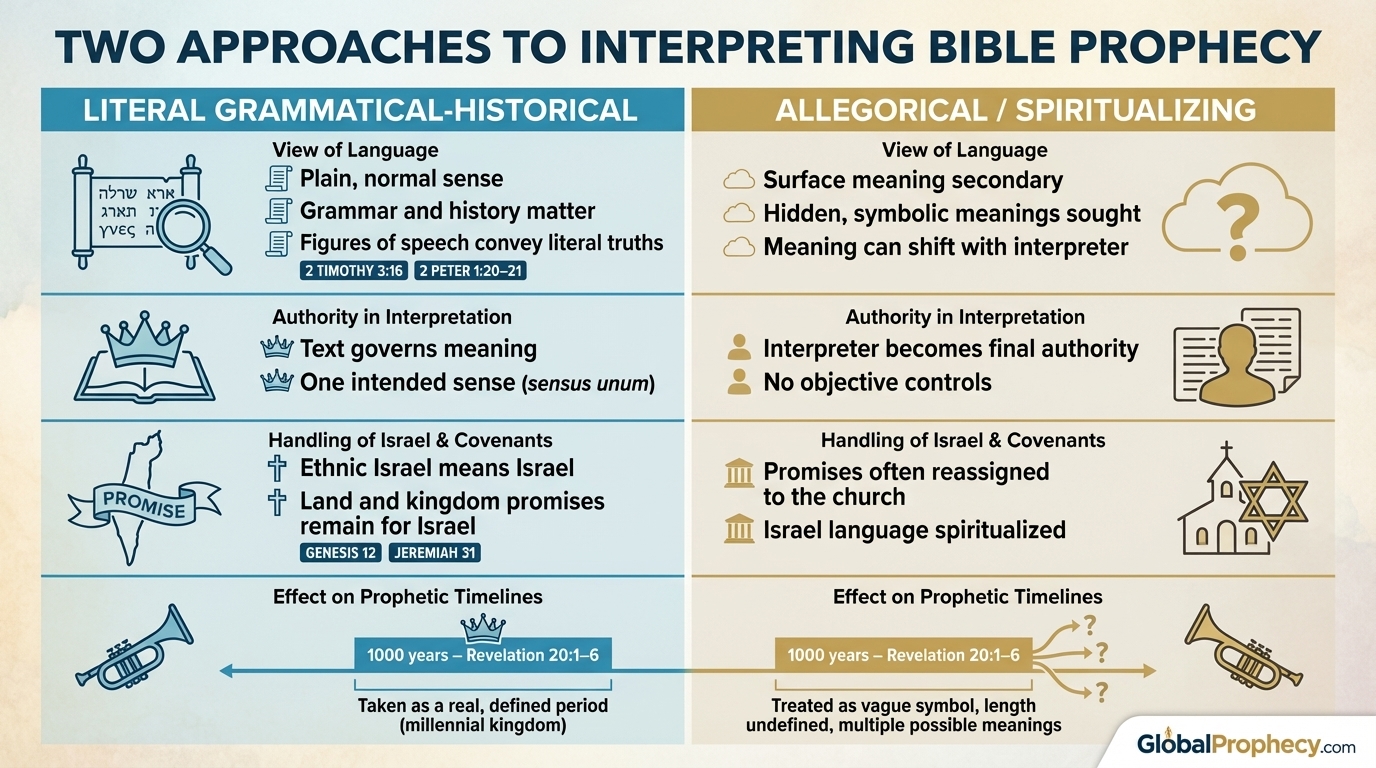
A spiritual or allegorical method treats the surface meaning as secondary and looks for a deeper, hidden sense beneath the text. This approach:
- Has no objective controls; one person’s allegory is as good as another’s.
- Quietly makes the interpreter, not the text, the final authority.
- Regularly overrides clear promises, such as God’s covenants with Israel, and reassigns them to other entities (often the church).
By contrast, a literal, grammatical-historical method:
- Respects God as a competent communicator.
- Honors the fact that Scripture’s words are “breathed out by God” (2 Timothy 3:16).
- Gives us one stable meaning, with many legitimate applications.
3. Pay Close Attention to Context and Genre
3.1 Immediate and wider context
Context is king in interpreting Bible prophecy.
- Immediate context – What do the surrounding verses say? How does the argument flow?
- Book-level context – What is the purpose, audience, and structure of this book?
- Canonical context – How does this fit with the rest of Scripture?
For example, Israel in prophecy consistently refers to ethnic Israel, not a vague “spiritual Israel,” unless the text clearly signals otherwise. Reading promises about Israel’s land and future restoration in their original covenant context prevents us from dissolving them into general spiritual ideas.
Scripture also interprets Scripture. Peter insists:
"No prophecy of Scripture comes from someone’s own interpretation." — 2 Peter 1:20
That is, no prophecy stands in isolation. We must compare each prophecy with all God has said on the same subject.
3.2 Genre: prophecy, poetry, narrative, apocalyptic
Different genres use language differently. We must let genre guide our expectations:
- Narrative (e.g., Acts) – primarily straightforward historical prose.
- Poetry (e.g., Psalms, many sections of Isaiah) – rich in imagery and parallelism but still pointing to real people and events.
- Parable (e.g., Matthew 13) – brief stories teaching one or more concrete truths.
- Apocalyptic (e.g., Daniel 7–12; Revelation) – highly symbolic visions of real future events.
You do not interpret a psalm of praise like a legal contract, nor a vision of beasts like a travel diary. But in each case the referent is real. Poetic and apocalyptic forms intensify meaning; they do not evaporate it.
4. Handle Symbols and Figurative Language Carefully
Prophecy often uses symbols and vivid imagery. These are not invitations to imaginative free play; they are precise, God-chosen tools of communication.
4.1 Look first for “built-in” explanations
Many symbols are explained in the immediate text:
-
In Revelation, the risen Christ says:
"The seven stars are the angels of the seven churches, and the seven lampstands are the seven churches." — Revelation 1:20
So:
- Stars → messengers
- Lampstands → local churches
-
In Ezekiel’s vision:
"These bones are the whole house of Israel." — Ezekiel 37:11
Whenever a symbol is interpreted directly by the prophet, an angel, or Christ Himself, that explanation sets the authoritative meaning.
4.2 Use the larger biblical context
When the immediate context is silent, ask: Where else does Scripture use this image?
Revelation is saturated with Old Testament imagery. For example:
- The “wings of the great eagle” that carry the woman to safety (Revelation 12:14) echo Exodus 19:4 and Isaiah 40:31, where eagle’s wings picture God’s powerful care and deliverance. The symbol points to God’s protection of Israel, not to a modern airlift or a specific nation’s air force.
This comparative approach:
- Keeps interpretation tied to biblical patterns, not modern speculation.
- Honors the unity of Scripture—one divine Author, coherent symbolism.
4.3 Consider the historical-cultural background
Some images arise from ancient customs or objects:
- A “white stone” (Revelation 2:17) or a “pillar” (Revelation 3:12) draw on first-century practices and architecture.
- The “horn” as a symbol of power and a king (e.g., Daniel 7–8; Revelation 13; 17) reflects how ancient peoples saw animal horns as emblems of strength and authority.
Good interpretation asks: How would the original audience have recognized this image?
5. Compare Prophecy with Prophecy
God did not give all prophetic information to one writer. He gradually unfolded future events through many prophets across centuries. Therefore, a key principle in interpreting Bible prophecies is:
Prophecy must be interpreted in light of all other prophecy.
5.1 Let Scripture build the full picture
One passage rarely contains everything about a topic:
- The millennial kingdom is mentioned as a 1,000-year reign in Revelation 20, but its character, geography, and blessings are richly described in Isaiah, Jeremiah, Ezekiel, Zechariah, and others.
- The Antichrist is portrayed in Daniel 7; 9:27; 11:36–39; 2 Thessalonians 2:3–12; Revelation 13. Each text adds details about his origin, character, actions, and destiny.
Because God cannot contradict Himself, we approach difficulties assuming:
- Apparent tensions are harmonizable.
- Later revelation clarifies and supplements, but does not cancel, earlier promises.
5.2 One meaning, many applications
Biblical prophecy has one intended meaning (sensus unum) shared by the human and divine Author. Later texts can:
- Highlight implications of an earlier prophecy.
- Apply its principle in a new situation.
But they do not retroactively change the original meaning.
For example, New Testament writers sometimes apply Israel’s experiences typologically to the church (1 Corinthians 10:1–11). This is an application, not a denial of the original historical meaning.
6. Recognize Prophetic Time Gaps and Fulfillment Status
6.1 The “mountain peaks” of prophecy
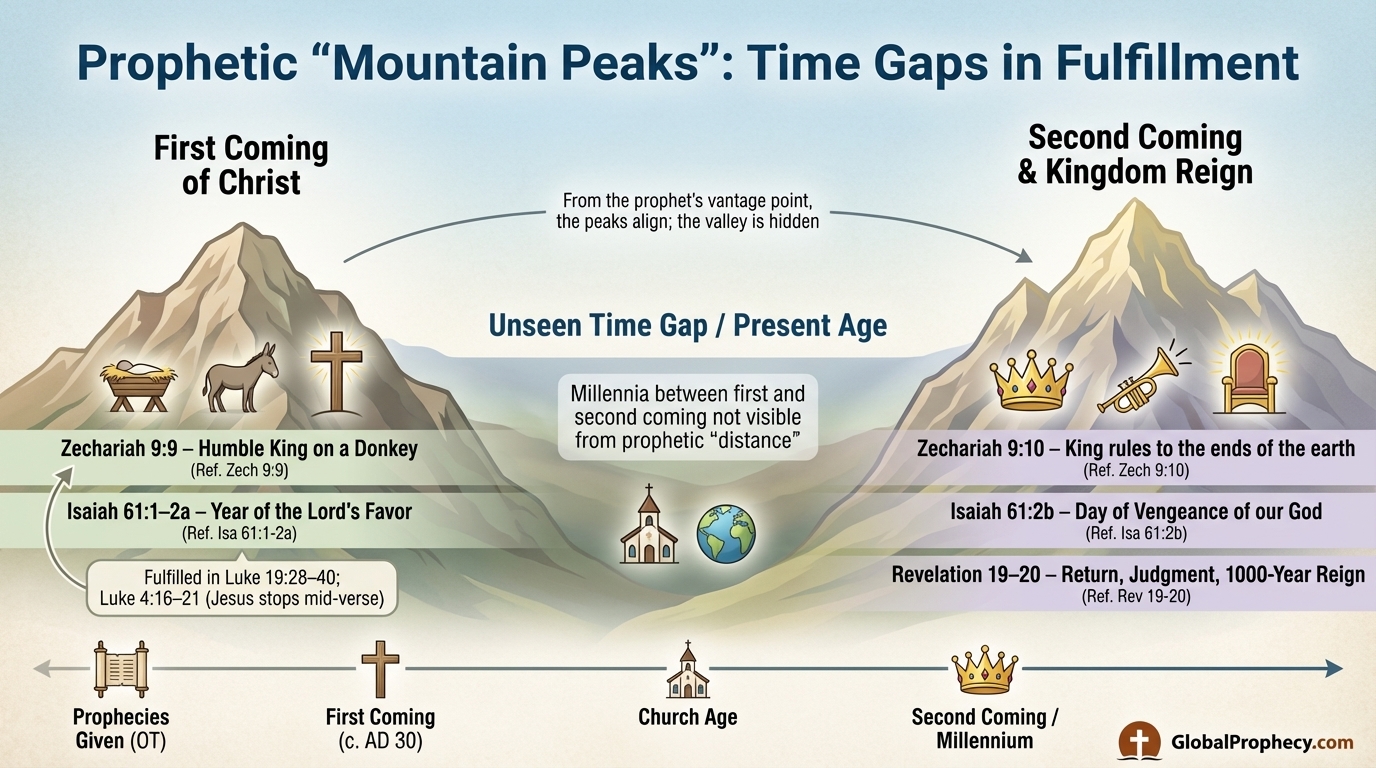
Old Testament prophets often saw multiple future events side by side, without being shown the time intervals between them. From a distance, the peaks line up; the valleys are invisible.
Classic examples:
-
Zechariah 9:9–10
- Verse 9: Messiah comes “humble and mounted on a donkey” – fulfilled at His first coming (Triumphal Entry).
- Verse 10: He rules over all the earth – to be fulfilled at His second coming.
-
Isaiah 61:1–2
Jesus read this in the synagogue (Luke 4:16–21), stopped halfway through verse 2, and declared:"Today this Scripture has been fulfilled in your hearing." — Luke 4:21
The first part (“to proclaim the year of the Lord’s favor”) described His first-advent ministry. The next phrase—“the day of vengeance of our God”—awaits His second coming. Isaiah saw them together; history reveals a gap of millennia.
Recognizing such prophetic telescoping helps us avoid compressing all fulfillment into one era (e.g., the first century) when Scripture and history suggest otherwise.
6.2 Distinguish fulfilled, partially fulfilled, and future prophecies
A practical step in interpreting Bible prophecy is to ask of each passage:
- Has this prophecy been fulfilled in history?
- If so, was it fulfilled completely or partially?
- Which elements clearly remain unfulfilled?
Where a prophecy has been clearly fulfilled, we can study how it was fulfilled. This provides a pattern:
- Over a hundred messianic prophecies of Christ’s first coming were fulfilled literally—His lineage, birth in Bethlehem (Micah 5:2), virgin conception (Isaiah 7:14), suffering (Isaiah 53), piercing (Zechariah 12:10), death around AD 33 (Daniel 9:24–26), and resurrection (Psalm 16:10; Acts 2:25–32).
This track record strongly supports the expectation that prophecies of His second coming and end-time events will also be fulfilled literally, not merely symbolically.
When some elements of a prophecy clearly remain undone—such as global judgment, Israel’s full restoration to the promised land, universal peace—we should mark these as future and interpret them in harmony with the same literal pattern.
7. Depend on the Holy Spirit and Maintain Humility
Interpreting Bible prophecies is not only a technical exercise; it is a spiritual discipline.
7.1 The Spirit’s role in illumination
Believers have been anointed with the Holy Spirit (1 John 2:20, 27), and:
"The Spirit searches everything, even the depths of God." — 1 Corinthians 2:10
The Spirit does not bypass the mind or cancel the need for careful study. Instead, He:
- Opens our understanding.
- Convicts us where prophecy calls for repentance and hope.
- Protects us from serious error as we submit to Scripture.
We therefore study prophecy with diligence and prayer, asking God to conform our thinking to His Word.
7.2 Conviction with charity
Sound interpretation of Bible prophecy should produce:
- Deepened confidence in God’s promises.
- Holy living in light of Christ’s return (2 Peter 3:11–14).
- Humility, not arrogance.
Christians who honor the authority of Scripture still differ on some prophetic details. It is right to test every view by the Bible and to argue vigorously for what we believe Scripture teaches. But it is wrong to:
- Mock or malign fellow believers.
- Let prophetic debates overshadow the central truths of the gospel.
We must hold our eschatological convictions firmly, but hold our brothers and sisters more tightly still.
8. Conclusion
To interpret Bible prophecies correctly, we must approach them as God intended—with a consistent, literal, grammatical-historical method, deep respect for context and genre, careful handling of symbols, and a commitment to compare prophecy with prophecy. We recognize that some prophecies telescope multiple events, and we distinguish between what has already been fulfilled and what awaits future completion.
Above all, we interpret Bible prophecy under the illumination of the Holy Spirit, with a heart ready to obey. Prophecy was given not to satisfy curiosity, but to strengthen faith, purify lives, and fix our hope on the soon appearing of Jesus Christ.
"Blessed is the one who reads aloud the words of this prophecy, and blessed are those who hear, and who keep what is written in it, for the time is near." — Revelation 1:3
FAQ
Q: How should a beginner start interpreting Bible prophecy?
Begin with clear passages and major themes rather than obscure details. Use a literal, grammatical-historical approach, read whole chapters (not isolated verses), and compare related prophecies across Scripture. Pray for the Holy Spirit’s help and use reliable study tools, but let the Bible itself be your primary guide.
Q: What is the literal method of interpreting Bible prophecies?
The literal method reads prophetic texts in their normal, plain sense, according to the ordinary rules of grammar and historical context. It recognizes figures of speech and symbols, but treats them as devices that communicate real, concrete truths, not as invitations to invent hidden meanings unrelated to the text.
Q: How do we know when a prophecy is symbolic and when it is literal?
First, look for explicit explanations in the passage itself (e.g., Revelation 1:20). Second, examine the genre and immediate context—is this poetry, apocalyptic vision, or straightforward narrative? Third, compare with other Scriptures that use the same imagery. Even when language is symbolic, it always points to literal realities.
Q: Why do Christians disagree so much about end-times prophecy?
Disagreements usually arise from different interpretive methods, especially over whether and how to apply a literal approach to prophetic texts. Some spiritualize many prophecies, while others consistently use the grammatical-historical method. Recognizing this helps you evaluate views by asking not only what they conclude, but how they got there.
Q: Does Bible prophecy really matter for everyday Christian life?
Yes. Prophecy reveals God’s plans, character, and faithfulness, and it is designed to shape how we live now. Knowing that Christ will return, judge, and reign motivates holiness, perseverance, evangelism, and hope. Interpreting Bible prophecy correctly is therefore not an academic luxury but a vital part of mature Christian discipleship.
Frequently Asked Questions
How should a beginner start interpreting Bible prophecy?
What is the literal method of interpreting Bible prophecies?
How do we know when a prophecy is symbolic and when it is literal?
Why do Christians disagree so much about end-times prophecy?
Does Bible prophecy really matter for everyday Christian life?
L. A. C.
Theologian specializing in eschatology, committed to helping believers understand God's prophetic Word.
Related Articles
The Historical-Grammatical Method: How to Read Prophecy Correctly
Historical-grammatical method explained: learn how to interpret biblical prophecy by context, grammar, and authorial intent for accurate application.
Literal vs Allegorical: The Right Way to Interpret Bible Prophecy
Literal vs allegorical prophecy: learn how the literal-grammatical-historical method guides when to read Bible prophecy plainly and when symbolically.
What the Bible Says about Antichrist?
Antichrist in the Bible: discover what Scripture reveals about his identity, character, deceptive power, and end-time role in the Tribulation.
What the Bible Says about False Prophet?
False Prophet biblical identity and role in end times. Discover what Scripture reveals about this key figure in Revelation's tribulation prophecy.