
How Will Jesus Return? The Nature of Christ's Second Coming
1. Introduction
The Second Coming of Jesus Christ is the climactic event of biblical eschatology. While Christians debate the timing of related events (such as the Rapture and the Millennium), Scripture is explicit and unified about how Jesus will return.
This article focuses exclusively on the manner and nature of Christ’s Second Coming—what His return will be like, how it will be experienced, and how the Bible describes this decisive appearing of the Son of Man in glory.
Understanding the nature of Christ’s return safeguards believers from false claims, clarifies Christian hope, and provides a solid biblical framework for studying prophecy.
2. A Literal, Bodily Return of the Same Jesus
2.1 The Same Jesus Who Ascended
The New Testament insists that the Jesus who returns is the very same person who lived, died, rose, and ascended. After the ascension, two angels said to the disciples:
"This Jesus, who was taken up from you into heaven, will come in the same way as you saw him go into heaven."
— Acts 1:11
Key points from this text about the nature of His return:
- “This Jesus” – the identical, historical, risen Christ
- “Will come” – a future, guaranteed event
- “In the same way” – the mode of His departure defines the mode of His return
Jesus ascended in a real, resurrected human body from the Mount of Olives (Acts 1:12), and He will return in that same glorified body to that same location (Zech. 14:4).
2.2 Physical and Tangible
The Second Coming is not a mere “spiritual experience” or symbolic event. It is literal and physical. The same body that was crucified and raised is the body in which He will appear again.
The resurrection narratives emphasize:
- Physicality: “See my hands and my feet, that it is I myself. Touch me, and see.” (Luke 24:39)
- Continuity: He bore the crucifixion scars (John 20:27).
- Material existence: He ate food in the presence of the disciples (Luke 24:42–43).
Because He ascended bodily, He must return bodily. His Second Coming is therefore:
- Literal – not allegorical
- Corporeal – in a real, glorified human nature
- Personal – not delegated, but He Himself returns (cf. Rev. 22:20).
3. A Visible, Public, and Universal Appearing
3.1 “Every Eye Will See Him”
Scripture repeatedly stresses the visibility and public character of Christ’s Second Coming. It will not be hidden, localized, or secret.
"Behold, he is coming with the clouds, and every eye will see him, even those who pierced him, and all tribes of the earth will wail on account of him."
— Revelation 1:7
Here we observe:
- “Every eye will see him” – universal visibility
- “Even those who pierced him” – His enemies will also witness His return
- “All tribes of the earth will wail” – global response and recognition
Similarly, Jesus Himself said:
"They will see the Son of Man coming on the clouds of heaven with power and great glory."
— Matthew 24:30
The Second Coming is therefore:
- Public, not private – the entire world sees Him
- Objective, not merely inward – not just “Christ in the heart,” but Christ in the sky
- Inescapably manifest – all nations are confronted with His appearing
3.2 The Language of Appearing and Revelation
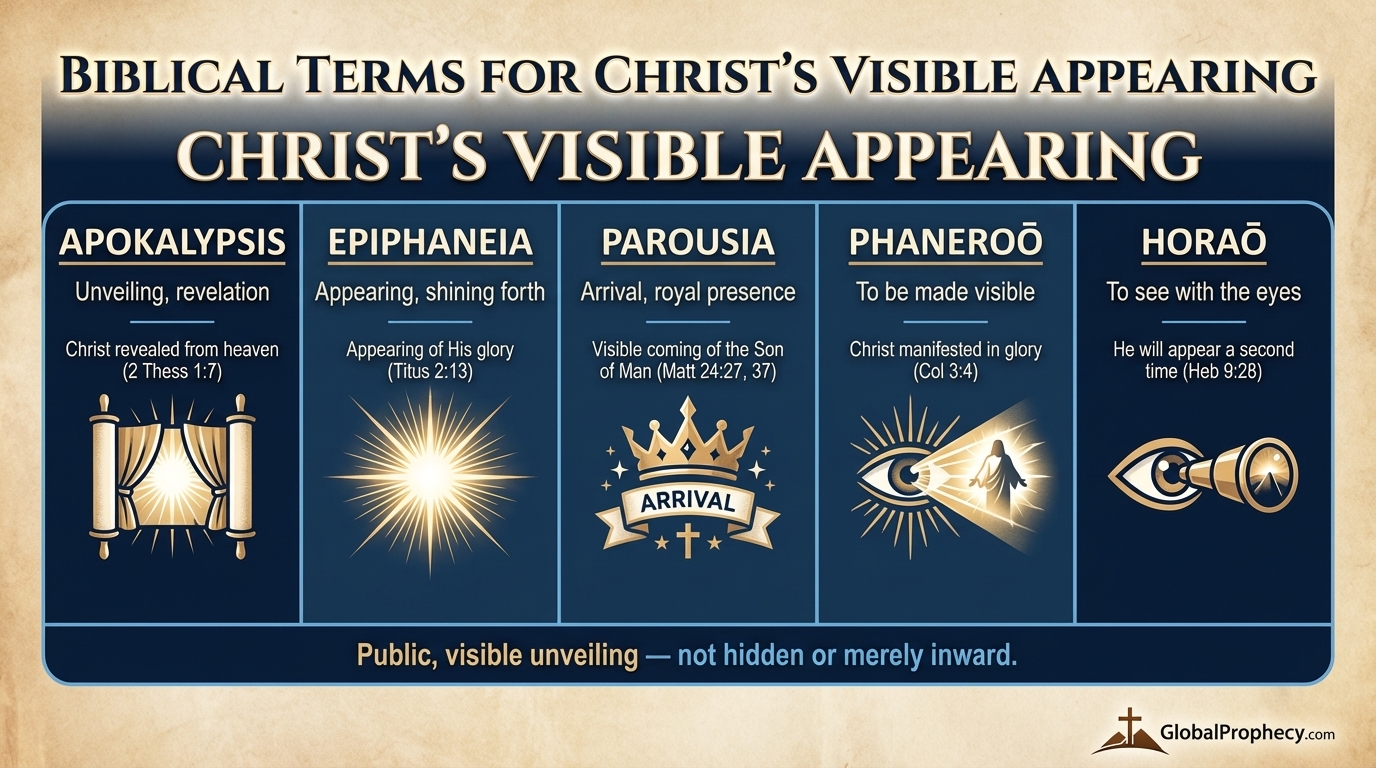
Several key Greek terms emphasize the visible unveiling of Christ at His return:
| Term | Meaning | Relevance to Nature of Return |
|---|---|---|
| apokalypsis | Unveiling, revelation | Christ is revealed from heaven (2 Thess 1:7). |
| epiphaneia | Appearing, shining forth | “The appearing of the glory” (Titus 2:13). |
| parousia | Arrival and presence | Seen by the world (Matt. 24:27, 37). |
| phaneroō | To be made visible, manifest | “When Christ…is revealed” (Col. 3:4). |
| horaō | To see with the eyes | “He will appear a second time” (Heb. 9:28). |
These terms consistently depict a visible, open, radiant disclosure of Christ—not a hidden or purely spiritual coming.
4. Glorious, Majestic, and Supernatural in Power
4.1 Coming with Power and Great Glory
The Second Coming will be marked by overwhelming glory and divine majesty. Jesus described it in His Olivet Discourse:
"They will see the Son of Man coming on the clouds of heaven with power and great glory."
— Matthew 24:30
Several features stand out:
- Clouds of heaven – a biblical symbol of divine presence and glory (cf. Exod. 40:34–35; Dan. 7:13).
- Power – His coming is accompanied by irresistible authority and might.
- Great glory – the unveiled splendor of His divine and messianic kingship.
Paul echoes this when he says:
"...the Lord Jesus is revealed from heaven with his mighty angels in flaming fire."
— 2 Thessalonians 1:7
Thus, the nature of His coming is:
- Supernatural – attended by heavenly armies and angelic hosts
- Radiant – His glory is manifest and unmistakable
- Royal – He comes as the declared *“King of kings and Lord of lords” (Rev. 19:16).
4.2 Cosmic Disturbance and Heavenly Signs
The Second Coming is preceded and accompanied by cosmic phenomena that announce His arrival:
"Immediately after the tribulation of those days the sun will be darkened, and the moon will not give its light, and the stars will fall from heaven, and the powers of the heavens will be shaken."
— Matthew 24:29
These signs indicate:
- Disruption of the natural order – the created cosmos responds to the Creator’s return.
- A transition of ages – from “this present evil age” to the visible reign of Christ.
- Heightened fear and awe among the nations – “people fainting with fear” (Luke 21:26).
Christ’s return is not a quiet adjustment in history; it is a cataclysmic, universe-altering intervention.
5. Sudden, Climactic, and Irresistible
5.1 Like Lightning and Like a Thief
Jesus likened His coming to lightning in the sky:
"For as the lightning comes from the east and shines as far as the west, so will be the coming of the Son of Man."
— Matthew 24:27
This imagery communicates:
- Suddenness – it appears with no gradual unfolding
- Visibility – seen across vast distances
- Irresistibility – unstoppable and overwhelming
Elsewhere the New Testament compares His coming to a thief in the night (e.g., Rev. 3:3; 1 Thess. 5:2), emphasizing:
- Unexpectedness for the unprepared
- Inability to resist or avoid
- Urgency of watchfulness and readiness
5.2 A Single, Climactic Public Return
From the standpoint of His manifestation in glory to the world, the Second Coming is presented as a single, climactic event:
- The nations are assembled in opposition (Rev. 19:19).
- Heaven opens and Christ appears on a white horse (Rev. 19:11).
- His enemies are judged and overthrown by the word of His mouth (2 Thess. 2:8; Rev. 19:15, 21).
His coming is therefore:
- Decisive – it brings an end to the current order of rebellion.
- Judicial – He comes as warrior-judge as well as king.
- Irreversible – it inaugurates the visible reign of Christ on earth.
While premillennial theology distinguishes the Rapture (Christ coming for His church) from the Revelation (Christ coming with His saints), the latter is consistently portrayed as a sudden, global, open intervention at the close of the tribulation.
6. Royal, Triumphant, and Accompanied by Heavenly Armies
6.1 The Warrior-King on a White Horse
The most detailed portrait of the nature of Christ’s Second Coming appears in Revelation 19:11–16:
"Then I saw heaven opened, and behold, a white horse! The one sitting on it is called Faithful and True… His eyes are like a flame of fire, and on his head are many diadems… He is clothed in a robe dipped in blood, and the name by which he is called is The Word of God… From his mouth comes a sharp sword with which to strike down the nations… On his robe and on his thigh he has a name written, King of kings and Lord of lords."
This passage presents His return as:
- Regal – He rides a white horse, symbolizing victory and royal procession.
- Judicial – He “judges and makes war” in perfect righteousness.
- Penetrating – His “eyes…like a flame of fire” see and expose all.
- Sovereign – “many diadems” indicate supreme, unrivaled kingship.
- Word-centered – His “sharp sword” is His authoritative, powerful word.
6.2 With Angels and Redeemed Saints
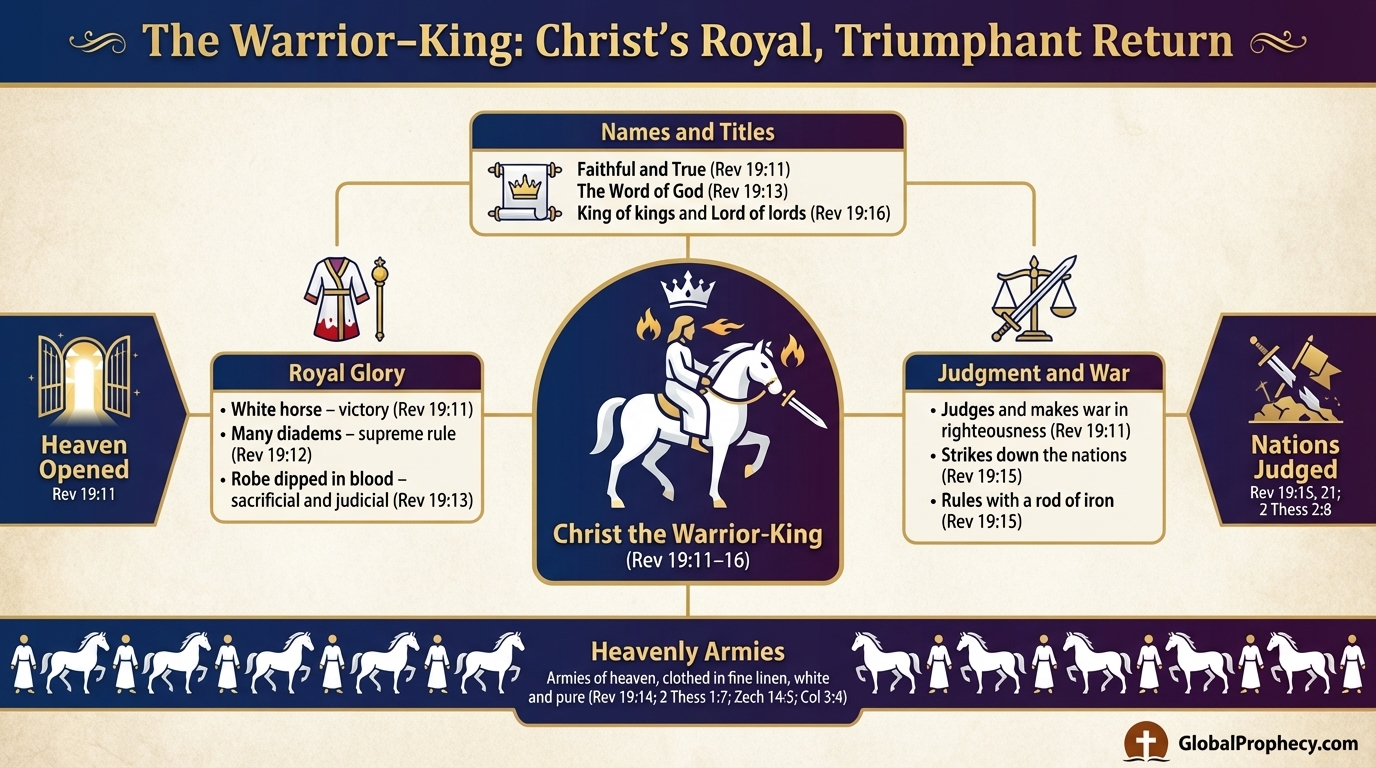
Christ does not return alone. He is accompanied by heavenly armies:
"And the armies of heaven, arrayed in fine linen, white and pure, were following him on white horses."
— Revelation 19:14
Other texts confirm this pattern:
- “The Lord…will come with his mighty angels” (2 Thess. 1:7).
- “The Lord my God will come, and all the holy ones with him” (Zech. 14:5).
- “When Christ who is your life appears, then you also will appear with him in glory” (Col. 3:4).
These passages highlight:
- The communal character of His appearing—angels and glorified saints participate in His triumph.
- The vindication of His people—those who suffered and waited now share in His revealed glory.
- The royal court surrounding the King as He takes His throne and executes judgment.
His Second Coming is thus not only a revelation of His personal glory but also of the glorified community that belongs to Him.
7. Theological Significance of the Manner of His Return
The way Christ returns is not incidental; it is theologically loaded. The visible, bodily, glorious nature of His Second Coming underscores several core truths:
- Continuity of the Incarnation – The eternal Son remains forever truly man and truly God; His bodily return confirms the permanence of His incarnate identity.
- Public vindication of Christ – The One rejected, mocked, and crucified returns openly as judge and king before the very world that despised Him.
- Public vindication of believers – Those who trusted in an unseen Christ will see Him and be seen with Him in glory.
- Final exposure of unbelief – Since “every eye will see him,” unbelief can no longer hide behind ignorance or invisibility.
- The end of the present order – The dramatic and cosmic character of His coming signals the close of this age and the beginning of Christ’s open reign.
The nature of Christ’s return thus stands at the heart of Christian hope, ethical watchfulness, and doctrinal orthodoxy. To deny its visible, bodily, glorious character is to undercut both the resurrection and the prophetic witness of Scripture.
8. Conclusion
According to the Bible, Jesus will return personally, physically, visibly, suddenly, gloriously, and triumphantly. The Second Coming is the literal, public, majestic appearing of the risen Son of Man in power and great glory, attended by angels and saints, accompanied by cosmic signs, and culminating in judgment and the establishment of His visible reign.
This is not a mystical idea or mere symbol of spiritual renewal. It is a concrete, future, historical event in which the same Jesus who ascended will descend again, and every eye will see Him.
The church’s task is not to speculate beyond Scripture, but to believe what God has revealed about how Christ will return, to reject false claims of hidden or purely spiritual comings, and to “wait for his Son from heaven” in faith, holiness, and hope (1 Thess. 1:10).
FAQ
Q: Will Jesus’ Second Coming be visible to everyone or only to believers?
The Second Coming will be universally visible. Revelation 1:7 states that “every eye will see him,” including those who opposed Him. Jesus taught that “all the tribes of the earth…will see the Son of Man coming on the clouds of heaven with power and great glory” (Matt. 24:30).
Q: Is the Second Coming of Christ physical or just a spiritual experience in our hearts?
The Bible presents Christ’s return as physical and bodily. The same Jesus who rose in a tangible, resurrected body and ascended from the Mount of Olives will return “in the same way” (Acts 1:11). His coming is not merely spiritual renewal but a real descent of the incarnate Son of God.
Q: How will the Bible’s “clouds” imagery be fulfilled when Jesus returns?
In Scripture, clouds often signify the visible glory and presence of God. Jesus was taken up in a cloud at His ascension and will come “with the clouds” (Rev. 1:7; Matt. 24:30). This indicates a glorious, majestic manifestation of His presence, not ordinary weather phenomena.
Q: How will Jesus return—suddenly or gradually?
His Second Coming will be sudden and climactic. Jesus compared His coming to lightning flashing from east to west (Matt. 24:27) and Scripture likens it to a thief in the night for the unprepared (Rev. 3:3; 1 Thess. 5:2). It will not unfold slowly over centuries but occur at a definite moment in history.
Q: What is the difference between the Rapture and the Second Coming in terms of how Christ appears?
From a premillennial perspective, the Rapture is Christ’s coming in the air for His church (primarily experienced by believers), while the Second Coming (the Revelation) is His public, visible return to the earth with His saints, seen by the entire world and accompanied by judgment and the inauguration of His earthly reign.
Frequently Asked Questions
Will Jesus’ Second Coming be visible to everyone or only to believers?
Is the Second Coming of Christ physical or just a spiritual experience in our hearts?
How will the Bible’s “clouds” imagery be fulfilled when Jesus returns?
How will Jesus return—suddenly or gradually?
What is the difference between the Rapture and the Second Coming in terms of how Christ appears?
L. A. C.
Theologian specializing in eschatology, committed to helping believers understand God's prophetic Word.
Related Articles
The Second Coming of Christ: What the Bible Really Says
Second Coming of Christ explained from Scripture: timing, nature, signs, and purpose of His return, focusing on what the Bible really says.
The Abrahamic Covenant: God's Unconditional Promise to Israel
Abrahamic Covenant explained as God’s unconditional promise to Israel, defining land, seed and blessing and shaping key end-times Bible prophecy.
What the Bible Says about Antichrist?
Antichrist in the Bible: discover what Scripture reveals about his identity, character, deceptive power, and end-time role in the Tribulation.
What the Bible Says about False Prophet?
False Prophet biblical identity and role in end times. Discover what Scripture reveals about this key figure in Revelation's tribulation prophecy.