
What Is the Intermediate State?
1. Introduction
The intermediate state is the condition of the human person between physical death and the future resurrection of the body. It answers the practical question many ask at a graveside: “Where is this person now, and what are they experiencing?”
Biblical eschatology teaches that death does not end personal existence. The body returns to the dust, but the soul or spirit continues in a conscious, personal state, awaiting reunion with a resurrected body. This is true for both believers and unbelievers, though their experiences in this interim period are radically different.
This article focuses exclusively on this state of the soul between death and resurrection, drawing on key biblical passages to describe:
- What happens to believers when they die
- What happens to unbelievers when they die
- The nature and significance of this temporary, intermediate condition
2. Death and the Survival of the Soul
2.1 Death as Separation, Not Annihilation
In Scripture, death is not the extinction of the person but the separation of body and soul.
“For as the body apart from the spirit is dead, so also faith apart from works is dead.”
— James 2:26
When Rachel died, Genesis describes her death as her soul departing:
“And as her soul was departing (for she was dying), she called his name Ben-oni; but his father called him Benjamin.”
— Genesis 35:18
The body dies and returns to dust (Ecclesiastes 12:7), but the immaterial aspect of man “returns to God who gave it.” Thus, human persons continue to exist consciously after death, even though their bodies lie in the grave.
Hebrews affirms that this post-mortem existence leads on to judgment, not oblivion:
“And just as it is appointed for man to die once, and after that comes judgment…”
— Hebrews 9:27
2.2 Refuting Soul Sleep and Annihilation
Some teach that the soul becomes unconscious (“soul sleep”) or ceases to exist (annihilation) between death and resurrection. This is not how Scripture speaks:
- Jesus promised the repentant thief,
“Truly, I say to you, today you will be with me in Paradise.” (Luke 23:43)
not after centuries of unconsciousness, but that very day. - Paul says to be “away from the body” is to be “at home with the Lord” (2 Corinthians 5:8), a meaningful state, not oblivion.
- In Philippians 1:23, Paul desires “to depart and be with Christ, for that is far better,” which makes no sense if death brought non-existence or insensibility.
- The rich man in Hades in Luke 16:19–31 is conscious, in torment, remembers his life, and speaks.
The Bible consistently presents the intermediate state as personal and conscious, not as sleep of the soul or its destruction.
3. The Intermediate State of Believers
3.1 Immediate Presence with Christ
For those who die in Christ, the intermediate state is one of immediate, blessed fellowship with the Lord.
Key texts:
-
Stephen’s death
“And as they were stoning Stephen, he called out, ‘Lord Jesus, receive my spirit.’”
— Acts 7:59
Stephen expected his spirit to be received by the risen Christ at the moment of death. -
Paul’s teaching
“Yes, we are of good courage, and we would rather be away from the body and at home with the Lord.”
— 2 Corinthians 5:8“My desire is to depart and be with Christ, for that is far better.”
— Philippians 1:23In both passages, Paul sees only two options for the believer:
- In the body = living here in a fallen world
- Away from the body = with Christ in His presence
There is no third category of unconsciousness or purgatorial cleansing.
-
Jesus and the repentant thief
“Truly, I say to you, today you will be with me in Paradise.”
— Luke 23:43“Paradise” is used in the New Testament for the dwelling of God (2 Corinthians 12:2–4; Revelation 2:7). The thief’s body went to the grave; his soul went that day to be with Christ.
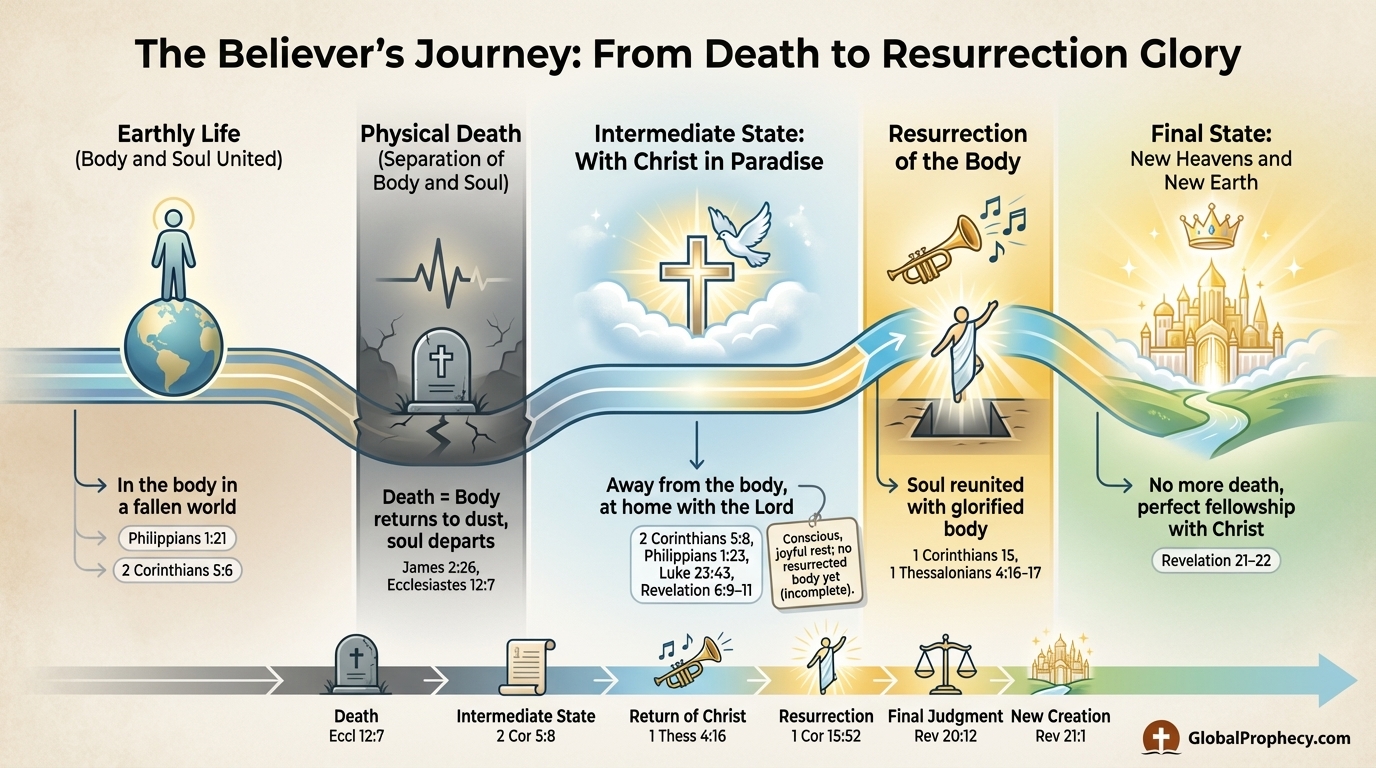
Thus, the state of the believer’s soul between death and resurrection is best summarized as: consciously with Christ in heaven, in what Scripture calls Paradise.
3.2 Nature of the Believer’s Experience
The intermediate state for believers is characterized by rest, comfort, awareness, and worship, though it is still incomplete compared to the final resurrection.
-
Conscious rest and blessing
“Blessed are the dead who die in the Lord from now on… that they may rest from their labors, for their deeds follow them!”
— Revelation 14:13Believers who die are “blessed” and enjoy rest from the toils of earthly life.
-
Conscious awareness in heaven
The martyrs under the altar in heaven cry out:
“O Sovereign Lord, holy and true, how long before you will judge and avenge our blood on those who dwell on the earth?”
— Revelation 6:10They:
- Remember how they died
- Know that justice has not yet been fully executed on earth
- Are given white robes and told to “rest a little longer” (Revelation 6:11)
This is a conscious intermediate state, not the final resurrection, since their bodies still await that future event.
-
Comfort and joy
In the account of the rich man and Lazarus, Abraham says:
“But now he is comforted here, and you are in anguish.”
— Luke 16:25Lazarus is depicted as in “Abraham’s bosom,” a Jewish image for close fellowship and joy. Though this passage focuses on the contrast with the wicked, it confirms that the righteous dead are consciously comforted.
3.3 Incompleteness and the Hope of Resurrection
The intermediate state, though “far better” than life in this fallen world, is still not the believer’s final state. Paul speaks of a kind of “nakedness” in this condition:
“For in this tent we groan, longing to put on our heavenly dwelling, if indeed by putting it on we may not be found naked.”
— 2 Corinthians 5:2–3
Believers, in the intermediate state:
- Are with Christ
- Are without their resurrected, glorified bodies
- Are therefore in an incomplete condition, longing for full bodily redemption (Romans 8:23)
So the intermediate state for believers is conscious, joyful, Christ-centered rest, awaiting the climactic hope of Scripture: the resurrection of the body and life in the new heavens and new earth.
4. The Intermediate State of Unbelievers
The Bible also teaches a real, terrible intermediate state for those who die without saving faith. This state is described primarily with the term Hades.
4.1 Hades: Temporary Place of Punishment
In the New Testament, Hades is the temporary abode of the wicked dead prior to the final judgment and the lake of fire (Revelation 20:13–15).
The clearest portrayal is Jesus’ account of the rich man and Lazarus:
“The rich man also died and was buried, and in Hades, being in torment, he lifted up his eyes and saw Abraham far off and Lazarus at his side. And he called out, ‘Father Abraham, have mercy on me… for I am in anguish in this flame.’”
— Luke 16:22–24
Important features of the unbeliever’s intermediate state emerge:
- Immediate torment after death – “in Hades, being in torment”
- Consciousness – he sees, speaks, feels pain, remembers his life
- Moral awareness – he recognizes the justice of his condition
- Irreversibility –
“Between us and you a great chasm has been fixed…” (Luke 16:26)
Hades is thus a conscious, irreversible state of punishment between death and the final judgment.
Peter describes God as:
“…keeping the unrighteous under punishment until the day of judgment.”
— 2 Peter 2:9
The wicked dead are “kept” under ongoing punishment now, awaiting their resurrection and final sentencing at the Great White Throne (Revelation 20:11–15).
4.2 No Second Chance After Death
Scripture gives no hint of repentance or salvation in the intermediate state:
- The rich man in Hades cannot cross over to Abraham’s side (Luke 16:26).
- Jesus warns,
“Where I am going, you cannot come.” (John 8:21, 24)
- Hebrews is explicit:
“…it is appointed for man to die once, and after that comes judgment.” (Hebrews 9:27)
There is no purgatory in which punishments purge sin and eventually lead to heaven. The intermediate state of the unbeliever is already punitive, not corrective, and it leads infallibly to the lake of fire, the final, eternal destiny of the lost (Revelation 20:14–15).
5. The Intermediate State in Redemptive History
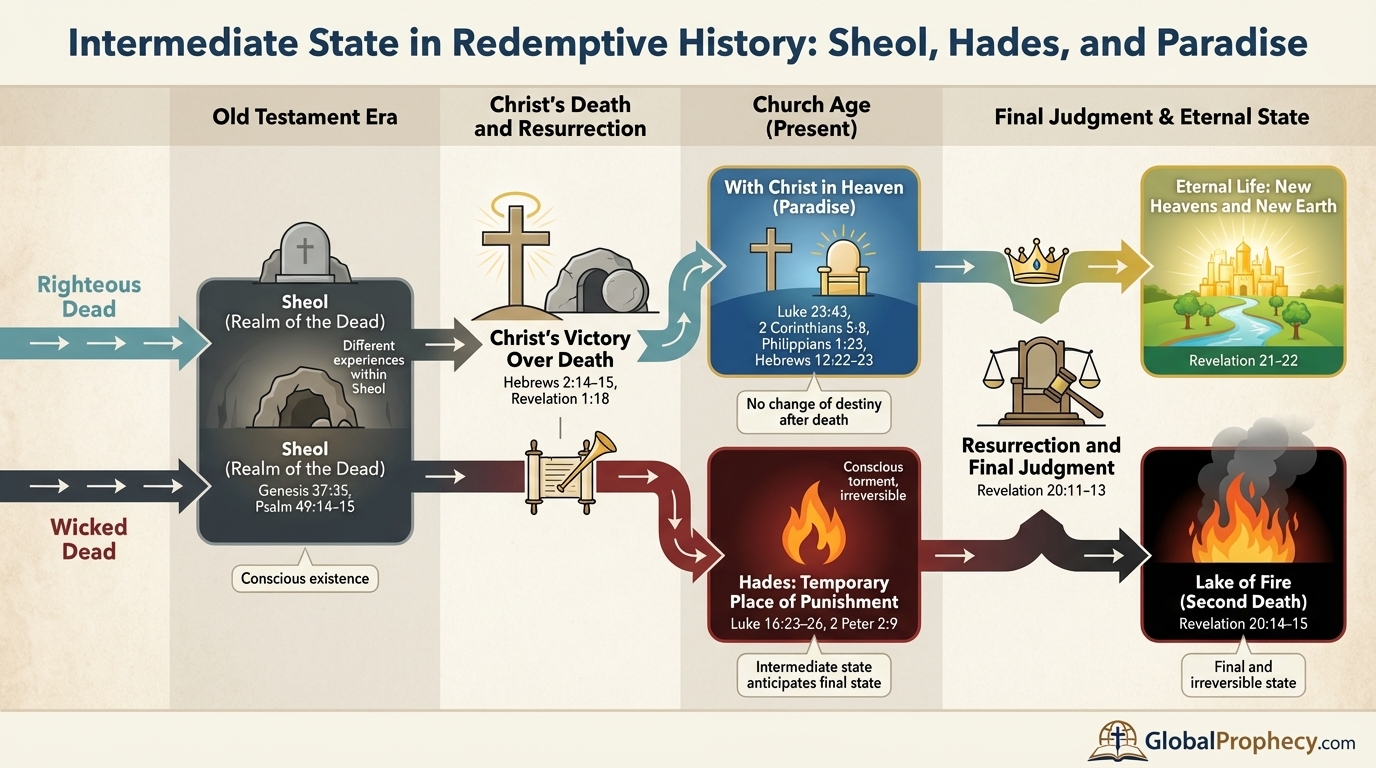
While the essential realities of the intermediate state (blessedness for the saved, torment for the lost) are constant throughout Scripture, there is some development in location and terminology as God’s plan unfolds.
In the Old Testament:
- The generic term Sheol often denotes the realm of the dead.
- Both righteous and wicked are said to “go down to Sheol” (Genesis 37:35; Psalm 49:14–15), though their experiences within the realm of the dead differ.
By the time of the New Testament:
- The blessed condition of the righteous dead is pictured as “Paradise” or “Abraham’s bosom” (Luke 16:22; 23:43).
- The lost are explicitly said to be in Hades, in conscious torment (Luke 16:23).
Since Christ’s resurrection and ascension, believers who die go directly to be with Christ in heaven (2 Corinthians 5:8; Philippians 1:23; Hebrews 12:22–23). The wicked continue to go to Hades, to be raised later for final judgment (Revelation 20:13–15).
What remains unchanged from Genesis to Revelation is this: no one ceases to exist at death, and no one’s eternal destiny changes after death. The intermediate state simply anticipates and foreshadows the final state that will be fully manifested after resurrection and judgment.
6. The Significance of the Intermediate State
Understanding the intermediate state clarifies several crucial truths in biblical eschatology:
-
Death is not the end of personal existence.
Humans continue consciously after death, either in Christ’s presence or under God’s wrath. -
The intermediate state is real but temporary.
It is not the ultimate goal. Believers look beyond death not merely to “heaven when I die,” but to resurrection glory and the new heavens and new earth (Revelation 21–22). Unbelievers in Hades look ahead only to a more fearful judgment. -
For believers, it is profoundly comforting.
- No gap of abandonment between death and glory
- Immediate presence “with Christ, which is far better”
- Rest from earthly toil and suffering
-
For unbelievers, it is a solemn warning.
- Judgment begins immediately after death
- No second chances, no post-mortem repentance
- Present decisions about Christ determine the soul’s condition both now and forever
7. Conclusion
The intermediate state is the conscious condition of the soul between death and resurrection. According to Scripture:
- Believers who die are immediately with Christ in Paradise, in a state of rest, comfort, and worship, yet still awaiting the resurrection of their bodies and the full glory of the eternal kingdom.
- Unbelievers who die enter Hades, a conscious, irreversible state of torment and separation from God, awaiting resurrection to final judgment and the lake of fire.
This doctrine both comforts the believer (“to die is gain,” Philippians 1:21) and warns the unbeliever (“after that comes judgment,” Hebrews 9:27). It centers our hope not merely on life after death, but on Christ Himself, who holds “the keys of Death and Hades” (Revelation 1:18) and will one day raise every person for eternal life or eternal judgment.
FAQ
Q: What is the intermediate state in the Bible?
The intermediate state is the condition of the soul between physical death and the final resurrection of the body. During this period, believers are consciously with Christ in heaven (Paradise), while unbelievers are consciously in Hades, a temporary place of punishment, awaiting the final judgment.
Q: Are we conscious between death and the resurrection?
Yes. Scripture repeatedly shows conscious existence after death: the rich man and Lazarus in Luke 16:19–31, the repentant thief in Luke 23:43, Stephen in Acts 7:59, Paul’s desire to “be with Christ” in Philippians 1:23, and the martyrs under the altar in Revelation 6:9–11. There is no biblical support for the idea that souls sleep or are unconscious.
Q: Do believers go directly to heaven when they die?
Believers go immediately into the presence of Christ, which the New Testament locates in heaven. Paul says to be “away from the body” is to be “at home with the Lord” (2 Corinthians 5:8), and he desires “to depart and be with Christ” (Philippians 1:23). Their bodies remain in the grave until the resurrection, but their souls are with Christ.
Q: Is the intermediate state the same as purgatory?
No. The biblical intermediate state for believers is one of rest and blessing, not a place of purifying punishment. Christ’s atonement fully satisfies God’s justice for His people, so there is no need for further purgation after death. For unbelievers, the intermediate state (Hades) is punitive, but it is not a remedial step toward eventual salvation; it anticipates the final judgment and eternal punishment.
Q: Can people in the intermediate state see or communicate with the living?
Scripture gives no permission or encouragement for communication between the living and the dead. Attempts to contact the dead are condemned (Deuteronomy 18:10–12). While those in heaven may have some awareness of events on earth (Revelation 6:10), there is no biblical basis for ordinary interaction between them and us in this age.
Frequently Asked Questions
What is the intermediate state in the Bible?
Are we conscious between death and the resurrection?
Do believers go directly to heaven when they die?
Is the intermediate state the same as purgatory?
Can people in the intermediate state see or communicate with the living?
L. A. C.
Theologian specializing in eschatology, committed to helping believers understand God's prophetic Word.
Related Articles
Is the Soul Conscious After Death?
Is the soul conscious after death? Explore key biblical texts on the intermediate state and examine evidence for ongoing awareness beyond the grave.
What Is Abraham's Bosom and Paradise?
Abraham's bosom and Paradise explain where believers go after death, describing the blessed intermediate state of the saved before the final resurrection.
What Is Death According to the Bible?
Death in the Bible is more than dying physically. Explore its origin in sin, the meaning of physical and spiritual death, and God’s answer in Christ.
Death and the Unbeliever
Death and the unbeliever explores what happens at death, conscious judgment, and the eternal destiny of those who die without saving faith in Christ.