
Is Hell's Punishment Eternal?
1. Introduction
Is hell’s punishment eternal or temporary? This question sits at the center of biblical eschatology and shapes how we understand God’s justice, human responsibility, and the urgency of the gospel.
Scripture presents not only the reality of hell, but also its duration. While some modern theological views argue for eventual salvation of all (universalism) or the final extinction of the wicked (annihilationism / conditional immortality), the Bible consistently describes the punishment of hell as conscious, irreversible, and everlasting.
This article examines the key biblical data on the duration of hell’s punishment and responds to major alternative views, staying focused on one question: Is hell’s punishment eternal?
2. Biblical Language for the Duration of Hell
2.1 “Eternal” (Greek: aionios)
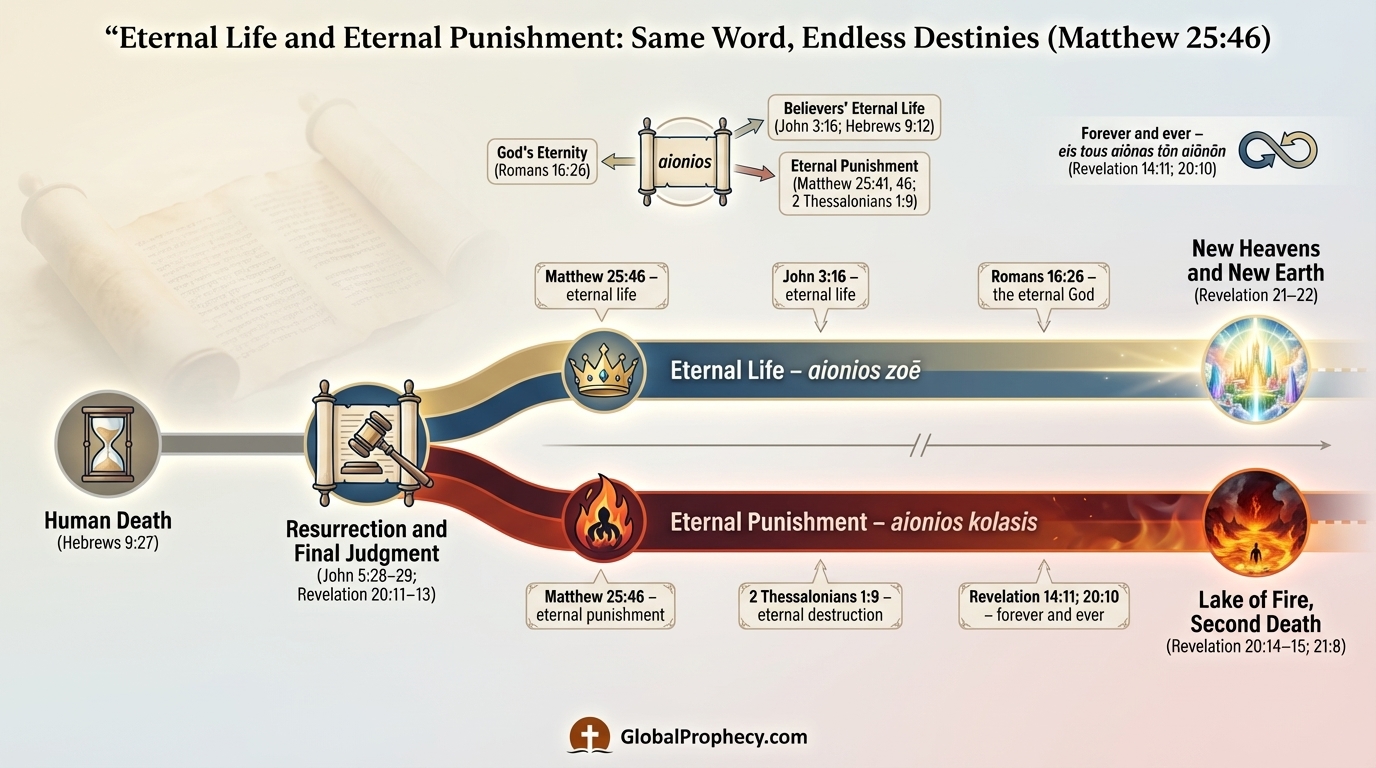
The New Testament repeatedly describes the destiny of the lost using the adjective “eternal” (aionios):
-
Eternal fire – “Depart from me, you cursed, into the eternal fire prepared for the devil and his angels.”
— Matthew 25:41 -
Eternal punishment – “And these will go away into eternal punishment, but the righteous into eternal life.”
— Matthew 25:46 -
Eternal destruction – “[They] will suffer the punishment of eternal destruction, away from the presence of the Lord.”
— 2 Thessalonians 1:9
In all these texts, the same word aionios is used for:
- God’s own eternality (Romans 16:26),
- the believer’s salvation and life (John 3:16; Hebrews 9:12), and
- the punishment of the wicked.
To argue that aionios means “never-ending” for God and for eternal life, but only “temporary” for hell’s punishment, is exegetically inconsistent. In Matthew 25:46, the contrast is explicit: eternal punishment and eternal life stand in strict parallel. If the joy of the saved is unending, the punishment of the lost is as well.
2.2 “Forever,” “Forever and Ever”
Other expressions reinforce the same idea:
-
“The smoke of their torment goes up forever and ever, and they have no rest, day or night.”
— Revelation 14:11 -
The devil, the beast, and the false prophet “will be tormented day and night forever and ever.”
— Revelation 20:10
The phrase translated “forever and ever” (eis tous aiōnas tōn aiōnōn) is the strongest Greek expression for endless duration. It is used of:
- God’s eternal life (Revelation 4:9–10),
- Christ’s eternal reign (Revelation 11:15; 22:5), and
- the unending torment of the wicked (Revelation 14:11; 20:10).
Biblically, then, the same vocabulary that secures the eternity of God, heaven, and Christ’s kingdom secures the eternity of hell’s punishment.
3. Jesus’ Teaching on the Eternity of Hell
Any serious discussion of whether hell’s punishment is eternal must begin with Jesus. He spoke more about hell than anyone else in Scripture, and He used the strongest possible images to describe both its horror and permanence.
3.1 Gehenna and Unquenchable Fire
Jesus regularly used the term Gehenna (hell), drawn from the Valley of Hinnom outside Jerusalem, a place associated with idolatry, burning refuse, and continual fire. He applied it to the final destiny of the wicked:
“It is better for you to enter life crippled than with two hands to go to hell, to the unquenchable fire.”
— Mark 9:43
He then adds:
“Where their worm does not die and the fire is not quenched.”
— Mark 9:48, citing Isaiah 66:24
Two elements point directly to endlessness:
- “Their worm does not die.”
- “The fire is not quenched.”
The image is not of a fire that burns until it runs out of fuel and then dies, but an unquenchable fire and an ongoing, undying state of corruption and remorse.
3.2 Eternal Fire Prepared for the Devil and His Angels
In the judgment scene of Matthew 25, Jesus addresses those on his left:
“Depart from me, you cursed, into the eternal fire prepared for the devil and his angels.”
— Matthew 25:41
This “eternal fire” is later described as the lake of fire:
“The devil … was thrown into the lake of fire and sulfur … and they will be tormented day and night forever and ever.”
— Revelation 20:10
Humans who reject Christ are said to share this same “eternal fire.” The duration is not qualified; it matches the devil’s own endless torment.
3.3 Fixed, Irreversible State after Death
In Luke 16:19–31, Jesus describes the rich man in hades, in conscious torment. Abraham tells him:
“Between us and you a great chasm has been fixed, in order that those who would pass from here to you may not be able, and none may cross from there to us.”
— Luke 16:26
Though this scene concerns the intermediate state, it clearly teaches the irreversibility of one’s condition after death. There is no movement from punishment to blessedness. This anticipates the finality of the second death in the lake of fire (Revelation 20:14–15; 21:8).
4. Answering Annihilationism and Conditional Immortality
Annihilationism (or conditional immortality) claims that the wicked will ultimately be destroyed—reduced to nonexistence—after a period of punishment. Immortality, it is argued, belongs only to believers; the lost are eventually extinguished.
4.1 Do “Destruction” and “Perish” Mean Nonexistence?
Texts such as 2 Thessalonians 1:9 (“eternal destruction”) and John 3:16 (“perish”) are often cited. But destruction in Scripture does not mean ceasing to exist; it means ruin or loss of intended purpose.
- A “destroyed” wineskin still exists, but is ruined for its purpose (Matthew 9:17).
- The “lost” sheep or coin in Luke 15 has not passed into nonbeing.
Thus, “eternal destruction” in 2 Thessalonians 1:9 is everlasting ruin, exclusion “from the presence of the Lord and from the glory of his might,” not annihilation.
4.2 “Eternal” Cannot Mean Merely “Irreversible” for the Wicked
Some annihilationists argue that aionios (“eternal”) in phrases like “eternal punishment” means only the irreversible result (extinction), not an ongoing process. Yet in Matthew 25:46, the same adjective describes both the life of the saved and the punishment of the lost.
If “eternal life” refers to unending conscious blessedness, “eternal punishment” must likewise refer to unending conscious punishment. To split the meaning of the same word in the same sentence creates arbitrary exegesis.
4.3 The Lake of Fire and Continued Existence
Annihilationism also struggles with the texts that show persons still existing after long periods of torment.
- The beast and false prophet are thrown alive into the lake of fire at Christ’s coming (Revelation 19:20).
- A thousand years later, when Satan is cast into the lake of fire, they are still there:
“…where the beast and the false prophet were, and they will be tormented day and night forever and ever.”
— Revelation 20:10
This is explicit, continual, conscious torment, not extinction. The same lake of fire is then the destiny of all whose names are not in the book of life (Revelation 20:15; 21:8).
4.4 The Moral Problem Reversed
Annihilationism is often justified on moral grounds: it is claimed that eternal punishment is disproportionate to finite sins. Yet this argument ignores:
- The dignity of the One offended: sin is against an infinite God and so carries an infinite demerit.
- The ongoing nature of rebellion: hell is not a place of repentant saints; Scripture gives no hint that the damned ever love God. The disposition of rebellion endures.
Moreover, annihilation introduces another moral difficulty: it levels all unbelievers into one identical fate (nonexistence), despite Scripture’s insistence on degrees of punishment according to light and deeds (Matthew 11:20–24; Luke 12:47–48; Revelation 20:12–13). Eternal, conscious punishment allows for true proportionality; annihilation does not.
5. Answering Universalism and Postmortem Conversion
Universalism teaches that all will ultimately be saved—either immediately, or after a purifying period of punishment. Some versions also propose second chances after death.
5.1 “All” Will Be Saved? Understanding the Key Texts
Several verses are cited to support universalism:
- John 12:32 – “I … will draw all people to myself.”
- 1 Timothy 2:4 – God “desires all people to be saved.”
- 1 Corinthians 15:22 – “As in Adam all die, so also in Christ shall all be made alive.”
- Philippians 2:10–11 – “Every knee” bows and “every tongue” confesses Jesus as Lord.
However, in context these texts do not teach universal salvation:
- John 12:32 – The “all” refers to all kinds of people (Jews and Gentiles), not every individual without exception. In the same context Jesus speaks of judgment for rejecters (v. 48).
- 1 Timothy 2:4 – Expresses God’s saving desire, not a decree that all will be saved. The same letter affirms that many remain in unbelief and condemnation.
- 1 Corinthians 15:22–23 – The “all” who are made alive are explicitly limited: “each in his own order: Christ the firstfruits, then at his coming those who belong to Christ.”
- Philippians 2:10–11 – Universal acknowledgment of Christ’s lordship does not equal universal salvation; even the demons recognize His lordship (James 2:19). Reluctant, compelled confession is not saving faith.
5.2 Clear Texts on Eternal, Irreversible Punishment
Against the ambiguous reading of universalist proof-texts, Scripture places explicit statements on the hopelessness of the lost:
-
“These will go away into eternal punishment, but the righteous into eternal life.”
— Matthew 25:46 -
“They will be tormented with fire and sulfur … and the smoke of their torment goes up forever and ever, and they have no rest, day or night.”
— Revelation 14:10–11 -
“It is appointed for man to die once, and after that comes judgment.”
— Hebrews 9:27
In Jesus’ account of the rich man and Lazarus, there is no hint of eventual release; instead the emphasis is on the fixed chasm and the urgent need for repentance in this life (Luke 16:26–31). Scripture nowhere speaks of a “second chance” or postmortem evangelization.
5.3 The Love and Justice of God Held Together
Universalism often elevates God’s love in such a way that His holiness, righteousness, and wrath are eclipsed. Yet biblical love does not negate justice; it fulfills it in Christ.
At the cross, God’s love and justice meet:
“…so that he might be just and the justifier of the one who has faith in Jesus.”
— Romans 3:26
Those who refuse this provision remain under wrath (John 3:36). To claim that God’s love will eventually override His own declared judgments turns Him into a God who does not mean what He says.
6. Why Eternal Punishment Is Theologically Coherent
6.1 The Infinite Seriousness of Sin
Every sin is committed against the infinitely holy God to whom we owe all love, obedience, and worship. The gravity of a crime is measured not only by the act itself, but by the dignity of the one offended. Striking a post is not the same as striking a person; striking a king is more serious still.
Because God is infinitely holy, sin carries infinite guilt, warranting an infinite (endless) punishment. To reduce the penalty to something finite effectively diminishes God’s holiness.
6.2 Human Freedom and the Fixity of Destiny
Hell is not God delighting in suffering; it is God ratifying human choices. Those who persistently say to God in this life, “Go away and leave me alone,” finally hear God say, “Your will be done.”
- God will not coerce rebels into loving Him in heaven.
- God will not erase His image in them by annihilation.
The only just alternative is eternal separation and ongoing punishment proportionate to their unrepentant rebellion.
6.3 The Necessity of Hell for the Reality of Heaven
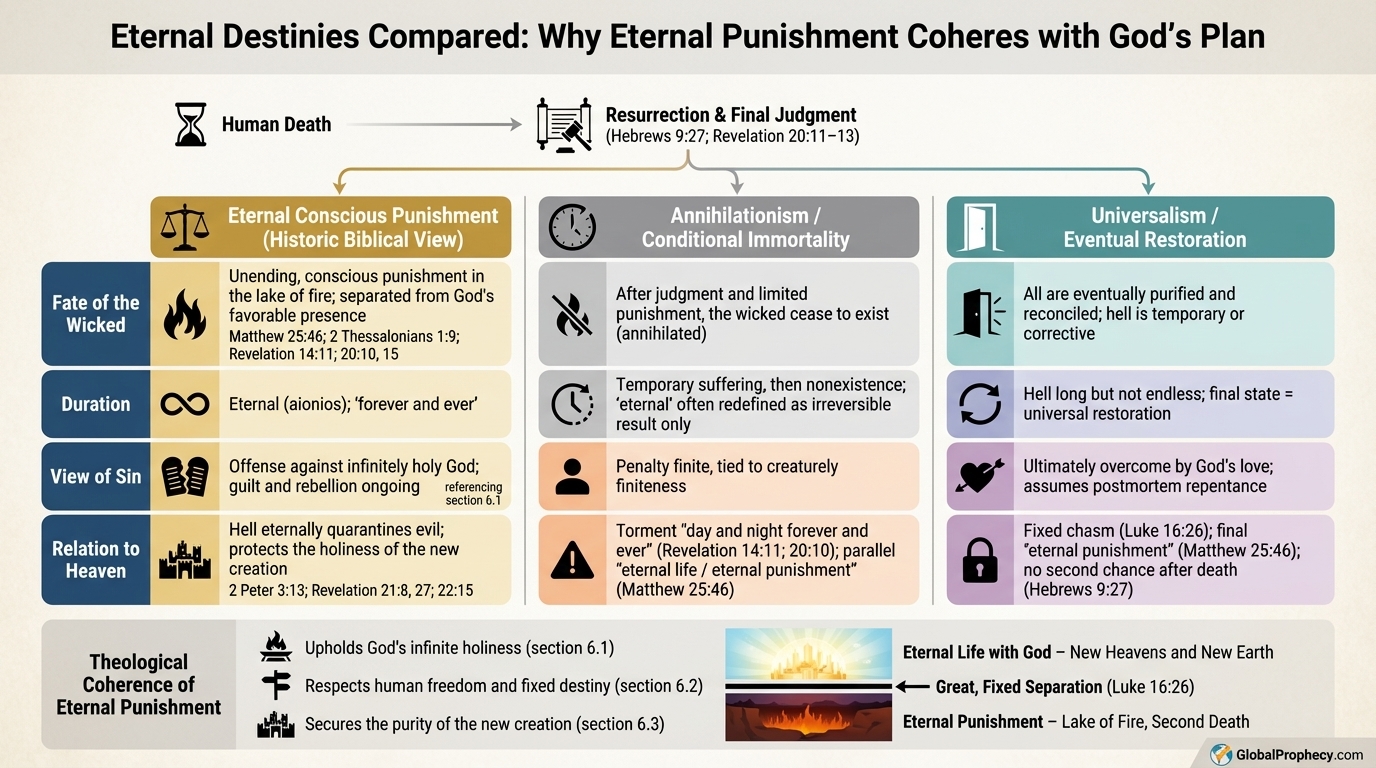
If evil were never finally and eternally quarantined, it would forever threaten God’s renewed creation. Scripture presents the new heavens and new earth as a realm where righteousness dwells (2 Peter 3:13), and nothing unclean can enter (Revelation 21:27).
For heaven’s holiness to be secure, the wicked must be excluded forever (Revelation 21:8; 22:15). The eternal punishment of hell is the dark backdrop against which the grace of eternal life shines in full brilliance.
7. Practical and Pastoral Implications
If hell’s punishment is truly eternal, several implications follow:
- Evangelism is urgent. There is no second chance beyond death; “now is the day of salvation” (2 Corinthians 6:2).
- Doctrine shapes compassion. A biblical view of eternal punishment should not produce cruelty, but tears, prayer, and bold, loving witness.
- God’s character must be received, not edited. We cannot accept Scripture’s teaching on God’s love while rejecting its teaching on His wrath and eternal judgment. The same Christ who saves from hell also warns of it.
8. Conclusion
Scripture, when allowed to speak on its own terms, teaches that hell’s punishment is eternal—conscious, irreversible, and unending. The terms “eternal fire,” “eternal punishment,” “forever and ever,” and the parallelism with eternal life make a temporary or annihilating hell exegetically untenable.
Universalism and annihilationism both arise from understandable emotional tensions, but they cannot be sustained by careful, context-sensitive reading of the Bible. To deny the eternity of hell’s punishment is, in the end, to weaken the very language that secures the eternity of heaven, the glory of Christ, and the unchangeable life of God Himself.
The doctrine of eternal punishment is sobering. Yet it magnifies the grace of God in Christ, who bore the wrath we deserved so that all who repent and believe might have eternal life instead of eternal punishment.
“For God so loved the world, that he gave his only Son, that whoever believes in him should not perish but have eternal life.”
— John 3:16
FAQ
Q: Is hell’s punishment really eternal, or just for a long time?
According to Scripture, hell’s punishment is truly eternal. The same Greek word (aionios) describes both “eternal punishment” and “eternal life” in Matthew 25:46. Passages such as Revelation 14:11 and 20:10 speak of torment “day and night forever and ever,” leaving no room for a merely temporary fate.
Q: Do “destruction” and “perish” mean the wicked will be annihilated?
No. In the Bible, “destroy” and “perish” typically mean ruin or loss of well-being, not nonexistence. “Eternal destruction” in 2 Thessalonians 1:9 refers to everlasting ruin and exclusion from God’s presence, not ceasing to exist. The wicked are resurrected for judgment (John 5:29) and then consigned to the lake of fire (Revelation 20:11–15).
Q: If God is loving, how can He punish people eternally?
God’s love does not cancel His holiness and justice. Sin is an infinite offense against an infinitely holy God and thus merits an infinite (endless) punishment. At the cross, God’s love and justice meet perfectly; those who reject that provision remain under His wrath (John 3:36). Eternal punishment reflects both the seriousness of sin and the reality of human freedom.
Q: Will everyone eventually be saved and leave hell?
The Bible gives no support to universalism or postmortem salvation. Instead, it teaches that destiny is fixed at death (Hebrews 9:27; Luke 16:26), that some “will go away into eternal punishment” (Matthew 25:46), and that the smoke of the wicked’s torment goes up “forever and ever” (Revelation 14:11). There is no biblical promise that anyone will ever be released from hell.
Q: How should Christians respond to the doctrine of eternal punishment?
Believers should respond with humility, reverence, and urgency. The reality of eternal punishment should deepen gratitude for God’s grace in Christ, stir compassion for the lost, and fuel earnest evangelism. It is not a doctrine to wield harshly, but a sobering reality that magnifies the glory of the gospel and the necessity of faith in Jesus.
Frequently Asked Questions
Is hell’s punishment really eternal, or just for a long time?
Do “destruction” and “perish” mean the wicked will be annihilated?
If God is loving, how can He punish people eternally?
Will everyone eventually be saved and leave hell?
How should Christians respond to the doctrine of eternal punishment?
L. A. C.
Theologian specializing in eschatology, committed to helping believers understand God's prophetic Word.
Related Articles
What Is Hell?
Hell is the eternal place of punishment for the unrighteous. Discover what the Bible teaches about hell's nature, purpose, and who goes there.
Are There Degrees of Punishment in Hell?
Hell degrees of punishment: explore Bible passages where Jesus and other texts teach varying levels of judgment and accountability in eternal torment.
The Lake of Fire Explained
The lake of fire is the final eternal destination for the unrighteous. Discover what Scripture reveals about this place of judgment and who will be cast there.
Annihilationism Examined and Refuted
Annihilationism examined and refuted from Scripture, showing why conditional immortality fails and hell is eternal conscious punishment for the lost.