
Is the Soul Conscious After Death?
1. Introduction
Is the human soul conscious after death, or does it enter a state of unconscious “soul sleep” until the resurrection? This question lies at the heart of biblical eschatology and shapes how we view death, comfort the grieving, and anticipate eternity.
From Scripture, a consistent pattern emerges: death is separation, not extinction, and the soul remains awake, self-aware, and morally accountable between death and resurrection. This period is often called the intermediate state—the condition of a person between physical death and bodily resurrection.
This article surveys key biblical texts and arguments to answer one narrow question: Does the soul remain conscious after death?
2. The Biblical Nature of Death: Separation, Not Annihilation
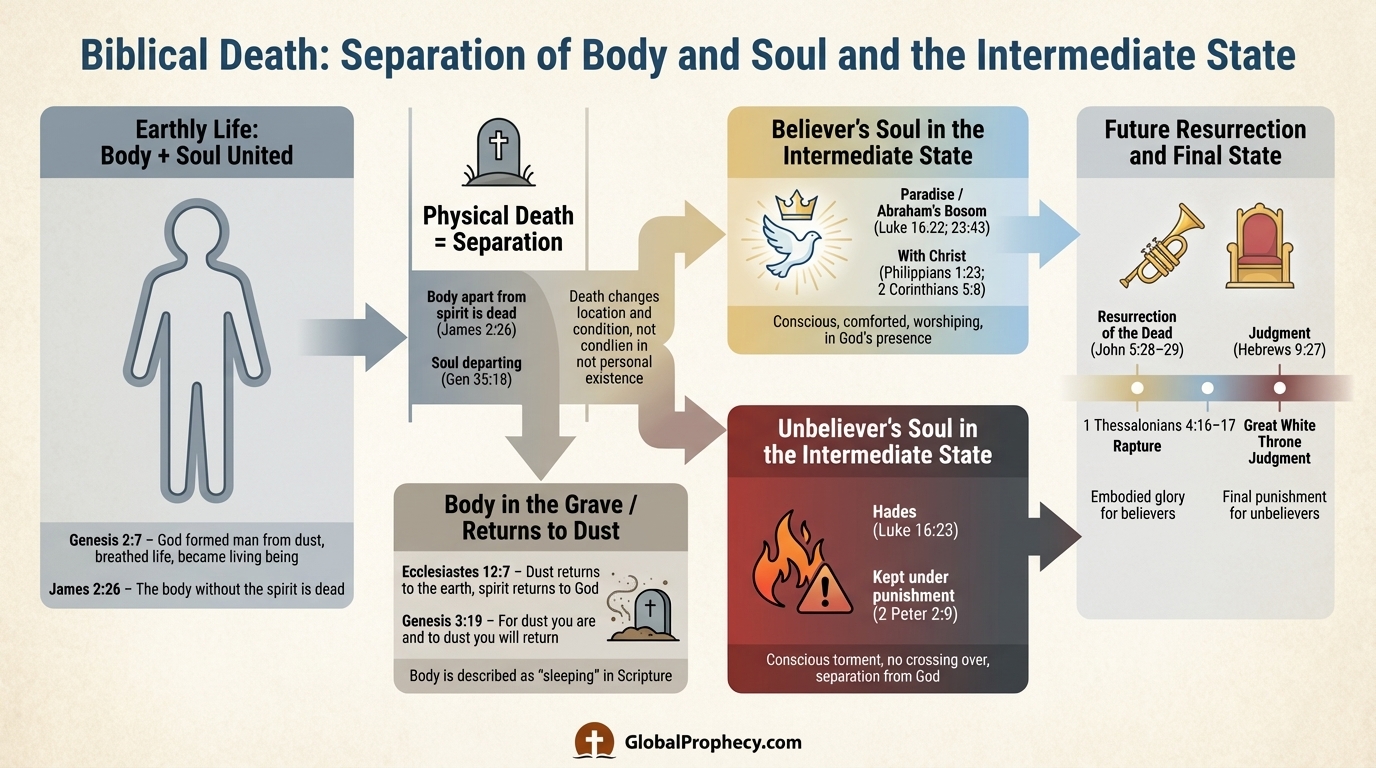
The Bible defines death as the separation of body and soul/spirit, not the end of personal existence.
- James 2:26 – “For as the body apart from the spirit is dead, so also faith apart from works is dead.”
- Genesis 35:18 (KJV) – Of Rachel: “as her soul was in departing (for she died)…”
In physical death:
- The body returns to dust (Eccl 12:7; Gen 3:19).
- The spirit “returns to God who gave it” (Eccl 12:7), i.e., moves into the unseen realm.
Death, then, is not the soul dying; it is the soul departing the body. This framework already undermines the idea that the person ceases to exist or lapses into non-being. The question is: in what condition does this disembodied soul exist?
3. Old Testament Evidence of Conscious Existence After Death
Though the Old Testament is less detailed than the New, it still affirms personal, conscious existence after death.
3.1 Sheol as the Realm of the Living Dead
Sheol is the common Old Testament term for the realm of the departed. It is not merely the physical grave.
Key features:
- Distinguished from the grave/body
In Psalm 49:14–15, the wicked are said to be “appointed for Sheol,” yet their form is “consumed” there, while the righteous soul is redeemed from the power of Sheol. Body and Sheol are treated as distinct realities. - Not simply death itself
Psalm 49:14: “Death shall be their shepherd” and Sheol is their destination. Death leads; Sheol receives. - A real place under God’s oversight
“If I make my bed in Sheol, you are there!” (Ps 139:8).
3.2 Conscious Personalities in Sheol
Several texts portray the departed as aware, relational, and responsive:
-
Isaiah 14:9–10 – Sheol is “stirred up” to meet the fall of the king of Babylon; it “rouses the shades” (rephaim) who speak and mock him:
“You too have become as weak as we! You have become like us!”
These are recognizable individuals engaging in conversation, implying consciousness.
-
Genesis 37:35 – Jacob expects to “go down to Sheol to my son mourning.” He anticipates personal reunion, not mere non-being.
-
Job 14:13 – Job wishes God would “hide me in Sheol,” treating it as a real sphere where God could conceal him, not extinguish him.
The Old Testament perspective is: death changes location and condition, not personality and awareness.
4. New Testament Evidence for Conscious Existence in the Intermediate State
The New Testament speaks with remarkable clarity about the conscious survival of the soul between death and resurrection, both for the saved and the lost.
4.1 Jesus’ Teaching: Lazarus and the Rich Man (Luke 16:19–31)
This is the most detailed single passage on the intermediate state.
Key observations:
- Both men die (v. 22). The rich man is “buried,” yet immediately:
- “In Hades, being in torment, he lifted up his eyes and saw Abraham far off and Lazarus at his side.” (v. 23)
- He speaks, feels pain, and remembers his earthly life and brothers (vv. 24–28).
- Abraham, also conscious, replies and explains the irreversible separation (vv. 25–26).
The narrative explicitly depicts:
| Person | Location | Condition |
|---|---|---|
| Lazarus | “Abraham’s side” (Paradise) | Comforted, at rest, in fellowship |
| Rich man | Hades | Tormented, thirsty, regretful |
Even if one insists this is a parable, Jesus never uses fiction to teach false doctrine. The entire force of the account rests on the reality that the dead are awake, feeling, thinking, remembering, longing, not sleeping unconsciously.
4.2 Jesus’ Promise to the Thief (Luke 23:43)
“Truly, I say to you, today you will be with me in Paradise.”
— Luke 23:43
Important points:
- The thief’s body was buried that day.
- Yet Jesus promises that “today” he will be “with Me” in Paradise, i.e., conscious presence with Christ.
- This makes sense only if the man’s soul survives death in active fellowship with Jesus.
Attempts to move the comma (“I say to you today, you will be with me in Paradise [later]”) distort both Greek usage and the natural reading. Throughout Luke, “today” denotes immediate fulfillment of salvation realities.
4.3 Stephen’s Death (Acts 7:59–60)
As Stephen is being stoned:
“He called out, ‘Lord Jesus, receive my spirit.’ … And when he had said this, he fell asleep.”
— Acts 7:59–60
Stephen clearly expects his spirit to be received by the living Christ at the moment his body dies (“fell asleep”). He is not asking to be extinguished or to lapse into unconscious suspension; he anticipates personal reception by Jesus.
4.4 Paul’s Desire “to Depart and Be with Christ” (Philippians 1:21–23)
“My desire is to depart and be with Christ, for that is far better.”
— Philippians 1:23
For Paul:
- To live = fruitful ministry for Christ.
- To die = gain.
- To depart = to be with Christ.
This only makes sense if:
- Paul’s personal self continues after death; and
- The post-death condition is consciously better than earthly life.
Unconscious non-existence or “soul sleep” cannot plausibly be described as “far better” or “gain.”
4.5 Present with the Lord, Absent from the Body (2 Corinthians 5:1–8)
“We know that while we are at home in the body we are away from the Lord. … We would rather be away from the body and at home with the Lord.”
— 2 Corinthians 5:6, 8
Paul sets up a two-state contrast:
- In the body → away from the Lord (in a certain sense).
- Away from the body → at home with the Lord.
There is no suggestion of a third, unconscious middle condition. To be “away from the body” is to be “at home with the Lord,” which is relational and conscious by definition.
Paul does call this bodiless state a kind of “nakedness” (2 Cor 5:3–4), indicating incompleteness, but it is still conscious presence with Christ, not non-being.
4.6 The Souls Under the Altar (Revelation 6:9–11)
“I saw under the altar the souls of those who had been slain for the word of God… They cried out with a loud voice, ‘O Sovereign Lord… how long…?’”
— Revelation 6:9–10
These martyrs:
- Are called “souls” (psychae), distinct from resurrected bodies.
- Are self-aware (“who had been slain for the word of God”).
- Speak, remember, desire justice, and are given white robes.
- Are told to “rest a little longer”, indicating ongoing experience in time.
This is an explicit picture of disembodied, yet conscious, saints in heaven before the final resurrection.
5. Answering the “Soul Sleep” View Biblically
Some groups (e.g., Seventh-day Adventists, Jehovah’s Witnesses) teach that the dead are unconscious until the resurrection. Their view rests mainly on texts that describe death as “sleep” and on a monistic view of human nature (no separable soul). Scripture, however, does not support this conclusion.
5.1 The Biblical Use of “Sleep” for Death
The New Testament frequently calls death “sleep”:
- John 11:11–14 – “Lazarus has fallen asleep… Then Jesus told them plainly, ‘Lazarus has died.’”
- 1 Thessalonians 4:13–15 – Believers who have “fallen asleep” are those who have died.
- Acts 7:60 – Stephen “fell asleep” (i.e., died).
Key point: In every case, “sleep” describes the body’s condition as viewed from earth—still, inactive, awaiting resurrection. It is a metaphor of appearance, not a literal description of the soul’s state.
If “sleep” meant literal unconsciousness of the whole person, then Jesus Himself would have been unconscious between Good Friday and Easter Sunday, contradicting His own words in Luke 23:43 and Luke 23:46.
5.2 Consciousness After Death Is Explicitly Taught
The soul sleep view cannot account for:
- The rich man and Lazarus consciously experiencing comfort and torment in Luke 16.
- Jesus’ assurance of same-day fellowship in Paradise (Luke 23:43).
- Stephen’s prayer, “receive my spirit” (Acts 7:59).
- Paul’s expectation of being with Christ immediately upon death (Phil 1; 2 Cor 5).
- The conscious souls under the altar (Rev 6:9–11).
- The “spirits of the righteous made perfect” presently in heaven (Hebrews 12:22–23).
These texts are direct and didactic. They cannot be dismissed as merely symbolic without gutting core New Testament teaching on the intermediate state.
5.3 Theological Considerations
-
Nature of the human person
Scripture presents humans as capable of existing apart from the body:- Rachel’s soul departs (Gen 35:18).
- The spirit returns to God (Eccl 12:7).
- Angels and God Himself are conscious without bodies (Heb 1:14; John 4:24).
There is no biblical or logical necessity that consciousness requires a physical brain.
-
Nature of salvation hope
If death brings total unconsciousness, statements like “to die is gain” (Phil 1:21) and “better to depart and be with Christ” become incoherent. The biblical hope is not an empty gap of non-awareness, but immediate, though incomplete, fellowship with the Lord.
6. The Conscious Fate of Believers and Unbelievers Between Death and Resurrection
Summarizing the biblical data:
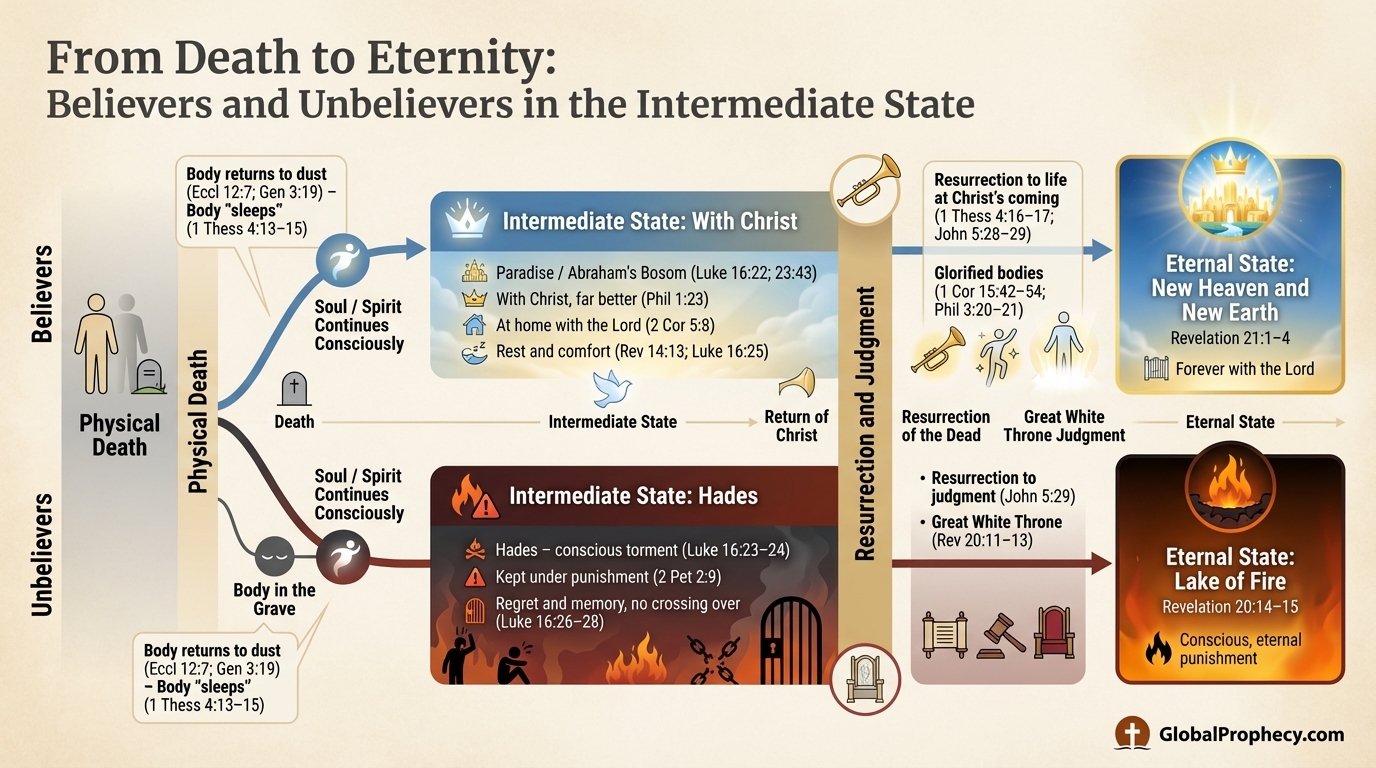
6.1 Believers
At death:
- Their body “sleeps” in the grave, awaiting resurrection (1 Thess 4:14–16).
- Their soul/spirit goes immediately:
- To Paradise / “Abraham’s bosom” (Luke 16:22; 23:43),
- To be “with Christ” (Phil 1:23),
- To be “at home with the Lord” (2 Cor 5:8),
- Among “the spirits of the righteous made perfect” in the heavenly Jerusalem (Heb 12:22–23).
Their experience is characterized by:
- Rest and comfort (Rev 14:13; Luke 16:25).
- Conscious worship and longing (Rev 6:9–11).
- Incomplete yet blessed fellowship, awaiting bodily resurrection (2 Cor 5:1–4).
6.2 Unbelievers
At death:
- Their body goes to the grave.
- Their soul/spirit goes to Hades, a temporary place of conscious torment (Luke 16:23; 2 Pet 2:9).
Their experience is characterized by:
- Agony and thirst (Luke 16:24).
- Regret and memory of lost opportunities (Luke 16:27–28).
- No possibility of crossing over to comfort (Luke 16:26).
- Continual punishment while awaiting judgment (2 Pet 2:9).
At the Great White Throne (Rev 20:11–15), Hades will “give up the dead who were in it,” and the wicked will be judged and cast into the lake of fire—the final, eternal state of conscious punishment.
In both cases, believer and unbeliever remain fully conscious from the moment of death onward. The resurrection changes their embodied condition, not their personal awareness.
7. Conclusion
Biblical eschatology consistently teaches that the soul is conscious after death. Death is a transition, not a termination:
- The body returns to dust and “sleeps” until resurrection.
- The soul/spirit continues in personal, conscious existence—either in the presence of Christ (for believers) or in Hades awaiting judgment (for unbelievers).
The doctrine of soul sleep fails to do justice to the plain sense of numerous New Testament passages and misunderstands the metaphorical use of “sleep” for bodily death.
For the believer, this truth brings profound comfort:
“We would rather be away from the body and at home with the Lord.”
— 2 Corinthians 5:8
For the unbeliever, it is a sober warning: there is no second chance beyond the grave (Heb 9:27; Luke 16:26). Now is the day of salvation.
A biblically grounded view of the intermediate state calls us to live and die in light of eternity, confident that our souls will be awake and accountable the moment we pass from this life.
FAQ
Q: Does the Bible teach that the soul sleeps after death?
No. The Bible sometimes describes death as “sleep,” but always in reference to the body’s appearance (John 11:11–14; 1 Thess 4:13–15). Clear passages like Luke 16:19–31; Luke 23:43; Phil 1:23; 2 Cor 5:8; Rev 6:9–11 show the dead as conscious, speaking, remembering, and experiencing either comfort or torment.
Q: Where does the soul go immediately after death according to the Bible?
According to Scripture, believers go immediately into the presence of Christ—described as Paradise, Abraham’s bosom, being “with Christ,” and “at home with the Lord” (Luke 23:43; Phil 1:23; 2 Cor 5:8; Heb 12:22–23). Unbelievers go to Hades, a temporary place of conscious torment, awaiting final judgment (Luke 16:23; 2 Pet 2:9; Rev 20:13).
Q: Is the intermediate state the final destination of the soul?
No. The intermediate state is temporary, lasting from death until the resurrection of the body. Believers will be raised in glorified bodies to dwell forever with Christ in the new heaven and new earth (1 Thess 4:16–17; Rev 21:1–4). Unbelievers will be resurrected to face judgment and eternal punishment in the lake of fire (John 5:28–29; Rev 20:11–15).
Q: If believers are already with Christ after death, why is the resurrection still necessary?
Because human beings were created to be embodied persons. The intermediate state, though blessed, is a form of “nakedness” or incompleteness (2 Cor 5:3–4). The resurrection reunites the soul with a glorified, immortal body, fulfilling God’s original design and completing our salvation (1 Cor 15:42–54; Phil 3:20–21).
Q: How should the doctrine of a conscious soul after death affect Christians today?
It should bring comfort in bereavement, knowing that departed believers are truly with Christ now. It should also foster seriousness about salvation, since Scripture allows no second chance after death (Heb 9:27; Luke 16:26). And it should encourage believers to live with eternity in view, confident that “to die is gain” (Phil 1:21).
Frequently Asked Questions
Does the Bible teach that the soul sleeps after death?
Where does the soul go immediately after death according to the Bible?
Is the intermediate state the final destination of the soul?
If believers are already with Christ after death, why is the resurrection still necessary?
How should the doctrine of a conscious soul after death affect Christians today?
L. A. C.
Theologian specializing in eschatology, committed to helping believers understand God's prophetic Word.
Related Articles
What Is the Intermediate State?
Intermediate state explained: what happens to the soul between death and resurrection, for believers and unbelievers, in the biblical afterlife timeline.
What Is Abraham's Bosom and Paradise?
Abraham's bosom and Paradise explain where believers go after death, describing the blessed intermediate state of the saved before the final resurrection.
What Is Death According to the Bible?
Death in the Bible is more than dying physically. Explore its origin in sin, the meaning of physical and spiritual death, and God’s answer in Christ.
Death and the Unbeliever
Death and the unbeliever explores what happens at death, conscious judgment, and the eternal destiny of those who die without saving faith in Christ.