
Israel's Rebirth: The Supersign of the End Times
1. Introduction
Among all the “signs of the times” discussed in biblical eschatology, Israel’s rebirth as a nation in 1948 stands out as the supersign of the end times. Without a living nation of Israel in its ancient land, most major end-time prophecies could not occur in a literal, straightforward way.
This article explains why the rebirth of Israel is so prophetically significant, how Scripture foretold it, and how it functions as the central sign that the stage is being set for the events of the last days.
2. Prophetic Promises of Israel’s End-Time Regathering
Long before Israel’s dispersion among the nations, the Old Testament prophets predicted a worldwide regathering of the Jewish people to their ancient homeland in the latter days.
Key passages include:
- Ezekiel 36:24
“I will take you from the nations and gather you from all the countries and bring you into your own land.”
- Isaiah 11:11–12
“In that day the Lord will extend his hand yet a second time to recover the remnant that remains of his people… and will gather the dispersed of Judah from the four corners of the earth.”
- Ezekiel 37:11–14 (the vision of dry bones)
“Son of man, these bones are the whole house of Israel… I will open your graves and raise you from your graves, O my people. And I will bring you into the land of Israel… And I will put my Spirit within you, and you shall live…”
Several elements are crucial:
-
International scope – Israel is not just regathered from one empire, but from “the nations” and “all the countries” (Ezekiel 36:24; Isaiah 11:12). This goes beyond the limited return from Babylon (from a single region).
-
Return to “your own land” – The regathering is not generic; it is explicitly to the land of Israel, the same territory promised to Abraham, Isaac, and Jacob.
-
End-time context – Isaiah describes this as a “second” great regathering (Isaiah 11:11), connected to the Messianic kingdom that follows, placing it in an eschatological setting.
These prophecies anticipated a future moment when a scattered, seemingly dead nation would be brought back to life on its ancient soil.
3. 1948 and the Modern Regathering: From Exile to Statehood
Historically, Israel ceased to exist as a political nation in AD 70, when Roman forces under Titus destroyed Jerusalem and scattered the Jewish people (cf. Luke 21:20–24). For nearly nineteen centuries, the Jews lived in dispersion across the globe—often persecuted, yet never fully assimilated.
From a human perspective, the reemergence of Israel as a sovereign state after such a long dispersion was highly improbable. Yet in May 14, 1948, the modern State of Israel was declared, and Jews began returning in growing numbers from Russia, Europe, North Africa, the Middle East, and beyond.
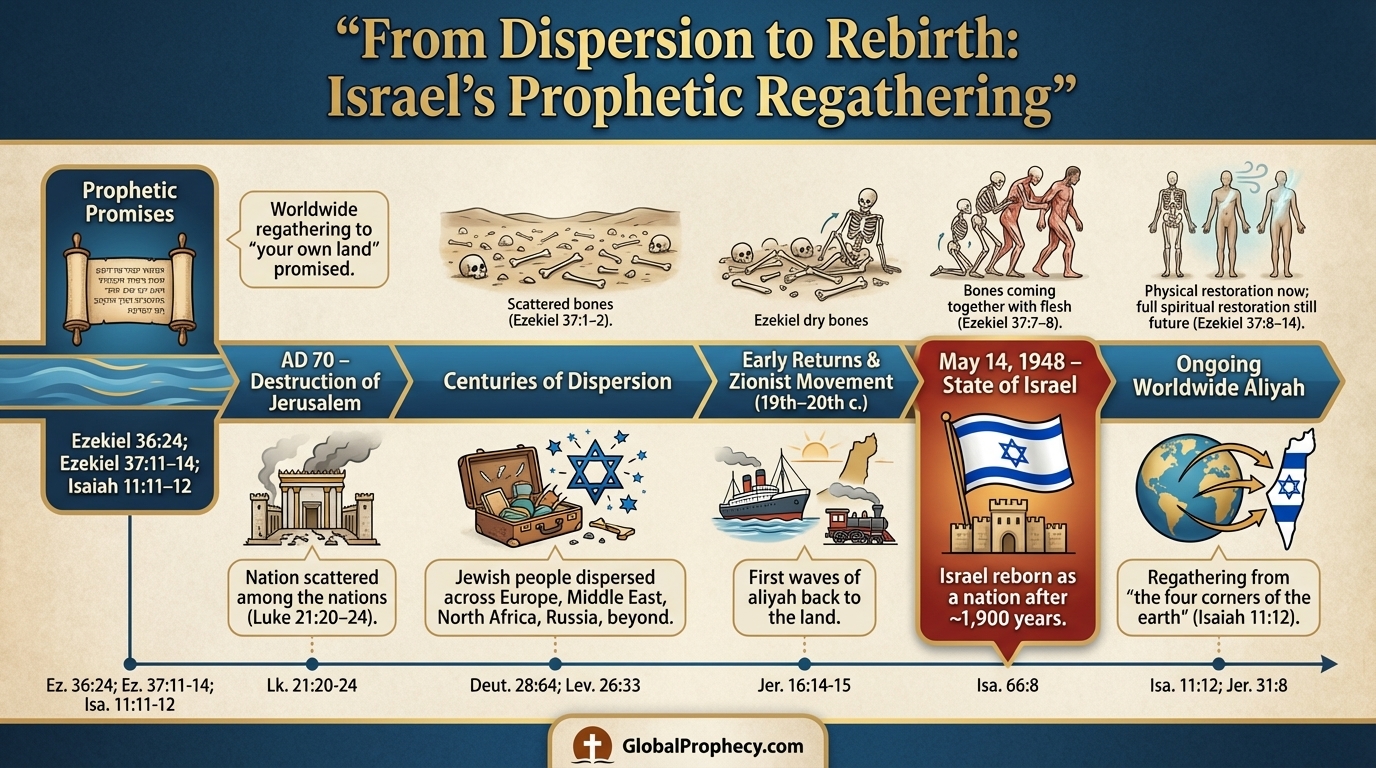
This modern regathering matches the prophetic pattern:
- It is international—from “the four corners of the earth” (Isaiah 11:12).
- It is a return to the ancient homeland—“your own land” (Ezekiel 36:24).
- It comes after many centuries of global exile, unlike the short-term Babylonian captivity.
The vision of dry bones in Ezekiel 37—bones reassembled, then covered with flesh, then finally given breath—aptly pictures this process: a nation “brought back from the dead” to political life.
4. Why Israel’s Rebirth Is the Supersign of the End Times
Israel’s rebirth is called the supersign of the end times because:
-
Most end-time prophecies presuppose a nation of Israel in its land.
Many key passages only make sense if Israel exists as a political entity in the last days. Without Israel, these prophecies would remain abstract or impossible to fulfill literally. -
Israel is the geographic and theological center of end-time events.
The Bible consistently locates end-time conflicts and divine interventions in and around Israel (for example, Zechariah 12–14; Joel 3; Ezekiel 38–39). Jerusalem is the focal point of the final drama. -
The regathering is explicitly an end-time phenomenon.
The prophetic texts link the worldwide return of Israel with the period leading up to the Day of the Lord and the Messianic kingdom (Isaiah 11; Ezekiel 36–37).
Because the existence of modern Israel is a necessary precondition for a literal fulfillment of these prophecies, its rebirth functions as a master-key event—a visible, measurable, datable sign that the world has entered the conditions the Bible associates with the end times.
5. Stages of Restoration: Physical First, Spiritual Later
Scripture presents Israel’s end-time restoration in two main phases:
- Regathering in unbelief (physical restoration)
- Regathering in faith (spiritual restoration)
5.1 Physical Regathering in Unbelief
Many Jews today have returned to the land of Israel without embracing Jesus as Messiah. This accords with prophecies that depict a preliminary regathering for discipline and refining before national conversion:
- Ezekiel 22:17–22 describes God gathering Israel into the land for refining “in the midst of Jerusalem.”
- Zephaniah 2:1–2 speaks of a nation “not ashamed” gathered before the outpouring of God’s anger.
In Ezekiel 37, note the sequence:
“There were sinews on them, and flesh had come upon them, and skin had covered them. But there was no breath in them.”
— Ezekiel 37:8
First the bodies form (national, physical restoration), and only later does the Spirit give life (spiritual rebirth).
5.2 Final Spiritual Restoration
A future moment of national repentance and faith is also promised:
- Zechariah 12:10
“And I will pour out on the house of David and the inhabitants of Jerusalem a spirit of grace and pleas for mercy, so that, when they look on me, on him whom they have pierced, they shall mourn for him…”
- Romans 11:25–27
“A partial hardening has come upon Israel, until the fullness of the Gentiles has come in. And in this way all Israel will be saved…”
Israel’s present regathering is therefore not the final, spiritual fulfillment but the preparatory stage. The supersign is that the “bones” have come together on the land; the breath of the Spirit is yet to come, associated with Christ’s second coming and the end of the tribulation.
6. Eschatological Events That Require a Reborn Israel
From an end-times perspective, several major prophetic events cannot occur unless Israel exists again as a nation in its land. This is why Israel’s rebirth so powerfully signals that the world is nearing the final phase of God’s plan.
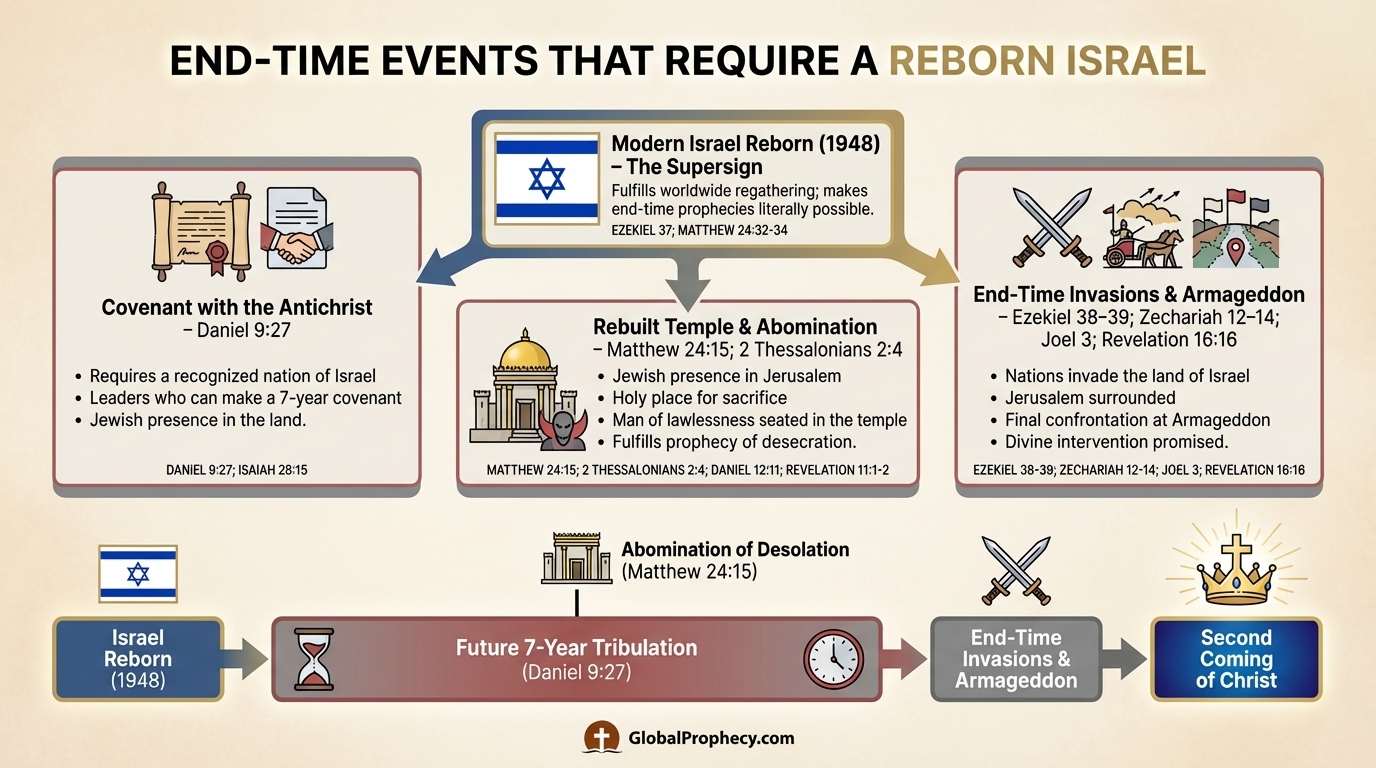
6.1 The Covenant with the Antichrist (Daniel 9:27)
Daniel 9:27 describes a future “prince who is to come” who will:
“make a strong covenant with many for one week, and for half of the week he shall put an end to sacrifice and offering…”
This “week” is widely understood as seven years, the period commonly called the tribulation. For a binding covenant to be made “with many” in Israel:
- Israel must exist as a recognized political entity.
- Israel must have leaders capable of entering international agreements.
Only since 1948 has such a scenario been geopolitically realistic.
6.2 A Rebuilt Temple in Jerusalem (Matthew 24:15; 2 Thessalonians 2:4)
Jesus predicted:
“So when you see the abomination of desolation spoken of by the prophet Daniel, standing in the holy place…”
— Matthew 24:15
Similarly, 2 Thessalonians 2:4 speaks of the “man of lawlessness” who:
“…takes his seat in the temple of God, proclaiming himself to be God.”
For these prophecies to be fulfilled literally:
- There must be a Jewish presence in Jerusalem.
- There must be a sanctuary (“holy place”) in which sacrificial worship can occur.
- There must be Jewish religious life centered on that place.
Again, all of this presupposes the existence of a nation of Israel with control over, or at least access to, the Temple Mount area.
6.3 End-Time Invasions and Armageddon
Prophecies like Ezekiel 38–39; Zechariah 12–14; Joel 3; Revelation 16:16 describe:
- Armies from surrounding regions invading the land of Israel.
- Nations gathering against Jerusalem.
- A final confrontation often associated with Armageddon (Revelation 16:16).
Without an Israel in the land, such prophecies would lose their geographical and political substance. The rebirth and ongoing existence of modern Israel therefore provide the necessary framework for these future conflicts.
7. Practical Implications: Reading the “Signs of the Times”
Jesus rebuked His generation for failing to interpret the signs of His first coming (Matthew 16:1–3). Concerning His return, He used the analogy of a fig tree:
“As soon as its branch becomes tender and puts out its leaves, you know that summer is near. So also, when you see all these things, you know that he is near, at the very gates.”
— Matthew 24:32–33
Believers are not given the day or hour (Matthew 24:36), but we are expected to recognize the season by observing key prophetic developments.
In this sense, Israel’s rebirth is like the budding of the fig tree:
- It does not tell us the exact date of the Lord’s return.
- It does tell us that the prophetic summer is near—that the conditions specified in Scripture for the tribulation and the second coming are now in place or rapidly forming.
Israel in Bible prophecy, therefore, is not a marginal curiosity; it is a central indicator that God’s program for the end of the age is moving forward according to His Word.
8. Conclusion
The rebirth of Israel in 1948 is not merely a remarkable geopolitical event; it is the supersign of the end times.
- It fulfills specific prophecies of a worldwide regathering to the ancient land.
- It initiates the first stage of Israel’s restoration—national, physical, and largely in unbelief.
- It provides the necessary framework for all major end-time events: the covenant with the Antichrist, the tribulation, the abomination of desolation, end-time invasions of Israel, and ultimately the return of Christ to Jerusalem.
While Israel’s present state is not yet the final, spiritual fulfillment promised in Scripture, its existence is an unmistakable sign that the end-time scenario the prophets described is now possible in a literal way. For those who study biblical eschatology, Israel’s rebirth should prompt watchfulness, confidence in God’s promises, and renewed commitment to the gospel in this closing age.
FAQ
Q: Why is Israel’s rebirth called the “supersign” of the end times?
Israel’s rebirth is the “supersign” because so many other end-time prophecies depend on it. The covenant with the Antichrist, the rebuilding of the temple, end-time invasions of Israel, and the final deliverance of Jerusalem all presuppose a living nation of Israel in its land. Without Israel, these prophecies could not be fulfilled in a straightforward, literal way.
Q: Does the modern State of Israel fulfill all Old Testament promises to Israel?
No. The current State of Israel represents primarily a physical regathering in unbelief, as pictured in Ezekiel 37:7–8. The full fulfillment includes a future spiritual transformation when Israel looks to the pierced Messiah (Zechariah 12:10) and “all Israel will be saved” (Romans 11:26). The present rebirth sets the stage; it does not complete the story.
Q: How does Israel’s rebirth relate to the tribulation period?
According to Daniel 9:27, the seven-year tribulation begins with a covenant between Israel and a coming world ruler (the Antichrist). For such a covenant to be made, Israel must exist as a nation with political leadership. Israel’s rebirth in 1948 makes this scenario possible for the first time since AD 70.
Q: Is the rebirth of Israel a sign of the Rapture or of the Second Coming?
Biblically, signs are associated with the tribulation and the Second Coming, not directly with the Rapture, which is presented as imminent and signless. However, because Israel’s rebirth sets the stage for the tribulation, and the Rapture occurs before that period, the existence of modern Israel indirectly suggests that the Rapture may be drawing near.
Q: What should Christians do in light of Israel’s rebirth as the supersign?
Believers should respond with watchfulness, confidence, and obedience. Israel’s rebirth confirms God’s faithfulness to His Word and signals that His prophetic timetable is advancing. This should motivate Christians to take Scripture seriously, proclaim the gospel urgently, and live in readiness for Christ’s return, knowing that “he is near, at the very gates” (Matthew 24:33).
Frequently Asked Questions
Why is Israel’s rebirth called the “supersign” of the end times?
Does the modern State of Israel fulfill all Old Testament promises to Israel?
How does Israel’s rebirth relate to the tribulation period?
Is the rebirth of Israel a sign of the Rapture or of the Second Coming?
What should Christians do in light of Israel’s rebirth as the supersign?
L. A. C.
Theologian specializing in eschatology, committed to helping believers understand God's prophetic Word.
Related Articles
The 7 Biblical Signs of the End Times
End times signs explained from Scripture. Discover the 7 key biblical signs of the end times and how they point to Christ’s soon return.
Technology and the End Times: Setting the Stage for Prophecy
Technology and end times prophecy: How modern digital systems, biometrics, and global surveillance enable biblical predictions like the mark of the beast.
The 144,000 Sealed Israelites
144,000 sealed Israelites in Revelation identified and explained—their identity, purpose, and distinct role as preserved witnesses during the Tribulation.
The 70 Weeks of Daniel: Understanding Bible's Prophetic Timeline
The 70 weeks of Daniel explain God's prophetic timeline for Israel, Christ's first coming, and a future 70th week leading to the end-time climax.