
Jewish Wedding Customs and Biblical Prophecy
1. Introduction
Jewish wedding customs in the first century provide an essential backdrop for understanding biblical prophecy about the marriage of the Lamb. The New Testament repeatedly presents Christ as the Bridegroom and the church as His bride (cf. 2 Cor 11:2; Eph 5:25–27; Rev 19:7–9). When these images are read against ancient Hebrew marriage practices, key end‑time events—the rapture, the marriage of the Lamb, the marriage supper, and Christ’s return—form a coherent prophetic pattern.
This article explains how the stages of a Jewish wedding illuminate the prophetic sequence of the church’s betrothal, the rapture, the heavenly marriage, and the future celebration in Christ’s kingdom.
2. The Jewish Marriage Pattern in the Bible
Ancient Jewish marriage normally unfolded in three major stages, which are reflected in Scripture and then applied prophetically to Christ and the church:
- Betrothal (Kiddushin) – the legally binding covenant and purchase.
- The Coming of the Bridegroom – the unannounced arrival to take the bride to his father’s house.
- The Marriage Feast – the public celebration with invited guests.
These stages appear repeatedly in Jesus’ teaching and in Revelation:
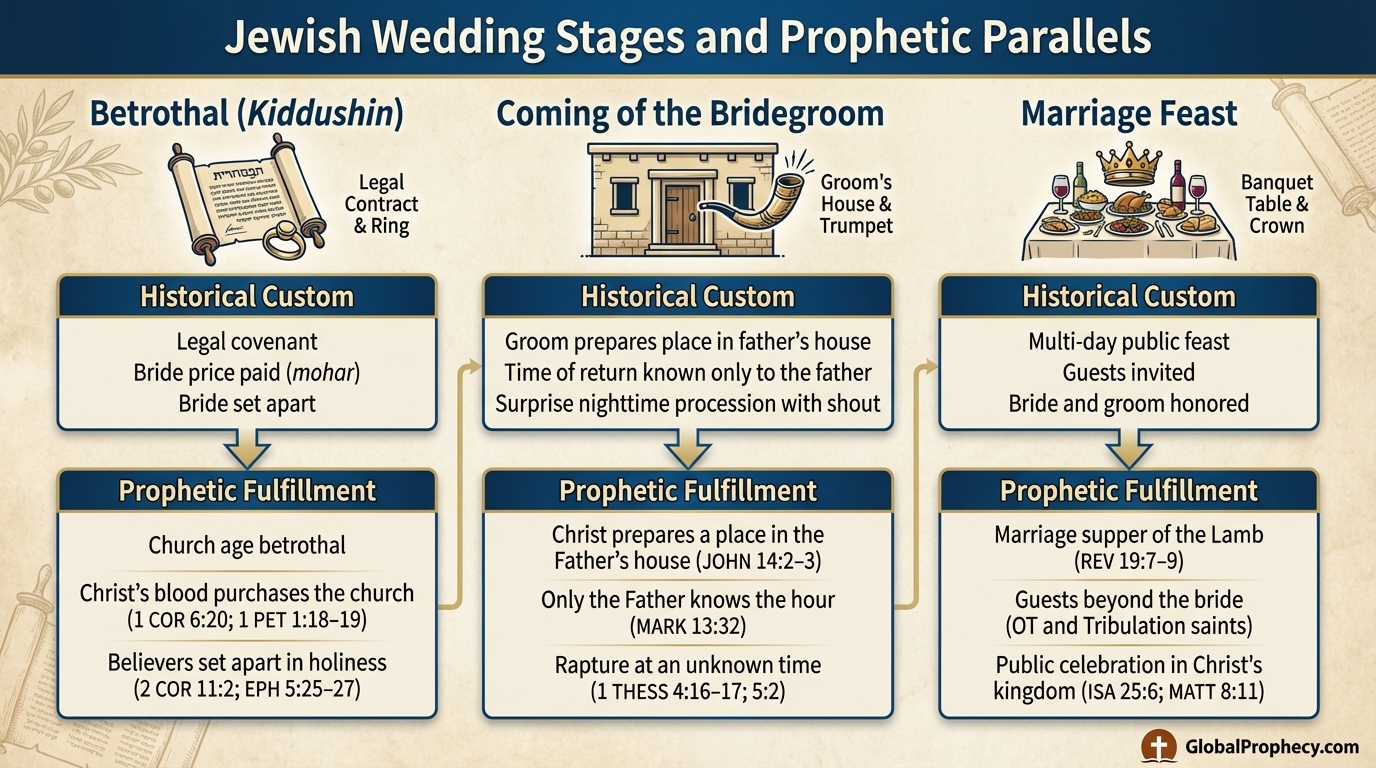
- Jesus calls Himself the bridegroom (Matt 9:15; John 3:29).
- The kingdom is compared to a wedding feast (Matt 22:1–14).
- The parable of the ten virgins centers on the midnight coming of the bridegroom (Matt 25:1–13).
- Revelation 19 climaxes with “the marriage of the Lamb” and “the marriage supper of the Lamb” (Rev 19:7–9).
Understanding how each stage worked historically clarifies how they prophetically correspond to the church’s relationship to Christ.
3. Betrothal: The Present Church Age
3.1 Betrothal in Jewish Custom
In Jewish practice, betrothal was more than an engagement; it was the legal beginning of marriage:
- A marriage contract was established, often by the fathers.
- A bride price (mohar) was paid by or on behalf of the groom.
- The bride and groom were now legally husband and wife, though they did not yet live together or consummate the union.
- The bride was set apart exclusively for her groom and expected to remain pure.
3.2 Betrothal and the Church
The New Testament explicitly uses this stage to describe the present relationship between Christ and the church:
"I betrothed you to one husband, to present you as a pure virgin to Christ."
— 2 Corinthians 11:2
Key prophetic parallels:
- The marriage covenant – At conversion believers enter the new covenant in Christ’s blood (Luke 22:20). The church, as a corporate bride, is now covenantally bound to Christ.
- The bride price – Christ purchased the church with His own blood:
"You were bought with a price." — 1 Corinthians 6:20
"…you were ransomed…with the precious blood of Christ." — 1 Peter 1:18–19 - Sanctification and preparation – The church is being prepared as a pure bride:
"…that he might sanctify her…so that he might present the church to himself in splendor…holy and without blemish."
— Ephesians 5:26–27
In prophetic terms, the entire church age is the betrothal period. The marriage is legally certain but not yet fully realized. The church awaits the Bridegroom’s coming to take her home.
4. The Coming of the Bridegroom and the Rapture
4.1 The Bridegroom’s Surprise Arrival
In Jewish wedding custom, after betrothal:
- The groom returned to his father’s house to prepare a place for his bride.
- The exact time of his return to fetch the bride was unknown to the bride—only the father determined it.
- When the time came, the groom would come, usually at night, with a shout and a procession, and take the bride to his father’s house, where the marriage would be consummated and the festivities would begin (cf. Matt 25:1–13).
Jesus’ language directly mirrors this pattern:
"In my Father’s house are many rooms… I go to prepare a place for you… I will come again and will take you to myself, that where I am you may be also."
— John 14:2–3
"But concerning that day or that hour, no one knows, not even the angels in heaven, nor the Son, but only the Father."
— Mark 13:32
4.2 The Rapture as the Bridegroom’s Coming for His Bride
The rapture of the church corresponds to the groom’s coming for his bride:
"For the Lord himself will descend from heaven with a cry of command, with the voice of an archangel, and with the sound of the trumpet of God… Then we who are alive, who are left, will be caught up together with them in the clouds to meet the Lord in the air."
— 1 Thessalonians 4:16–17
Parallels between Jewish custom and biblical prophecy:
| Jewish Wedding Stage | Prophetic Fulfillment in Christ and the Church |
|---|---|
| Groom prepares a place in his father’s house | Christ preparing a place in the Father’s house (John 14:2) |
| Only the father knows the time of the groom’s return | Only the Father knows the time of Christ’s coming (Acts 1:7) |
| Groom comes unexpectedly, often at night | Rapture at an unknown day and hour (1 Thess 5:2) |
| Shout and trumpet announce his arrival | "Cry of command…voice of an archangel…trumpet of God" (1 Thess 4:16) |
| Bride taken from her house to the groom’s father’s house | Church caught up from the earth to meet Christ and go to the Father’s house in heaven (John 14:3; 1 Thess 4:17) |
From a prophetic perspective, the rapture is the Bridegroom’s retrieval of His bride. It ends the betrothal separation and moves the church to heaven, where the formal marriage of the Lamb will be completed.
5. The Marriage of the Lamb in Heaven
5.1 The Heavenly Ceremony
Revelation 19 presents the consummation of this long‑awaited union:
"Let us rejoice and exult and give him the glory, for the marriage of the Lamb has come, and his Bride has made herself ready; it was granted her to clothe herself with fine linen, bright and pure—for the fine linen is the righteous deeds of the saints."
— Revelation 19:7–8
Several prophetic features correspond to Jewish practice:
- Timing after preparation – In Jewish custom, the marriage proper followed the period of preparation and purity. In prophecy, the bride has been evaluated and rewarded at the judgment seat of Christ; her “fine linen…bright and pure” reflects her purified, rewarded works.
- Location in the father’s house – The core act of marriage took place in the groom’s father’s home, not in the bride’s. In prophecy, after the rapture the church is in heaven, in the Father’s house, when the marriage of the Lamb is announced (Rev 19:1, 7).
Thus, the marriage of the Lamb refers to the formal union of Christ and the church in heaven, following the rapture and the church’s heavenly evaluation. It completes the covenant inaugurated at the cross and enjoyed spiritually during the church age.
5.2 The Bride’s Dress and Eschatological Purity
The bridal garments in Jewish weddings symbolized purity and honor. Revelation applies this directly:
"…it was granted her to clothe herself with fine linen, bright and pure—for the fine linen is the righteous deeds of the saints."
— Revelation 19:8
This indicates:
- The bride’s purity and glory in prophecy are the result of Christ’s saving work and the outworking of that grace in righteous living.
- By the time the marriage of the Lamb is announced, the church’s sanctification and reward are complete. The betrothed virgin has become a fully adorned bride, ready for eternal union with her Bridegroom.
6. The Marriage Supper of the Lamb and Christ’s Return
6.1 The Marriage Feast in Jewish Custom
After the private consummation, Jewish weddings climaxed in a public feast, often lasting seven days (cf. Gen 29:27–28; Judg 14:10–12).
- Many guests were invited.
- The focus of honor was the groom, who was celebrated for the beauty and status he conferred on his bride.
- The feast marked the beginning of their new life together in the community.
6.2 The Marriage Supper of the Lamb
Revelation moves from the heavenly marriage to the announcement of a marriage feast:
"Blessed are those who are invited to the marriage supper of the Lamb."
— Revelation 19:9
Key prophetic implications drawn from Jewish custom and related texts:
- Distinction between marriage and supper – As in human weddings, the ceremony and the feast are related but distinct. The marriage of the Lamb takes place in heaven; the marriage supper is a broader celebration that includes invited guests.
- Guests beyond the bride – In Jewish practice, the bride and groom are distinct from the invited guests. Prophetically, those “invited” to the marriage supper are redeemed people who are not part of the church (e.g., Old Testament and Tribulation saints). The church remains uniquely the bride.
- Connection to the kingdom – Several passages connect end‑time feasting with the Messianic kingdom on earth (Isa 25:6; Matt 8:11; 26:29; Luke 22:16–18). This suggests that the marriage supper of the Lamb is linked to the inauguration of Christ’s millennial reign, when He will openly present His bride and feast with redeemed Israel and the nations.
From a prophetic standpoint, the marriage supper of the Lamb represents the public, kingdom‑age celebration of the union already consummated in heaven. It highlights the joy and honor of Christ and His bride before all redeemed humanity.
7. Summary: Jewish Wedding Customs and the Prophetic Program
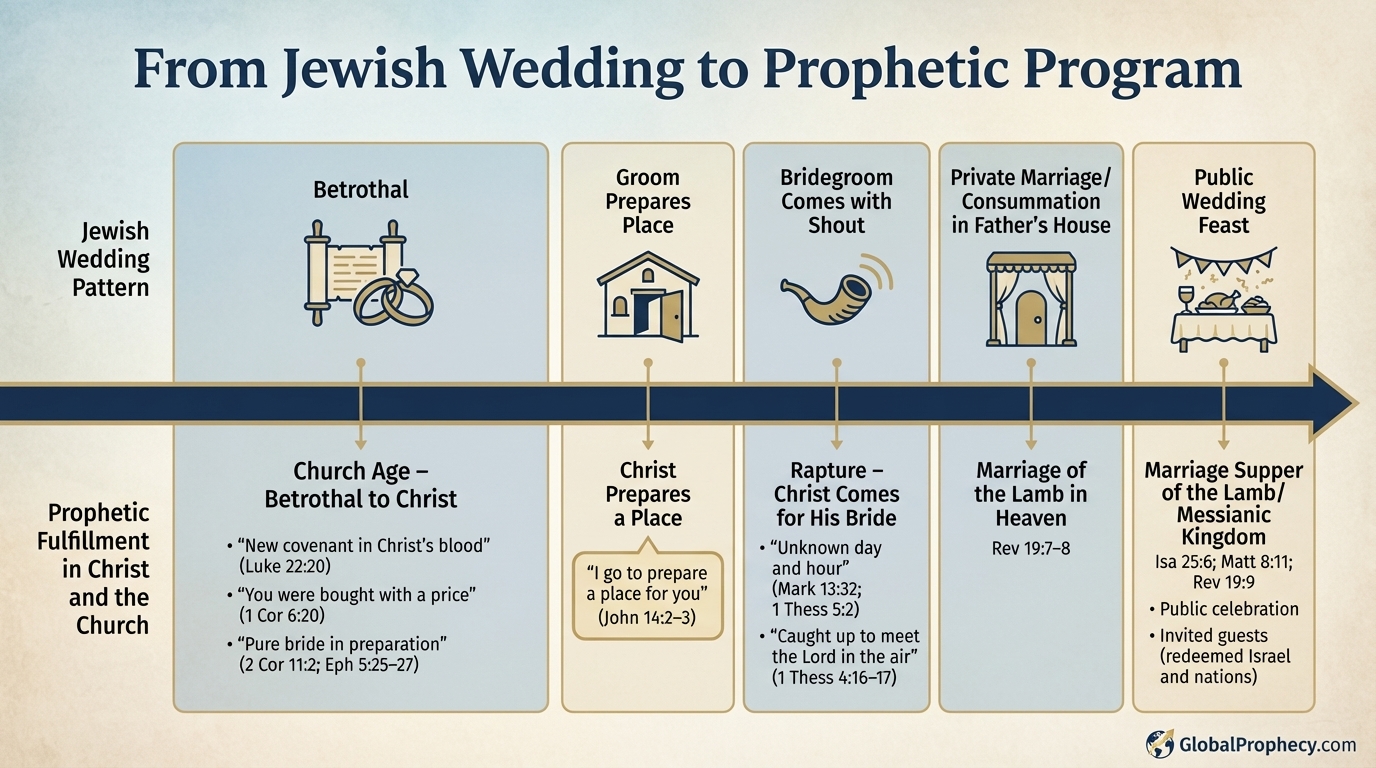
The following table summarizes how Jewish wedding customs illuminate biblical prophecy about the marriage of the Lamb, the rapture, and the return of Christ:
| Jewish Wedding Stage | Historical Description | Prophetic Fulfillment |
|---|---|---|
| Betrothal | Legal covenant; bride price paid; bride set apart for groom | Church age: Christ purchases the church with His blood; believers are betrothed to Christ and called to purity (2 Cor 11:2; Eph 5:25–27) |
| Groom prepares a place | Groom returns to father’s house to prepare lodging | Christ ascends to the Father and prepares a place for His bride (John 14:2) |
| Unknown time of return | Only the father knows when the groom will fetch the bride | Only the Father knows the timing of Christ’s return for the church (Mark 13:32) |
| Midnight procession with shout and lamps | Groom comes unexpectedly at night, announced with a shout; bride taken to father’s house | Rapture: Christ descends with a shout and trumpet, and the church is caught up to meet Him and go to the Father’s house (1 Thess 4:16–17) |
| Private marriage and consummation | In the father’s house, the union is completed | Marriage of the Lamb in heaven after the rapture and rewards (Rev 19:7–8) |
| Public wedding feast with guests | Multi‑day banquet; bride and groom honored before guests | Marriage supper of the Lamb, associated with Christ’s kingdom and reign, where the bride is publicly honored and guests (redeemed Israel and nations) share in the joy (Rev 19:9; Isa 25:6; Matt 8:11) |
Jewish wedding imagery is therefore not decorative; it is structural to New Testament eschatology. It explains why Scripture speaks of betrothal now, a sudden coming of the Bridegroom, a heavenly marriage, and a kingdom feast to come.
8. Conclusion
Jewish wedding customs provide a powerful interpretive key for biblical prophecy about the marriage of the Lamb.
- In the betrothal stage, we see the present age: Christ has paid the price, established the covenant, and set apart the church as His virgin bride.
- In the coming of the Bridegroom, we recognize the rapture, when Christ will unexpectedly take His bride from earth to the Father’s house, announced by a shout and trumpet.
- In the marriage of the Lamb, we see the heavenly completion of that relationship, as the purified church is formally united to Christ and clothed in righteous splendor.
- In the marriage supper of the Lamb, we anticipate the public, kingdom‑age celebration of that union, when Christ will feast with His bride and all redeemed guests in His Messianic reign.
By reading Revelation 19 and related passages through the lens of Jewish wedding customs, the prophetic drama of the end times is seen not merely as a sequence of events, but as the unfolding of a marriage story—the story of the Lamb who loved, purchased, prepared, and will finally celebrate His bride forever.
FAQ
Q: What are the main Jewish wedding customs that relate to the marriage of the Lamb?
The key customs are betrothal (a binding covenant and bride price), the surprise coming of the bridegroom to take the bride to his father’s house, and the marriage feast with invited guests. These stages parallel the church’s present betrothal to Christ, the rapture, the marriage of the Lamb in heaven, and the marriage supper of the Lamb associated with Christ’s kingdom.
Q: How does the rapture fit into the Jewish wedding pattern?
In Jewish custom, the groom came unexpectedly, often at night, with a shout and procession, to take the bride from her home to his father’s house. This corresponds to the rapture, where Christ descends with a shout and trumpet and catches up His bride to meet Him in the air and go to the Father’s house (John 14:1–3; 1 Thess 4:16–17).
Q: Is the marriage of the Lamb the same as the marriage supper of the Lamb?
They are closely related but not identical. The marriage of the Lamb refers to the formal union of Christ and the church in heaven (Rev 19:7–8), while the marriage supper of the Lamb is the broader celebratory feast with invited guests (Rev 19:9), associated with the public manifestation of Christ’s kingdom.
Q: Who is the bride in biblical prophecy, and who are the guests?
In New Testament prophecy, the bride is the church, the collective body of redeemed believers of the church age (Eph 5:25–27; Rev 19:7). The guests at the marriage supper are redeemed people who are not part of the church (such as Old Testament and Tribulation saints), invited to share in the joy of the Lamb’s union with His bride.
Q: Why are Jewish wedding customs important for understanding biblical eschatology?
Because the New Testament intentionally frames end‑time events using bridegroom and wedding imagery. Without understanding Jewish wedding practices, references to betrothal, the bridegroom’s coming, the marriage of the Lamb, and the marriage supper can seem disconnected. Recognizing the cultural pattern reveals a unified prophetic picture of Christ’s love for, coming for, and eternal celebration with His bride.
Frequently Asked Questions
What are the main Jewish wedding customs that relate to the marriage of the Lamb?
How does the rapture fit into the Jewish wedding pattern?
Is the marriage of the Lamb the same as the marriage supper of the Lamb?
Who is the bride in biblical prophecy, and who are the guests?
Why are Jewish wedding customs important for understanding biblical eschatology?
L. A. C.
Theologian specializing in eschatology, committed to helping believers understand God's prophetic Word.
Related Articles
What are the Marriage of the Lamb?
Marriage of the Lamb reveals Christ’s union with His church in Revelation 19. Explore its meaning, timing, and eternal significance in God’s plan.
The 70 Weeks of Daniel: Understanding Bible's Prophetic Timeline
The 70 weeks of Daniel explain God's prophetic timeline for Israel, Christ's first coming, and a future 70th week leading to the end-time climax.
Amillennialism Examined: Is the Church the Millennial Kingdom?
Amillennialism examined: is the church the millennial kingdom? Explore its claims, symbols, and a biblical critique of this end-times view.
Babylon the Great
Babylon the Great in Revelation 17–18 reveals end-time religious and commercial rebellion against God and its sudden, final destruction in judgment.