
The Judgment of the Nations (Sheep and Goats)
1. Introduction
The Judgment of the Nations (Sheep and Goats) in Matthew 25:31–46 is one of the most significant end-times judgments described in the New Testament. It portrays the Son of Man separating sheep and goats—a metaphor for righteous and unrighteous Gentiles—based on how they treated “the least of these my brothers.”
This passage is crucial for biblical eschatology, because it:
- Occurs after Christ’s Second Coming and before the Millennial Kingdom.
- Determines who among the surviving nations will enter Christ’s earthly kingdom.
- Reveals the criteria Christ uses to distinguish true believers from unbelievers at that time.
This article will focus exclusively on Matthew 25:31–46, explaining when this judgment occurs, who is judged, and the basis of the separation between sheep and goats.
"When the Son of Man comes in his glory, and all the angels with him, then he will sit on his glorious throne."
— Matthew 25:31 (ESV)
2. Setting and Timing of the Judgment
2.1 Context in Matthew 24–25
The Judgment of the Nations occurs at the end of Jesus’ Olivet Discourse (Matthew 24–25), which presents a chronological flow:
- Tribulation events (Matthew 24:4–28).
- The Second Coming of Christ in glory (Matthew 24:29–31).
- Parables warning Israel and professing believers to be ready (Matthew 24:45–25:30).
- The Judgment of the Nations (Matthew 25:31–46).
Thus, this judgment is not a general or symbolic statement about all history. It is an eschatological event linked directly to Christ’s visible return.
"When the Son of Man comes in his glory, and all the angels with him, then he will sit on his glorious throne."
— Matthew 25:31
Key features of the timing:
- It takes place after the Tribulation.
- It follows Christ’s visible return to earth (“comes in his glory”).
- It is connected with His sitting on His glorious throne, the Davidic/Messianic throne over the nations.
2.2 Distinct from the Great White Throne Judgment
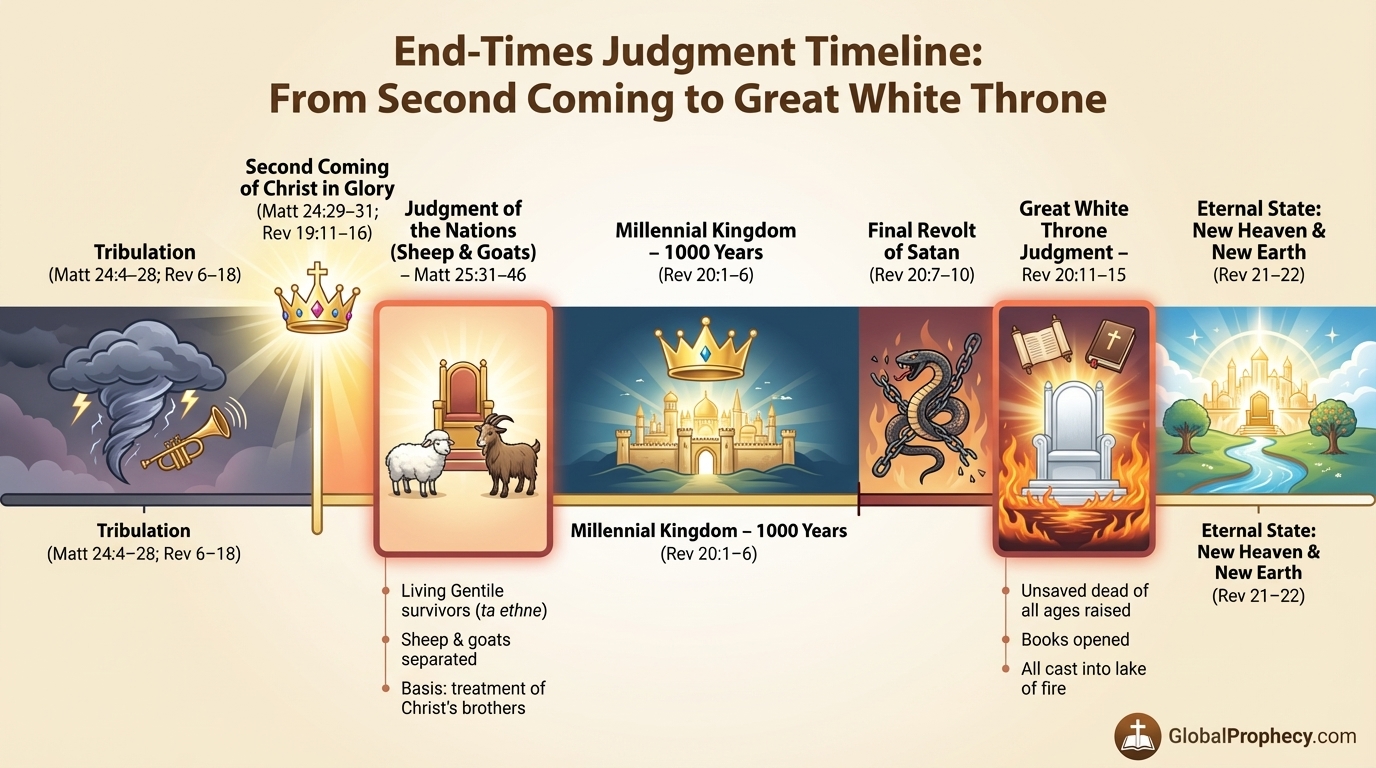
For clarity in biblical eschatology, the Judgment of the Nations must be distinguished from the Great White Throne Judgment in Revelation 20:11–15:
| Feature | Judgment of Nations (Matt 25:31–46) | Great White Throne (Rev 20:11–15) |
|---|---|---|
| Time | After Second Coming, before Millennium | After the Millennium |
| Place | On earth (“His glorious throne”) | Before a great white throne; creation fled |
| Subjects | Living nations/Gentiles (sheep & goats) | Unsaved dead of all ages |
| Resurrection mentioned? | No | Yes – “the dead… were judged” |
| Groups present | Sheep, goats, and “brothers” | Only the lost; no saved group in view |
| Result | Some enter the Kingdom; some to eternal fire | All cast into the lake of fire |
The Judgment of the Nations is therefore a pre‑millennial judgment of the living, not the final, universal judgment of all the dead.
3. Who Is Judged? Identifying Sheep, Goats, and “Brothers”
3.1 “All the Nations” – The Scope
"Before him will be gathered all the nations, and he will separate people one from another as a shepherd separates the sheep from the goats."
— Matthew 25:32
The phrase “all the nations” translates the Greek ta ethnē, commonly used for Gentiles. In this judgment:
- The focus is on Gentile individuals, not political blocs.
- Jesus “separates people one from another,” indicating a personal judgment, not a corporate, national verdict.
- These are living survivors of the Tribulation—those still alive when Christ returns.
So this judgment does not include:
- The dead of previous ages (they appear later at the Great White Throne if unsaved).
- Resurrected church saints (already glorified at the Rapture and rewarded at the Judgment Seat of Christ).
- Resurrected Old Testament and Tribulation martyrs (rewarded and raised to reign with Christ).
It concerns living Gentiles who have just passed through the Tribulation and now stand before Christ to determine whether they may enter His millennial kingdom.
3.2 The Sheep
The sheep are those placed on Christ’s right hand (a place of favor and acceptance):
"Then the King will say to those on his right, ‘Come, you who are blessed by my Father, inherit the kingdom prepared for you from the foundation of the world.’"
— Matthew 25:34
Key points about the sheep:
- They are described as “righteous” (Matthew 25:37, 46).
- They are believers—their works reveal a heart transformed by grace.
- They enter the kingdom in their mortal bodies and will repopulate the earth in the Millennium.
3.3 The Goats
The goats are placed on Christ’s left and are called “cursed”:
"Then he will say to those on his left, ‘Depart from me, you cursed, into the eternal fire prepared for the devil and his angels.’"
— Matthew 25:41
Key points about the goats:
- They are unbelieving Gentiles who rejected the truth during the Tribulation.
- Their lack of compassionate action toward Christ’s brothers reveals an unregenerate heart.
- They are removed in judgment and sent to eternal punishment (Matthew 25:46).
3.4 “The Least of These My Brothers”
The third group—“these my brothers”—is crucial for identifying the criteria of the judgment.
"And the King will answer them, ‘Truly, I say to you, as you did it to one of the least of these my brothers, you did it to me.’"
— Matthew 25:40
While some apply “my brothers” to all needy people in general, the context of end-times and the language of Scripture point to a more specific group:
- “My brothers” most naturally refers to Jesus’ Jewish brethren.
- In a Tribulation context, this likely highlights believing Jews, including the 144,000 witnesses (Revelation 7), who proclaim the gospel of the kingdom under intense persecution.
- These brothers are suffering, hunted, imprisoned, and marginalized during the Tribulation.
Thus, the nations are judged based on how they treated Christ’s Jewish brethren, especially believing Jews preaching His message in a hostile, Antichrist‑dominated world.
4. The Criteria of Judgment: Works as Evidence of Faith
The central interpretive question of Matthew 25:31–46 is: On what basis are the sheep and goats distinguished?
4.1 The Six Acts of Mercy
Jesus lists six specific acts:
"For I was hungry and you gave me food, I was thirsty and you gave me drink,
I was a stranger and you welcomed me,
I was naked and you clothed me,
I was sick and you visited me,
I was in prison and you came to me."
— Matthew 25:35–36
The corresponding charge against the goats is that they did not perform these acts (Matthew 25:42–43).
These actions:
- Are concrete expressions of compassion and loyalty.
- In the Tribulation context, they are dangerous: aiding Christ’s persecuted witnesses risks one’s economic survival and even life (cf. Revelation 13).
- Function as public evidence of one’s stance toward Christ and His message.
4.2 Not Salvation by Works, but Works Revealing Faith
It is essential to maintain biblical balance:
- Scripture is clear that salvation is by grace through faith, not by works (Ephesians 2:8–9; Titus 3:5).
- Yet true saving faith always produces fruit (James 2:14–26).
In this judgment:
- Faith in Christ during the Tribulation is revealed by courageous acts of love toward His persecuted brethren.
- The sheep are not saved because they did good works; they did good works because they were saved.
- The goats’ refusal to aid Christ’s brothers exposes unbelief and alignment with the world system opposed to God.
Therefore, the criteria at the Judgment of the Nations can be summarized as:
The demonstrated response of Gentile individuals to Christ and His gospel during the Tribulation, as evidenced by their treatment of His Jewish brethren.
4.3 Identification with Christ
A key theological insight in this judgment is the personal identification of Christ with His people:
"As you did it to one of the least of these my brothers, you did it to me."
— Matthew 25:40"As you did not do it to one of the least of these, you did not do it to me."
— Matthew 25:45
This means:
- To receive His messengers is to receive Christ Himself.
- To reject or neglect His suffering people is to reject Christ Himself.
The Judgment of the Nations publicly vindicates this union between the King and His people before the watching world.
5. Outcomes of the Judgment: Kingdom Entry and Eternal Destiny
The Judgment of the Nations produces two eternal directions and one immediate historical outcome.
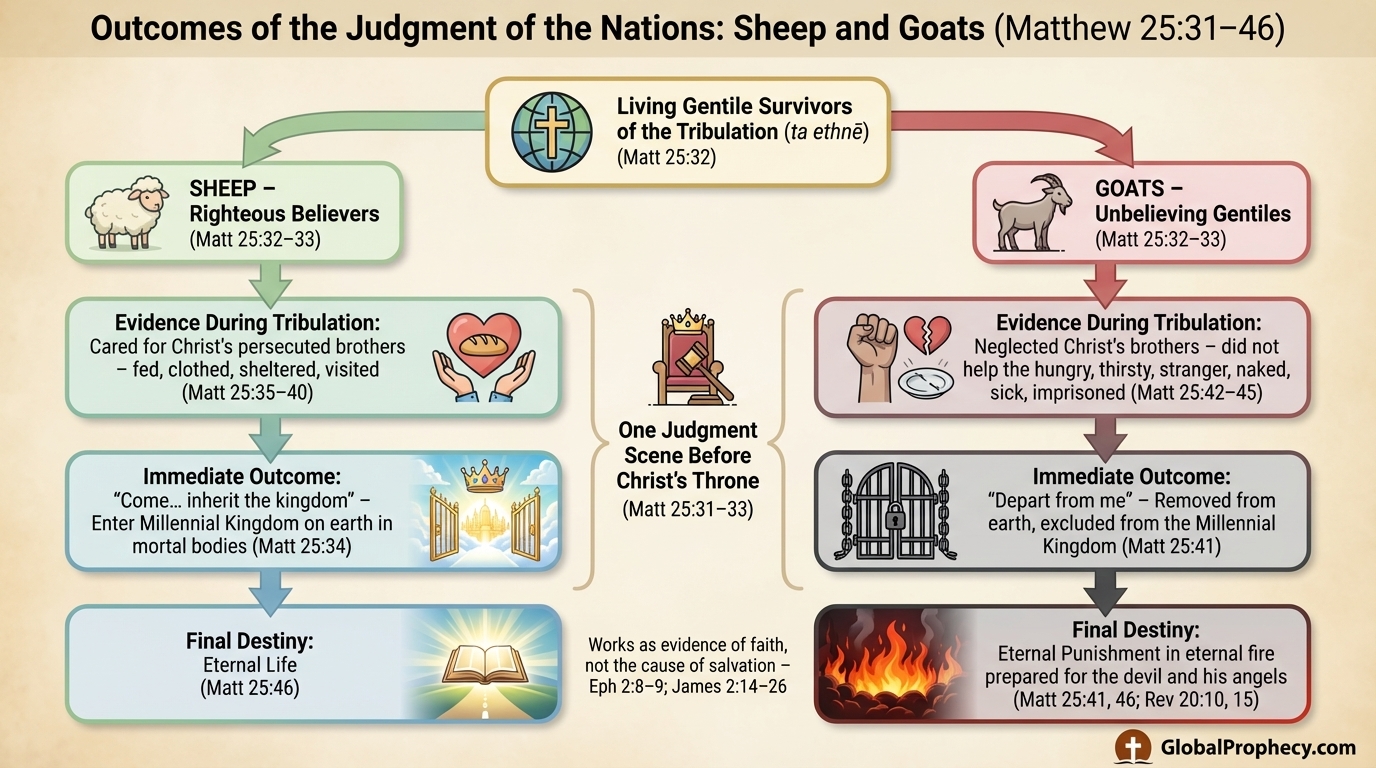
5.1 The Sheep: Inheriting the Kingdom and Eternal Life
"Then the King will say to those on his right, ‘Come, you who are blessed by my Father, inherit the kingdom prepared for you from the foundation of the world.’"
— Matthew 25:34"And the righteous [will go] into eternal life."
— Matthew 25:46
For the sheep:
- They inherit the kingdom—they are granted entrance into Christ’s millennial reign on earth.
- They also receive eternal life; the kingdom is the earthly, mediatorial phase of their eternal blessedness.
- They enter the Millennium in natural bodies, have families, and live under the direct rule of Christ.
5.2 The Goats: Eternal Punishment
"Then he will say to those on his left, ‘Depart from me, you cursed, into the eternal fire prepared for the devil and his angels.’"
— Matthew 25:41"And these will go away into eternal punishment, but the righteous into eternal life."
— Matthew 25:46
For the goats:
- They are removed from the earth and excluded from the Millennial Kingdom.
- They go into eternal punishment, the same ultimate destiny as the devil and his angels (cf. Matthew 25:41; Revelation 20:10, 15).
- There is no second chance, no further probation, no partial purgation; the sentence is final.
5.3 The Purified Entrance into the Millennial Kingdom
The effect of the Judgment of the Nations is that:
- Only believers—both saved Jews and saved Gentiles—enter the Millennium.
- All unbelievers among the nations are removed, ensuring that the kingdom begins with a regenerate population under Christ’s righteous rule.
The Judgment of the Nations, therefore, is a gateway judgment: it forms the moral and spiritual threshold between this present evil age and the Messianic Kingdom on earth.
6. Theological Significance for Biblical Eschatology
The Judgment of the Nations (Sheep and Goats) in Matthew 25:31–46 contributes several key themes to biblical eschatology:
- Christ’s Authority as King and Judge: He sits on His glorious throne, exercising universal judgment over the nations.
- The Centrality of Israel and Christ’s “Brothers”: The way the nations treat Christ’s Jewish brethren—especially believing Jews—is the visible gauge of their true response to God’s redemptive plan.
- Faith Demonstrated in Extreme Conditions: During the Tribulation, outward acts toward persecuted believers become a sharp test of genuine faith.
- A Structured, Multi‑Stage Judgment Program: This judgment sits alongside the Judgment Seat of Christ, the judgment of Israel, the Great White Throne, and the judgment of fallen angels, underscoring that God’s final dealings are ordered, purposeful, and discriminating, not a single undifferentiated “Judgment Day.”
For students of end-times prophecy, Matthew 25:31–46 must be read as a specific, future judgment of living Gentiles, not as a general justification for a social‑gospel theology or a denial of salvation by grace through faith. It is a dramatic public scene in which the King reveals who truly belonged to Him during earth’s darkest hour, and who did not.
Conclusion
The Judgment of the Nations (Sheep and Goats) in Matthew 25:31–46 is a distinct, end‑time judgment that takes place after Christ’s glorious return and before His Millennial Kingdom begins. It concerns living Gentile individuals, gathered before Christ’s throne, and separated as sheep and goats.
The sheep, identified as righteous, are those whose sacrificial care for Christ’s persecuted “brothers” in the Tribulation reveals genuine faith in the King. They are welcomed: “Come, you who are blessed by my Father, inherit the kingdom…” The goats, whose indifference or hostility exposes their unbelief, are sent away into eternal fire.
The criteria of this judgment are not a denial of salvation by grace, but a powerful affirmation that true faith is never invisible. Under extreme pressure, it shows itself in loyalty to Christ and love for His people. Through this judgment, Christ publicly vindicates His own, purifies the earth for His reign, and forever settles the destiny of those nations who lived to see His coming.
FAQ
Q: Is the Judgment of the Nations in Matthew 25 the same as the Great White Throne Judgment?
No. The Judgment of the Nations (Sheep and Goats) occurs after the Second Coming and concerns living Gentile survivors of the Tribulation. The Great White Throne Judgment in Revelation 20:11–15 occurs after the Millennium and concerns the unsaved dead of all ages, who are then cast into the lake of fire.
Q: Who exactly are the “sheep” and “goats” in the Judgment of the Nations?
The sheep represent believing Gentiles who, during the Tribulation, showed genuine faith in Christ by caring for His persecuted “brothers.” The goats represent unbelieving Gentiles whose refusal to aid Christ’s brethren reveals their rejection of Him. Both groups are living individuals, not symbolic nations or church‑age believers.
Q: Who are “the least of these my brothers” in Matthew 25:40?
In this eschatological context, “my brothers” most naturally refers to Jesus’ Jewish brethren, particularly believing Jews who proclaim the gospel during the Tribulation and suffer severe persecution. The way Gentiles treat these brothers becomes the visible evidence of their response to Christ and His message.
Q: Does the Judgment of the Nations teach salvation by works?
No. Scripture uniformly teaches that salvation is by grace through faith. In Matthew 25, the works mentioned (feeding, clothing, visiting, sheltering) are evidence of genuine faith, not the cause of salvation. The sheep’s actions show that they truly belonged to Christ; the goats’ neglect shows they did not.
Q: What happens to the sheep and goats immediately after this judgment?
The sheep are invited to inherit the kingdom and enter Christ’s Millennial Kingdom on earth in their mortal bodies, where they will live under His rule and repopulate the earth. The goats are removed in judgment and go away into eternal punishment, excluded from the kingdom and consigned to the same eternal fire prepared for the devil and his angels.
Frequently Asked Questions
Is the Judgment of the Nations in Matthew 25 the same as the Great White Throne Judgment?
Who exactly are the “sheep” and “goats” in the Judgment of the Nations?
Who are “the least of these my brothers” in Matthew 25:40?
Does the Judgment of the Nations teach salvation by works?
What happens to the sheep and goats immediately after this judgment?
L. A. C.
Theologian specializing in eschatology, committed to helping believers understand God's prophetic Word.
Related Articles
The Books Opened at the Great White Throne Judgment
Great White Throne books opened: explore the book of life, books of works, and how these heavenly records determine final judgment in Revelation 20.
What is The Day of the Lord?
Day of the Lord: discover what Scripture means by this future time of divine judgment and restoration, its timing in prophecy, and key end-time events.
Death and the Unbeliever
Death and the unbeliever explores what happens at death, conscious judgment, and the eternal destiny of those who die without saving faith in Christ.
Are There Degrees of Punishment in Hell?
Hell degrees of punishment: explore Bible passages where Jesus and other texts teach varying levels of judgment and accountability in eternal torment.