
What is the Judgment Seat of Christ?
1. Introduction
Within biblical eschatology, few subjects are more searching for believers than the Judgment Seat of Christ. Unlike the final condemnation of unbelievers, this judgment concerns only those who are already saved. Its purpose is not to decide heaven or hell, but to evaluate the lives of believers and to assign eternal rewards.
Two key passages define this doctrine:
"For we must all appear before the judgment seat of Christ, so that each one may receive what is due for what he has done in the body, whether good or evil."
— 2 Corinthians 5:10
"For we will all stand before the judgment seat of God. … So then each of us will give an account of himself to God."
— Romans 14:10, 12
This article explains what the Judgment Seat of Christ is and why it exists, focusing especially on these two foundational texts.
2. The Meaning of the “Judgment Seat” (Bema)
The expression “judgment seat” translates the Greek word bēma, which literally means a raised platform or step.
In the New Testament world, a bēma had two main uses:
- Judicial seat – the official place where a governor or judge sat to hear cases (e.g., Acts 18:12; John 19:13).
- Athletic platform – the stand from which officials observed the games and awarded prizes to the winners.
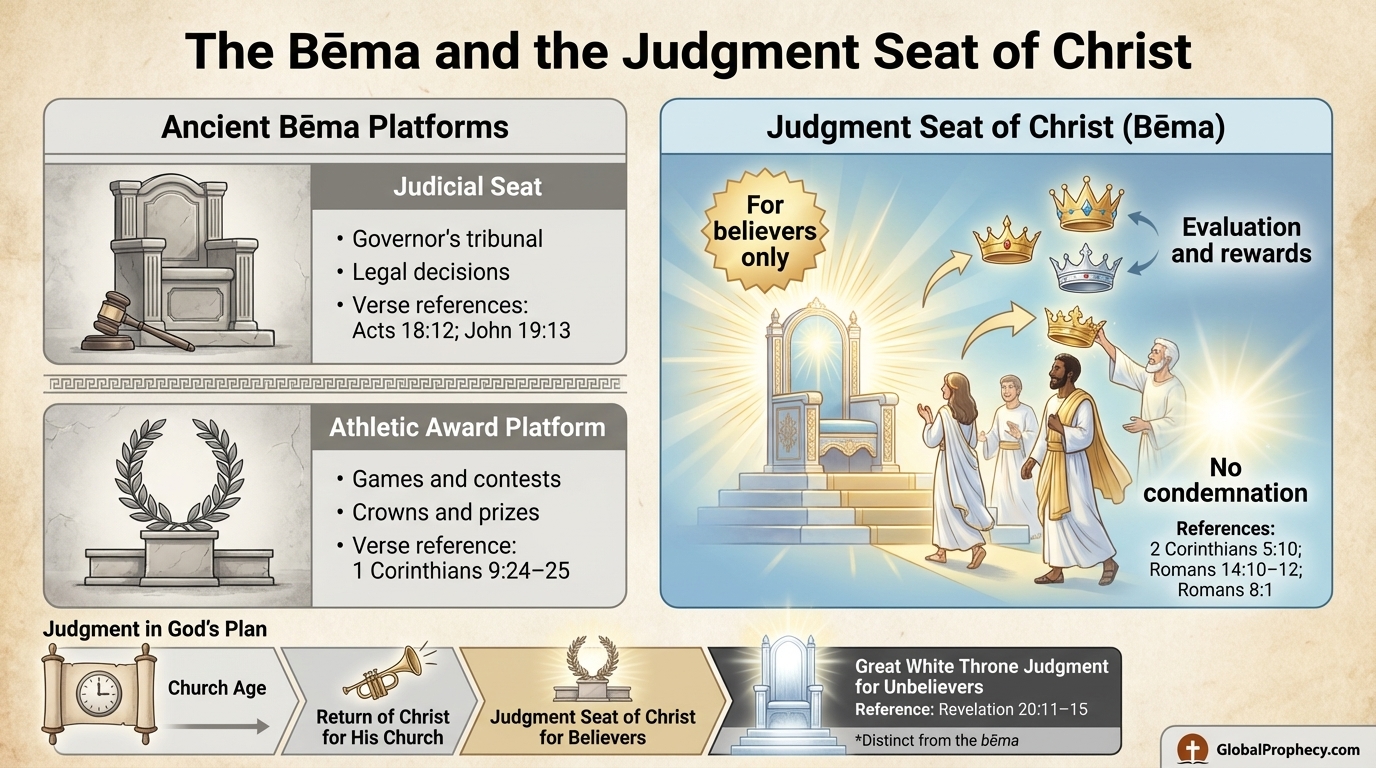
Paul writes to Corinth, a city familiar with major athletic festivals, using this athletic imagery. The Judgment Seat of Christ is therefore best pictured not as a criminal court where believers risk condemnation, but as an award platform where Christ evaluates and rewards His people.
This aligns with the clear New Testament teaching that believers are no longer under condemnation:
"There is therefore now no condemnation for those who are in Christ Jesus."
— Romans 8:1
The bēma is thus an evaluative and rewarding judgment, not a salvific or punitive one.
3. Who Will Appear at the Judgment Seat of Christ?
Both 2 Corinthians 5:10 and Romans 14:10 emphasize universality among believers:
- "For we must all appear before the judgment seat of Christ" (2 Cor 5:10).
- "For we will all stand before the judgment seat of God" (Rom 14:10).
Key points:
- The “we” in context refers to Christians (church saints), not the world at large.
- Participation is universal and unavoidable for believers: “each one” and “each of us” must give an account (2 Cor 5:10; Rom 14:12).
- This judgment is distinct from the Great White Throne Judgment of unbelievers in Revelation 20:11–15.
In other words, every true believer in Christ will personally stand before Him to have his or her life evaluated.
4. What Is Judged? The Basis of Christ’s Evaluation
4.1 “What he has done in the body” (2 Corinthians 5:10)
Paul states that we will be recompensed:
"…for what he has done in the body, whether good or evil."
— 2 Corinthians 5:10
Several observations follow:
- The focus is on post‑conversion life – “in the body” refers to our earthly Christian experience.
- The term translated “evil” (Greek phaulos) often means worthless rather than morally wicked. The issue is value and rewardability, not guilt and condemnation.
- Christ will evaluate both:
- Actions – outward deeds of service or disobedience.
- Motives – the inner intentions behind those deeds.
Paul elsewhere links this to an evaluation of motives:
"…[He] will bring to light the things now hidden in darkness and will disclose the purposes of the heart. Then each one will receive his commendation from God."
— 1 Corinthians 4:5
Thus, even seemingly impressive works may prove “wood, hay, and straw” if driven by pride or self‑promotion (1 Corinthians 3:12–15), while simple, unseen obedience may shine as “gold, silver, [and] precious stones.”
4.2 “Each of us will give an account” (Romans 14:10–12)
In Romans 14, Paul addresses disputes over non-essential matters (food, special days) and warns believers not to usurp Christ’s role as Judge:
"Why do you pass judgment on your brother? Or you, why do you despise your brother? For we will all stand before the judgment seat of God."
— Romans 14:10
The eschatological point is clear:
- We are not the final evaluators of other believers.
- Christ alone will weigh each believer’s decisions, scruples, and conscience.
- Every believer will give an individual, personal account: “each of us will give an account of himself to God” (Rom 14:12).
At the Judgment Seat of Christ, therefore, the Lord will review how we treated one another, especially in areas of liberty, conscience, and Christian love.
5. The Purpose of the Judgment Seat of Christ
5.1 Not to determine salvation
The Judgment Seat of Christ does not decide whether a person is saved. That issue is settled in this life by faith in Christ alone:
"For by grace you have been saved through faith. And this is not your own doing; it is the gift of God, not a result of works…"
— Ephesians 2:8–9
Those who appear before Christ’s bēma are already:
- Justified (Romans 5:1),
- Forgiven (Hebrews 10:17),
- Secure in Christ (John 10:28–29).
To re‑judge believers for sin with respect to eternal destiny would contradict the finished work of Christ and the promise of “no condemnation.”
5.2 To evaluate and reward
The stated purpose in 2 Corinthians 5:10 is:
"…that each one may receive what is due for what he has done in the body…"
The verb “receive” points to recompense or reward. Similarly, Romans 14:12 emphasizes accountability. When we synthesize these texts with 1 Corinthians 3:10–15 and other passages, a clear picture emerges:
- The Judgment Seat of Christ is a review of the believer’s life and service.
- Its outcome is the distribution or loss of rewards, not entrance into heaven.
- Some works will remain and be rewarded; others will be burned up as worthless (yet the believer “will be saved,” 1 Cor 3:15).
In summary, the purpose of the Judgment Seat of Christ is:
- To reveal the true quality of each believer’s works and motives.
- To grant appropriate eternal rewards, including:
- Crowns (2 Timothy 4:8; James 1:12; 1 Peter 5:4),
- Degrees of responsibility and service in Christ’s kingdom (Luke 19:11–27),
- Commendation from Christ Himself (1 Corinthians 4:5).
6. The Character of This Judgment
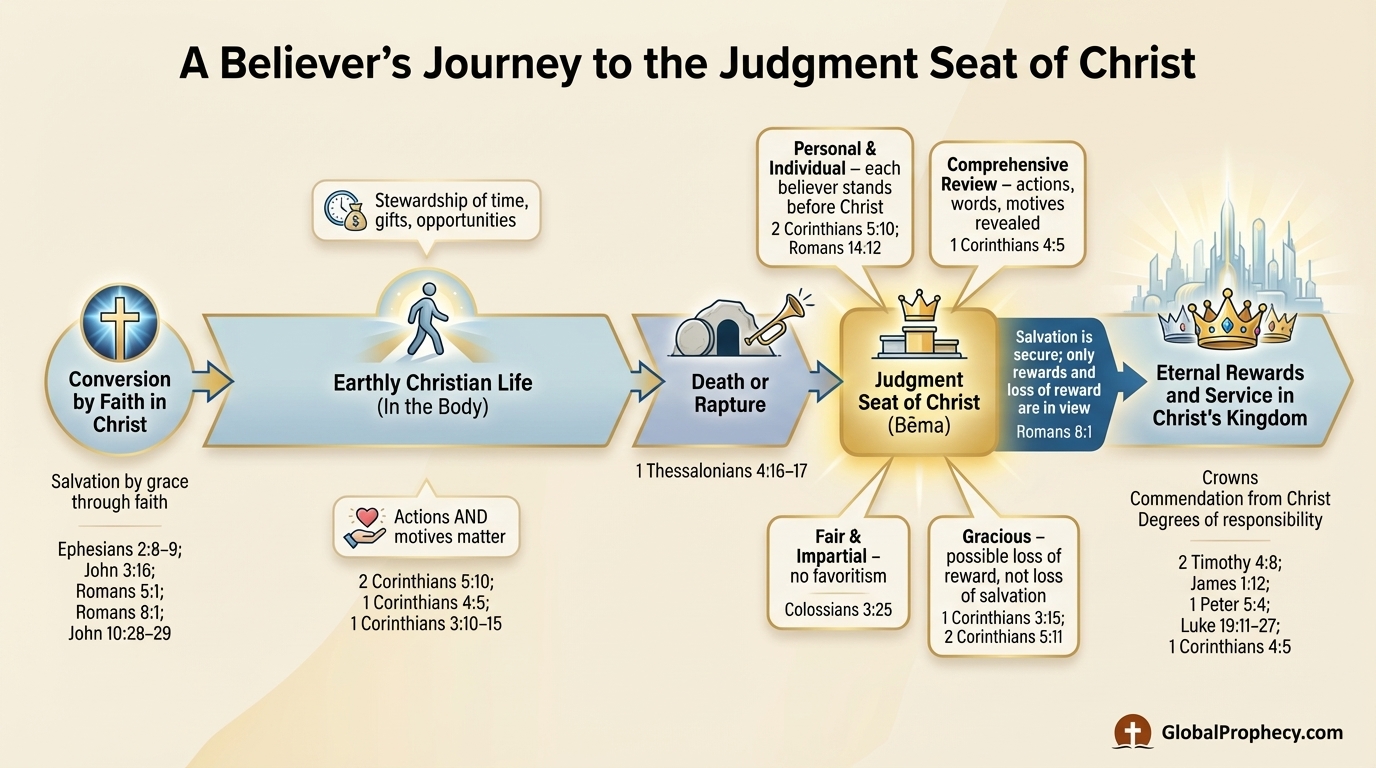
6.1 Personal and individual
Both key passages stress individuality:
- “Each one may receive…” (2 Cor 5:10).
- “Each of us will give an account…” (Rom 14:12).
The Judgment Seat is not a group assessment. Every believer will stand face-to-face with Christ, with no mediator, no crowd, and no comparison with others.
6.2 Comprehensive yet gracious
From a synthesis of 2 Corinthians 5:10, Romans 14:10–12, and related texts, we can say the judgment will be:
- Comprehensive – including actions, words, thoughts, and motives.
- Fair and impartial – Christ judges without favoritism (Colossians 3:25).
- Thorough – “We must all appear” can be translated “be made manifest”; our lives will be laid bare.
- Gracious – even where there is “loss” of reward (1 Cor 3:15), the believer himself is still saved; and Scripture hints that each believer will receive at least some praise from God (1 Corinthians 4:5).
The fear of the Lord connected to this judgment (2 Corinthians 5:11) is not terror of damnation but a sober awareness that our lives matter eternally.
7. Practical Implications for Believers
The doctrine of the Judgment Seat of Christ is not abstract speculation; it is designed to shape Christian living.
From 2 Corinthians 5 and Romans 14, several applications emerge:
-
Motivation for pleasing Christ
In the immediate context of 2 Corinthians 5:10, Paul says:"So whether we are at home or away, we make it our aim to please him."
— 2 Corinthians 5:9
Knowing we will stand before Christ should make His approval our highest ambition. -
Guarding our treatment of other believers
In Romans 14, the reality of the judgment seat undercuts harsh criticism and contempt:- Instead of judging one another over disputable matters, believers should live charitably, remembering that Christ will judge us all.
-
Encouragement in hidden faithfulness
Many acts of obedience and sacrifice are unseen and unappreciated on earth. But:"Then each one will receive his commendation from God."
— 1 Corinthians 4:5
The Judgment Seat of Christ guarantees that nothing done for Christ in the right spirit is ever wasted. -
Sobriety about wasted opportunities
The possibility of “suffering loss” (1 Cor 3:15) warns against a careless Christian life. Time, gifts, and opportunities are a stewardship that will be reviewed.
8. Conclusion
The Judgment Seat of Christ is a central element of New Testament eschatology, especially as explained in 2 Corinthians 5:10 and Romans 14:10–12. It teaches that:
- Every believer will personally and individually stand before Christ.
- Christ will evaluate what we have done in the body, including the motives of the heart.
- This judgment is not about salvation, but about reward, commendation, and loss of reward.
- The proper response is a life aimed at pleasing Christ, marked by love for fellow believers and faithfulness in all things.
Far from producing paralyzing fear, this doctrine is meant to produce holy seriousness, enduring hope, and joyful anticipation of hearing, “Well done, good and faithful servant.”
FAQ
Q: What is the Judgment Seat of Christ?
The Judgment Seat of Christ is the post‑salvation evaluation of believers by Christ, described in 2 Corinthians 5:10 and Romans 14:10–12. At this judgment, every Christian will give an account to the Lord and will receive reward—or suffer loss of reward—based on what he or she has done in the body, whether good or worthless.
Q: Is the Judgment Seat of Christ about salvation or rewards?
It is about rewards, not salvation. Salvation is settled in this life by faith in Christ alone (Ephesians 2:8–9). The Judgment Seat of Christ concerns the quality of a believer’s life and service and determines eternal rewards and responsibilities, not entrance into heaven.
Q: How is the Judgment Seat of Christ different from the Great White Throne Judgment?
The Judgment Seat of Christ is for believers only and focuses on rewards (2 Cor 5:10; Rom 14:10–12). The Great White Throne Judgment, described in Revelation 20:11–15, is for unbelievers and results in final condemnation. No believer appears at the Great White Throne, and no unbeliever appears at the Judgment Seat of Christ.
Q: What will Christ judge at the Judgment Seat?
Christ will judge what each believer has done in the body, including actions, words, and motives. 2 Corinthians 5:10 emphasizes deeds done in the body, while Romans 14:12 stresses that each of us will give an account of himself to God. Other passages show that motives and hidden things of the heart will also be revealed (1 Corinthians 4:5).
Q: Can a believer “lose” anything at the Judgment Seat of Christ?
A believer cannot lose salvation, but can lose reward. 1 Corinthians 3:15 teaches that some works will be burned up as worthless; the believer will “suffer loss,” yet “he himself will be saved.” This loss refers to forfeited rewards, opportunities, and commendation—not to eternal life itself.
Frequently Asked Questions
What is the Judgment Seat of Christ?
Is the Judgment Seat of Christ about salvation or rewards?
How is the Judgment Seat of Christ different from the Great White Throne Judgment?
What will Christ judge at the Judgment Seat?
Can a believer “lose” anything at the Judgment Seat of Christ?
L. A. C.
Theologian specializing in eschatology, committed to helping believers understand God's prophetic Word.
Related Articles
The Crowns of Heaven: Eternal Rewards for Believers
Discover the five eternal crowns believers can receive as rewards in heaven. Learn what Scripture teaches about earning the imperishable, rejoicing, righteousness, glory, and life crowns.
The Abrahamic Covenant: God's Unconditional Promise to Israel
Abrahamic Covenant explained as God’s unconditional promise to Israel, defining land, seed and blessing and shaping key end-times Bible prophecy.
The Nature of the Believer's Resurrection Body
Resurrection body of believers explained: explore 1 Corinthians 15 on the glorified, imperishable, Christlike nature of the believer’s future body.
What the Bible Says about Antichrist?
Antichrist in the Bible: discover what Scripture reveals about his identity, character, deceptive power, and end-time role in the Tribulation.