
Life in the Millennium: Physical and Spiritual Blessings
1. Introduction
The millennial kingdom is the future thousand‑year reign of Jesus Christ on earth following the Tribulation (Rev. 19:11–20:6). Scripture portrays this era as a unique blend of spiritual renewal and physical restoration. Life in the Millennium will not be an abstract, mystical state but a concrete, historical period in which real people live, work, worship, marry, raise children, and interact under the direct rule of Christ.
This article focuses specifically on what life will be like in that kingdom—its spiritual atmosphere and its material conditions—drawing together key biblical data into a concise overview.
2. The Setting and Population of the Millennial Kingdom
When Christ returns, He will:
- Destroy the rebellious armies (Rev. 19:19–21)
- Judge the nations, separating “sheep” (believers) from “goats” (unbelievers) (Matt. 25:31–46)
- Bind Satan for a thousand years (Rev. 20:1–3)
Those who survive the Tribulation as believers—both Jews and Gentiles—will enter the kingdom in mortal bodies (e.g., Ezek. 20:34–38; Matt. 25:34). At the same time, resurrected saints (Old Testament believers, the church, and Tribulation martyrs) will share in Christ’s rule in glorified bodies (Rev. 20:4–6; 5:10; 2 Tim. 2:12).
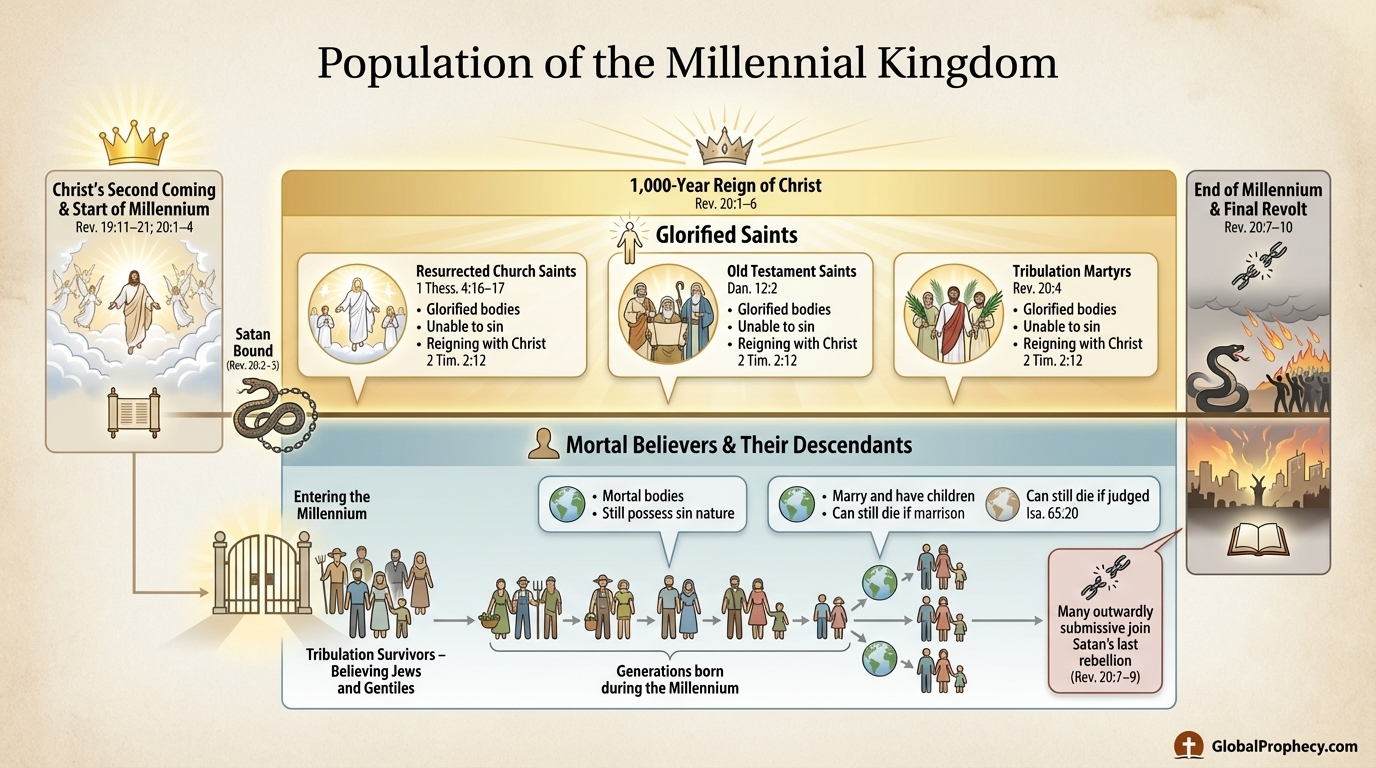
This creates a distinctive situation:
- Glorified saints: unable to sin, sharing Christ’s authority, not marrying or reproducing.
- Mortal believers: still possessing a sin nature, marrying, having children, aging, and—if judged or at the very end—dying (Isa. 65:20).
Across the thousand years, the earth’s population will grow dramatically as generations are born under the visible reign of Christ.
3. Spiritual Blessings and the Inner Life of the Kingdom
3.1 The Presence of Christ and the Knowledge of God
Central to millennial life is the personal, visible reign of Jesus Christ from Jerusalem:
“Out of Zion shall go the law, and the word of the LORD from Jerusalem. He shall judge between the nations…”
— Isaiah 2:3–4
Christ’s presence transforms the world’s spiritual climate:
- Universal awareness of God: “The earth shall be full of the knowledge of the LORD as the waters cover the sea” (Isa. 11:9; Hab. 2:14).
- Israel nationally converted: God gives them a new heart and Spirit, and they all know Him (Jer. 31:31–34; Ezek. 36:25–27; Rom. 11:26–27).
- Gentile nations discipled: Nations stream to Jerusalem to be taught God’s ways (Isa. 2:2–3; Mic. 4:1–2).
Evangelism in the millennial kingdom is not about ignorance being removed so much as rebellion being confronted. The facts about God and His Christ will be universally known; the issue will be whether hearts submit.
3.2 Righteousness, Justice, and Holiness
The spiritual tone of the kingdom is captured by repeated words: righteousness, justice, holiness.
- Christ reigns “in righteousness” (Isa. 32:1) and judges with perfect equity (Isa. 11:3–5).
- Only the righteous enter the kingdom at its outset (Matt. 25:37; Isa. 60:21).
- Sin is restrained and punished swiftly—He rules with a “rod of iron” (Ps. 2:9; Rev. 19:15).
Holiness will permeate every aspect of life:
“On that day there shall be inscribed on the bells of the horses, ‘Holy to the LORD’…and every pot in Jerusalem and Judah shall be holy to the LORD of hosts.”
— Zechariah 14:20–21
This means:
- No tolerated public idolatry or open blasphemy
- Corrupt officials and violent criminals are removed from influence
- Public life (business, art, law, education) operates under God’s revealed standards
3.3 The Work of the Holy Spirit
The New Covenant is in full effect for Israel, with overflow to the nations:
- God puts His law within His people (Jer. 31:33).
- He pours out His Spirit “on all flesh” (Joel 2:28–29).
- The Spirit indwells, teaches, and empowers obedience (Ezek. 36:27; 37:14).
This results in:
- Genuine heart-level obedience
- Widespread love for God’s Word
- A global culture of worship and praise
3.4 Worship and the Millennial Temple
Worship in the Millennium is both spiritual and formal:
- A millennial temple in Jerusalem serves as the central house of prayer for all nations (Ezek. 40–48; Isa. 56:7).
- The Shekinah glory of God returns to dwell there (Ezek. 43:1–7; 48:35).
- Nations make regular pilgrimages to worship the King, especially at the Feast of Tabernacles (Zech. 14:16–19).
Animal sacrifices are reinstituted (Ezek. 43; 45–46). These do not add to Christ’s once‑for‑all atonement (Heb. 10:10–14); rather, they function as:
- Ceremonial purification for mortal worshipers approaching a holy God in a holy place
- Visible memorials of Christ’s sacrifice, reinforcing in a highly tangible way the cost of sin and the grace of God
3.5 Satan Bound and Temptation Restrained
For the entire thousand years:
“[Satan]…was thrown into the pit…and sealed it over him, so that he might not deceive the nations any longer, until the thousand years were ended.”
— Revelation 20:2–3
The absence of satanic and demonic deception radically alters the spiritual environment:
- No global false religions energized by demons
- No occult powers or satanic world system
- Temptation arises primarily from the human heart, not from cosmic seduction
Yet at the end, when Satan is briefly released, many who have only submitted outwardly will join his final revolt (Rev. 20:7–10), proving that the core problem is the sinful heart, even under ideal conditions.
4. Physical Blessings and the Transformation of Creation
4.1 Reversal of the Curse and Renewal of Nature
The Millennium features a partial lifting of the Adamic curse:
-
The land becomes extraordinarily fruitful:
- Deserts blossom like the rose (Isa. 35:1–2).
- The plowman overtakes the reaper due to overlapping harvests (Amos 9:13).
- “Showers of blessing” bring abundant crops (Ezek. 34:26–27).
-
The animal kingdom is transformed:
- Predatory and dangerous behavior ceases: the wolf dwells with the lamb, the lion eats straw like the ox (Isa. 11:6–9; 65:25).
- Children play safely near formerly poisonous creatures (Isa. 11:8).
This is not yet the new heaven and new earth, but it is truly Eden‑like in many respects.
4.2 Health, Longevity, and Freedom from Common Hazards
Physical well‑being is a hallmark of life in the Millennium:
- “No inhabitant will say, ‘I am sick’” (Isa. 33:24).
- The blind see, the deaf hear, the lame leap (Isa. 35:5–6).
- Deformities and chronic disease are removed (Isa. 61:1–2; Ezek. 34:16).
Longevity is dramatically extended:
“He who dies at a hundred years old shall be thought a youth, and he who fails to reach a hundred shall be considered accursed.”
— Isaiah 65:20
Death during the Millennium appears to be:
- Rare, not normal
- Associated primarily with divine judgment on persistent rebellion rather than with natural decay
For mortals who walk in obedience, life spans approach those before the Flood.
4.3 Global Peace and Security
Because Christ reigns and enforces justice:
-
War ceases:
- Weapons are turned into farming tools (Isa. 2:4; Mic. 4:3).
- Nations no longer train for war.
-
Personal security is enjoyed:
- People sit under their own vine and fig tree “with no one to make them afraid” (Mic. 4:4).
- Jerusalem and the land are “secure” and will “never again be destroyed” (Zech. 14:11).
The familiar fears of violence, invasion, terrorism, and crime will be absent from daily life.
4.4 Prosperity, Work, and Social Life
The Millennium is not a life of idle leisure but of fruitful, secure labor:
- People build houses and live in them, plant vineyards and eat their fruit (Isa. 65:21–22).
- Economic injustice is erased: “They shall not build and another inhabit; they shall not plant and another eat.”
- Work is rewarding, meaningful, and unexploited; the curse of futility is rolled back (Gen. 3:17–19 vs. Isa. 65:23).
Socially:
- The earth is filled with children and families (Zech. 8:4–5).
- Poverty is eradicated; no underclass or permanent marginalized group exists (Ps. 72:12–13).
- Many interpreters see indications of a unified or purified language, enhancing global communication and worship (Zeph. 3:9).
5. Political and Ecclesiastical Order
5.1 Christ’s Government
The government of the Millennium is a worldwide theocracy:
- Christ rules as King from Jerusalem on David’s throne (Isa. 9:7; Luke 1:32–33).
- His reign is global, visible, and personal (Ps. 2:6–9; Dan. 7:13–14; Zech. 14:9).
- Government is characterized by:
- Absolute justice
- Uncorrupted administration
- Perfect wisdom
Disputes between nations and individuals are settled righteously and decisively.
5.2 Shared Rule with the Saints
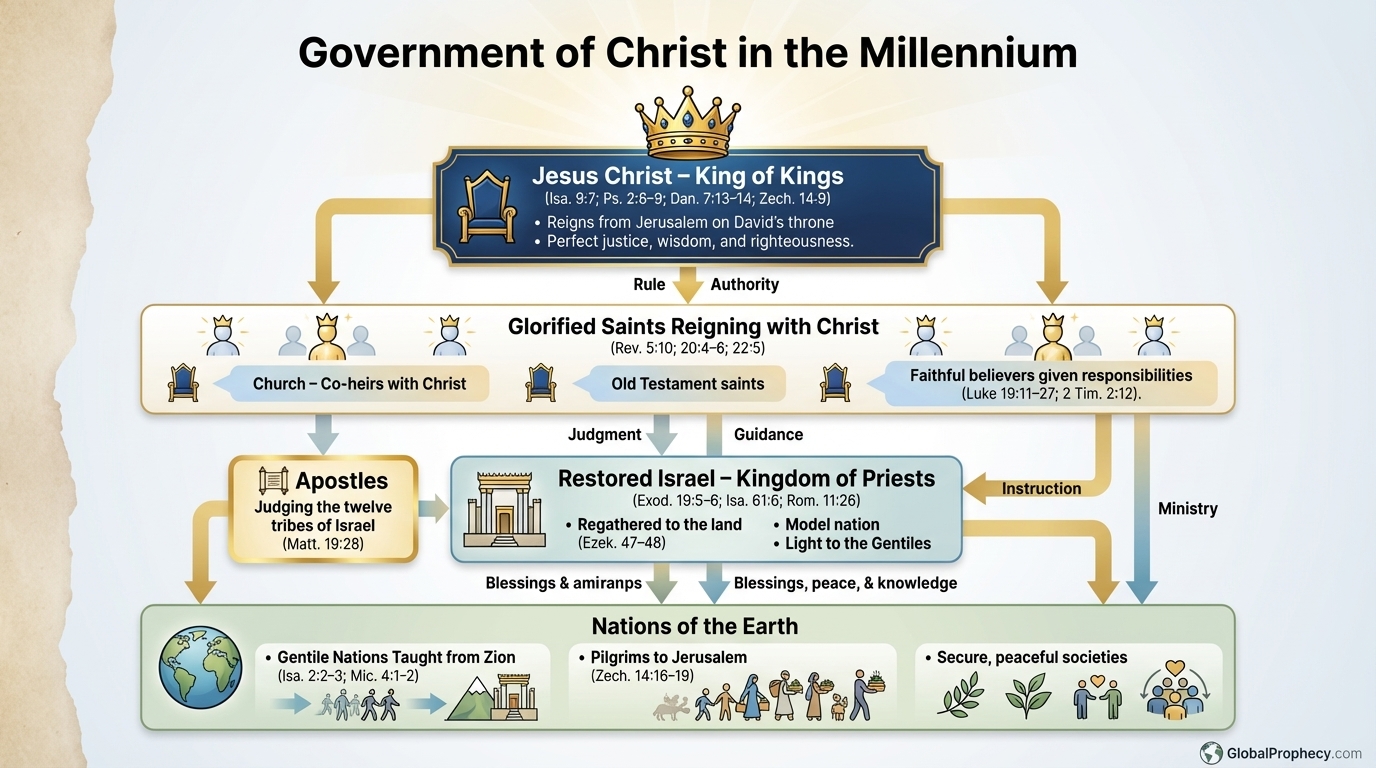
Christ delegates authority to His saints:
- The church reigns with Him (Rev. 5:10; 20:4–6; 22:5).
- The apostles judge the twelve tribes of Israel (Matt. 19:28).
- Faithful believers receive varying levels of responsibility based on their prior faithfulness (Luke 19:11–27; 2 Tim. 2:12).
This yields a hierarchical yet perfectly just political structure.
5.3 Israel’s Role Among the Nations
Israel is restored to her promised land (Gen. 15:18–21; Ezek. 47–48) and to her covenantal calling:
- A nation of priests and a light to the Gentiles (Exod. 19:5–6; Isa. 61:6).
- Jerusalem becomes both the religious and administrative capital of the world (Isa. 2:2–3; Jer. 3:17).
- Gentile nations come under her instruction and protection, while sharing the blessings of Messiah’s reign (Isa. 60–61; Zech. 8:22–23).
6. Daily Life in the Millennium: A Summary Portrait
Putting these threads together, life in the Millennium will look like this:
-
Spiritually
- People wake each day in a world where Christ is visibly reigning.
- Worship is central—locally and through pilgrimages to Jerusalem.
- Scripture, sound doctrine, and the presence of the Spirit shape education, culture, and law.
- Overt sin is rare and swiftly judged, while genuine piety is common and honored.
-
Physically
- The environment is lush, clean, and bountiful; food is plentiful and healthy.
- Disease is virtually unknown; disabilities are healed.
- People live long, productive lives, seeing multiple generations of descendants.
-
Socially and Politically
- No wars, no arms races, no military-industrial complex.
- Crime is minimized by both internal renewal and external enforcement.
- Work is satisfying and fairly rewarded; property rights are respected.
- Government is honest, wise, and incorruptible under Christ’s direct supervision.
Yet, despite these ideal conditions, the Millennium does not equal the eternal state. Sin and death still exist in limited forms; unregenerate hearts still arise in later generations. The Millennium is the last chapter of human history under Christ’s mediatorial rule—a final demonstration of God’s grace and man’s need for full, final redemption—before the new heaven and new earth.
7. Conclusion
The biblical picture of the Millennium is one of unprecedented spiritual depth and astounding physical blessing. It is a time when:
- God’s covenant promises to Israel and the nations are fulfilled,
- The last Adam succeeds where the first Adam failed,
- The earth tastes a preview of the coming eternal glory.
Life in the Millennium will be as real and tangible as life today, yet incomparably better—Christ is present, Satan is bound, creation is renewed, and righteousness dominates public and private life. Still, the Millennium is not the final goal; it stands as the gateway to the eternal state, when sin and death are abolished forever and God is “all in all” (1 Cor. 15:24–28; Rev. 21–22).
FAQ
Q: Will people still sin and die during the Millennium?
Yes. Only believers enter the Millennium, but those in mortal bodies still possess a sin nature. Sin will be restrained by Christ’s righteous rule and swiftly judged, but it will not be eradicated. Death remains possible, especially as a judgment on rebellion (Isa. 65:20), though lifespans will be greatly extended.
Q: How are the physical blessings of the Millennium different from the eternal state?
In the Millennium, the curse is partially lifted: creation is renewed, health is restored, and peace prevails, yet sin and death still exist in limited ways. In the eternal state (new heaven and new earth), there is no more death, sorrow, or sin at all (Rev. 21:4). The Millennium is the final, ideal stage of history; the eternal state is history’s complete transformation.
Q: What role will Israel play in the millennial kingdom?
Israel will be regathered, saved, and restored to the land promised to Abraham. As a nation, Israel will function as a kingdom of priests and a mediator of spiritual truth to the nations (Isa. 61:6; Zech. 8:22–23). Jerusalem will be the global center of worship and government, with Christ reigning on David’s throne.
Q: Why are there animal sacrifices in the Millennium if Jesus already died for sins?
Millennial sacrifices do not compete with or add to Christ’s once‑for‑all atonement (Heb. 10:10–14). They appear to serve as ceremonial purification for mortal worshipers approaching God’s holy presence in the temple and as tangible memorials of Christ’s sacrifice, much like the Lord’s Supper today reminds the church of the cross.
Q: What will daily life be like for an ordinary believer in the Millennium?
An ordinary believer in the Millennium will experience secure housing, fruitful labor, abundant food, excellent health, and freedom from war and violent crime. Life will center around worship, family, meaningful work, and learning God’s ways under the visible kingship of Christ. It will be a normal human life—yet lived in the best possible conditions this present earth will ever know.
Frequently Asked Questions
Will people still sin and die during the Millennium?
How are the physical blessings of the Millennium different from the eternal state?
What role will Israel play in the millennial kingdom?
Why are there animal sacrifices in the Millennium if Jesus already died for sins?
What will daily life be like for an ordinary believer in the Millennium?
L. A. C.
Theologian specializing in eschatology, committed to helping believers understand God's prophetic Word.
Related Articles
The Government of the Millennial Kingdom
Millennial kingdom government explained: how Christ’s theocratic rule, resurrected saints, and restored Israel form the structure of His 1,000-year reign.
Amillennialism Examined: Is the Church the Millennial Kingdom?
Amillennialism examined: is the church the millennial kingdom? Explore its claims, symbols, and a biblical critique of this end-times view.
The Millennial Temple and Worship
Millennial temple and worship in Ezekiel 40–48 explained: layout, priestly service, sacrifices, and how kingdom-age worship centers on Messiah’s reign.
Comparing the Millennial Views: Which View Is Biblical?
Millennial views compared: premillennialism, amillennialism, and postmillennialism. Examine key texts to see which view best fits Scripture.