
Literal vs Allegorical: The Right Way to Interpret Bible Prophecy
1. Introduction
How we interpret Bible prophecy—literally or allegorically—shapes our entire understanding of the end times. Is the “thousand years” of Revelation 20 an actual future kingdom, or merely a symbol for the present age? Are Israel’s land promises in Genesis 15 and 17 future geography, or spiritual metaphors for the church?
The core issue is not curiosity about the future, but hermeneutics—the method we use to interpret Scripture. This article explains the difference between literal and allegorical interpretation of Bible prophecy, defends the literal‑grammatical‑historical approach, and clarifies when prophetic texts should be taken figuratively without abandoning literal truth.
2. What Is the Literal Interpretation of Bible Prophecy?
2.1 Definition: Literal = Normal, Plain Sense
In hermeneutics, literal comes from sensus literalis—the plain, normal sense of the text. Literal interpretation of Bible prophecy means:
Interpreting prophetic words the same way we interpret any ordinary, serious communication—according to normal grammar, vocabulary, and historical context.
If someone says, “I saw three brown dogs in the alley,” we do not look for a hidden code; we understand three (not five) brown (not black) dogs (not cats) in the alley (not the park). Literal interpretation approaches prophecy with this same basic assumption.
2.2 The Grammatical–Historical–Contextual Method
Literal interpretation of prophecy is often called the grammatical‑historical method:
- Grammatical – Words and sentences are understood by normal rules of language: syntax, verb tenses, nouns, prepositions, etc.
- Historical – Texts are read in their original historical and cultural setting; we ask what they meant to the original author and audience.
- Contextual – Verses are interpreted within their immediate context, within the book, and within the whole Bible.
The goal is to discover the author’s intended meaning, not to impose our own spiritual or symbolic ideas onto the text.
2.3 Literal Interpretation Allows Figures, Symbols, and Types
Literal does not mean “wooden” or “hyper‑literal.” It means that:
- Figures of speech are recognized as such.
- Symbols are acknowledged, but always as symbols of something real and literal.
- Types (e.g., sacrifices pointing to Christ) are understood as real people, events, and institutions that foreshadow future literal fulfillments.
Examples:
- “I am the door” (John 10:9) is obviously figurative; Jesus is not a wooden door. Yet there is a literal truth: He is the only way of access to salvation.
- God is not literally a “rock” (Ps. 18:2), but He is actually as reliable and unshakable as a rock.
- In Revelation, the “seven lampstands” are symbolic, but they are interpreted literally by the text itself as seven churches (Rev. 1:20).
A literal method asks: What literal reality does this figure or symbol point to? It does not deny symbols; it insists they signify real things.
2.4 One Meaning, Many Applications
Literal interpretation also affirms:
- One meaning (sensus unum): Every prophetic text has one basic meaning—the one intended by God through the human author.
- Many implications and applications: A prophecy can have multiple legitimate applications and far‑reaching implications, but these all flow from that single original meaning.
This guards us against the idea that passages have endless “deeper” or contradictory meanings (sensus plenior used as multiple, competing senses).
3. What Is Allegorical Interpretation of Bible Prophecy?
3.1 Definition: Allegorical / Spiritual Interpretation
Allegorical interpretation (often called “spiritualizing”) treats the literal sense of prophecy as secondary or even expendable, seeking instead a hidden, deeper, spiritual meaning.
In this method:
- Israel may become a symbol of the church.
- Land promises may be reinterpreted as heaven or “spiritual blessings.”
- The millennium may be reduced to a symbol of the present church age.
- Concrete prophetic details are often absorbed into broad ideas like “good triumphing over evil.”
The text becomes a shell, and the “real meaning” is said to lie beneath or behind the words.
3.2 Why Allegorical Interpretation Is Problematic
From a biblical and logical standpoint, this method is deeply flawed:
-
No objective controls
There are no clear rules for discovering the “deeper” sense. One allegorical reading is as valid as another. Interpretation becomes the projection of the interpreter’s imagination. -
Self‑defeating
To argue, “Prophecies don’t mean what they seem; they have a deeper, spiritual meaning,” is itself a literal claim about how prophecy should be read. Allegorists expect others to take their theory literally while denying literal meaning to Scripture. -
Contradicts biblical patterns
Old Testament narratives—Adam, Noah, Abraham, Jonah—are treated literally by later biblical writers (e.g., Rom. 5:12–14; Matt. 12:39–41). Scripture itself does not allegorize historical or prophetic texts, except in rare cases explicitly labeled as allegories (e.g., Gal. 4:24). -
Inconsistent usage
Many who spiritualize prophecy interpret other doctrines (sin, justification, the resurrection of Christ) literally. Shifting to an allegorical method only for prophecy creates internal inconsistency and reveals theological bias, not sound exegesis.
4. Why Literal Interpretation Is the Right Way to Interpret Bible Prophecy
4.1 Prophecies of Christ’s First Coming Were Fulfilled Literally
The strongest biblical argument for literal interpretation of prophecy is how God has already fulfilled it. More than 100 messianic prophecies were fulfilled literally in Christ’s first advent:
- Seed of the woman – Genesis 3:15
- Offspring of Abraham – Genesis 12:3
- From the tribe of Judah – Genesis 49:10
- Son of David – Jeremiah 23:5–6
- Born of a virgin – Isaiah 7:14
- Born in Bethlehem – Micah 5:2
- Heralded by a forerunner – Isaiah 40:3
- Pierced – Zechariah 12:10
- “Cut off” (killed) around A.D. 33 – Daniel 9:24–26
- Raised from the dead – Psalm 16:10; Acts 2:30–32
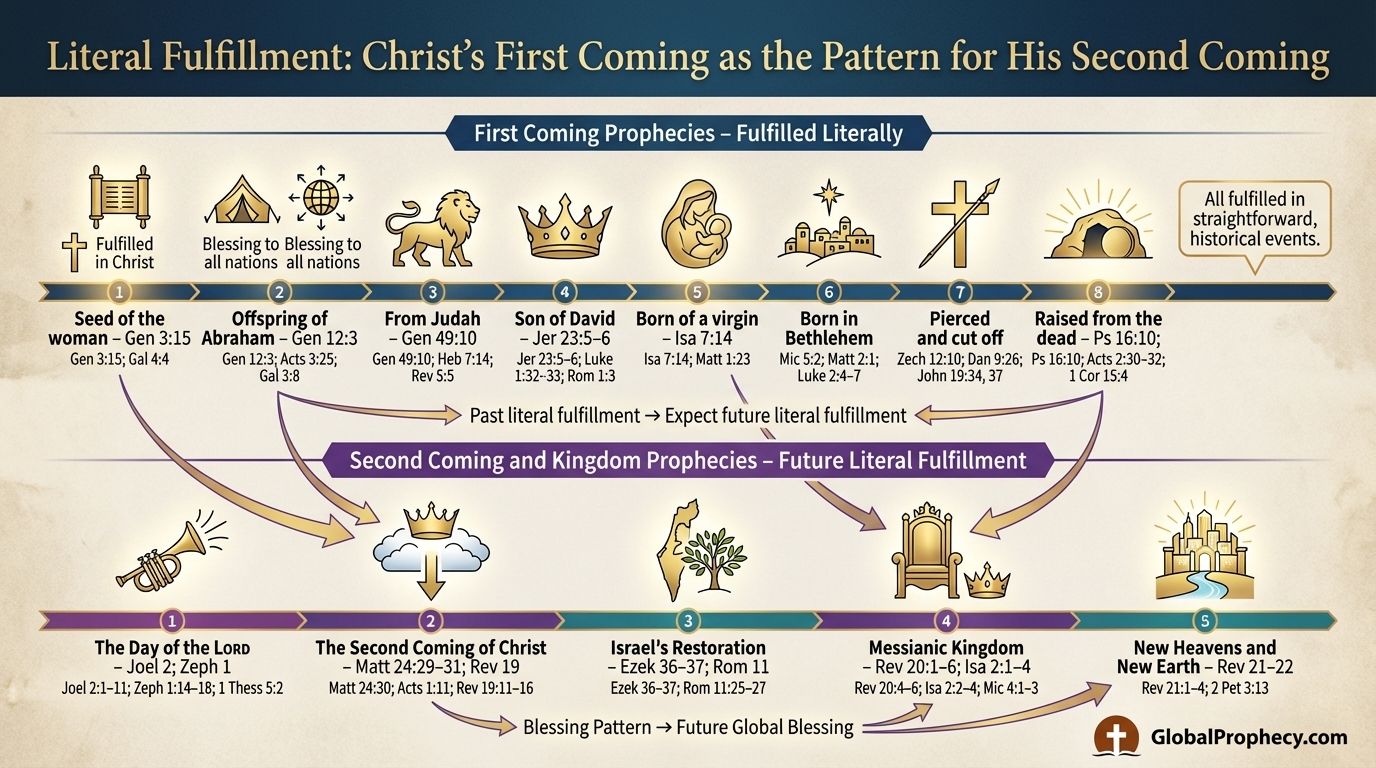
If God fulfilled first‑coming prophecies in a straightforward, literal way, consistency demands we expect the same for second‑coming prophecies—unless the text itself clearly signals symbolism.
If you want to understand how God will fulfill prophecy in the future, look at how He has fulfilled it in the past.
4.2 Jesus’ Own Use of Prophecy
In Luke 4:16–21, Jesus reads Isaiah 61:1–2:
“The Spirit of the Lord is upon me… to proclaim the year of the Lord’s favor.”
— Luke 4:18–19
He then says:
“Today this Scripture has been fulfilled in your hearing.”
— Luke 4:21
He applies the first part of Isaiah’s prophecy literally to His first coming—but He stops in the middle of the verse, before “the day of vengeance of our God.” That phrase awaits literal fulfillment at His second coming.
This shows:
- Jesus interpreted prophecy in a precise, literal way.
- The same verse can contain separated fulfillments (first and second advent) without changing the meaning.
- The “vengeance” is not spiritualized away; it is simply not yet fulfilled.
4.3 Revelation’s Symbols Still Point to Literal Realities
The book of Revelation is filled with symbols, but it repeatedly interprets its own symbols literally:
- Seven stars = seven angels – Rev. 1:20
- Seven lampstands = seven churches – Rev. 1:20
- Golden bowls of incense = prayers of the saints – Rev. 5:8
- Many waters = “peoples and multitudes and nations and languages” – Rev. 17:15
Symbolism coexists with literal interpretation; it does not replace it.
4.4 Reasons to Prefer Literal Interpretation of Prophecy
Summarizing key reasons:
- It is the normal way we understand all serious communication.
- The majority of the Bible makes sense when read literally.
- All figurative or allegorical uses depend on knowing the literal meaning first.
- It provides the only sane and safe check on human imagination.
- It best fits the doctrine of verbal inspiration: God breathed out actual words, not nebulous ideas.
- It aligns with how later Scripture interprets earlier Scripture.
5. When Prophecy Uses Figurative or Allegorical Language
A literal‑grammatical‑historical method fully recognizes that prophecy often uses vivid imagery, poetry, and symbols. The key question is not “literal versus figurative?” but:
Is this figure intended to replace the literal reality or to communicate it more powerfully?
5.1 Guidelines for Recognizing Figurative Language
Literal interpretation takes a text figuratively when:
-
It is obviously figurative
- Jesus: “I am the door” (John 10:9) or “I am the true vine” (John 15:1).
No reader thinks He is wood or plant; the figure communicates real spiritual dependence.
- Jesus: “I am the door” (John 10:9) or “I am the true vine” (John 15:1).
-
The text itself labels it as figurative
- Paul explicitly says he is using an allegory in Galatians 4:24.
- Jesus says, “The parable is this” and explains symbols (Luke 8:11–15).
-
A strictly literal reading would contradict clear, non‑figurative texts
- “Four corners of the earth” (Rev. 7:1) does not overturn the earth’s sphericity; it is an idiom for the whole world.
The classic maxim sums it up:
When the literal sense makes good sense, seek no other sense, lest it result in nonsense.
5.2 Parables and Allegories Still Convey Literal Truth
- Parables (e.g., the parable of the tenants – Luke 20:9–18) use fictional stories to convey literal truths about Israel’s rejection of Christ and His future judgment.
- The few biblical allegories (Gal. 4:21–31) are clearly identified and still rooted in real historical figures (Sarah and Hagar).
We must not assume that because a passage uses imagery or narrative form, its prophecies are “merely spiritual.” Without knowing what is literally true, we could not know what is figuratively expressed.
5.3 A Comparison: Literal vs. Allegorical Approaches
| Feature | Literal-Grammatical-Historical Method | Allegorical / Spiritualizing Method |
|---|---|---|
| Basic question | What did the author mean in context? | What deeper spiritual idea can I find here? |
| Treatment of language | Normal rules of grammar and history | Words often become symbols beyond grammar |
| Use of symbols | Symbols point to concrete realities | Symbols may dissolve concrete referents |
| Number of meanings | One basic meaning, many applications | Often multiple, layered “fuller” meanings |
| Control / objectivity | High – based on text, context, language | Low – heavily dependent on interpreter’s ideas |
| Fulfillment of prophecy | Expect literal fulfillment unless clearly figurative | Expect spiritual/“deeper” fulfillment |
6. Practical Principles for Interpreting Bible Prophecy Today
To interpret Bible prophecy faithfully and avoid both naïve literalism and subjective allegorizing, several practical principles should guide us.
6.1 Start with the Plain Sense
Read prophetic passages as you would any other serious prose. When Revelation 20:2–6 repeatedly speaks of “a thousand years,” the plain sense is a defined period of time. Nothing in the grammar compels us to spiritualize it into a vague symbol of “a long time.”
If the plain sense fits the context and does not contradict other Scripture, we should accept it.
6.2 Compare Prophecy with Prophecy
“No prophecy of Scripture comes from someone’s own interpretation.”
— 2 Peter 1:20
No single prophecy says everything about a topic. To interpret a passage rightly:
- Compare Old Testament and New Testament prophecies about the same event or person (e.g., the Antichrist, the Day of the LORD, the millennium).
- Let clearer prophecies illuminate more difficult ones.
- Never use one passage to cancel the literal sense of another (e.g., do not let a New Testament application to the church erase the original promises to Israel).
6.3 Recognize Prophetic Time Gaps
Old Testament prophets often saw the future like mountain peaks in a row—events far apart in time appear side by side in a single verse:
- Zechariah 9:9–10 combines Messiah’s first coming (riding a donkey) and His worldwide reign at His second coming.
- Isaiah 61:1–2 joins the “year of the Lord’s favor” (first advent) with “the day of vengeance of our God” (second advent), a gap Jesus Himself exposes in Luke 4:16–21 by stopping mid‑verse.
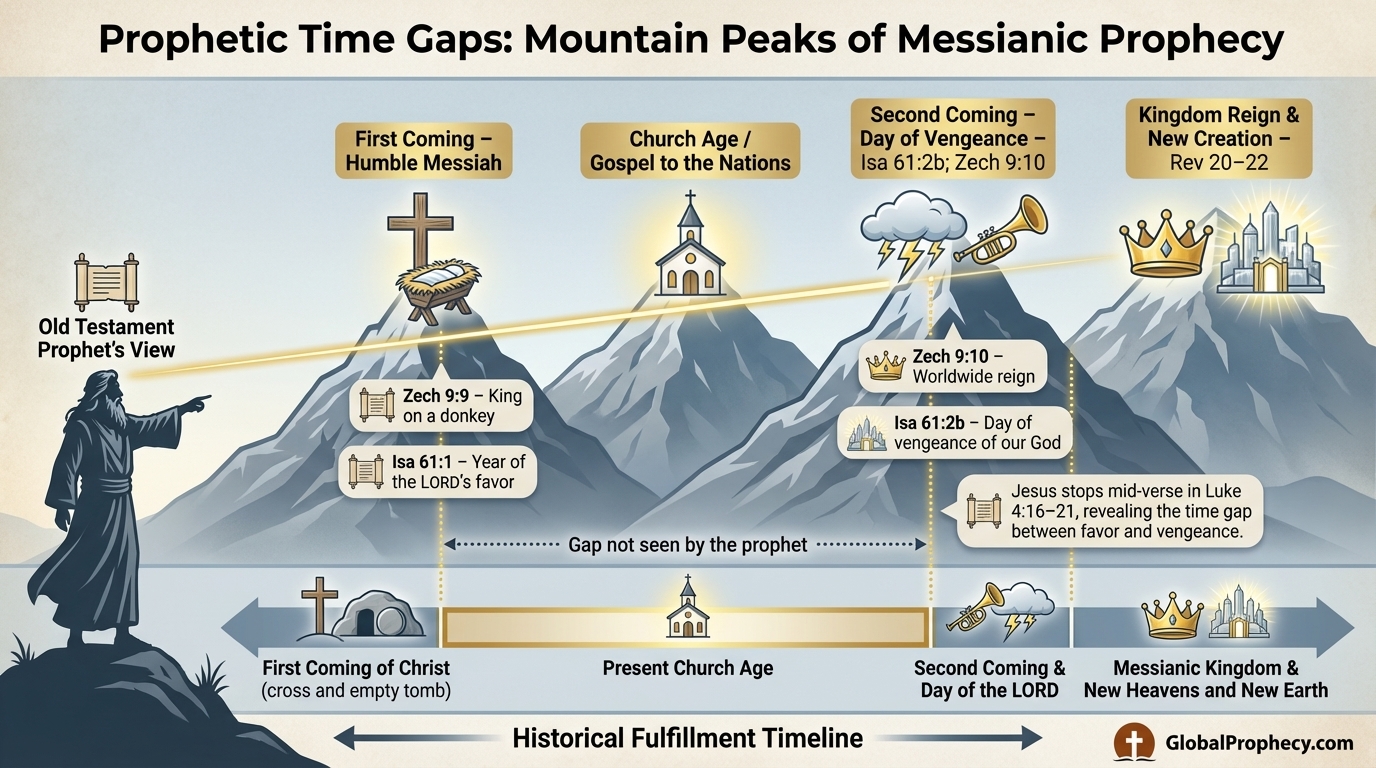
Recognizing such intervals protects us from forcing all prophetic fulfillment into a single era and from allegorizing unfulfilled details.
6.4 Distinguish Interpretation from Application
- Interpretation asks: What did the text mean to its original audience?
- Application asks: How does that same truth apply to us now?
For example, Jeremiah 31:31–34 promises a new covenant with the house of Israel and the house of Judah. The church today shares in the spiritual blessings of that covenant through Christ, but this application does not erase the original promise to national Israel or convert it into a mere symbol.
7. Conclusion
The debate between literal and allegorical interpretation of Bible prophecy is not a minor technicality. It is foundational. A literal‑grammatical‑historical approach:
- Takes seriously that God is a master communicator who intends to be understood.
- Honors the words God inspired, not just vague concepts.
- Follows the biblical pattern of how earlier prophecies have already been fulfilled.
- Provides an objective, text‑based framework that restrains human imagination.
Allegorical or spiritualizing methods, by contrast, loosen prophecy from its textual anchors and place meaning in the hands of the interpreter. Once Israel, the kingdom, the millennium, or judgment become mainly “symbols,” any theological system can be read into them.
Interpreting Bible prophecy literally does not deny figures of speech, symbols, or deep spiritual truths. It insists that every symbol points to a real referent, every image communicates an actual truth, and every prophecy will be fulfilled just as specifically and faithfully as those concerning Christ’s first coming.
For those who seek to understand “the prophetic word more fully confirmed” (2 Peter 1:19), the literal‑grammatical‑historical method is not just one option among many—it is the right way to interpret Bible prophecy.
FAQ
Q: What does “literal interpretation of Bible prophecy” actually mean?
Literal interpretation means reading prophetic texts in their normal, grammatical, historical sense, just as we would any serious writing. It allows for figures of speech and symbols but insists that these always point to real, concrete truths rather than free‑floating spiritual ideas.
Q: Does a literal approach to prophecy ignore symbolism and imagery?
No. A literal approach fully recognizes symbolism, poetic language, and imagery in prophecy, especially in books like Daniel and Revelation. The key is that every symbol is understood as representing something literally real, and the meaning is discovered from the text and its biblical context, not from the interpreter’s imagination.
Q: Why is allegorical interpretation of prophecy considered dangerous?
Allegorical interpretation is problematic because it often lacks objective controls and can turn the text into whatever the interpreter wishes it to mean. This undermines the authority of Scripture, weakens confidence in God’s specific promises (especially to Israel), and departs from the way the Bible itself interprets earlier prophecies.
Q: How can I know when a prophecy should be taken figuratively?
Ask three questions: (1) Is the language obviously figurative (e.g., “I am the door”)? (2) Does the text or a parallel passage explicitly label it as a parable, allegory, or symbol? (3) Would a strictly literal reading contradict clear nonfigurative teaching elsewhere in Scripture? If not, the prophecy should normally be taken in its plain sense.
Q: Why does it matter whether we interpret prophecy literally or allegorically?
Because our hermeneutic determines our conclusions. A literal method leads to expecting future, concrete fulfillments of God’s promises, including Christ’s return and His kingdom reign. An allegorical method often dissolves these expectations into general spiritual truths, reshaping doctrines of Israel, the church, judgment, and the kingdom—and, ultimately, our hope.
Frequently Asked Questions
What does “literal interpretation of Bible prophecy” actually mean?
Does a literal approach to prophecy ignore symbolism and imagery?
Why is allegorical interpretation of prophecy considered dangerous?
How can I know when a prophecy should be taken figuratively?
Why does it matter whether we interpret prophecy literally or allegorically?
L. A. C.
Theologian specializing in eschatology, committed to helping believers understand God's prophetic Word.
Related Articles
The Historical-Grammatical Method: How to Read Prophecy Correctly
Historical-grammatical method explained: learn how to interpret biblical prophecy by context, grammar, and authorial intent for accurate application.
How to Interpret Bible Prophecies
How to interpret Bible prophecies with sound hermeneutics. Learn practical principles, context rules, and safeguards for reading prophetic Scripture well.
The 70 Weeks of Daniel: Understanding Bible's Prophetic Timeline
The 70 weeks of Daniel explain God's prophetic timeline for Israel, Christ's first coming, and a future 70th week leading to the end-time climax.
Babylon the Great
Babylon the Great in Revelation 17–18 reveals end-time religious and commercial rebellion against God and its sudden, final destruction in judgment.