
Loss of Reward: Can Christians Lose Their Crowns?
1. Introduction: Can Christians Lose Their Crowns?
Biblical eschatology teaches that every believer will one day stand before the judgment seat of Christ (the bema). At that moment, our service for Christ will be evaluated, and eternal rewards and crowns will be granted—or lost.
This raises a crucial question: Can Christians lose their rewards and crowns without losing their salvation? Scripture answers yes: salvation is secure, but rewards are not. Understanding this distinction is essential for a biblical view of Christian accountability and eternal reward.
This article will focus exclusively on the loss of reward and loss of crowns, not on the timing of the Rapture or other prophetic debates.
2. Salvation vs. Rewards: Two Different Issues
The New Testament consistently distinguishes between:
- Salvation – a free gift of God’s grace, received by faith alone.
- Rewards and crowns – a wage or recompense for faithful service after salvation.
"For by grace you have been saved through faith. And this is not your own doing; it is the gift of God, not a result of works, so that no one may boast."
— Ephesians 2:8–9
Right after affirming free grace, Paul adds:
"For we are his workmanship, created in Christ Jesus for good works, which God prepared beforehand, that we should walk in them."
— Ephesians 2:10
Key distinctions:
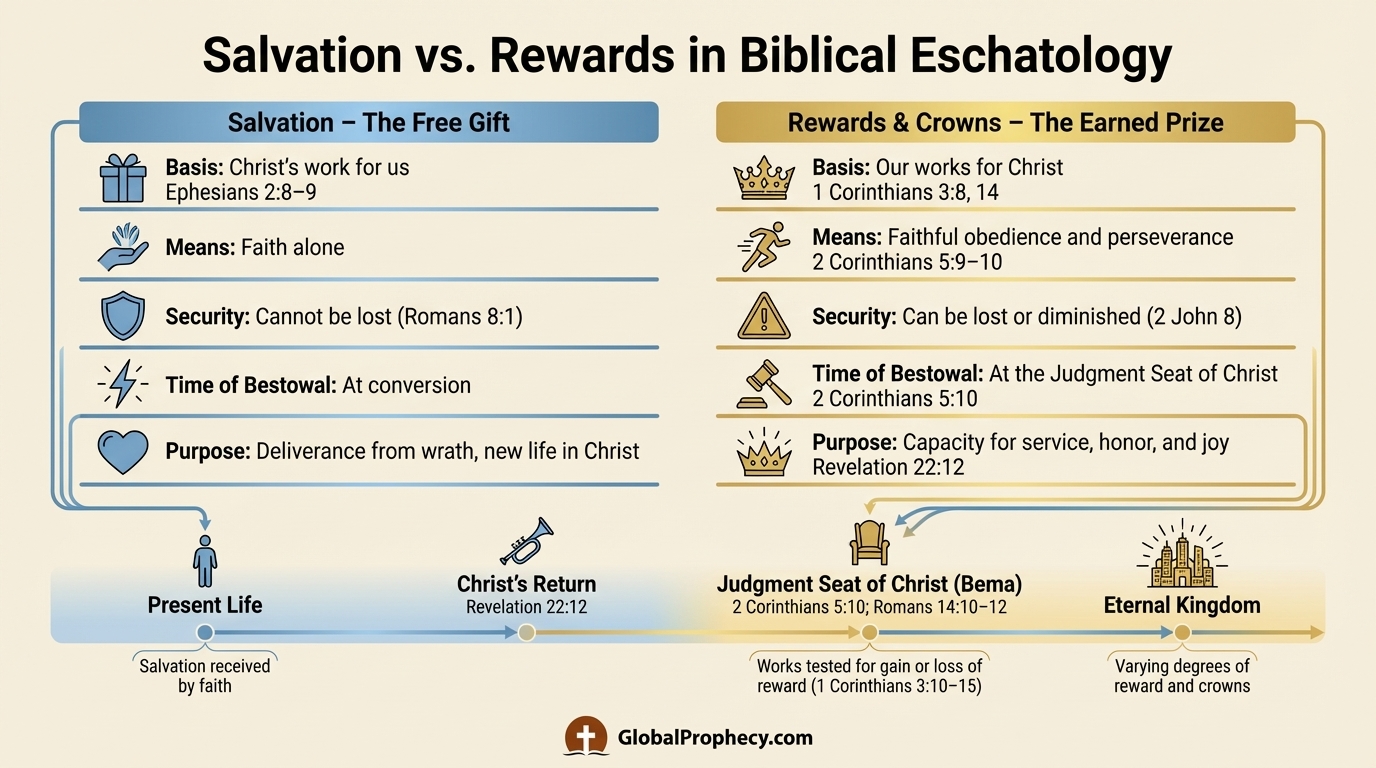
| Aspect | Salvation | Rewards / Crowns |
|---|---|---|
| Basis | Christ’s work for us | Our works for Christ |
| Means | Faith alone | Faithful obedience and perseverance |
| Security | Cannot be lost (Rom 8:1) | Can be lost or diminished (2 Jn 8) |
| Time of bestowal | At conversion | At the judgment seat of Christ |
| Purpose | Deliverance from wrath | Capacity for service, honor, and joy |
Jesus affirmed both realities: free salvation (John 3:16) and measured reward:
"Behold, I am coming soon, bringing my recompense with me, to repay each one for what he has done."
— Revelation 22:12
The judgment seat of Christ does not decide heaven or hell; it evaluates the believer’s life to determine gain or loss of reward.
3. The Judgment Seat of Christ and Loss of Reward
3.1 The nature of the judgment
Paul writes:
"For we must all appear before the judgment seat of Christ, so that each one may receive what is due for what he has done in the body, whether good or evil."
— 2 Corinthians 5:10
And again:
"We will all stand before the judgment seat of God… So then each of us will give an account of himself to God."
— Romans 14:10, 12
This judgment is:
- For believers only (those already in Christ).
- Individual – "each one," "each of us."
- Evaluative – dealing with works, motives, and faithfulness, not with the question of salvation.
3.2 1 Corinthians 3:10–15 – Saved, yet suffering loss
The clearest passage on loss of reward is 1 Corinthians 3:10–15. Paul compares the Christian life and ministry to building on a foundation:
"For no one can lay a foundation other than that which is laid, which is Jesus Christ."
— 1 Corinthians 3:11
Every believer builds on Christ with different kinds of “materials”:
"Now if anyone builds on the foundation with gold, silver, precious stones, wood, hay, straw—each one’s work will become manifest, for the Day will disclose it, because it will be revealed by fire, and the fire will test what sort of work each one has done."
— 1 Corinthians 3:12–13
Two categories emerge:
- Enduring works – “gold, silver, precious stones”: Spirit-empowered, Christ-centered, done with pure motives and in obedience.
- Perishable works – “wood, hay, straw”: self-centered, fleshly, done for human praise or with wrong motives, or simply spiritually worthless.
The outcome:
"If the work that anyone has built on the foundation survives, he will receive a reward. If anyone’s work is burned up, he will suffer loss, though he himself will be saved, but only as through fire."
— 1 Corinthians 3:14–15
Notice:
- The believer is “saved”, even if most of his work is burned.
- Yet he “suffers loss”—this is the loss of reward, not loss of salvation.
- The “fire” symbolizes Christ’s holy, penetrating evaluation of both deeds and motives (1 Cor 4:5).
Thus Scripture explicitly teaches that a Christian can stand before Christ with little to show for a redeemed life and experience significant loss of reward—while still being eternally secure in Christ.
4. Can Christians Lose Their Crowns?
Scripture does not only speak of general rewards; it also uses the imagery of crowns (stephanos, victor’s wreath) to describe specific aspects of eternal reward. It also warns that these crowns can be lost.
4.1 Major New Testament crowns
From a rewards perspective, at least five crowns are prominent:
- The Imperishable Crown – for disciplined, self-controlled service (1 Corinthians 9:25).
- The Crown of Rejoicing – often associated with soul-winning and ministry to others (1 Thessalonians 2:19).
- The Crown of Life – for enduring trials and persecution out of love for Christ (James 1:12; Revelation 2:10).
- The Crown of Righteousness – for those who love and long for Christ’s appearing (2 Timothy 4:8).
- The Crown of Glory – for faithful shepherds and spiritual leaders (1 Peter 5:4).
These crowns likely symbolize greater capacities for joy, service, and honor in Christ’s kingdom, rather than mere metal objects. Yet, whatever their exact nature, they are presented as earnable—and therefore losable—rewards.
4.2 Explicit warnings about losing crowns and reward
Several passages directly address loss of reward or loss of crown:
"Watch yourselves, so that you may not lose what we have worked for, but may win a full reward."
— 2 John 8
John warns that believers can fail to receive a “full reward” if they do not continue faithfully in truth and obedience. The issue is not losing eternal life; it is losing the degree of reward.
Jesus Himself says:
"I am coming soon. Hold fast what you have, so that no one may seize your crown."
— Revelation 3:11
This is addressed to believers in the church in Philadelphia. The command presupposes:
- They already have a crown in prospect.
- Persistent faithfulness is required to retain it.
- Neglect or compromise can result in that crown being lost (whether “seized” by another in terms of opportunity, or simply forfeited).
Paul uses similar language about disqualification:
"But I discipline my body and keep it under control, lest after preaching to others I myself should be disqualified."
— 1 Corinthians 9:27
In context, the disqualification is from the prize, not from salvation. The imagery is of an athlete barred from winning the crown due to failure to compete according to the rules (cf. 2 Tim 2:5).
Taken together, these passages clearly affirm:
- A genuine believer cannot be disqualified from eternal life.
- A genuine believer can be disqualified from certain rewards and crowns if he lives carelessly, compromises doctrinally, or serves Christ from impure motives.
5. What Does “Loss of Reward” Actually Mean?
If Christians can lose rewards and crowns, what does that loss look like in eternity? Scripture gives at least three dimensions.
5.1 Diminished capacity for service and honor
Many texts connect rewards with future responsibility in Christ’s kingdom.
In the parable of the minas (Luke 19:11–27), faithful servants are rewarded with authority over cities:
"‘Well done, good servant! Because you have been faithful in a very little, you shall have authority over ten cities.’"
— Luke 19:17
The unfaithful servant is not executed; he remains a servant, but his mina is taken away (Luke 19:24). This illustrates:
- Faithful service = increased responsibility and privilege.
- Unfaithfulness = loss of opportunity to reign to the same degree.
Similarly, Paul writes:
"If we endure, we will also reign with him…"
— 2 Timothy 2:12
Loss of reward, then, likely includes a reduced capacity to reign and serve in both the millennial and eternal kingdom.
5.2 Less “praise from God”
Surprisingly, Paul says:
"Then each one will receive his commendation from God."
— 1 Corinthians 4:5
Every true believer will receive some praise from Christ. Yet 1 Corinthians 3 and 2 John 8 make clear that this praise varies in degree. Some will hear much more of “Well done” than others. Loss of reward involves less divine commendation than might have been granted.
5.3 Regret, but not eternal misery
Standing before Christ with a largely wasted Christian life will not be emotionally neutral. John hints at the possibility of shame:
"And now, little children, abide in him, so that when he appears we may have confidence and not shrink from him in shame at his coming."
— 1 John 2:28
Believers who have lived carnally may “shrink back” in that moment, confronted with the full truth of what their lives could have been for Christ.
However:
- There will be no jealousy, bitterness, or sin in glory.
- God Himself will ultimately wipe away every tear (Revelation 21:4).
- Even the believer with few rewards will still be perfectly joyful, though his capacity to glorify God and serve in the kingdom may be less than it could have been.
Loss of reward is thus real and sobering, but it does not contradict the eternal joy and security of the saints.
6. Why Loss of Reward Matters Now
Understanding that Christians can lose rewards and crowns should shape our present discipleship in several ways.
6.1 It motivates holy, purposeful living
Paul explicitly connects the reality of the judgment seat to his ambition to please Christ:
"So whether we are at home or away, we make it our aim to please him. For we must all appear before the judgment seat of Christ…"
— 2 Corinthians 5:9–10
Awareness of future evaluation fuels:
- Seriousness about sin and holiness.
- Diligence in service.
- Care for motives (“for the Lord rather than for men,” Col 3:23–24).
6.2 It clarifies that not all believers will be rewarded equally
The New Testament repeatedly teaches differing degrees of reward (1 Cor 3:14–15; 2 Cor 9:6). This corrects the idea that heaven is a flat experience where everyone receives the same outcome regardless of faithfulness.
"The one who sows sparingly will also reap sparingly, and the one who sows bountifully will also reap bountifully."
— 2 Corinthians 9:6
6.3 It safeguards the doctrine of grace
Far from undermining grace, the doctrine of rewards preserves it:
- Salvation remains entirely of grace, not works.
- Rewards honor God’s justice and His desire to recognize Spirit-enabled obedience.
Believers are thus freed from trying to earn salvation, yet are strongly motivated to live in a way that will not forfeit eternal reward.
7. Conclusion
Biblical eschatology teaches that:
- Every believer will stand before the judgment seat of Christ.
- Salvation is secure and cannot be lost.
- Rewards and crowns are conditional and can be lost through unfaithfulness, wrong motives, doctrinal compromise, and wasted opportunity.
- Loss of reward involves diminished capacity for service, lesser degrees of honor and praise from God, and a real (though temporary) sense of regret at Christ’s evaluation.
Therefore, Scripture calls us to watch ourselves, to hold fast what we have, and to live so that we may receive a full reward and not lose our crowns.
"Watch yourselves, so that you may not lose what we have worked for, but may win a full reward."
— 2 John 8
"Hold fast what you have, so that no one may seize your crown."
— Revelation 3:11
The reality of possible loss of reward does not threaten the believer’s eternal security; it intensifies the call to faithful, Christ-centered living in light of the coming day when our works will be tested by fire.
FAQ
Q: Can a Christian lose salvation if they lose their crown or reward?
No. Salvation is a free gift received by faith in Christ and is eternally secure (Ephesians 2:8–9; Romans 8:1). Loss of crown or reward refers to the evaluation of a believer’s works at the judgment seat of Christ, not to their eternal destiny. A believer may be “saved, but only as through fire” (1 Corinthians 3:15), indicating security of salvation but loss of reward.
Q: What does the Bible mean by “losing your crown”?
Passages like Revelation 3:11 warn believers to “hold fast” so that no one may seize their crown. This language means that a Christian can forfeit specific rewards or crowns that were available to them through faithful service. It does not mean losing eternal life, but losing the degree of honor, responsibility, and joy in service that could have been theirs.
Q: How can a believer avoid losing rewards at the judgment seat of Christ?
Believers avoid loss of reward by abiding in Christ (1 John 2:28), walking in the Spirit, serving with pure motives, and persevering in faith and obedience. Works done in dependence on the Holy Spirit and for the glory of Christ (1 Corinthians 10:31; Colossians 3:23–24) are the “gold, silver, and precious stones” that will endure Christ’s evaluation and be richly rewarded.
Q: Are all Christians guaranteed at least some reward?
Scripture suggests that every true believer will receive some commendation from God (1 Corinthians 4:5), since the Spirit always produces some fruit in a genuine Christian. However, the extent of reward varies widely. Some will “receive a reward,” while others will “suffer loss” (1 Corinthians 3:14–15), depending on the quality and faithfulness of their service.
Q: Why does God give rewards if salvation is already by grace?
Rewards do not add to salvation; they express God’s justice and generosity in recognizing Spirit-enabled obedience. Salvation displays the riches of God’s grace; rewards display the rightness of His government. God saves us freely, then graciously chooses to crown the very works His grace has produced in us (Philippians 2:12–13), without compromising the freeness of the gospel.
Frequently Asked Questions
Can a Christian lose salvation if they lose their crown or reward?
What does the Bible mean by “losing your crown”?
How can a believer avoid losing rewards at the judgment seat of Christ?
Are all Christians guaranteed at least some reward?
Why does God give rewards if salvation is already by grace?
L. A. C.
Theologian specializing in eschatology, committed to helping believers understand God's prophetic Word.
Related Articles
Building for Eternity: Gold, Silver, and Precious Stones
Building for eternity starts now. Explore gold, silver, and precious stones vs wood, hay, stubble in 1 Corinthians 3 and the judgment seat of Christ.
The Crowns of Heaven: Eternal Rewards for Believers
Discover the five eternal crowns believers can receive as rewards in heaven. Learn what Scripture teaches about earning the imperishable, rejoicing, righteousness, glory, and life crowns.
What is the Judgment Seat of Christ?
Judgment Seat of Christ explained from 2 Corinthians 5:10 and Romans 14:10—when believers are evaluated for rewards, not condemned for sin.