
What are the Marriage of the Lamb?
1. Introduction
The marriage of the Lamb in Revelation 19:7–9 is one of the central images in biblical eschatology for describing Christ’s final, joyful union with His redeemed church. Jesus Christ is pictured as the Lamb—the crucified, risen Redeemer—and the church is His bride, now presented to Him in purity and glory. Understanding this marriage imagery is crucial for grasping the destiny of the church and the relational heart of God’s end-time plan.
This article explains the marriage of the Lamb from Revelation 19, its biblical meaning, timing, and theological significance, focusing exclusively on Christ’s union with His bride, the church.
2. The Biblical Text: Revelation 19:7–9
The key passage reads:
"Let us rejoice and exult and give him the glory, for the marriage of the Lamb has come, and his Bride has made herself ready; it was granted her to clothe herself with fine linen, bright and pure—for the fine linen is the righteous deeds of the saints. And the angel said to me, 'Write this: Blessed are those who are invited to the marriage supper of the Lamb.' And he said to me, 'These are the true words of God.'" — Revelation 19:7–9
Several essential elements appear here:
- The Lamb – Jesus Christ, the sacrificial Redeemer (cf. Rev 5:6–9).
- The Bride – the church, collectively described as Christ’s wife (cf. 2 Cor 11:2; Eph 5:25–27).
- The marriage itself – “the marriage of the Lamb has come.”
- The bride’s readiness – she is clothed in “fine linen, bright and pure,” interpreted as “the righteous deeds of the saints.”
- The marriage supper – a blessed celebration connected with, but distinct from, the marriage.
Revelation 19 places this scene in heaven, just before Christ’s visible return to earth in Revelation 19:11–16.
3. The Bride of Christ: The Church as Christ’s Wife
3.1 New Testament Identification of the Bride
The New Testament repeatedly describes the relationship between Christ and the church in marital terms:
- 2 Corinthians 11:2 – Paul says, “I betrothed you to one husband, to present you as a pure virgin to Christ.”
- Ephesians 5:25–27 – Christ “loved the church and gave himself up for her… that he might present the church to himself in splendor, without spot or wrinkle… that she might be holy and without blemish.”
- Romans 7:4 – Believers “belong to another, to him who has been raised from the dead.”
Together with Revelation 19:7–9 and Revelation 21:2, 9, these texts show that the bride of the Lamb is the church, the redeemed people called out from Pentecost to the rapture, united to Christ as His spiritual body (Eph 1:22–23).
3.2 Betrothal and Present Status
In the present age, the church is in a betrothal relationship with Christ:
- The marriage covenant is established through Christ’s atoning death and the new covenant in His blood (Luke 22:20).
- Believers are already legally “His”, yet the full, public union is still future.
- The church is called to live as a “pure virgin” (2 Cor 11:2), keeping herself spiritually faithful, “unstained from the world.”
Thus, believers live between betrothal and consummation, awaiting the eschatological marriage of the Lamb.
4. Jewish Wedding Customs and the Marriage of the Lamb
Revelation’s imagery is rooted in ancient Jewish marriage customs, which generally had three main stages:
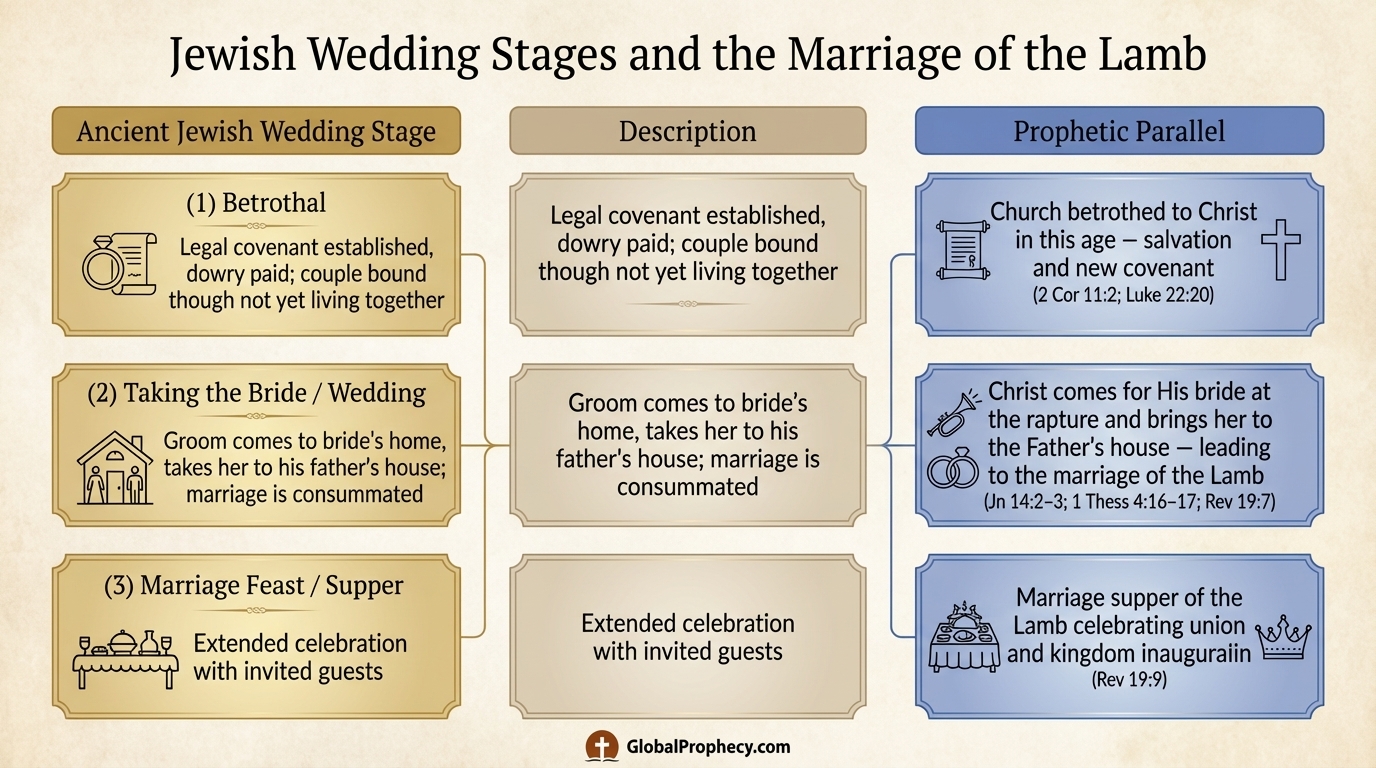
| Jewish Wedding Stage | Description | Parallel with Christ and the Church |
|---|---|---|
| Betrothal | Legal covenant, dowry paid; couple considered bound though not yet living together | The church is betrothed to Christ as people are saved in the present age (2 Cor 11:2). |
| Taking the Bride / Wedding | Groom comes to bride’s home, takes her to his father’s house; marriage is consummated | Christ comes for His church and takes her to the Father’s house (rapture), leading to the marriage of the Lamb (Jn 14:2–3; 1 Thess 4:16–17). |
| Marriage Feast / Supper | Extended celebration with invited guests | The marriage supper of the Lamb, celebrating Christ’s union with His bride (Rev 19:9). |
This background clarifies that the “marriage of the Lamb” (v. 7) refers especially to the formal consummation of the union between Christ and the church in heaven, while the “marriage supper” (v. 9) is the celebratory feast that follows.
5. Timing and Location of the Marriage of the Lamb
5.1 When Does the Marriage Occur?
Within Revelation’s sequence, several indicators point to the timing:
- After the destruction of the harlot Babylon – The celebration of Revelation 19:1–6 follows the judgment of the corrupt religious system symbolized as a harlot (Rev 17–18). Only then is the pure bride introduced, ready for marriage (Rev 19:7).
- Before the visible Second Coming – The marriage is announced in Revelation 19:7–9. Immediately afterward, Christ appears riding from heaven to earth (Rev 19:11–16).
From a premillennial, pretribulational reading:
- The rapture of the church (Christ taking His bride to the Father’s house, Jn 14:1–3; 1 Thess 4:13–18) occurs before the Tribulation.
- In heaven, the church appears before Christ’s judgment seat (the “bema,” 2 Cor 5:10; Rom 14:10–12), where believers’ works are evaluated.
- By Revelation 19:7–8 the bride is already “made herself ready” and is clothed in “fine linen… the righteous deeds of the saints,” implying that this judgment and reward are complete.
- Therefore, the marriage of the Lamb occurs in heaven, near the end of the Tribulation, after the church has been purified and rewarded, and just before Christ returns to earth with His saints.
5.2 Where Does the Marriage Take Place?
The context of Revelation 19:1–10 places this event in heaven:
- The scene opens with “a great multitude in heaven” (Rev 19:1).
- The bride is seen already in heaven, prepared and clothed in fine linen.
- The armies that accompany Christ from heaven are “clothed in fine linen, white and pure” (Rev 19:14), matching the bride’s description.
This fits the Jewish pattern in which the wedding proper occurs at the house of the groom’s father, not at the bride’s original home. Christ, the heavenly Bridegroom, brings His bride to the Father’s house for the marriage.
6. The Meaning and Theological Significance of the Marriage of the Lamb
6.1 Fulfillment of the Redemptive Relationship
The marriage of the Lamb represents the final, public consummation of Christ’s redemptive purpose for the church:
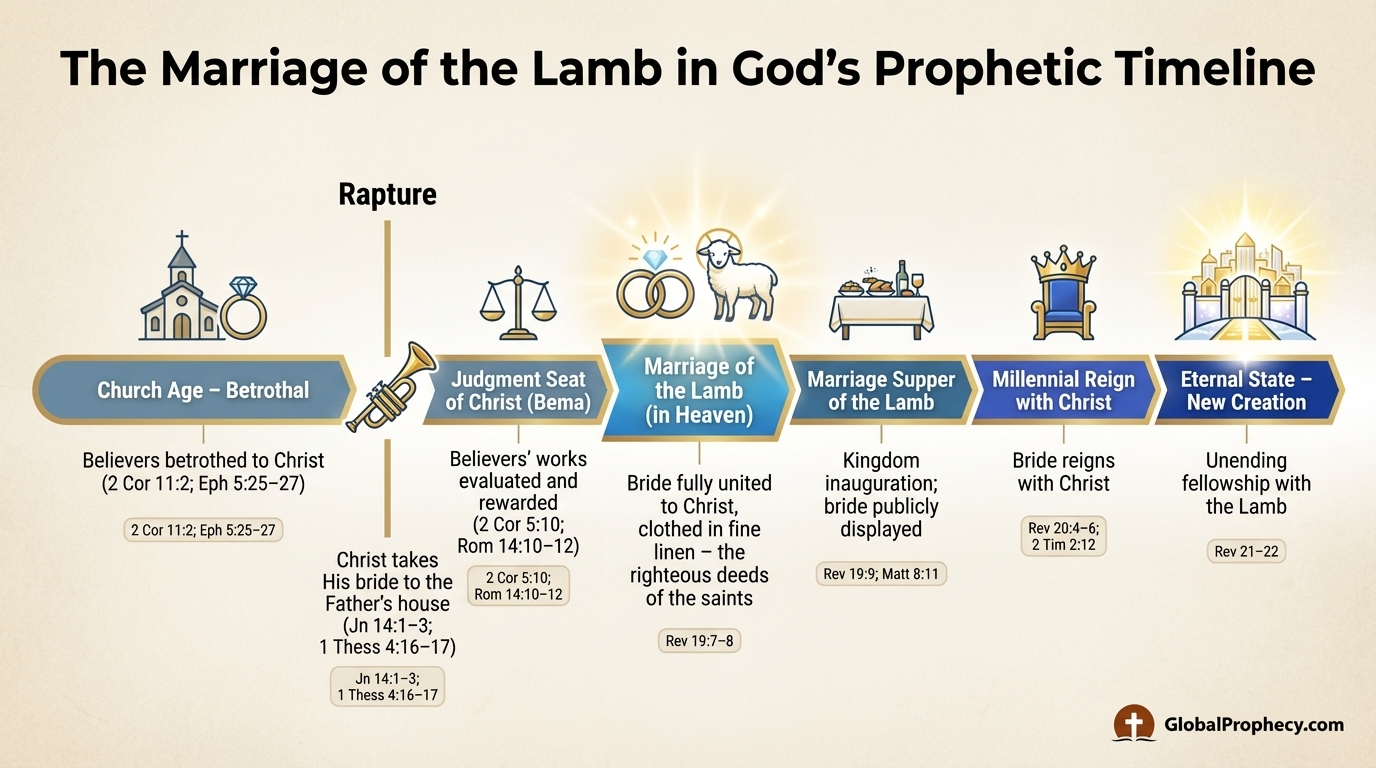
- What began at the cross and in personal conversion now becomes a corporate, glorified union.
- The church is no longer merely “engaged” to Christ, but fully and eternally united to Him in glory.
This fulfills Christ’s intent in Ephesians 5:25–27:
“…that he might present the church to himself in splendor, without spot or wrinkle or any such thing…”
The marriage is that very presentation.
6.2 The Bride’s Preparation and Righteous Deeds
Revelation emphasizes that the bride has “made herself ready” (Rev 19:7), yet also that “it was granted her” to be clothed in fine linen (v. 8). This highlights a dual truth:
- Grace: Her beautiful garment is a gift—“it was granted her.” All true righteousness flows from God’s grace (Phil 2:13).
- Faithful obedience: The fine linen is defined as “the righteous deeds of the saints.” The bride’s eschatological adornment is linked to the Spirit-empowered works of believers in this present age.
Thus, the marriage of the Lamb underscores the eternal significance of faithful Christian living. Believers’ works do not earn salvation, but they do contribute to the church’s corporate adornment for her Bridegroom and are recognized and rewarded at the judgment seat of Christ.
6.3 Contrast with the Harlot and the Purity of the Bride
Revelation juxtaposes two women:
- The great prostitute (symbolic of false, idolatrous religion and spiritual infidelity, Rev 17–18).
- The bride, the wife of the Lamb (symbolizing the true, faithful church, Rev 19:7–8; 21:9–10).
The marriage of the Lamb therefore vindicates the true church:
- She has refused alliance with the world’s spiritual corruption.
- She appears in “fine linen, bright and pure”, in stark contrast to Babylon’s gaudy, luxurious, yet doomed finery.
The marriage proclaims that only those united to Christ in truth and holiness will share His eternal reign.
6.4 Inauguration of Shared Reign with Christ
Immediately following the marriage scene, Christ returns in glory and the saints accompany Him (Rev 19:14). Elsewhere believers are promised:
- To reign with Christ (2 Tim 2:12; Rev 20:4–6).
- To sit with Him on His throne (Rev 3:21).
The marriage of the Lamb thus marks the transition from betrothed waiting to royal participation. The bride now enters into:
- Permanent fellowship with Christ (“so we will always be with the Lord,” 1 Thess 4:17).
- Shared royal authority in His millennial kingdom and beyond.
The marriage is not merely a ceremony; it is the formal commencement of the church’s eternal role in the kingdom of God.
6.5 The Marriage Supper and the Display of the Bride
While this article focuses on the marriage itself, Revelation 19:9 also mentions the “marriage supper of the Lamb”. From a dispensational perspective:
- The marriage (v. 7) is the consummating union of Christ and the church in heaven.
- The marriage supper (v. 9) is the celebratory feast that follows, associated with the inauguration of Christ’s kingdom, where the bride is publicly displayed and the Bridegroom is honored before His friends—redeemed Israel and the nations.
In both, the central figure is Christ the Lamb, and the central display is the beauty He has imparted to His bride.
7. Conclusion
The marriage of the Lamb in Revelation 19:7–9 is the climactic moment in God’s program for the church. Rooted in ancient Jewish wedding customs, it portrays:
- The transition from betrothal to consummated union between Christ and His church.
- The heavenly ceremony that follows the church’s rapture and judgment seat evaluation.
- The public vindication and glorification of the bride, now clothed in fine linen that represents the righteous deeds of the saints.
- The launch point for the church’s eternal fellowship and co-reign with Christ.
For believers, this doctrine is not speculative detail. It calls the church to faithfulness, purity, and expectancy, living now as a betrothed bride preparing for the day when the voice of heaven will declare, “the marriage of the Lamb has come, and his Bride has made herself ready” (Rev 19:7).
FAQ
Q: What is the “marriage of the Lamb” in Revelation 19?
The marriage of the Lamb is the eschatological union of Jesus Christ (the Lamb) with His bride, the church, described in Revelation 19:7–8. It portrays the moment when the betrothed church is formally and publicly united to Christ in glory, after being purified and rewarded, and just before Christ returns to earth in power.
Q: Who is the bride in the marriage of the Lamb?
The bride is the church, the collective body of all true believers in Christ during the church age. Passages like 2 Corinthians 11:2 and Ephesians 5:25–27 present the church as a virgin bride betrothed to Christ, awaiting presentation to Him “in splendor… holy and without blemish,” which is fulfilled in the marriage of the Lamb.
Q: When does the marriage of the Lamb take place?
From a premillennial, pretribulational perspective, the marriage of the Lamb occurs in heaven near the end of the Tribulation, after the church has been raptured and has appeared before the judgment seat of Christ. It is announced in Revelation 19:7–8 immediately before Christ’s visible return in Revelation 19:11–16.
Q: How is the marriage of the Lamb different from the marriage supper of the Lamb?
The marriage of the Lamb refers to the actual union of Christ and the church in heaven (Rev 19:7–8). The marriage supper of the Lamb (Rev 19:9) is the festive celebration that follows this union, associated with the inauguration of Christ’s kingdom, where the Bridegroom is honored and the bride is displayed in glory before invited guests.
Q: What is the significance of the bride’s “fine linen” in Revelation 19:8?
The bride’s clothing of “fine linen, bright and pure” is explicitly defined as “the righteous deeds of the saints” (Rev 19:8). This symbolism shows that while salvation is by grace, the Spirit-enabled works of believers in this age will be recognized and will contribute to the church’s corporate adornment when she is presented to Christ at the marriage of the Lamb.
Frequently Asked Questions
What is the “marriage of the Lamb” in Revelation 19?
Who is the bride in the marriage of the Lamb?
When does the marriage of the Lamb take place?
How is the marriage of the Lamb different from the marriage supper of the Lamb?
What is the significance of the bride’s “fine linen” in Revelation 19:8?
L. A. C.
Theologian specializing in eschatology, committed to helping believers understand God's prophetic Word.
Related Articles
Amillennialism Examined: Is the Church the Millennial Kingdom?
Amillennialism examined: is the church the millennial kingdom? Explore its claims, symbols, and a biblical critique of this end-times view.
The Betrothal of the Church, the Marriage of the Lamb, and the Banquet
Marriage of the Lamb explains Christ’s betrothal with the church, the heavenly marriage ceremony and the end-time wedding banquet in glory.
Jewish Wedding Customs and Biblical Prophecy
Jewish wedding customs and biblical prophecy reveal how the betrothal, bridal chamber, and wedding feast picture the rapture and marriage of the Lamb.
Postmillennialism Examined: Will the Church Christianize the World?
Postmillennialism examined and tested by Scripture: can the church truly Christianize the world before Christ returns and the millennium begins?