
Mid-Tribulationalism Examined
1. Introduction
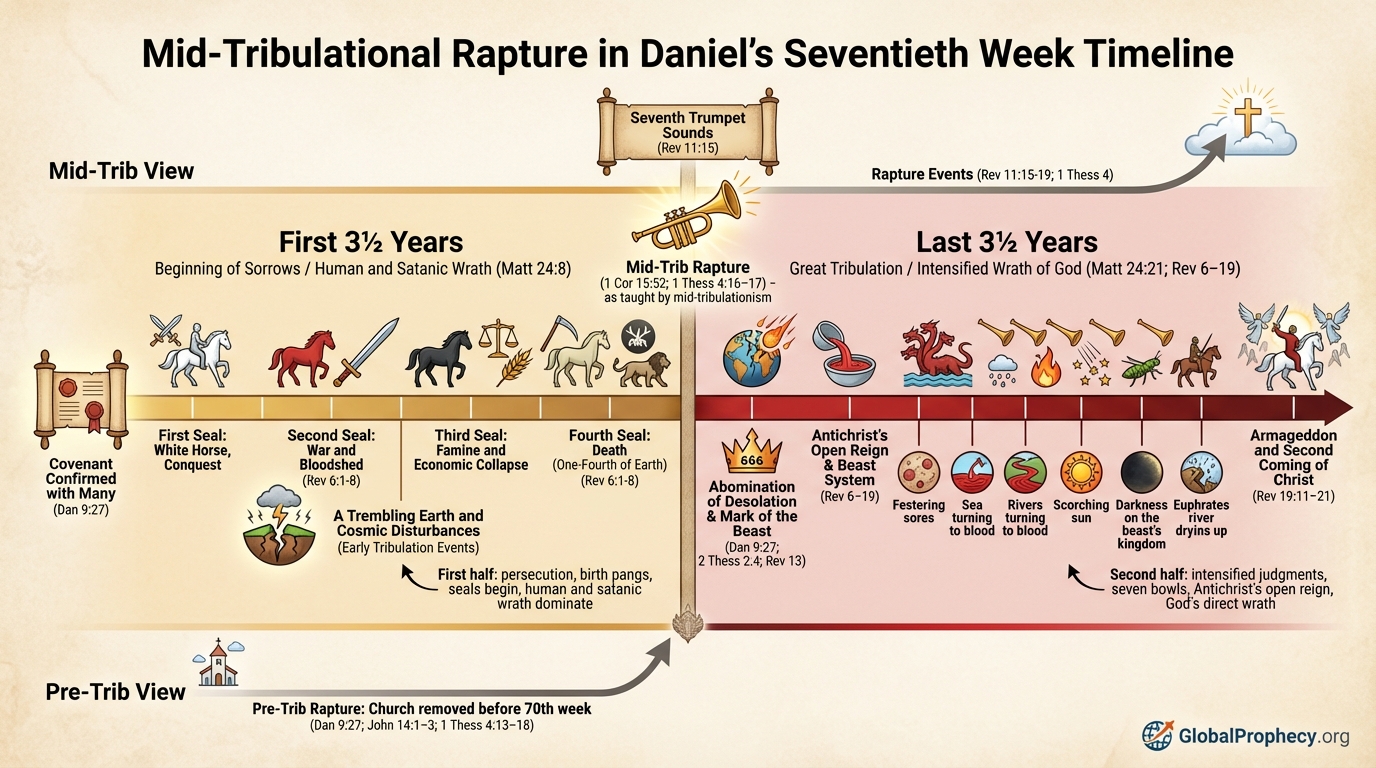
Among evangelical views on the timing of the rapture, mid‑tribulationalism (or midtribulationism) occupies a mediating position between pre‑ and post‑tribulational schemes. It proposes that the church will endure the first half of Daniel’s seventieth week, but will be removed before the “great tribulation” of the last three and a half years.
This article offers a focused, biblical examination of mid‑tribulationalism. We will (1) define the view and present its main arguments fairly, (2) analyze especially its “last trumpet” argument, and (3) show why Scripture indicates that the church is exempt from the entire tribulation, not just the latter half.
2. What Is Mid‑Tribulationalism?
Mid‑tribulationalism teaches that the rapture of the church will occur at the midpoint of the seven‑year tribulation (Daniel’s seventieth week, Dan 9:27). Its central claims are:
-
Only the last half is truly “the tribulation.”
- The first three and a half years are the “beginning of sorrows” (Matt 24:8), characterized by man’s and Satan’s wrath.
- The second half is the outpouring of God’s wrath; the church is removed before this.
-
The “last trumpet” of 1 Corinthians 15:52 equals the seventh trumpet of Revelation 11:15.
- Since the seventh trumpet sounds in the middle of the week, the rapture must occur there.
-
The two witnesses of Revelation 11 are connected with the rapture.
- Some midtribulationists view their ascension as symbolizing the church’s rapture at mid‑week.
-
The church is promised deliverance from wrath, not from tribulation.
- 1 Thessalonians 5:9 and Revelation 3:10 are read as promising exemption only from the last half, when God’s wrath falls, not from the entire seven‑year period.
Mid‑tribulationalism thus attempts to honor texts about persecution of saints, while also preserving texts that promise believers deliverance from divine wrath.
3. The “Last Trumpet” Argument Examined
The central textual argument for mid‑tribulationalism is the identification of the “last trumpet” in 1 Corinthians 15:52 with the seventh trumpet of Revelation 11:15:
“For the trumpet will sound, and the dead will be raised imperishable, and we shall be changed.”
— 1 Corinthians 15:52
“Then the seventh angel blew his trumpet, and there were loud voices in heaven, saying, ‘The kingdom of the world has become the kingdom of our Lord and of his Christ…’”
— Revelation 11:15
On this reading, since the seventh trumpet is sounded at or near the mid‑point of the tribulation, and it is called the “last” in Revelation’s series, it must be the same trumpet Paul refers to in connection with the rapture.
3.1. Similarity Does Not Equal Identity
Several serious problems undermine this identification:
-
Different settings and functions
- In 1 Corinthians 15 (and 1 Thessalonians 4:16), the trumpet is associated with the resurrection and transformation of church‑age believers—blessing and deliverance.
- In Revelation 11:15, the seventh trumpet is one of a series of judgment trumpets, linked to the outworking of God’s wrath on a rebellious world.
-
Different agents
- The rapture trumpet is associated with God/Christ (“the trumpet of God,” 1 Thess 4:16).
- The seventh trumpet of Revelation is explicitly blown by an angel (“the seventh angel blew his trumpet,” Rev 11:15).
-
Sequence problem with resurrection
- In 1 Corinthians 15:52, the trumpet sounds and then the dead are raised and the living changed.
- In Revelation 11, the two witnesses are raised before the seventh trumpet sounds (Rev 11:11–15). The sequence is reversed.
-
“Last” in what sense?
“Last” (Greek eschatē) in 1 Corinthians 15:52 does not require a last trumpet in all of redemptive history, but the last trumpet of a particular event—the rapture. As Gordon Fee notes, the word can mean “last in eschatological significance,” not necessarily last in an absolute sequence. Within the rapture event, this is the final call that summons the church to glory.
Moreover, if mere numerical order were decisive, one could more easily argue that the trumpet of Matthew 24:31, which sounds after the seventh trumpet, is the “last” in sequence:
“And he will send out his angels with a loud trumpet call, and they will gather his elect…”
— Matthew 24:31
To insist that Paul’s “last trumpet” must equal the seventh trumpet of Revelation is thus an unwarranted assumption, not demanded by exegesis.
3.2. Different Theological Roles
In Jewish apocalyptic literature, trumpets can announce:
- Assembly of God’s people
- Moments of deliverance
- Moments of judgment
- Changes in covenantal administration
Paul’s “last trumpet” clearly signals the finalization of the church’s earthly pilgrimage—a trumpet of resurrection and blessing. The seventh trumpet, by contrast, initiates further judgments (the bowl judgments) within the tribulation framework.
For these reasons, the “last trumpet” argument does not securely support a mid‑tribulational rapture.
4. Is Divine Wrath Limited to the Second Half?
Mid‑tribulationalism depends heavily on the claim that God’s wrath begins only at mid‑week, with the seventh trumpet, and that the first half of the tribulation is merely human or satanic wrath.
However, Revelation itself—and its Old Testament background—point strongly in the other direction.
4.1. The Seals as Divine Judgments
In Revelation 5, the Lamb (Christ) takes the sealed scroll from the right hand of Him who sits on the throne. As He breaks each seal, judgments fall on the earth (Rev 6). These are not autonomous acts of men or demons; they are triggered by the Lamb who alone is worthy to open the seals (Rev 5:9–10).
The four horsemen—conquest, war, famine, and death (Rev 6:1–8)—echo the fourfold judgment of God in the Old Testament:
“For thus says the Lord GOD: How much more when I send upon Jerusalem my four disastrous acts of judgment, sword, famine, wild beasts, and pestilence…”
— Ezekiel 14:21
Here, the same cluster of calamities is explicitly called “acts of judgment” sent by the Lord. Revelation draws on this imagery to depict the Lamb’s judicial action, not merely human chaos.
4.2. The Testimony of Revelation 6:16–17
At the opening of the sixth seal, terrified unbelievers cry out:
“…calling to the mountains and rocks, ‘Fall on us and hide us from the face of him who is seated on the throne, and from the wrath of the Lamb, for the great day of their wrath has come, and who can stand?’”
— Revelation 6:16–17
Several observations are decisive:
- This occurs well before the seventh trumpet of Revelation 11.
- The people themselves interpret these catastrophic events as “the wrath of the Lamb” and “the great day of their wrath.”
- The Greek verb “has come” (elthen) is an aorist indicative, best taken as indicating that the wrath has already arrived and is now being experienced, not merely that it will arrive in the future.
From the perspective of earth’s inhabitants, by the sixth seal the day of divine wrath is already underway. It is artificial to insist that God’s wrath does not begin until mid‑tribulation.
4.3. The Day of the Lord and the Whole Week
Paul links the Day of the Lord with sudden “destruction” and with “labor pains” coming upon the unbelieving world (1 Thess 5:2–3). Jesus calls the early tribulation events the “beginning of birth pains” (Matt 24:8), clearly associating the whole period with the onset of eschatological travail.
The birth‑pangs metaphor portrays a process that begins mildly and intensifies; it does not suggest that the first pangs are unrelated to the birth event. All belong to the same divinely orchestrated process.
Thus, God’s wrath characterizes the entire seventieth week, though it escalates in the latter half. The idea that only the last half is “wrath” is not sustained by the text.
5. The Two Witnesses and the Rapture
Some midtribulationists also appeal to Revelation 11:3–12, where the two witnesses prophesy for 1,260 days (three and a half years), are killed by the beast, raised, and then “went up to heaven in a cloud” (Rev 11:12). They suggest this scene prefigures the rapture of the church at mid‑week.
Several problems emerge:
-
Literal individuals, not corporate church
- The witnesses are described as two prophets performing miraculous signs like Moses and Elijah (shutting the sky, turning water to blood, striking the earth with plagues, Rev 11:6).
- There is no textual indication that they symbolize the entire church; rather, they represent a specific prophetic ministry in Jerusalem.
-
Universal martyrdom problem
- If the witnesses are the church, then the narrative implies the entire church is killed and their bodies lie in the street for three and a half days while “those who dwell on the earth” gloat (Rev 11:7–10). Yet the New Testament elsewhere anticipates believers alive at the rapture (1 Thess 4:17).
-
Timing ambiguity
- Even if one placed their ministry in the first half of the week, their ascension does not clearly coincide with the seventh trumpet; midtribulationists must conflate separate events to build their case.
The safest reading is that the two witnesses are distinct prophetic figures, not a code for the church’s mid‑trib rapture.
6. Imminency and Pastoral Concerns
Mid‑tribulationalism, by definition, denies the imminency of Christ’s coming for His church. If the rapture must await:
- The signing of the covenant with Israel (Dan 9:27),
- The first 42 months of tribulation events, and
- The sounding of the seventh trumpet,
then there are many identifiable signs that must precede it. In that case, believers cannot truly “wait for his Son from heaven” (1 Thess 1:10) at any moment, nor “eagerly wait for…our Savior” from heaven (Phil 3:20), for a host of prophetic events must intervene.
By contrast, New Testament exhortations repeatedly call the church to:
- “Wait for his Son from heaven” (1 Thess 1:10),
- “Be ready, for the Son of Man is coming at an hour you do not expect” (Matt 24:44),
- “Be patient…for the coming of the Lord is at hand” (Jas 5:8), and
- Look for “our blessed hope, the appearing of the glory of our great God and Savior Jesus Christ” (Tit 2:13).
Only a rapture that is not fixed to mid‑tribulation chronology can sustain this sense of any‑moment expectancy.
Pastorally, mid‑tribulationalism tends to shift the church’s focus from looking for Christ to watching for middle‑of‑the‑week signs. The New Testament, however, consistently directs our gaze to the Lord Himself, not to a calendar midpoint.
7. The Church’s Exemption from the Whole Tribulation
Scripture not only speaks of tribulation generally (John 16:33), which all believers experience, but also of a specific future period of unparalleled trouble (Matt 24:21; Jer 30:7). Crucially, the church is promised deliverance not merely from the last half of that period, but from the time of it as a whole.
7.1. 1 Thessalonians 1:10; 5:9
Paul commends the Thessalonians for turning “to God from idols to serve the living and true God, and to wait for his Son from heaven…Jesus who delivers us from the wrath to come” (1 Thess 1:9–10).
Later he writes:
“For God has not destined us for wrath, but to obtain salvation through our Lord Jesus Christ.”
— 1 Thessalonians 5:9
In the immediate context of 1 Thessalonians 5, the “wrath” in view is the Day of the Lord with its sudden “destruction” (5:2–3). Believers are explicitly contrasted with those on whom “that day” will come. The church’s destiny is not that day, but salvation—consummated in the rapture described in 1 Thessalonians 4:13–18.
Nothing in the text restricts this deliverance to half of the Day of the Lord; the contrast is absolute.
7.2. Revelation 3:10
To the faithful church at Philadelphia, Christ promises:
“Because you have kept my word about patient endurance, I will keep you from the hour of trial that is coming on the whole world, to try those who dwell on the earth.”
— Revelation 3:10
Note carefully:
-
It is not merely “trial” but “the hour of trial.” The promise concerns exemption from the time period itself, not preservation within it.
-
This hour affects “the whole world” and targets “those who dwell on the earth”—a technical phrase in Revelation for earth‑bound unbelievers (cf. Rev 6:10; 8:13; 13:8).
-
The verb “keep…from” (tēreō ek) parallels John 17:15, where Jesus prays that the Father would “keep them from the evil one”—not by leaving them under his power and protecting them there, but by transferring them out of his domain (cf. Col 1:13).
If Revelation 6–18 describe a global trial that fits this description, Revelation 3:10 promises the church removal from its hour, not survival through its first half.
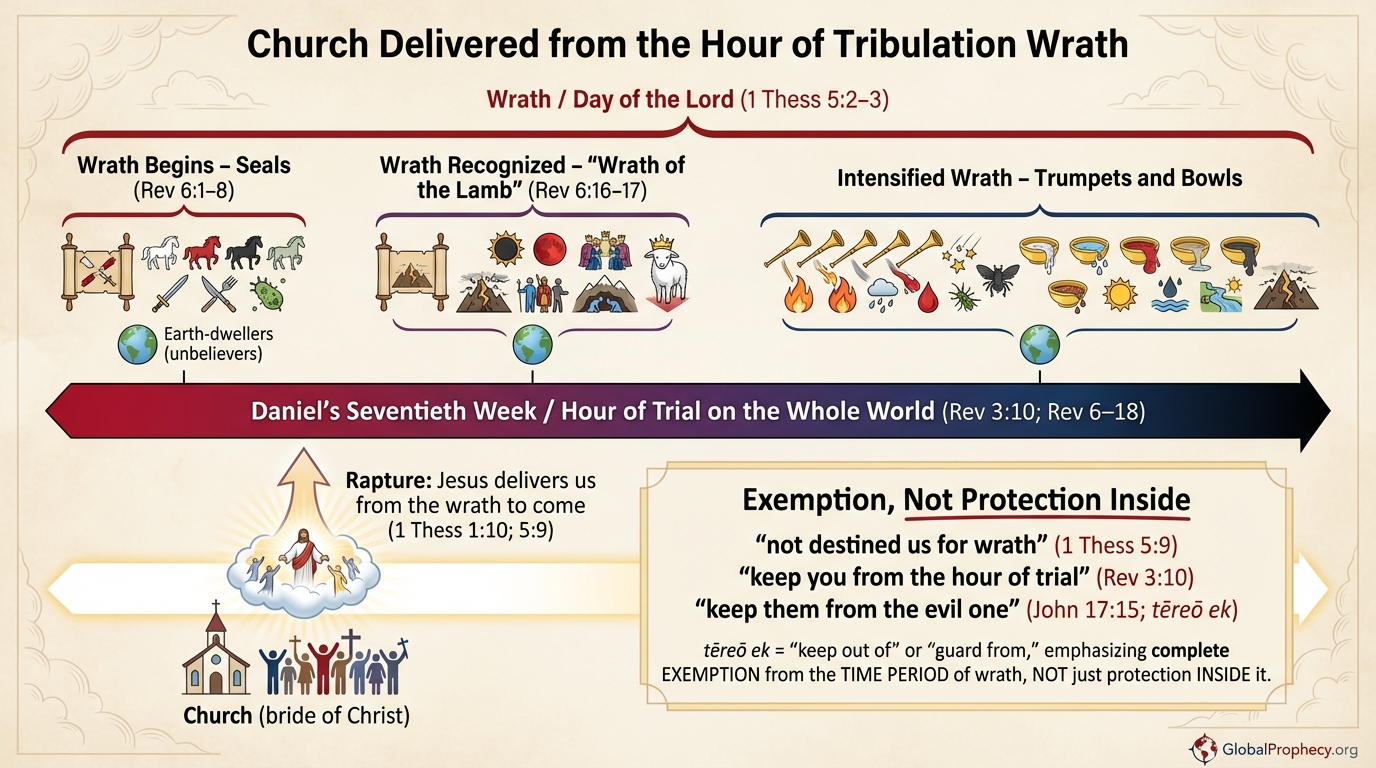
Put together, 1 Thessalonians 1:10; 5:9 and Revelation 3:10 indicate that the church is exempt from the whole period of eschatological wrath, not merely from one segment.
8. Conclusion
Mid‑tribulationalism seeks to balance passages on tribulation for believers with promises of deliverance from wrath. However, its exegetical pillars are unstable:
- The identification of the “last trumpet” with the seventh trumpet collapses under close comparison.
- Scripture presents God’s wrath as operative from the beginning of the seventieth week, escalating but already present in the seals.
- The two witnesses of Revelation 11 are best read as literal prophets, not symbolic of the church.
- The doctrine of imminency is severely compromised by fixing the rapture at mid‑week.
- Key texts (1 Thess 1:10; 5:9; Rev 3:10) promise deliverance from the entire hour of testing coming on the whole world.
From a consistent, literal, grammatical‑historical reading of Scripture, the evidence points not to a rapture in the middle of the tribulation, but to a pre‑tribulational rapture in which Christ removes His church before the seventieth week begins.
Believers today are not called to calculate midpoints, but to live in constant expectation and holiness, “waiting for our blessed hope, the appearing of the glory of our great God and Savior Jesus Christ” (Tit 2:13).
Frequently Asked Questions
What is mid‑tribulationalism in simple terms?
Why do mid‑tribulationists link the rapture to the “last trumpet”?
Does the Bible say God’s wrath only falls in the last half of the tribulation?
Are Christians promised exemption from the whole tribulation or just part of it?
Does mid‑tribulationalism affect the doctrine of Christ’s imminent return?
L. A. C.
Theologian specializing in eschatology, committed to helping believers understand God's prophetic Word.
Related Articles
Post-Tribulationalism Examined
Post-tribulationalism examined with a fair summary of the posttrib rapture view plus biblical critiques on imminence, the tribulation, and the millennium.
Pre-Tribulationalism Examined
Pretribulationalism examined: a detailed defense of the pre-trib rapture, Israel–Church distinction, exemption from wrath, and the doctrine of imminence.
The Pre-Wrath Rapture View Examined
Pre-wrath rapture view examined: timing in the second half of the tribulation, its Satan vs. God's wrath distinction, and why wrath begins at the seals.
The Partial Rapture View Examined
Partial rapture view examined and refuted biblically, showing from New Testament texts that Christ will rapture all true believers, not only the watchful few.