
The Millennial Temple and Worship
1. Introduction
The millennial temple and its worship system form the liturgical heart of Christ’s future earthly reign. According to Ezekiel 40–48, a new temple will stand in a transformed Jerusalem during the thousand‑year kingdom (cf. Rev 20:1–6). From this sanctuary Messiah will be worshiped by Israel and the nations in a restored, theocratic order.
This article surveys the temple and worship of the millennium—its biblical basis, structure, priesthood, sacrifices, feasts, and spiritual significance—drawing especially from Ezekiel’s detailed vision.
2. The Prophetic Basis for a Millennial Temple
2.1 Ezekiel 40–48 as the Foundational Text
Chapters 40–48 of Ezekiel present the most extensive description of the millennial temple:
- A precisely measured sanctuary and complex (Ezek 40–42).
- The return of the glory of Yahweh to the house (Ezek 43:1–7).
- A renewed altar and sacrifices (Ezek 43:13–27; 45:13–25).
- A restored priesthood and Levitical service (Ezek 44–46).
- A life‑giving river flowing from the temple (Ezek 47:1–12).
- A re‑apportioned land and holy district (Ezek 47–48).
Nothing like this has ever been built in Israel’s history (it does not match Solomon’s, Zerubbabel’s, or Herod’s temples). Nor can the details be reduced credibly to mere symbolism for the church. The repeated measuring, dimensions, and functional instructions strongly indicate a literal future structure.
2.2 Confirmation from Other Prophets
Ezekiel’s vision harmonizes with wider prophetic expectation:
-
Jerusalem/Zion as world worship center
“For out of Zion shall go forth the law, and the word of the LORD from Jerusalem.”
— Isaiah 2:3 -
A house of prayer for all peoples
“For my house shall be called a house of prayer for all peoples.”
— Isaiah 56:7 -
Future temple and offerings
Isa 2:2–3; 60:7, 13; Jer 33:17–18; Joel 3:18; Hag 2:7–9; Zech 6:12–15; 14:16–21.
These converge in portraying a literal sanctuary in a restored Israel, during Messiah’s earthly reign, distinct from both the present church age and the eternal state of Revelation 21–22 (where John explicitly says, “I saw no temple in the city” – Rev 21:22).
3. Architecture and Location of the Millennial Temple
3.1 Site and Topography
Zechariah links the second coming of Christ with a topographical transformation around Jerusalem:
“On that day his feet shall stand on the Mount of Olives that lies before Jerusalem on the east, and the Mount of Olives shall be split in two …”
— Zechariah 14:4
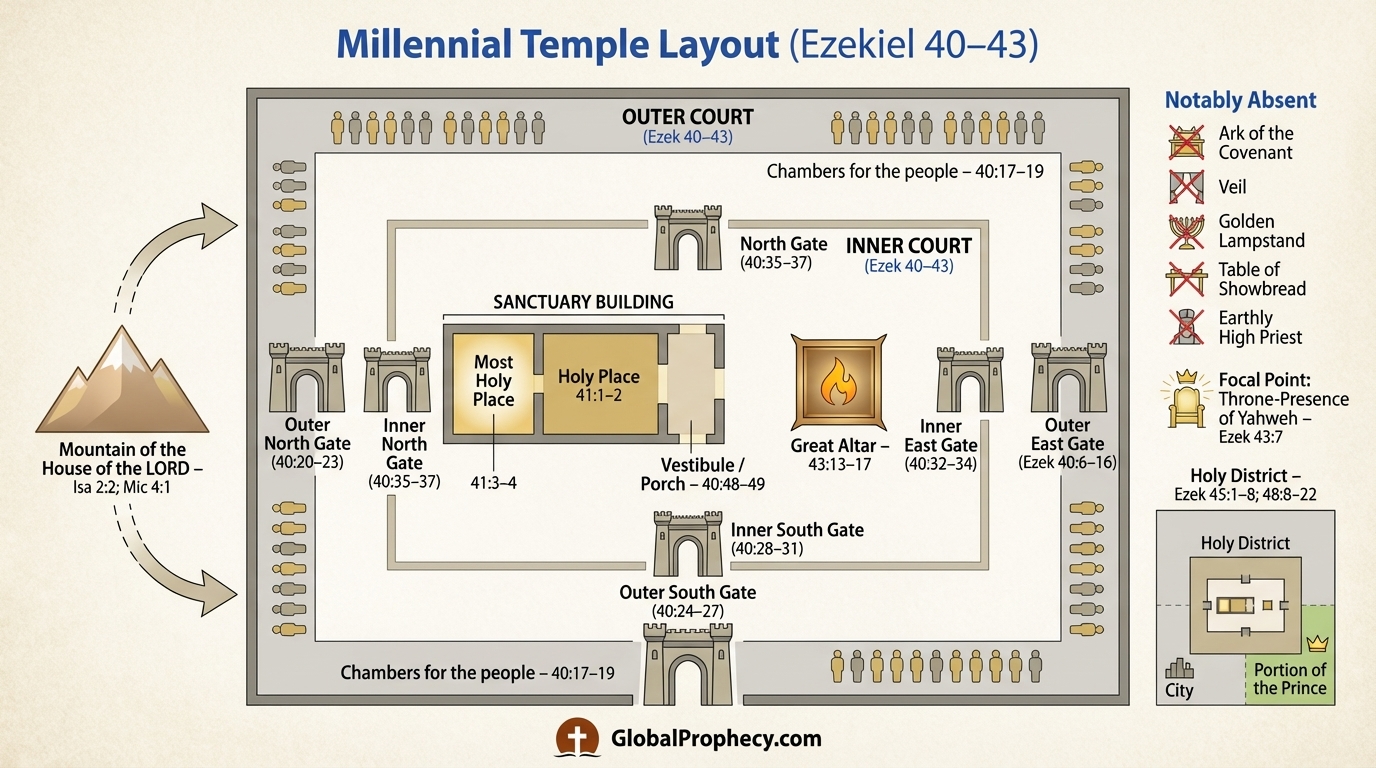
The elevated “mountain of the house of the LORD” (Isa 2:2; Mic 4:1) provides the platform for Ezekiel’s temple. The temple stands within a large holy district between the northern and southern tribal allotments (Ezek 45:1–8; 48:8–22), with the city and the “portion of the prince” nearby.
3.2 Temple Complex Overview (Ezekiel 40–43)
Key features include:
- Outer court with three monumental gates (east, north, south) and thirty chambers for the people (40:17–27).
- Inner court with three corresponding gates and the great altar at its center (40:28–47; 43:13–17).
- The sanctuary building:
- Vestibule (porch) (40:48–49).
- Holy Place (41:1–2).
- Most Holy Place (41:3–4).
Notably absent are the ark of the covenant, veil, golden lampstand, table of showbread, and earthly high priest. Instead, the focal point is the throne‑presence of Yahweh:
“This is the place of my throne and the place of the soles of my feet, where I will dwell in the midst of the people of Israel forever.”
— Ezekiel 43:7
3.3 The Temple River (Ezekiel 47:1–12)
From beneath the threshold of the house flows a river eastward, deepening supernaturally and bringing healing and life even to the Dead Sea (47:8–9). Abundant trees along its banks bear fruit “for food” and leaves “for healing” (47:12). This river symbolizes and effects the partial reversal of the curse in the millennial age, centered on the temple.
4. The Priestly Order and Sacrificial System
4.1 The Zadokite Priesthood and Levites
Ezekiel distinguishes between:
- Sons of Zadok – priests who remained faithful and are granted the closest access to the LORD (Ezek 44:15–16).
- Other Levites – who previously went astray and are now restricted to lesser temple duties such as guarding gates and slaughtering offerings (Ezek 44:10–14).
Thus, Levitical service is restored, but with Zadok’s line uniquely honored. This fits a literal, national Israel under the new covenant (cf. Jer 31:31–34; Ezek 36:25–27), not the church, where all believers are one priestly body in Christ.
4.2 Nature of Millennial Sacrifices
Ezekiel describes multiple offerings:
- Burnt offerings, grain offerings, peace offerings, sin offerings, and guilt offerings (Ezek 40:39; 42:13; 43:18–27; 45:15–25; 46:2–15).
Crucially, these do not compete with or replace the once‑for‑all sacrifice of Christ:
“For it is impossible for the blood of bulls and goats to take away sins.”
— Hebrews 10:4
In every age, forgiveness is grounded only in Christ’s death. The millennial sacrifices function in two closely related ways:
-
Memorial of the Cross
Just as the Lord’s Supper now “proclaim[s] the Lord’s death until he comes” (1 Cor 11:26), so millennial sacrifices will look back to the already‑accomplished atonement, vividly portraying the costliness of sin and grace in a kingdom where conditions are otherwise ideal. -
Ceremonial Purification in a Theocratic Order
Ezekiel repeatedly speaks of sacrifices that “make atonement” (Ezek 43:20, 26; 45:15, 17, 20). In the light of Leviticus and Hebrews, this refers to ritual cleansing—removing ceremonial defilement from the altar, sanctuary, and worshipers in the presence of God’s earthly glory. Mortal people with sin natures will still live in the kingdom; these rites protect the holiness of the temple as God dwells in their midst.
Thus, millennial sacrifices are not a regression to the Mosaic covenant, but a kingdom‑administration of worship under the new covenant, both commemorating Christ’s finished work and maintaining ceremonial purity in a unique theocratic setting.
5. Worship Practices and Feasts in the Millennium
5.1 Sabbaths, New Moons, and Daily Offerings
Ezekiel indicates a structured calendar of worship:
- Sabbath and New Moon worship – the gate of the inner court facing east is opened “on the sabbath day and on the day of the new moon,” and the people worship at its entrance while the prince offers sacrifices (Ezek 46:1–8).
- Daily burnt offering – a regular morning sacrifice (Ezek 46:13–15).
These observances express Israel’s restored covenant life under Messiah’s benevolent rule.
5.2 Annual Feasts
Two feasts receive special emphasis:
-
Passover and Unleavened Bread (Ezek 45:21–24)
The prince leads offerings in the first month, commemorating redemption. In the millennium, this will explicitly recall Christ our Passover (cf. 1 Cor 5:7), who secured Israel’s and the nations’ deliverance. -
Feast of Booths (Tabernacles) (Ezek 45:25; Zech 14:16–19)
Zechariah expands this, proclaiming that all nations will go up to Jerusalem annually to worship the King and keep the feast. Those who refuse will experience drought and plague (Zech 14:17–19). This feast celebrates God dwelling with His people and the ingathering of the harvest, fitting the climactic joy of the messianic age.
Significantly, no Day of Atonement or Feast of Trumpets is mentioned in Ezekiel’s millennial calendar, again underscoring that Christ’s atonement is complete, and the focus shifts from anticipation to celebration and memorial.
5.3 Universal Worship and Pilgrimage
Millennial worship is international in scope:
“From one new moon to another, and from one Sabbath to another, all flesh shall come to worship before me, declares the LORD.”
— Isaiah 66:23
“Many peoples and strong nations shall come to seek the LORD of hosts in Jerusalem and to entreat the favor of the LORD.”
— Zechariah 8:22
Gentile nations will:
- Pilgrim to Jerusalem to worship (Zech 14:16).
- Bring offerings to the temple (Isa 60:7; 66:20).
- Learn God’s law from Zion (Isa 2:2–3).
The millennial temple will truly be a “house of prayer for all peoples” (Isa 56:7), with Israel functioning as a kingdom of priests to the world (cf. Isa 61:6; Exod 19:5–6).
6. The Spiritual Significance of Millennial Worship
6.1 The Return of the Glory
The climax of Ezekiel’s vision is the return of the shekinah glory:
“As the glory of the LORD entered the temple by the gate facing east … the glory of the LORD filled the temple.”
— Ezekiel 43:4–5
In contrast to Ezekiel 10–11, where the glory departed the first temple, the millennial sanctuary becomes the permanent earthly throne of Yahweh in the person of Messiah. This visibly vindicates God’s name among the nations and fulfills the new covenant promise: “My dwelling place shall be with them” (Ezek 37:27).
6.2 Holiness and Instruction
The temple complex is governed by the principle:
“This is the law of the temple: the whole territory on the top of the mountain all around shall be most holy.”
— Ezekiel 43:12
Holiness pervades architecture, ritual, and daily life (cf. Zech 14:20–21). From this center, Messiah will teach the nations:
“For out of Zion shall go forth the law, and the word of the LORD from Jerusalem.”
— Isaiah 2:3
The temple thus serves as:
- Liturgical center – where formal worship and sacrifice occur.
- Educational center – where divine truth flows to the world.
- Judicial center – from which Messiah’s righteous rule extends.
6.3 Worship Under the New Covenant
Israel’s worship in the millennium is not a return to the old covenant, but its eschatological fulfillment:
- Hearts are circumcised and renewed (Jer 31:33; Ezek 36:26–27).
- All in Israel “know the LORD” (Jer 31:34).
- The Spirit is poured out (Joel 2:28–29).
In that context, the temple and its rituals are outward expressions of an inwardly transformed people, celebrating and honoring the King who saved and restored them.
7. Relationship to the Church and the Eternal State
From a premillennial, dispensational perspective:
- The church (resurrected and glorified) will reign with Christ (cf. Rev 20:4–6) and participate in worship, but the temple’s priestly system is Israel‑centered, fulfilling Old Testament promises to the nation.
- The millennial temple is temporary, limited to the thousand‑year reign. When Christ hands the kingdom to the Father (1 Cor 15:24–28), and the new heaven and new earth appear, John can say:
“And I saw no temple in the city, for its temple is the Lord God the Almighty and the Lamb.”
— Revelation 21:22
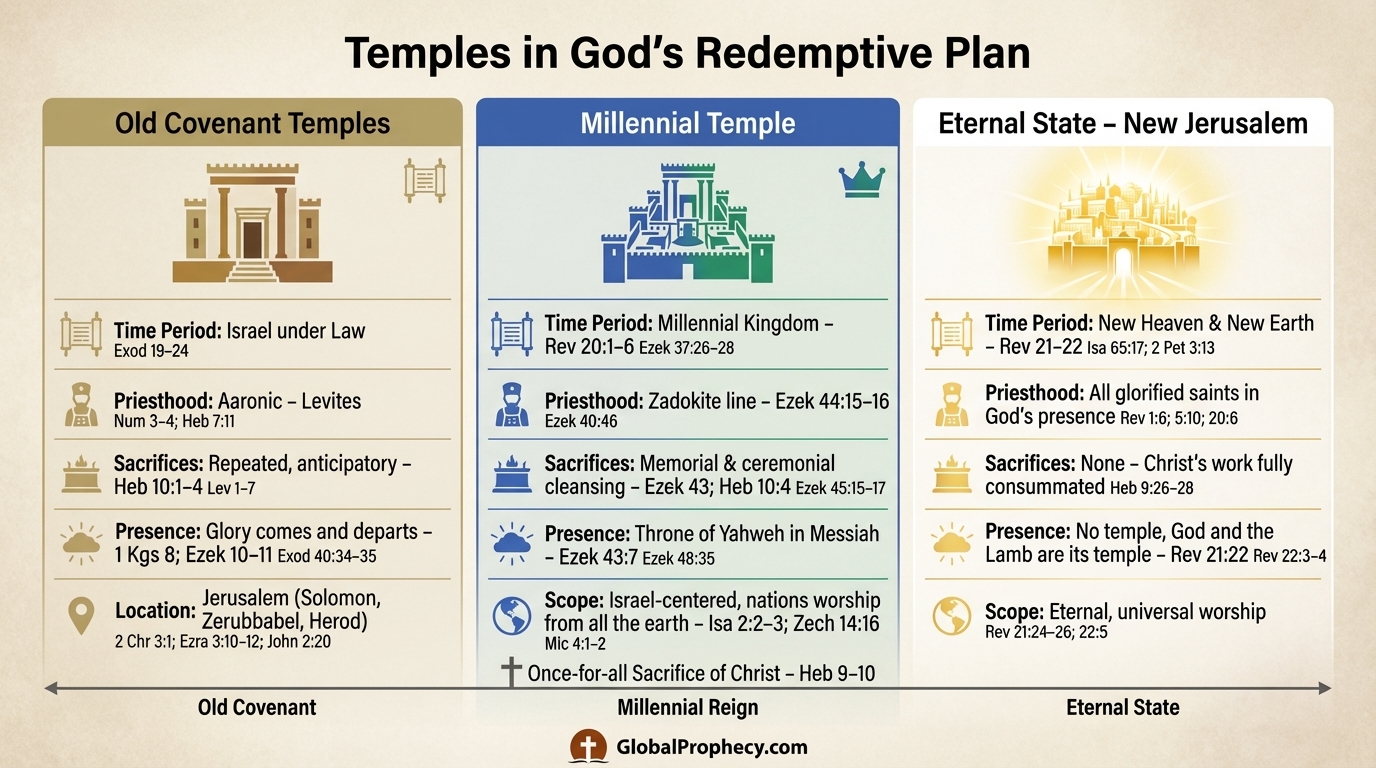
In the eternal state, no sacrificial system or localized sanctuary is needed; God’s immediate presence fills all. The millennial temple, then, is the final historical stage of God’s mediatorial kingdom before the eternal order.
8. Conclusion
The millennial temple and worship system of Ezekiel 40–48 present a coherent, prophetic portrait:
- A literal sanctuary in a transformed Jerusalem.
- The visible return and throne of Yahweh in the person of Messiah.
- A restored Zadokite priesthood and structured sacrificial worship, not to atone for sin, but to memorialize Christ’s cross and maintain ceremonial purity in God’s holy dwelling.
- A calendar of Sabbaths and feasts, with Passover and Tabernacles reframed in the light of fulfilled redemption.
- Universal pilgrimage and worship, as Israel leads the nations in honoring the King.
Far from diminishing the cross, millennial worship magnifies it in history’s final earthly era, displaying God’s faithfulness to His covenants, His holiness in dwelling among redeemed yet still‑mortal people, and His glory as King of all the earth.
FAQ
Q: Will there really be animal sacrifices in the millennial temple?
Yes. Ezekiel 40–48 explicitly describes animal sacrifices in the future temple. These do not add to or repeat Christ’s atonement. Rather, they function as memorials of His once‑for‑all sacrifice and as ceremonial purifications in a theocratic system where God’s glory dwells among mortal people. They are part of a kingdom‑administration of worship, not a return to Mosaic legalism.
Q: How does the millennial temple relate to the New Testament teaching that Christ fulfilled the sacrificial system?
Hebrews teaches that Christ’s death is the only true, final atonement for sin (Heb 9–10). Millennial sacrifices do not compete with this; they presuppose it. Just as the Lord’s Supper today commemorates the cross without re‑sacrificing Christ, so millennial offerings will visibly portray and apply the benefits of His finished work within a ceremonial framework suited to His earthly, royal presence.
Q: Will Gentiles participate in worship at the millennial temple?
Yes. The prophets repeatedly show nations streaming to Jerusalem to worship the LORD (Isa 2:2–3; Zech 14:16–19; Isa 56:6–7). Gentiles will bring offerings, keep the Feast of Booths, and seek instruction from the King. The temple will be a house of prayer for all peoples, with Israel serving as the priestly nation through whom the world approaches God.
Q: Why is there a temple in the millennium but no temple in the New Jerusalem?
The millennial kingdom is an intermediate, historical phase of God’s plan, with Christ reigning on earth amid both glorified saints and mortal nations. A temple suits that mediatorial, theocratic administration. In the eternal state of Revelation 21–22, however, all God’s people are glorified, sin and death are gone, and “the Lord God the Almighty and the Lamb” are the temple. No localized sanctuary is needed when God’s presence fills all.
Q: Is the millennial temple symbolic of the church, or should we expect a literal building?
While the temple certainly carries symbolic meaning, the detailed dimensions, functional descriptions, and integration with land allotments in Ezekiel 40–48 point strongly to a literal future structure. Symbolism and literal fulfillment are not mutually exclusive; a literal millennial temple can simultaneously embody rich theological truths about God’s holiness, presence, and kingdom.
Frequently Asked Questions
Will there really be animal sacrifices in the millennial temple?
How does the millennial temple relate to the New Testament teaching that Christ fulfilled the sacrificial system?
Will Gentiles participate in worship at the millennial temple?
Why is there a temple in the millennium but no temple in the New Jerusalem?
Is the millennial temple symbolic of the church, or should we expect a literal building?
L. A. C.
Theologian specializing in eschatology, committed to helping believers understand God's prophetic Word.
Related Articles
Amillennialism Examined: Is the Church the Millennial Kingdom?
Amillennialism examined: is the church the millennial kingdom? Explore its claims, symbols, and a biblical critique of this end-times view.
Who is Gog in Ezekiel 38-39?
Gog in Ezekiel 38-39: explore Gog’s identity, the specific nations allied with him, and when this end-times invasion of Israel will be fulfilled.
Gog and Magog
Gog and Magog prophecy explained: explore Ezekiel 38–39, the northern invasion of Israel, key nations, timing, and end-times significance.
Life in the Millennium: Physical and Spiritual Blessings
Millennium life brings profound physical and spiritual blessings under Christ’s reign—peace, righteousness, healing, and restored creation in the kingdom.