
What is the Millennium? The 1000-Year Reign of Christ
1. Introduction
The Millennium—the 1,000-year reign of Christ—is a central component of biblical eschatology. It describes a future, earthly kingdom in which Jesus Christ will rule the world in righteousness, peace, and glory. This period, revealed most explicitly in Revelation 20:1–6, stands between the present age and the final eternal state of the new heaven and new earth.
Understanding what the Millennium is, when it occurs, and why it matters is essential for a coherent view of God’s plan for history, the future of Israel and the nations, and the ultimate vindication of Christ.
2. What Is the Millennium? Definition and Core Features
The word “millennium” comes from the Latin mille (thousand) and annus (year), and refers to the thousand-year reign of Christ on earth following His second coming.
The classic description is:
"They came to life and reigned with Christ for a thousand years.… They will be priests of God and of Christ, and they will reign with him for a thousand years."
— Revelation 20:4, 6 (ESV)
From Scripture, the Millennium can be defined as:
The mediatorial, theocratic kingdom in which the risen Lord Jesus Christ personally rules the earth from Jerusalem for 1,000 years, fulfilling God’s covenant promises to Israel and the nations, with resurrected saints reigning with Him while Satan is bound.
Key elements in that definition:
- Rule of Christ: Jesus reigns as King over the whole earth (e.g., Psalm 2:6–9; Daniel 7:13–14; Zechariah 14:9).
- Earthly kingdom: This is not merely a “reign in hearts” but a global, geopolitical reign rooted in Mount Zion/Jerusalem (Isaiah 2:2–4; Zechariah 14:16–17).
- Mediatorial rule: Christ governs as the ultimate “Son of David” on David’s throne (2 Samuel 7:12–16; Luke 1:32–33), mediating God’s rule to the nations.
- Participation of the saints: Resurrected believers “reign with Christ” (Revelation 20:4–6; 2 Timothy 2:12).
- Binding of Satan: During this kingdom, Satan is imprisoned in the abyss and cannot deceive the nations (Revelation 20:1–3).
In sum, the Millennium is a literal, future, earthly kingdom ruled by Jesus Christ, in which His authority is openly acknowledged and enforced in human history.
3. Timing and Duration of the Millennium
3.1 When Does the Millennium Occur?
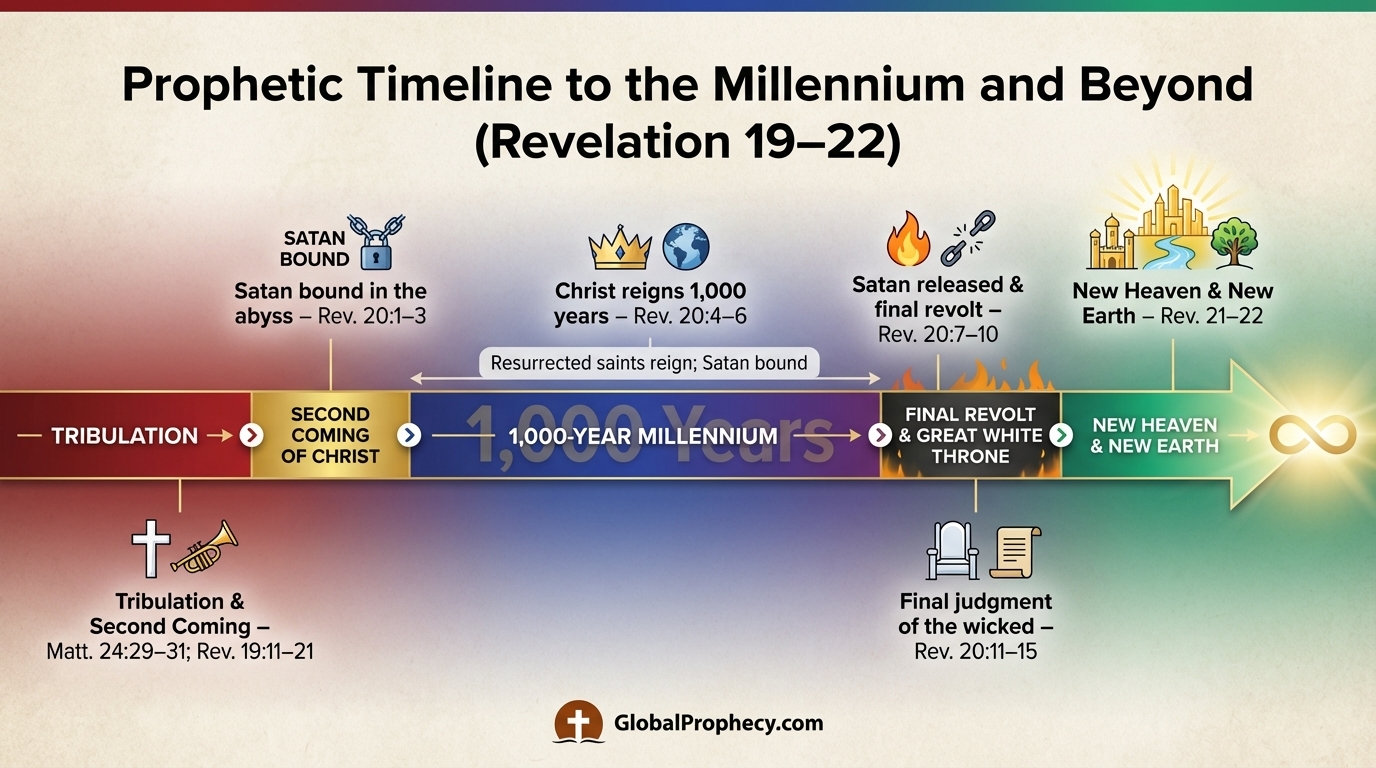
The Millennium follows a clear prophetic sequence:
-
The Tribulation and Second Coming of Christ
- Christ returns in glory to judge the nations and defeat His enemies (Matthew 24:29–31; Revelation 19:11–21).
- The Beast (Antichrist) and False Prophet are cast into the lake of fire (Revelation 19:20).
-
Satan Bound
- An angel binds Satan in the abyss “so that he might not deceive the nations any longer, until the thousand years were ended” (Revelation 20:1–3).
-
Resurrection and Reign of the Saints
- Martyrs and other saints come to life and “reign with Christ for a thousand years” (Revelation 20:4–6). This is called the first resurrection relative to the Millennium.
-
The Thousand-Year Kingdom
- Christ rules the world in righteousness and peace—a distinct historical era between this age and the eternal state.
-
Final Revolt, Final Judgment, Eternal State
- At the end of the thousand years, Satan is released, leads a brief revolt, is destroyed, and then cast into the lake of fire (Revelation 20:7–10).
- The wicked dead are judged at the Great White Throne (Revelation 20:11–15).
- Then comes the new heaven and new earth (Revelation 21–22).
This structure shows the Millennium is post-tribulational and premised on Christ’s bodily second coming.
3.2 Is the “Thousand Years” Literal?
Revelation 20:1–7 mentions “a thousand years” six times. Several observations support taking this number literally:
- Consistency of numbers in Revelation: Other time periods (e.g., 1,260 days, 42 months) correspond to literal spans.
- Repetition for emphasis: The unusual sixfold repetition suggests a definite, fixed period.
- Intermediate nature: The Millennium includes sin, death, and the eventual loosing of Satan—conditions incompatible with the eternal state, yet far superior to the present age. This fits an intermediate kingdom of set duration.
- Literal-symbolic harmony: Even if 1,000 carries symbolic overtones of completeness, that does not negate a literal 1,000-year span—just as Israel literally wandered “forty years” even while forty had symbolic weight.
Therefore, from a grammatical-historical reading, the Millennium is best understood as a literal 1,000-year reign.
4. The Nature and Character of Christ’s 1,000-Year Reign
4.1 The Form of Government: A Theocratic, Davidic Kingdom
The Millennium is a theocracy—God ruling directly through His Messiah:
- Jesus is King over all the earth (Zechariah 14:9).
- He sits on the throne of David, ruling Israel and the nations (Isaiah 9:6–7; Jeremiah 23:5–6; Luke 1:32–33).
- Government is centered in Jerusalem / Zion:
“For out of Zion shall go the law, and the word of the LORD from Jerusalem. He shall judge between the nations…”
— Isaiah 2:3–4
Human rulers (resurrected and mortal) serve under Him, but Christ alone is the absolute, righteous King.
4.2 Who Is in the Millennium?
The Millennium includes two main categories of people:
-
Resurrected, glorified saints
- Old Testament believers (Daniel 12:2).
- Church-age believers (1 Corinthians 15:51–52; Revelation 5:10).
- Tribulation martyrs (Revelation 20:4).
These reign with Christ in immortal bodies, not subject to death.
-
Mortal believers who survive the Tribulation
- Saved Israelites and Gentiles enter the kingdom in natural bodies after the judgment of the nations (Matthew 25:31–34; Ezekiel 20:34–38).
- They marry, have families, work, and age in a transformed but still fallen world (though under Christ’s rule).
- Their children, and generations born throughout the 1,000 years, must personally repent and believe; not all will, even under ideal conditions.
Thus the Millennium is a mixed population: glorified saints and mortal believers (and later, some unbelievers), all under the rule of Christ.
4.3 Moral and Spiritual Climate
The kingdom is marked by unprecedented righteousness, yet not absolute sinlessness in the mortal population:
-
Righteous rule:
Christ “will judge the needy… with righteousness he will judge the poor… He shall strike the earth with the rod of his mouth” (Isaiah 11:4–5).
He rules “with a rod of iron” (Psalm 2:9; Revelation 19:15), swiftly suppressing open rebellion. -
Peace and justice:
Wars cease; weapons are turned into agricultural tools (Isaiah 2:4; Micah 4:3). Justice is fair, immediate, and universal. -
Universal knowledge of God:
“The earth shall be full of the knowledge of the LORD as the waters cover the sea” (Isaiah 11:9).
Public ignorance of the true God is removed, though private unbelief still possible. -
Satan bound:
With Satan and his demons confined, external spiritual deception is removed. Human sin originates from the fallen human heart, not from demonic temptation during this period.
In short, the Millennium is the highest realization of godly government in history, though not yet the sinless perfection of the eternal state.
4.4 Intermediate, Not Final: Presence of Sin and Death
Several texts show that, while gloriously transformed, the Millennium is not yet heaven:
- Death still occurs among mortals (Isaiah 65:20)—though lifespans are greatly extended and death is often a judgment on sin.
- Sin is present, though outward rebellion is swiftly judged.
- A final revolt erupts when Satan is released at the end of the thousand years (Revelation 20:7–9), proving many hearts remained unregenerate despite outward conformity.
These features distinguish the Millennium sharply from the new heaven and new earth, where “death shall be no more, neither shall there be mourning nor crying nor pain anymore” (Revelation 21:4).
5. The Theological Significance of the Millennium
5.1 Fulfillment of God’s Covenants
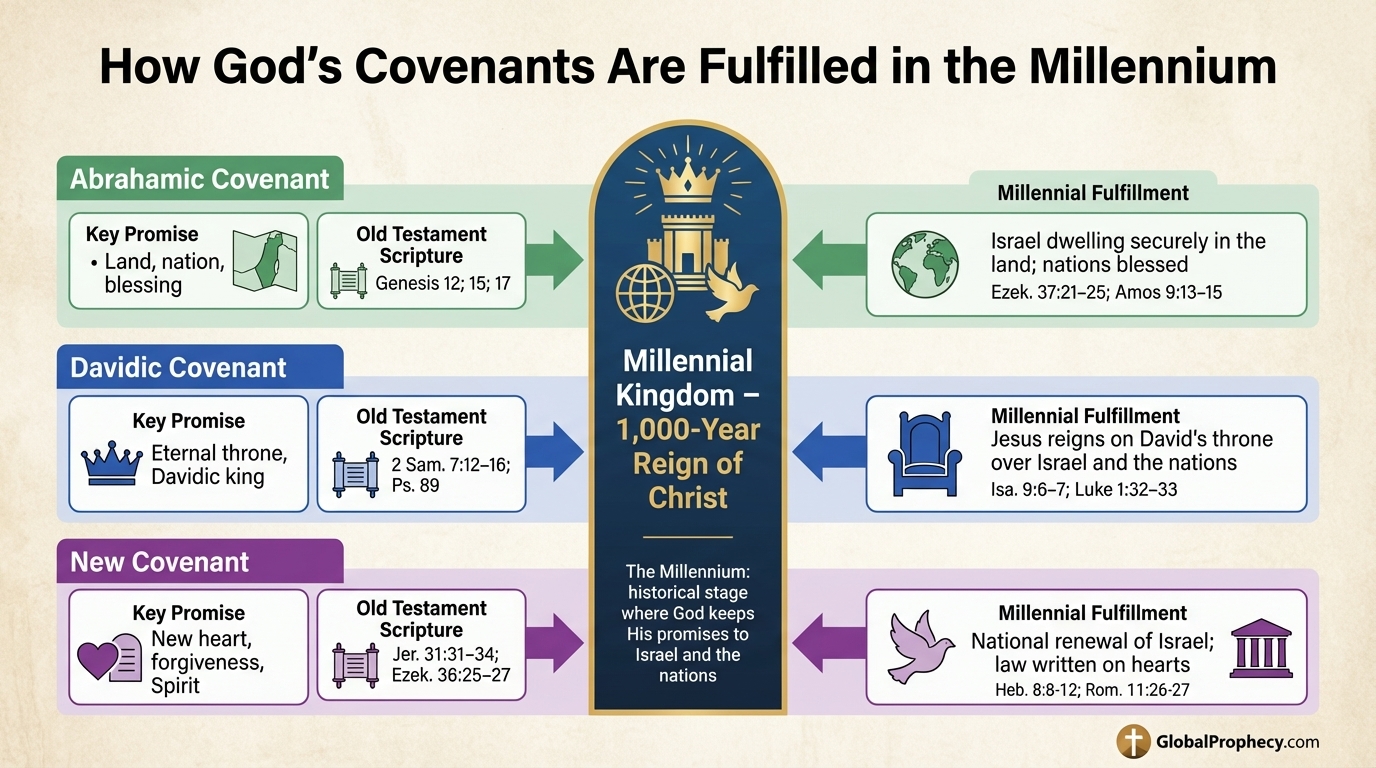
The Millennium is the stage on which major biblical covenants are literally fulfilled:
-
Abrahamic Covenant (Genesis 12; 15; 17):
Israel finally possesses the promised land in security and blessing (Ezekiel 37:21–25; Amos 9:13–15). -
Davidic Covenant (2 Samuel 7:12–16; Psalm 89:3–4, 35–37):
A descendant of David—Jesus—reigns on David’s throne over Israel and the nations. -
New Covenant (Jeremiah 31:31–34; Ezekiel 36:25–27):
Israel as a nation is spiritually renewed, with God’s law written on their hearts and an enduring relationship established.
The Millennium demonstrates that God keeps His promises in history, not merely in a spiritualized or symbolic sense.
5.2 Vindication of Christ in the Same World That Rejected Him
At His first coming, Christ was:
- Rejected by His own (John 1:11),
- Condemned by earthly rulers (1 Corinthians 2:8),
- Publicly humiliated and crucified.
The Millennium ensures that in the very world where He was rejected, He is openly enthroned:
- The same earth that saw Him mocked will see Him worshiped.
- The same Jerusalem that rejected Him will be His royal capital.
As 1 Corinthians 15:25 affirms, “He must reign until he has put all his enemies under his feet.” The Millennium is the historic, visible triumph of Christ before the eternal state begins.
5.3 Final Demonstration of Human Sinfulness
The Millennium also serves as God’s final test of humanity under ideal external conditions:
- Perfect government,
- Universal knowledge of the Lord,
- Abundant provision and peace,
- No satanic deception.
Yet when Satan is released, a vast number “like the sand of the sea” join his final revolt (Revelation 20:7–8). This proves:
- The root problem is not environment but the human heart.
- Even the most ideal circumstances cannot regenerate sinners; only God’s grace in Christ can.
Thus the Millennium silences every excuse and fully justifies God’s final judgment.
6. Conclusion
The Millennium, the 1,000-year reign of Christ, is not an incidental detail of biblical prophecy. It is the culmination of God’s purposes in history before the eternal state:
- It is the literal, earthly kingdom promised by the prophets.
- It is the era in which Christ’s kingship is public, global, and righteous.
- It is the time when God’s covenants with Israel and the nations are fulfilled.
- It exposes human sinfulness even under perfect rule and prepares the way for the final judgment and the new heaven and new earth.
To understand biblical eschatology is to understand the Millennium as the central, transitional kingdom between this fallen age and the everlasting, sinless glory to come.
FAQ
Q: What exactly is the Millennium in the Bible?
The Millennium is the future 1,000-year reign of Jesus Christ on earth described in Revelation 20:1–6. During this time, Christ rules the nations from Jerusalem, resurrected saints reign with Him, Satan is bound, and God’s promises to Israel and the nations are fulfilled in history.
Q: Is the 1,000 years of the Millennium meant to be literal or symbolic?
From a grammatical-historical reading, the 1,000 years is best taken literally. The term “a thousand years” is repeated six times in Revelation 20:1–7, other time periods in Revelation are literal, and the Millennium functions as a distinct intermediate era between the present age and the eternal state.
Q: What is the purpose of the Millennium in God’s plan?
The Millennium serves several purposes: it fulfills God’s covenants with Abraham, David, and Israel; vindicates Christ in the very world that rejected Him; demonstrates human sinfulness even under ideal conditions; and forms the bridge to the final judgment and the eternal new creation.
Q: Who will live in the Millennium?
The Millennium includes resurrected, glorified believers (from the Old Testament, church age, and Tribulation) who reign with Christ, as well as mortal believers who survive the Tribulation and enter the kingdom in natural bodies. Their descendants are born throughout the 1,000 years and must personally respond to Christ.
Q: How is the Millennium different from the eternal state?
The Millennium is an intermediate kingdom: sin and death still exist among mortals, though greatly restrained; Satan is bound but later released; and a final revolt and judgment occur at its end. The eternal state (new heaven and new earth, Revelation 21–22) is completely sinless, with no death, curse, or rebellion forever.
Frequently Asked Questions
What exactly is the Millennium in the Bible?
Is the 1,000 years of the Millennium meant to be literal or symbolic?
What is the purpose of the Millennium in God’s plan?
Who will live in the Millennium?
How is the Millennium different from the eternal state?
L. A. C.
Theologian specializing in eschatology, committed to helping believers understand God's prophetic Word.
Related Articles
The Millennium Explained: What the Bible Teaches About the 1000-Year Reign
Millennium explained from Scripture: explore the Bible’s teaching on Christ’s 1000-year reign, its purpose, timing, and promises for Israel and the nations.
Amillennialism Examined: Is the Church the Millennial Kingdom?
Amillennialism examined: is the church the millennial kingdom? Explore its claims, symbols, and a biblical critique of this end-times view.
The Government of the Millennial Kingdom
Millennial kingdom government explained: how Christ’s theocratic rule, resurrected saints, and restored Israel form the structure of His 1,000-year reign.
Postmillennialism Examined: Will the Church Christianize the World?
Postmillennialism examined and tested by Scripture: can the church truly Christianize the world before Christ returns and the millennium begins?