
The Millennium Explained: What the Bible Teaches About the 1000-Year Reign
1. Introduction: Defining the Millennium
The millennium is the prophesied 1,000‑year reign of Jesus Christ on earth following His second coming and the tribulation. The term comes from Revelation 20:1–7, where “a thousand years” is mentioned six times:
"…They came to life and reigned with Christ for a thousand years.… they will be priests of God and of Christ, and they will reign with him for a thousand years."
— Revelation 20:4, 6
In this period Christ will rule from Jerusalem, fulfill the covenants made to Israel, restore creation’s blessings, and exercise perfect justice over all nations before handing the kingdom to the Father and ushering in the eternal state (1 Cor 15:24–28).
2. When Will the Millennium Occur?
2.1 After the Tribulation and Second Coming
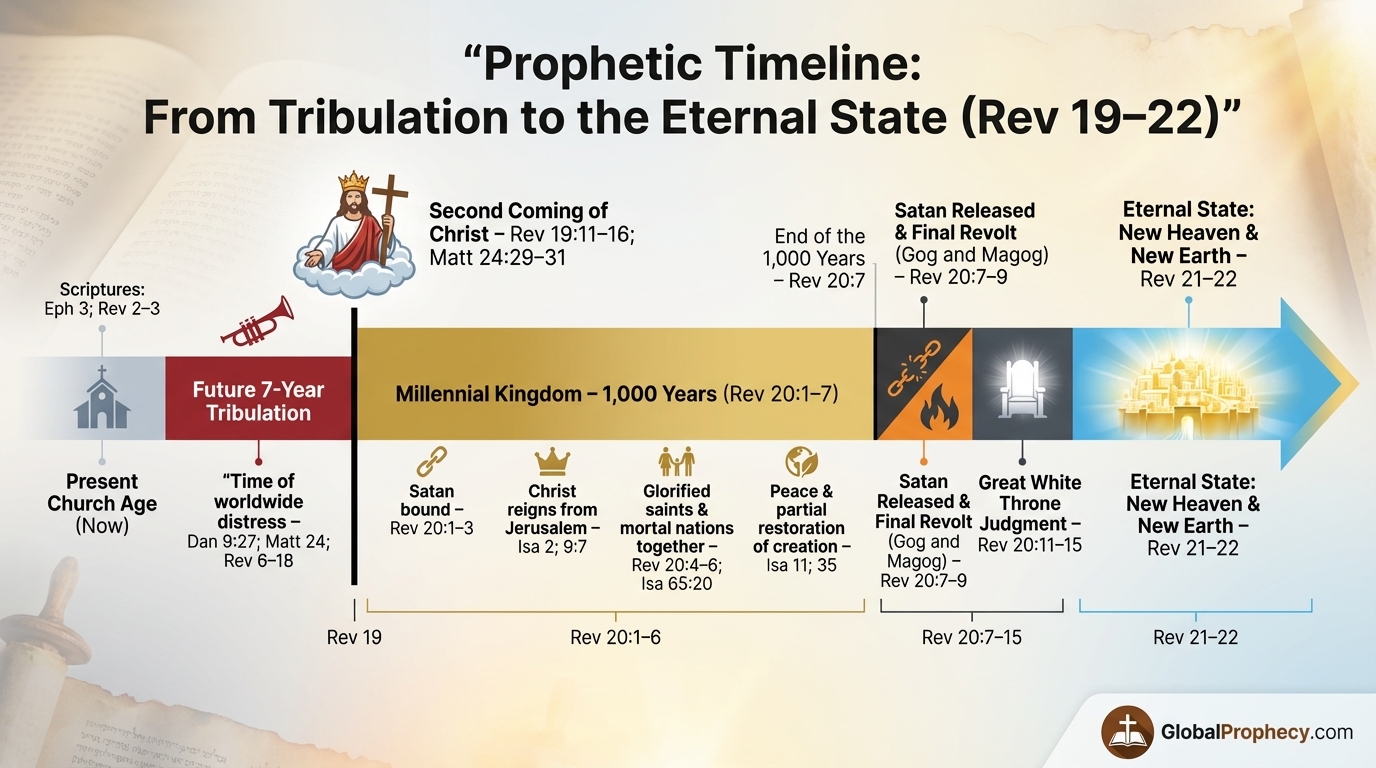
Scripture consistently places the millennial kingdom after the future tribulation and the visible return of Christ:
- Daniel 2 and 7: The final world empire (the ten‑king confederation) is destroyed by the “stone” from heaven, and then God’s kingdom fills the whole earth (Dan 2:34–35, 44–45; 7:23–27).
- Matthew 24–25: “Immediately after the tribulation of those days” (Matt 24:29), the Son of Man appears in glory, judges the nations (25:31–46), and invites the righteous to “inherit the kingdom” (25:34).
- Revelation 19–20: Chapter 19 describes Christ’s return and the destruction of the beast and false prophet; chapter 20 follows with Satan’s binding and the 1,000‑year reign.
This sequence rules out identifying the millennium with the present church age. The kingdom is established only after Christ returns in glory.
2.2 Distinct from the Eternal State
Revelation carefully distinguishes the millennium from the final new heaven and new earth:
-
In the millennium (Rev 20:1–10):
- Satan is bound, then released “when the thousand years are ended” (20:7).
- There is still sin, rebellion, and death (Isa 65:20; Rev 20:7–9).
-
In the eternal state (Rev 21–22):
- Satan is in the lake of fire forever (20:10).
- “Death shall be no more, neither shall there be mourning nor crying nor pain anymore” (21:4).
Thus the millennium is a transitional, intermediate kingdom—far better than the present age, but not yet perfect like the eternal state.
3. The Length and Nature of the 1,000 Years
3.1 A Literal Thousand Years
The repeated phrase “a thousand years” in Revelation 20:2–7 is best taken literally:
- The same book uses specific time spans literally (e.g., 1,260 days in Rev 12:6 = three and a half years).
- Numbers can be both literal and symbolically meaningful (e.g., Israel’s 40 years in the wilderness). The 1,000 years may symbolize completeness, but it is also a real, finite period.
3.2 The Intermediate Kingdom
Key contrasts clarify its character:
| Feature | Millennium (Rev 20) | Eternal State (Rev 21–22) |
|---|---|---|
| Duration | Exactly 1,000 years; has an end | Endless |
| Satan | Bound, then briefly released | Permanently in the lake of fire |
| Sin and Death | Present but restrained (Isa 65:20) | Completely absent (Rev 21:4) |
| Population | Glorified and mortal humans together | Only glorified, redeemed humanity |
| Judgment | Final judgment still future (Rev 20:11) | Already completed |
The millennium is therefore the final stage of earth’s history under the mediatorial rule of the “last Adam” (1 Cor 15:45), before God’s direct, unveiled reign in the new creation.
4. Who Will Be in the Millennium?
4.1 Christ the King and His Glorified Saints
Christ Himself is the central figure:
"He will reign on David’s throne and over his kingdom… from this time forth and forevermore."
— Isaiah 9:7
- He fulfills the Davidic covenant by ruling from David’s throne over Israel and the nations (2 Sam 7:12–16; Luke 1:32–33).
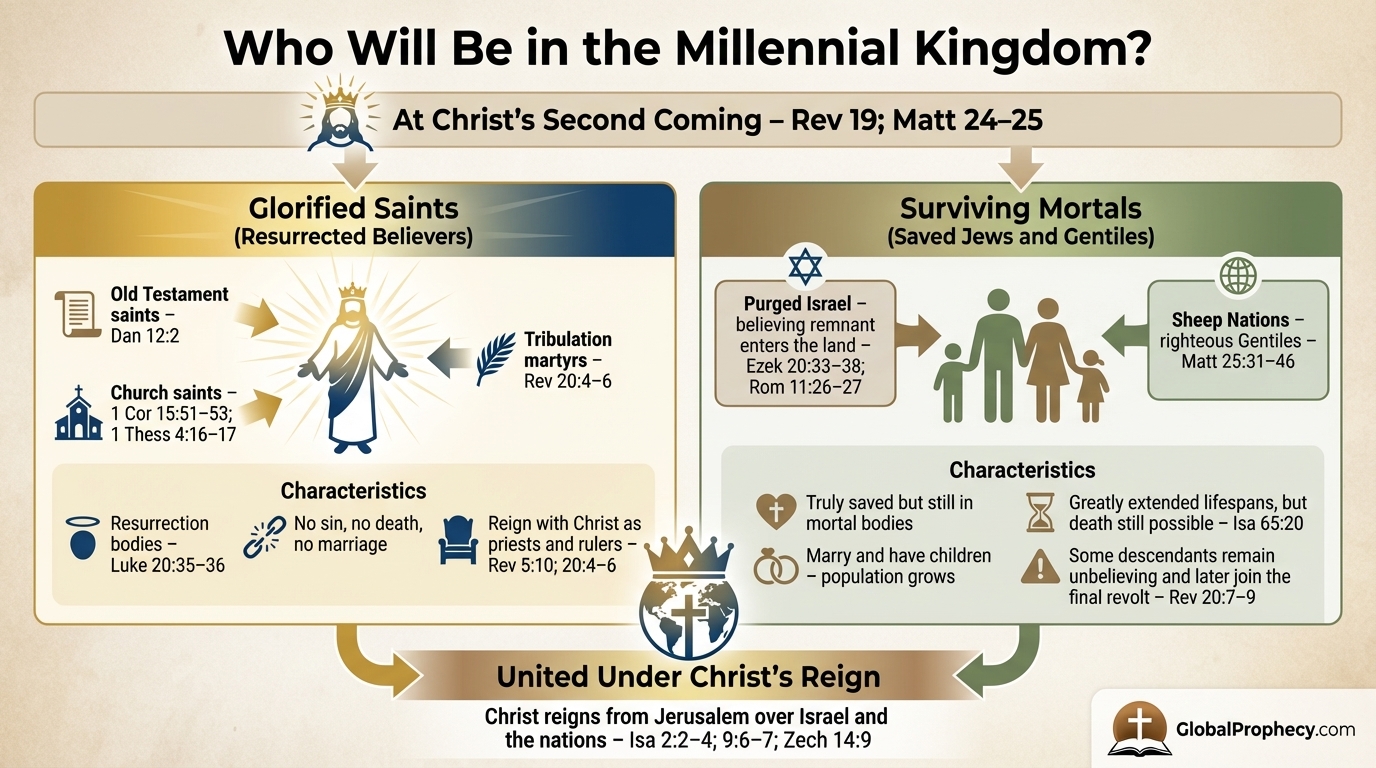
- Resurrected believers—Old Testament saints, church saints, and tribulation martyrs—share His reign:
"…they came to life and reigned with Christ for a thousand years.… they will be priests of God and of Christ, and they will reign with him for a thousand years."
— Revelation 20:4, 6
Jesus promised His apostles:
"You who have followed me will also sit on twelve thrones, judging the twelve tribes of Israel."
— Matthew 19:28
Faithful believers will receive differing degrees of authority (cf. Luke 19:17–19; 2 Tim 2:12; Rev 5:10).
These glorified saints have resurrection bodies, do not marry or die, and are not subject to sin (Luke 20:35–36).
4.2 Surviving Jews and Gentiles in Mortal Bodies
At His return, Christ will judge living humanity:
- Israel: Rebels are purged; the believing remnant enters the land and kingdom (Ezek 20:33–38; Rom 11:26–27).
- Gentiles: In the “sheep and goats” judgment (Matt 25:31–46), only the “sheep” (believers who proved their faith by how they treated Christ’s brethren) inherit the kingdom.
These saved Jews and Gentiles:
- Enter the millennium in natural, mortal bodies.
- Marry and have children during the 1,000 years.
- Live under Christ’s visible rule, with greatly extended lifespans:
"…the young man shall die a hundred years old, and the sinner a hundred years old shall be accursed."
— Isaiah 65:20
Not all descendants will believe. Many will outwardly submit to the King but harbor unbelief, becoming the core of the final rebellion (see section 7).
5. What Will the Millennial Kingdom Be Like?
5.1 Political: Christ’s Universal Theocracy
The millennium is a worldwide theocracy—God ruling the earth through the God‑Man, Jesus Christ.
- Seat of government: Jerusalem/Zion
"For out of Zion shall go the law, and the word of the LORD from Jerusalem. He shall judge between the nations…"
— Isaiah 2:3–4
- Scope: Global dominion
"May he have dominion from sea to sea, and from the River to the ends of the earth!"
— Psalm 72:8
"…that all peoples, nations, and languages should serve him; his dominion is an everlasting dominion…"
— Daniel 7:14
- Character: Perfect righteousness and justice
"With righteousness he shall judge the poor, and decide with equity for the meek of the earth…"
— Isaiah 11:4
He will “rule them with a rod of iron” (Ps 2:9; Rev 19:15), meaning swift, firm judgment on open rebellion. Justice will be immediate and impartial.
5.2 Spiritual: Worldwide Knowledge and Worship of the Lord
The millennium is intensely spiritual, not merely political:
- The earth will be saturated with true knowledge of God:
"For the earth shall be full of the knowledge of the LORD as the waters cover the sea."
— Isaiah 11:9
- Israel will experience the full blessings of the New Covenant:
"I will put my law within them, and I will write it on their hearts. And I will be their God, and they shall be my people."
— Jeremiah 31:33
- The Holy Spirit will be poured out on Israel and, by extension, on all flesh (Ezek 36:26–27; Joel 2:28–29).
Universal worship will be centered in a millennial temple in Jerusalem (Ezekiel 40–48):
"It shall come to pass that everyone who is left of all the nations that came against Jerusalem shall go up year after year to worship the King, the LORD of hosts…"
— Zechariah 14:16
Nations that refuse will be disciplined (no rain: Zech 14:17–19).
5.2.1 Sacrifices in the Millennial Temple
Ezekiel describes animal sacrifices and feasts in this future temple (Ezek 40–46; Isa 56:7; Jer 33:18). These do not contradict Christ’s once‑for‑all atonement (Heb 10:10–14). They function as:
- Ceremonial purification in the presence of God’s glory among a population that still includes sinful mortals.
- Visual memorials pointing back to the cross, much as Old Testament sacrifices pointed forward and the Lord’s Supper today looks back.
They never replace or supplement Christ’s atonement; they presuppose it.
5.3 Social and Economic: Peace, Justice, Prosperity
The kingdom will bring a total reordering of society:
- End of war: Weapons turned into tools of cultivation:
"They shall beat their swords into plowshares, and their spears into pruning hooks; nation shall not lift up sword against nation…"
— Micah 4:3
- Social justice: No systemic oppression; righteousness dominates legal and economic life (Ps 72:1–4; Isa 32:1–2).
- Economic abundance: Land productivity so high that harvests overlap:
"…the plowman shall overtake the reaper and the treader of grapes him who sows the seed…"
— Amos 9:13
People will enjoy the fruits of their labor without fear of loss (Isa 65:21–23).
5.4 Physical and Environmental: Creation Partially Restored
Creation’s curse will be partially lifted (the full removal awaits the new earth):
- Transformed animal kingdom:
"The wolf shall dwell with the lamb… the lion shall eat straw like the ox… They shall not hurt or destroy in all my holy mountain…"
— Isaiah 11:6–9; 65:25
- Healing and health:
"Then the eyes of the blind shall be opened, and the ears of the deaf unstopped; then shall the lame man leap like a deer…"
— Isaiah 35:5–6
"No inhabitant will say, ‘I am sick’; the people who dwell there will be forgiven their iniquity."
— Isaiah 33:24
- Land renewal: Deserts blossom; waste places rebuilt (Isa 35:1–2; 61:4; Ezek 36:33–36).
Yet death still exists for mortals, usually as judgment for sin (Isa 65:20; Rev 12:5). The millennium is Eden‑like but not yet the final, sinless creation.
6. Israel and the Nations in the Millennium
6.1 Israel’s Restoration
The millennium completes all four major covenants with Israel:
- Abrahamic (land, seed, blessing): Israel inhabits the full promised land (Gen 15:18–21; Ezek 47–48).
- Davidic (king and throne): The Son of David rules from Jerusalem (2 Sam 7:12–16; Ps 89:3–4, 35–37; Luke 1:32–33).
- New Covenant (spiritual renewal): All Israel knows the Lord (Jer 31:31–34; Rom 11:26–29).
- Land (Palestinian) Covenant: Regathered, secure possession of the land (Deut 30:1–5; Ezek 36:24–28).
Israel becomes a “kingdom of priests” to the nations (Exod 19:5–6; Isa 61:6), mediating knowledge of God to the world.
6.2 The Gentile Nations
Saved Gentile nations share in the blessings:
- They stream to Jerusalem to learn God’s ways (Isa 2:2–3; Zech 8:22–23).
- They enjoy spiritual and material prosperity (Isa 19:23–25; Zech 9:10).
- They remain distinct political entities but are subject to Christ’s rule.
7. The End of the Millennium and Satan’s Final Revolt
At the end of the 1,000 years, Satan is released from the abyss:
"And when the thousand years are ended, Satan will be released from his prison and will come out to deceive the nations…"
— Revelation 20:7–8
He gathers a vast multitude of unbelievers—“their number is like the sand of the sea” (20:8)—from all nations (called “Gog and Magog” as a typological reference to a great anti‑God coalition). They surround “the camp of the saints and the beloved city” (Jerusalem).
There is no real battle:
"…fire came down from heaven and consumed them, and the devil who had deceived them was thrown into the lake of fire and sulfur… and they will be tormented day and night forever and ever."
— Revelation 20:9–10
This final revolt demonstrates:
- Human depravity – Even with a perfect environment, a visible Christ, and no satanic temptation for 1,000 years, the unregenerate heart still chooses rebellion.
- God’s justice – His eternal judgment on Satan and all unrepentant sinners (Rev 20:11–15) is morally warranted and publicly vindicated.
Immediately afterward come:
- The Great White Throne judgment of all the unsaved dead (Rev 20:11–15).
- The dissolution of the present heaven and earth.
- The creation of the new heaven and new earth, where God dwells forever with His redeemed (Rev 21–22).
8. Conclusion
The Bible presents the millennium as a real, future, 1,000‑year reign of Christ on earth, following His return and prior to the eternal state. In this kingdom:
- Christ fulfills all promises to Israel and the nations.
- Justice, peace, and righteousness prevail.
- Creation experiences remarkable restoration.
- The saints share in the rule of their King.
- God decisively exposes the true nature of the human heart and the utter failure of every system apart from His saving grace.
The millennium is not an optional add‑on to biblical eschatology. It is the necessary capstone of history under the last Adam, the visible vindication of Christ in the very world that rejected Him, and the final prelude to the new creation in which “God may be all in all” (1 Cor 15:28).
FAQ
Q: Is the 1,000 years in Revelation 20 literal or symbolic?
The phrase “a thousand years” occurs six times in Revelation 20:1–7. While numbers in apocalyptic literature can have symbolic overtones, nothing in the context requires a non‑literal reading. Other specific time periods in Revelation (like 1,260 days) are literal, and a finite 1,000‑year interim best fits the flow from the present age to the eternal state.
Q: How is the millennium different from the eternal state?
In the millennium there is still sin, death, and the possibility of rebellion among people in natural bodies (Isa 65:20; Rev 20:7–9). Satan is bound but later released. In the eternal state (new heaven and new earth), sin and death are abolished, Satan is permanently in the lake of fire, and only glorified believers inhabit the new creation (Rev 21–22).
Q: Who will populate the earth during the millennium?
The earth will be populated by (1) glorified saints—resurrected Old Testament believers, church saints, and tribulation martyrs—who reign with Christ, and (2) saved Jews and Gentiles who survive the tribulation and enter the kingdom in mortal bodies. These mortals will marry, have children, and form growing nations under Christ’s rule.
Q: Why are there animal sacrifices in the millennial temple if Christ’s sacrifice is sufficient?
Ezekiel’s vision (chapters 40–48) describes sacrifices that function as ceremonial purification and memorials looking back to the cross, not as additional atonements. They operate within a theocratic system where God’s glory dwells among a partly unglorified population, and they never replace or diminish the once‑for‑all sufficiency of Christ’s sacrifice (Heb 10:10–14).
Q: Why does God release Satan at the end of the millennium?
Satan’s brief release at the close of the 1,000 years reveals the incorrigible evil of the unregenerate heart and provides the final demonstration of God’s power and justice. Even under perfect conditions with Christ visibly reigning, many will still join Satan’s revolt. God swiftly destroys this rebellion, consigns Satan to the lake of fire forever, and then ushers in the eternal state (Rev 20:7–10).
Frequently Asked Questions
Is the 1,000 years in Revelation 20 literal or symbolic?
How is the millennium different from the eternal state?
Who will populate the earth during the millennium?
Why are there animal sacrifices in the millennial temple if Christ’s sacrifice is sufficient?
Why does God release Satan at the end of the millennium?
L. A. C.
Theologian specializing in eschatology, committed to helping believers understand God's prophetic Word.
Related Articles
What is the Millennium? The 1000-Year Reign of Christ
Millennium: the 1000-year reign of Christ explained. Discover its duration, nature, and prophetic significance in God’s future kingdom plan.
Amillennialism Examined: Is the Church the Millennial Kingdom?
Amillennialism examined: is the church the millennial kingdom? Explore its claims, symbols, and a biblical critique of this end-times view.
Postmillennialism Examined: Will the Church Christianize the World?
Postmillennialism examined and tested by Scripture: can the church truly Christianize the world before Christ returns and the millennium begins?
Premillennialism Examined: The Biblical Case for Christ's Earthly Reign
Premillennialism explored: a clear biblical case that Christ returns before the millennium to establish His literal earthly reign in fulfillment of prophecy.