
The Nature of the Believer's Resurrection Body
1. Introduction
The Christian hope of resurrection is not merely survival of the soul but the transformation of the whole person, including the body. Scripture teaches that believers will receive a glorified resurrection body—real, physical, and eternal—patterned after the risen body of Christ. Understanding the nature of the believer’s resurrection body is essential to biblical eschatology and Christian hope.
This article surveys the key New Testament passages—especially 1 Corinthians 15—to describe what Scripture reveals about the characteristics and nature of the resurrection body for believers.
2. Biblical Foundation for the Believer’s Resurrection Body
The New Testament repeatedly affirms that believers will receive a transformed body in the future.
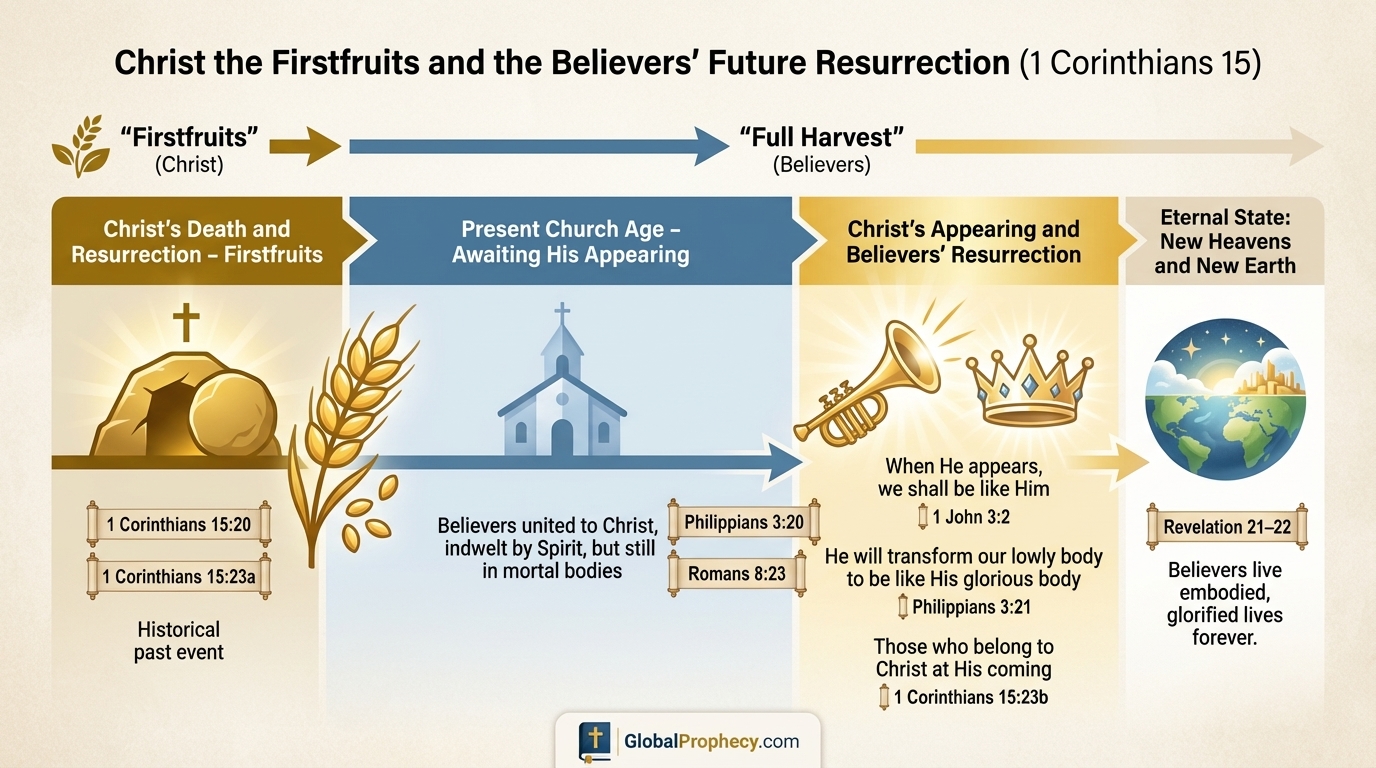
"But in fact Christ has been raised from the dead, the firstfruits of those who have fallen asleep."
— 1 Corinthians 15:20
Christ’s resurrection is the pattern and guarantee of the believer’s future bodily resurrection. Paul states explicitly:
"[He] will transform our lowly body to be like his glorious body."
— Philippians 3:21
And John adds:
"We know that when he appears we shall be like him, because we shall see him as he is."
— 1 John 3:2
The central text describing the nature of the resurrection body is 1 Corinthians 15:35–54, where Paul answers two key questions:
- How are the dead raised?
- With what kind of body do they come? (1 Cor 15:35)
From these and related passages we can summarize seven core characteristics of the believer’s resurrection body.
3. Continuity and Personal Identity
3.1 Same Person, Transformed Body
Resurrection is not replacement but transformation. Paul speaks of "the redemption of our bodies" (Romans 8:23), not the creation of entirely different bodies. The "seed" analogy in 1 Corinthians 15:36–38 is crucial: what is planted and what emerges are organically related—the same identity, yet gloriously changed.
"What you sow is not the body that is to be, but a bare kernel… But God gives it a body as he has chosen."
— 1 Corinthians 15:37–38
The empty tomb of Jesus and the presence of His crucifixion scars (John 20:27; Luke 24:39–40) show that His resurrection body was continuous with His pre-death body, though glorified. Since Christ is the "firstfruits" (1 Cor 15:20, 23), believers can expect the same pattern.
3.2 Recognizable Identity and Memory
The risen Christ was recognizable:
- Mary Magdalene knew Him when He spoke her name (John 20:16).
- The disciples recognized Him by His wounds (John 20:27–28).
- The Emmaus disciples recognized Him in fellowship and teaching (Luke 24:30–31).
These accounts strongly imply that personality, memory, and conscious identity continue in the resurrection. Believers will be themselves, fully restored, not anonymous spirits.
4. A Real, Physical but Glorified Body
4.1 Truly Physical, Not a Ghost
The believer’s resurrection body will be physical and material, not merely symbolic or spiritual in the sense of “non-bodily.” Paul speaks explicitly of "a spiritual body" (1 Cor 15:44), but "body" (Greek sōma) in his writings consistently refers to a real, tangible body when applied to humans.
Jesus’ post-resurrection appearances define what a glorified body is like:
"See my hands and my feet, that it is I myself. Touch me, and see. For a spirit does not have flesh and bones as you see that I have."
— Luke 24:39
Key evidences of physicality:
- His tomb was empty—the same body that was buried is the one raised (Matt 28; Luke 24; John 20).
- He invited touch (Matt 28:9; John 20:27).
- He ate food with the disciples (Luke 24:41–43; John 21:12–13).
Since our bodies will be made "like his glorious body" (Phil 3:21), believers will possess real, physical resurrection bodies, suited for the new creation.
4.2 “Flesh and Blood” vs. “Spiritual Body”
Paul writes:
"Flesh and blood cannot inherit the kingdom of God, nor does the perishable inherit the imperishable."
— 1 Corinthians 15:50
"Flesh and blood" here is a Jewish idiom for mortal, perishable humanity, not a denial of bodily existence. Mortal, decaying bodies as they now are cannot inherit the eternal kingdom. Therefore, Paul continues:
"This perishable body must put on the imperishable, and this mortal body must put on immortality."
— 1 Corinthians 15:53
A "spiritual body" (1 Cor 15:44) is not a non-physical body, but a body perfectly governed, empowered, and sustained by the Holy Spirit—in contrast to our current "natural" (soulish, Adamic) bodies, which are subject to sin and decay.
5. Four Core Qualities from 1 Corinthians 15
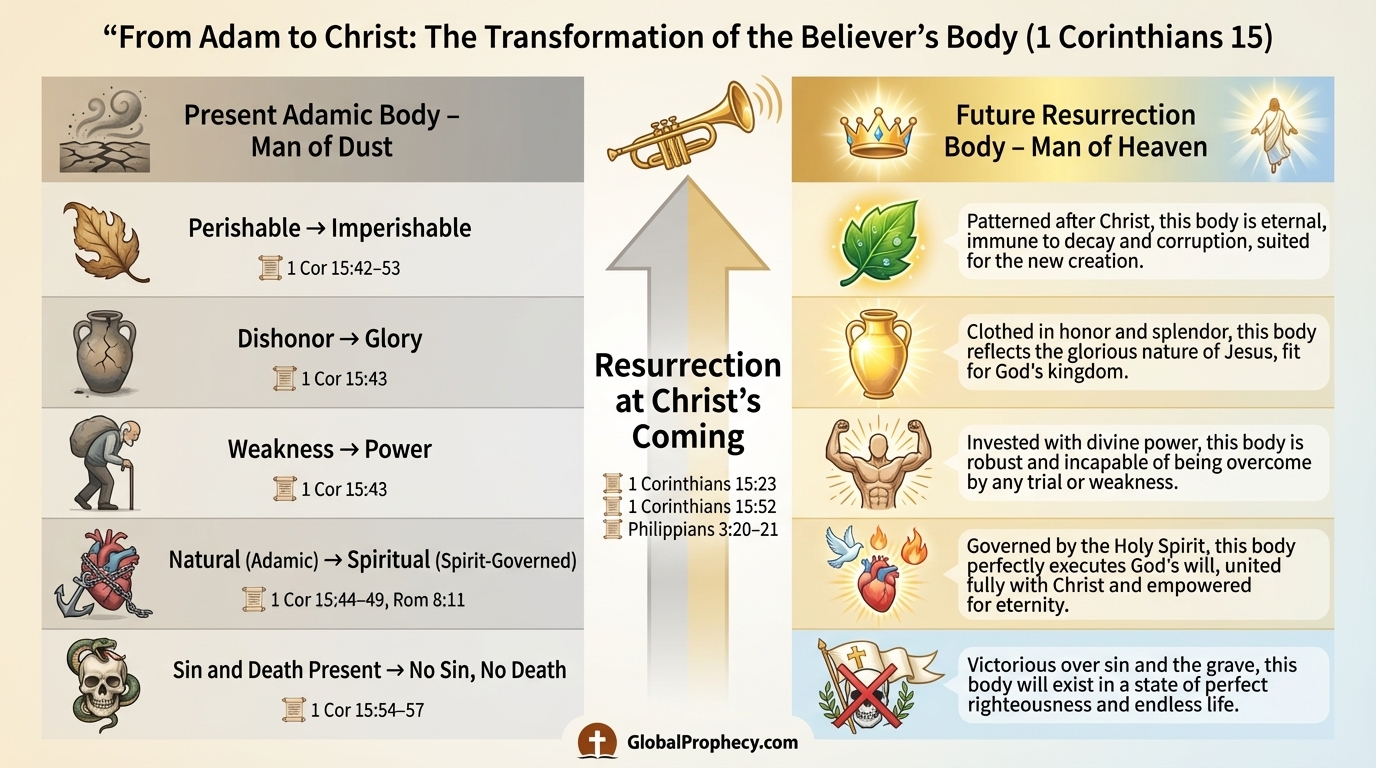
In 1 Corinthians 15:42–44, Paul sets out four key contrasts that define the nature of the glorified body:
"What is sown is perishable; what is raised is imperishable.
It is sown in dishonor; it is raised in glory.
It is sown in weakness; it is raised in power.
It is sown a natural body; it is raised a spiritual body."
— 1 Corinthians 15:42–44
These yield four core attributes:
5.1 Imperishable (Incorruptible)
"The body that is sown is perishable, it is raised imperishable."
— 1 Corinthians 15:42
The resurrection body is:
- Incapable of decay, disease, or aging.
- Free from all physical corruption and breakdown.
- Not subject to accident, deterioration, or death.
Paul summarizes:
"For this perishable body must put on the imperishable."
— 1 Corinthians 15:53
The believer’s glorified body is permanently healthy and whole, never again threatened by sickness or frailty.
5.2 Glorious
"It is sown in dishonor; it is raised in glory."
— 1 Corinthians 15:43
Death and burial, however respectfully handled, highlight the dishonor of fallen mortality—bodies returning to dust (Gen 3:19). In contrast, the resurrection body is characterized by glory:
- It reflects the splendor and honor of Christ’s risen humanity (Phil 3:21).
- It is free from the shame and defilement of sin.
- It is morally and aesthetically fitting for the presence of God.
This glory is both physical and moral: the body is radiant, and the person is fully conformed to Christ’s holy character.
5.3 Powerful
"It is sown in weakness; it is raised in power."
— 1 Corinthians 15:43
Our present bodies are marked by:
- Exhaustion and fatigue.
- Physical limitations, disability, and frailty.
- Vulnerability to pain, injury, and eventual death.
The resurrection body is raised in power:
- No more tiredness or depletion.
- Full, vigorous capacity for service, worship, and joy.
- No incapacity, diminishing strength, or bodily failure.
The believer will possess unhindered, Spirit-energized bodily life, forever.
5.4 Spiritual (Spirit-Governed)
"It is sown a natural body; it is raised a spiritual body."
— 1 Corinthians 15:44
"Natural" (psychikos) refers to our present Adamic, soul-dominated condition—subject to sin, weakness, and the limitations of fallen humanity. "Spiritual" (pneumatikos) signifies a body:
- Fully oriented to God, not to sin.
- Completely controlled and empowered by the Holy Spirit (Rom 8:11).
- Perfectly responsive to righteousness and incapable of moral failure.
This does not mean immaterial, but morally and spiritually perfected embodiment.
6. Patterned After the Risen Christ
6.1 Bearing the Image of the Heavenly Man
Paul links our future bodies directly to Christ:
"Just as we have borne the image of the man of dust, we shall also bear the image of the man of heaven."
— 1 Corinthians 15:49
Believers now bear Adam’s image: frail, sinful, and mortal. In the resurrection, they will bear Christ’s image: righteous, powerful, and immortal.
Philippians reinforces this:
"…the Lord Jesus Christ… will transform our lowly body to be like his glorious body."
— Philippians 3:20–21
This includes:
- Real continuity of body.
- Radical transformation in quality.
- Conformity to Christ both physically (glorified humanity) and morally (perfect holiness).
6.2 No More Sin or Death
Paul stresses that the resurrection body is not only immortal but free from sin’s corruption:
"For this perishable body must put on the imperishable, and this mortal body must put on immortality… ‘Death is swallowed up in victory.’"
— 1 Corinthians 15:53–54
Corruption in Scripture includes both:
- Physical decay (disease, breakdown, death).
- Moral corruption (sinful desires, disordered affections).
In the resurrection body:
- No sinful impulse remains.
- No internal struggle with the flesh.
- The believer’s whole being—body, soul, and spirit—is fully and finally sanctified.
The resurrection body is thus perfectly fitted for unending fellowship with God.
7. Suited for Heaven and the New Earth
Paul explains why glorification is necessary:
"Flesh and blood cannot inherit the kingdom of God."
— 1 Corinthians 15:50
Our current bodies are not suitable for the coming glory of the kingdom or the new heavens and new earth. Therefore:
"We wait eagerly for adoption as sons, the redemption of our bodies."
— Romans 8:23
The resurrection body is:
- Heavenly in origin and capacity (1 Cor 15:47–49).
- Perfectly adapted for eternal life on the renewed earth (Rev 21–22).
- In harmony with a creation where there is no curse, pain, or death.
Believers will live embodied, active lives—worshiping, serving, reigning with Christ—forever, in bodies that perfectly match that eternal environment.
8. Conclusion
The Bible presents the believer’s resurrection body as:
- Continuous with our present body, preserving identity and personhood.
- Physical and tangible, like Christ’s own risen body.
- Imperishable, glorious, powerful, and spiritual—incorruptible, radiant, strong, and Spirit-governed.
- Sinless and immortal, no longer subject to death or moral failure.
- Patterned after the resurrected Christ, and perfectly suited for eternal life in the kingdom and on the new earth.
This doctrine is not speculative theology but the center of Christian hope, grounded in the historical resurrection of Jesus. As Paul concludes:
"Thanks be to God, who gives us the victory through our Lord Jesus Christ."
— 1 Corinthians 15:57
FAQ
Q: Will our resurrection bodies be physical or just spiritual?
Our resurrection bodies will be truly physical. Jesus’ resurrection body had flesh and bones, could be touched, and ate food (Luke 24:39–43; John 21:12–13). Scripture promises that Christ "will transform our lowly body to be like his glorious body" (Phil 3:21), so believers’ resurrection bodies will likewise be tangible, physical, yet glorified.
Q: What does it mean that the resurrection body is a “spiritual body”?
In 1 Corinthians 15:44, "spiritual body" does not mean non-material. It means a body fully directed and empowered by the Holy Spirit rather than by fallen, natural impulses. The resurrection body is still a real body, but one perfectly aligned with God’s will and completely free from sin and weakness.
Q: Will we recognize one another in our resurrection bodies?
Yes. The risen Christ was recognized by His disciples, and Scripture assumes continuity of personal identity and memory (John 20:16; Luke 24:30–31). Since our resurrection is patterned after His, believers can expect to recognize one another and to remain fully themselves, now perfected.
Q: How does 1 Corinthians 15 describe the resurrection body?
1 Corinthians 15:42–44 describes the believer’s resurrection body as imperishable, glorious, powerful, and spiritual. Perishable bodies become imperishable; dishonor is replaced with glory; weakness with power; and the natural (Adamic) body with a Spirit-governed body, fully fit for God’s eternal kingdom.
Q: Why can’t our current bodies enter the kingdom of God?
Paul says, "flesh and blood cannot inherit the kingdom of God" (1 Cor 15:50), meaning that our present mortal, decaying condition is unfit for the eternal kingdom. Therefore "this perishable body must put on the imperishable, and this mortal body must put on immortality" (1 Cor 15:53). The resurrection body is God’s provision to fit believers for everlasting life in His presence.
Frequently Asked Questions
Will our resurrection bodies be physical or just spiritual?
What does it mean that the resurrection body is a “spiritual body”?
Will we recognize one another in our resurrection bodies?
How does 1 Corinthians 15 describe the resurrection body?
Why can’t our current bodies enter the kingdom of God?
L. A. C.
Theologian specializing in eschatology, committed to helping believers understand God's prophetic Word.
Related Articles
The Crowns of Heaven: Eternal Rewards for Believers
Discover the five eternal crowns believers can receive as rewards in heaven. Learn what Scripture teaches about earning the imperishable, rejoicing, righteousness, glory, and life crowns.
What is the Judgment Seat of Christ?
Judgment Seat of Christ explained from 2 Corinthians 5:10 and Romans 14:10—when believers are evaluated for rewards, not condemned for sin.
The Order of the Resurrections
The order of the resurrections explained: Christ’s resurrection, the first resurrection at the rapture, and the second resurrection at the final judgment.
What Will Happen at the Rapture?
Rapture events explained step by step: what believers will experience, how resurrection and transformation unfold, and the sequence revealed in Scripture.