
Understanding the New Covenant: Israel, the Church, or Both?
1. Introduction
The question “Who is the New Covenant for—Israel, the Church, or both?” lies at the heart of biblical eschatology and the interpretation of God’s plan for history. The answer shapes how we understand Israel’s future, the nature of the Church, and the fulfillment of Old Testament prophecy.
This article examines the New Covenant of Jeremiah 31 and its New Testament application, arguing that:
- The New Covenant is made with national Israel.
- The Church now participates in its spiritual blessings through Christ.
- The full covenant will be fulfilled in Israel in the future.
This preserves both the integrity of Old Testament promises and the unity of salvation in Christ.
2. The New Covenant in Jeremiah 31
The foundational passage is Jeremiah 31:31–34:
“Behold, the days are coming, declares the LORD, when I will make a new covenant with the house of Israel and the house of Judah, not like the covenant that I made with their fathers...
...For this is the covenant that I will make with the house of Israel after those days...
I will put my law within them, and I will write it on their hearts. And I will be their God, and they shall be my people...
For I will forgive their iniquity, and I will remember their sin no more.”
— Jeremiah 31:31–34
2.1. Directly Addressed Parties
The text is explicit: the New Covenant is made “with the house of Israel and the house of Judah”. In its original context:
- “Israel” and “Judah” refer to the literal ethnic nation(s) descended from Abraham, Isaac, and Jacob.
- The covenant is contrasted with the Mosaic covenant made at the Exodus (“when I took them by the hand to bring them out of the land of Egypt”).
Nothing in the chapter suggests “Israel” is being redefined as “the Church.”
2.2. Core Promises of the New Covenant
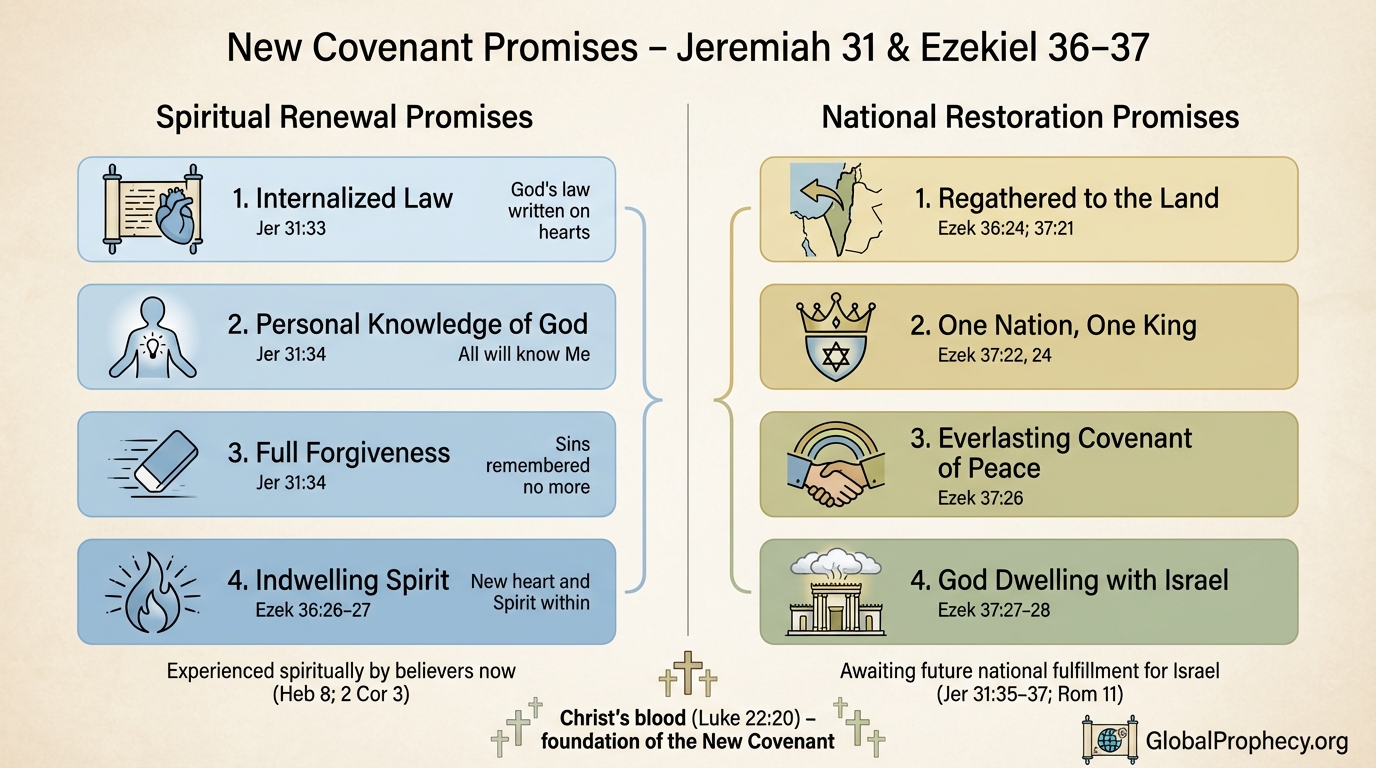
Key features of the New Covenant in Jeremiah 31 and related passages (e.g., Ezekiel 36:25–27; 37:21–28; Isaiah 59:21) include:
-
Internalized law
“I will put my law within them, and I will write it on their hearts” (Jer 31:33). -
Personal knowledge of God
“They shall all know me, from the least of them to the greatest” (Jer 31:34). -
Full and final forgiveness
“I will forgive their iniquity, and I will remember their sin no more” (Jer 31:34). -
The Spirit’s indwelling and enablement
“I will put my Spirit within you, and cause you to walk in my statutes” (Ezek 36:27). -
National restoration of Israel
“I will take the people of Israel from the nations...and bring them to their own land. And I will make them one nation in the land” (Ezek 37:21–22).
These promises together define the New Covenant package: spiritual renewal, forgiveness, the Spirit, and national restoration in the land under one Davidic King.
2.3. Permanence and Israel’s Future
Jeremiah immediately anchors the New Covenant in God’s unbreakable commitment to Israel’s continued existence:
“Thus says the LORD,
who gives the sun for light by day
and the fixed order of the moon and the stars...
‘If this fixed order departs from before me...
then shall the offspring of Israel cease from being a nation before me forever.’”
— Jeremiah 31:35–36
The New Covenant therefore guarantees Israel’s national future. Far from being replaced, Israel is assured of eventual restoration.
3. New Testament Application of the New Covenant
The New Testament repeatedly links Jesus’ death to the New Covenant, and applies its blessings to Church-age believers.
3.1. Jesus’ Words at the Last Supper
At the institution of the Lord’s Supper, Jesus said:
“This cup that is poured out for you is the new covenant in my blood.”
— Luke 22:20 (cf. Matthew 26:28; 1 Corinthians 11:25)
Here:
- Jesus explicitly initiates the New Covenant by His sacrificial death.
- His blood is the covenant-ratifying sacrifice anticipated in Jeremiah and Ezekiel.
Yet the original covenant partners (Israel and Judah) have not yet experienced all that was promised—especially national restoration and universal knowledge of the Lord.
3.2. Paul and the New Covenant
Paul twice refers to the New Covenant explicitly:
- 1 Corinthians 11:25 — applying Jesus’ words to the Church’s ongoing observance of the Lord’s Supper.
- 2 Corinthians 3:6 — “who has made us competent to be ministers of a new covenant, not of the letter but of the Spirit. For the letter kills, but the Spirit gives life.”
The Corinthian believers (largely Gentile) are:
- Recipients of New Covenant ministry (“ministers of a new covenant”).
- Experiencing the Spirit’s work written on hearts, in contrast to the law written on stone (2 Cor 3:3).
Thus the Church participates in New Covenant blessings—especially forgiveness, the indwelling Spirit, and transformed hearts—because these blessings flow from Christ’s atoning work, which is the basis of the New Covenant.
3.3. Hebrews and the New Covenant
Hebrews quotes Jeremiah 31:31–34 at length (Hebrews 8:8–12; 10:16–17), and then concludes:
“In speaking of a new covenant, he makes the first one obsolete. And what is becoming obsolete and growing old is ready to vanish away.”
— Hebrews 8:13
Key points:
- The author contrasts the Mosaic covenant (“the first one”) with the New Covenant.
- He insists that the Mosaic covenant is obsolete because the promised New Covenant has been inaugurated through Christ’s priestly work.
- New Covenant blessings (forgiveness, internal law, access to God) are applied to believers now.
Yet Hebrews does not say that the Church replaces Israel as the “house of Israel” and “house of Judah.” Rather, believers in Christ—Jew and Gentile—share in the spiritual blessings of the New Covenant that was promised to Israel.
4. Major Views: Israel, the Church, or Both?
Within evangelical theology, especially in discussions of biblical prophecy, four main views have emerged on who the New Covenant applies to. These can be summarized as follows:
| View | Who It Applies To | Main Problem(s) |
|---|---|---|
| Church Alone | New Covenant is for the Church only; “Israel” = Church | Ignores explicit OT wording (“house of Israel and house of Judah”); erases Israel’s national future. |
| Israel Alone | New Covenant is only for ethnic Israel; Church unrelated | Cannot explain Jesus’ and Paul’s application of New Covenant language to believers now. |
| Two New Covenants | One New Covenant for Israel; a separate one for the Church | Scripture never speaks of two New Covenants; same terminology and cross-based forgiveness are shared. |
| Church Participation | New Covenant made with Israel; the Church participates in its spiritual blessings now, with full fulfillment in restored Israel | Harmonizes OT and NT data; maintains Israel–Church distinction and unity in Christ. |
From a dispensational, premillennial standpoint, the “Church Participation” view best accounts for all the biblical data.
5. So Who Is the New Covenant For?
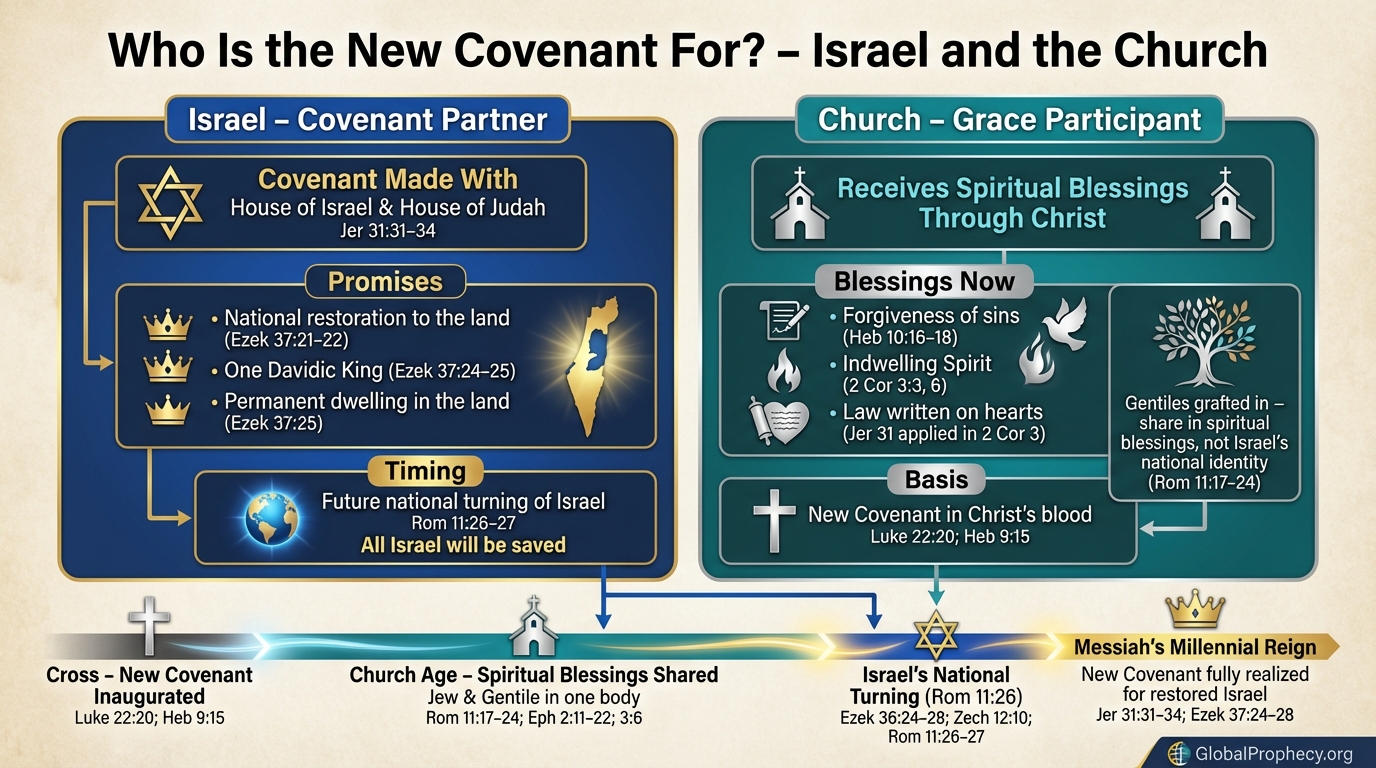
5.1. Primarily for Israel (the Covenant Partner)
Biblically, the New Covenant is made with Israel:
- It is explicitly addressed to “the house of Israel and the house of Judah” (Jer 31:31).
- Its promises include national, territorial, and political elements (e.g., regathering to the land, one king over a united Israel, permanent dwelling in the land — Ezek 37:21–28).
- Romans 11:26–27 cites Isaiah 59:20–21 in connection with Israel’s final salvation:
“And in this way all Israel will be saved, as it is written,
‘The Deliverer will come from Zion,
he will banish ungodliness from Jacob’;
‘and this will be my covenant with them
when I take away their sins.’”
Here Paul:
- Affirms a future, national turning of Israel to Christ.
- Connects this event with the New Covenant promise of forgiveness.
Thus, Israel remains the primary, direct covenant partner. The New Covenant guarantees that a future generation of Israel will be brought into a permanent relationship with God, in their land, under Messiah’s reign.
5.2. Secondarily for the Church (Participation in Its Blessings)
At the same time, the New Testament clearly teaches that Church-age believers already enjoy key spiritual blessings promised in the New Covenant:
- Forgiveness of sins (Heb 10:17–18).
- Indwelling Holy Spirit (Rom 8:9; 2 Cor 3:3, 6).
- God’s law written on hearts (applied in 2 Cor 3 using Jer 31 language).
- Access to God through Christ, our High Priest (Heb 10:19–22).
This is possible because:
- The basis of the New Covenant is Christ’s blood (Luke 22:20; Heb 9:15).
- That atoning work is sufficient for all—Jews and Gentiles alike.
- As Gentiles are united to Christ, they are “grafted in” to the olive tree of promise (Rom 11:17–24), and thus share in Israel’s spiritual blessings (not its national identity).
In this sense:
- The Church does not take over Israel’s New Covenant.
- Rather, the Church shares in its spiritual provisions while the full national fulfillment awaits Israel’s future restoration.
6. Israel, the Church, and the Integrity of God’s Promises
Understanding the New Covenant this way preserves:
6.1. God’s Faithfulness to Israel
God’s covenants with Israel (Abrahamic, Davidic, New) are:
- Unconditional (grounded in God’s “I will”).
- Everlasting (e.g., Jer 32:40; Ezek 37:26).
- Irrevocable (Rom 11:29: “For the gifts and the calling of God are irrevocable.”).
If the Church simply replaces Israel, these covenants—especially Jeremiah 31’s guarantee of Israel’s perpetual national existence—would be voided or redefined, calling God’s faithfulness into question.
6.2. Unity of Salvation in Christ
At the same time, there is only one way of salvation for Jew and Gentile alike:
- Through faith in Christ and His once-for-all sacrifice (Heb 10:10, 14).
- All the redeemed, in every age, are included in the people of God.
The New Covenant is the final, superior covenant under which all redeemed—Israel and the Church—ultimately stand. But within that unity there remain distinct roles and promises, particularly for national Israel in God’s eschatological plan.
7. Conclusion
So, who does the New Covenant apply to—Israel, the Church, or both?
- In origin and primary intent, the New Covenant is made with national Israel (“the house of Israel and the house of Judah”) and guarantees her future spiritual renewal and national restoration under Messiah in the land.
- In application and present experience, the Church participates in the spiritual blessings of the New Covenant—especially forgiveness, the indwelling Spirit, and transformed hearts—because these flow from Christ’s New Covenant blood.
This balanced, text-driven view:
- Honors the plain meaning of Jeremiah 31.
- Accounts for the New Testament’s application of New Covenant language to believers now.
- Safeguards God’s faithfulness to Israel and the unity of redemption in Christ.
The New Covenant, then, is for Israel as covenant partner and for the Church as grace-participant—different roles, one covenant, centered in Jesus Christ.
FAQ
Q: Does the New Covenant replace the Old Testament promises to Israel?
No. The New Covenant fulfills and secures God’s promises to Israel; it does not cancel them. Jeremiah 31 explicitly ties the New Covenant to the permanent existence of Israel as a nation, and Romans 11 expects a future national turning of Israel to Christ in connection with this covenant.
Q: Is the Church the “new Israel” under the New Covenant?
Scripture never calls the Church “Israel.” While the Church shares in New Covenant blessings through union with Christ, the term “Israel” consistently refers to ethnic Israel in both Old and New Testaments. The Church is a distinct entity, composed of believing Jews and Gentiles, not a replacement for Israel.
Q: How does the Church participate in the New Covenant today?
The Church participates in the New Covenant through Christ’s blood, which inaugurated it. Believers today experience forgiveness of sins, the indwelling Holy Spirit, and God’s law written on their hearts—all core New Covenant blessings—while the full national and territorial aspects await Israel’s future restoration.
Q: Will the New Covenant have a future fulfillment for Israel?
Yes. Jeremiah 31; Ezekiel 36–37; Romans 11:26–27 all point to a future, national fulfillment when Israel is regathered, regenerated, and ruled by the Messiah in the land. That future era—associated with Christ’s millennial kingdom—is when the New Covenant will be completely realized for Israel.
Q: Is there more than one New Covenant—one for Israel and one for the Church?
No. The Bible speaks of one New Covenant, grounded in Christ’s once-for-all sacrifice. Proposing two separate New Covenants creates an artificial distinction not found in Scripture. There is one covenant, made with Israel, whose spiritual blessings are shared with the Church and whose full national promises await Israel’s future salvation and restoration.
Frequently Asked Questions
Does the New Covenant replace the Old Testament promises to Israel?
Is the Church the “new Israel” under the New Covenant?
How does the Church participate in the New Covenant today?
Will the New Covenant have a future fulfillment for Israel?
Is there more than one New Covenant—one for Israel and one for the Church?
L. A. C.
Theologian specializing in eschatology, committed to helping believers understand God's prophetic Word.
Related Articles
The 144,000 Sealed Israelites
144,000 sealed Israelites in Revelation identified and explained—their identity, purpose, and distinct role as preserved witnesses during the Tribulation.
The Abrahamic Covenant: God's Unconditional Promise to Israel
Abrahamic Covenant explained as God’s unconditional promise to Israel, defining land, seed and blessing and shaping key end-times Bible prophecy.
Amillennialism Examined: Is the Church the Millennial Kingdom?
Amillennialism examined: is the church the millennial kingdom? Explore its claims, symbols, and a biblical critique of this end-times view.
The Betrothal of the Church, the Marriage of the Lamb, and the Banquet
Marriage of the Lamb explains Christ’s betrothal with the church, the heavenly marriage ceremony and the end-time wedding banquet in glory.