
The New Jerusalem
1. Introduction
In biblical eschatology, the New Jerusalem is the final, eternal dwelling place of the redeemed. It appears at the climax of Scripture, when God has judged evil, abolished death, and created a new heaven and new earth (Rev 21:1). This “holy city” is not merely a symbol of salvation; it is presented as a real, resplendent city in which God dwells with His people forever.
“And I saw the holy city, new Jerusalem, coming down out of heaven from God, prepared as a bride adorned for her husband.”
— Revelation 21:2
Understanding the New Jerusalem is essential to understanding the eternal state and the believer’s ultimate hope. It is the consummation of God’s redemptive plan: heaven and earth united, curse removed, and God’s people at home in His presence forever.
2. Biblical Foundations for the New Jerusalem
2.1 Key Texts
The primary biblical description of the New Jerusalem is in Revelation 21–22. Several key statements frame its identity as the eternal home of believers:
- It appears after the final judgment and the destruction of the present heaven and earth (Rev 20:11; 21:1).
- It is called “the holy city, new Jerusalem” and described repeatedly as a city (Rev 21:2, 10, 14–16, 18–19; 22:2–3, 14, 19).
- It comes down “out of heaven from God” to rest upon or in direct relationship with the new earth (Rev 21:2, 10).
- It is described as the bride, the wife of the Lamb (Rev 21:9), highlighting its intimate association with the redeemed people of God.
Other New Testament passages anticipate this reality:
- Believers are said to desire “a better country, that is, a heavenly one” and to look “forward to the city that has foundations, whose designer and builder is God” (Heb 11:10, 16).
- Christians are already spiritually related to this realm:
“You have come to Mount Zion and to the city of the living God, the heavenly Jerusalem …”
— Hebrews 12:22
The New Jerusalem, then, is the final form of heaven—the center of God’s eternal kingdom, located on the new earth, where believers will dwell bodily and consciously forever.
2.2 Eternal, Not Millennial
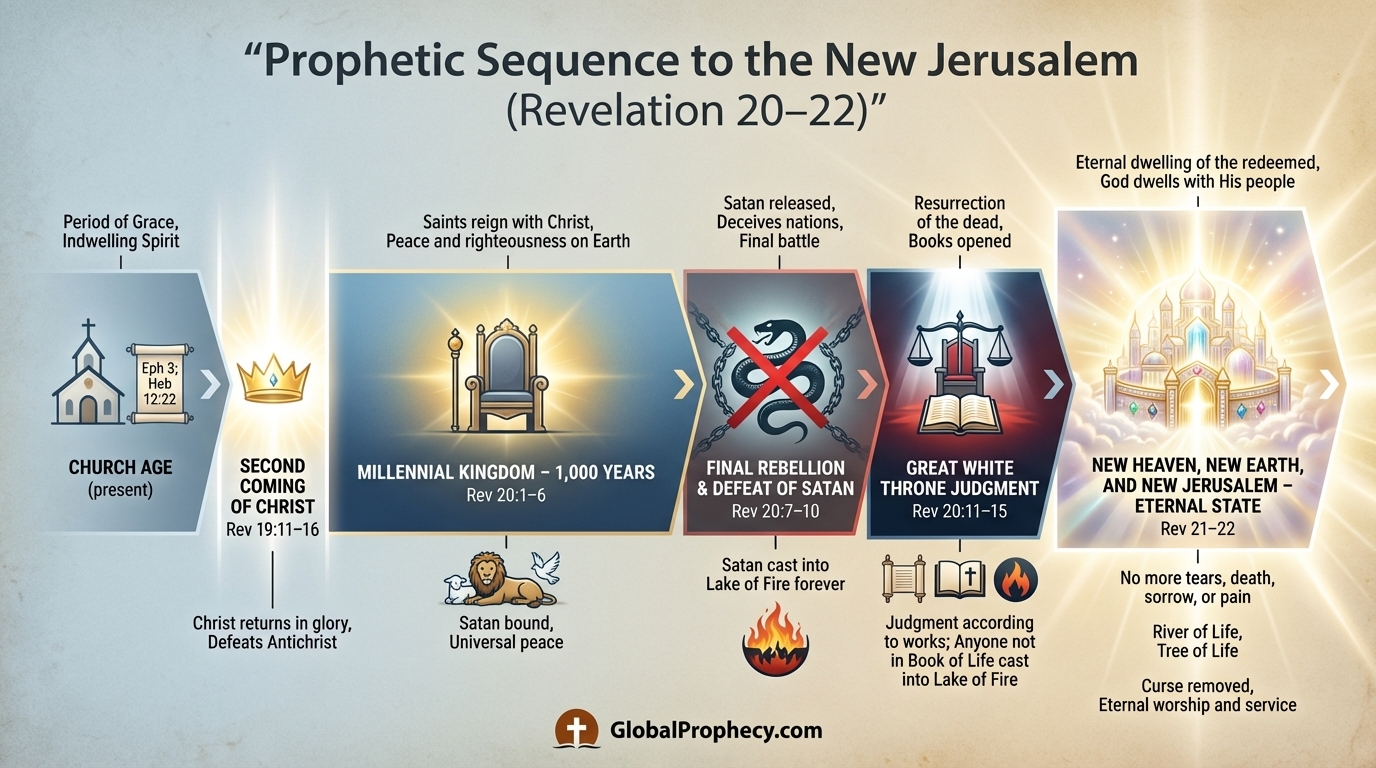
Revelation’s sequence places the New Jerusalem after:
- Christ’s millennial reign (Rev 20:1–6)
- The final rebellion and defeat of Satan (Rev 20:7–10)
- The great white throne judgment (Rev 20:11–15)
Only then do we read of a new heaven and new earth and the descent of the New Jerusalem (Rev 21:1–2). This shows that the New Jerusalem is not temporary or merely millennial; it is the permanent, eternal dwelling place of the saints.
3. The Physical and Structural Features of the New Jerusalem
3.1 A Real, Measured City
John is given an explicitly spatial description:
“The city lies foursquare, its length the same as its width. And he measured the city with his rod, 12,000 stadia. Its length and width and height are equal.”
— Revelation 21:16
- Shape: A perfect cube (or possibly a pyramid), length = width = height.
- Scale: 12,000 stadia—roughly 1,400–1,500 miles in each direction.
This yields billions of cubic miles of habitable space, more than sufficient for “a great multitude that no one could number” (Rev 7:9). - Wall: 144 cubits (about 216 ft) in measurement (Rev 21:17), likely height or thickness, emphasizing security and majesty.
The repeated mention of precise measurements and materials strongly supports a literal city rather than a mere metaphor.
3.2 Walls, Gates, and Foundations
The New Jerusalem’s architecture visibly displays God’s redemptive work:
- Great, high wall of jasper (Rev 21:12, 18): speaks of security and separation from all evil.
- Twelve gates, three on each side, each made of one great pearl (Rev 21:12–13, 21).
- Each gate bears the name of one of the twelve tribes of Israel (Rev 21:12).
- Angels stand at the gates, symbolizing holy guardianship and welcome.
- Twelve foundations of the city wall, adorned with twelve different precious stones (Rev 21:19–20).
- On each foundation is the name of one of the twelve apostles of the Lamb (Rev 21:14).
This twofold inscription—tribes and apostles—indicates that the New Jerusalem is the eternal home of all God’s redeemed people, both Israel and the church, in their proper distinctions yet united in one city.
3.3 Materials and Light
The city is designed to display and transmit the glory of God:
- The city is “pure gold, like clear glass” (Rev 21:18, 21).
- The wall is “built of jasper” and the foundations are inlaid with a spectrum of precious stones (Rev 21:18–20).
- Translucent materials allow the glory of God to radiate unhindered:
“The city has no need of sun or moon to shine on it, for the glory of God gives it light, and its lamp is the Lamb.”
— Revelation 21:23
There is no night there (Rev 21:25; 22:5). The New Jerusalem is permanently, radiantly lit by God’s own presence.
3.4 The River of Life and the Tree of Life
At the heart of the city stands the throne and the symbols of eternal life:
“Then the angel showed me the river of the water of life, bright as crystal, flowing from the throne of God and of the Lamb through the middle of the street of the city.”
— Revelation 22:1–2
Key features:
- River of the water of life: Clear as crystal, proceeding from the one throne of God and the Lamb; signifies the constant outflow of spiritual and physical life in the eternal state.
- Tree of life: Located on either side of the river, “with its twelve kinds of fruit, yielding its fruit each month” (Rev 22:2).
- Its leaves are “for the healing [health-giving] of the nations” (Rev 22:2), not to cure sickness (which no longer exists, Rev 21:4), but to enhance and sustain the fullness of life.
The tree of life, barred to humanity after the fall (Gen 3:22–24), is now permanently accessible, signifying that paradise is fully restored—and exceeded—in the New Jerusalem.
3.5 No Temple, No Sea, No Curse
Several absences mark the New Jerusalem as qualitatively different from the present world:
- No temple:
“I saw no temple in the city, for its temple is the Lord God the Almighty and the Lamb.”
— Revelation 21:22
Worship is no longer localized; the entire city is a holy of holies. - No sea (Rev 21:1): likely indicating the complete removal of chaos and separation that seas symbolized in the ancient world.
- No curse:
“No longer will there be anything accursed, but the throne of God and of the Lamb will be in it …”
— Revelation 22:3
All effects of the fall—sin, decay, futility—are eradicated.
These features underscore that the New Jerusalem is a perfect, curse-free environment suited to glorified people in glorified bodies.
4. The Inhabitants and Life in the New Jerusalem
4.1 God’s Immediate Presence
The central reality of the New Jerusalem is not architecture, but God Himself:
“Behold, the dwelling place of God is with man. He will dwell with them, and they will be his people, and God himself will be with them as their God.”
— Revelation 21:3
This fulfills the repeated covenant promise, “I will be their God, and they shall be my people,” in its fullest, visible, permanent form. Believers will experience the Beatific Vision:
“They will see his face, and his name will be on their foreheads.”
— Revelation 22:4
To “see His face” is to enjoy direct, immediate, unhindered fellowship with God in Christ.
4.2 The Redeemed of All Ages
Hebrews depicts the heavenly Jerusalem as populated by diverse groups of redeemed beings (Heb 12:22–24):
- “Thousands upon thousands of angels in joyful assembly”
- “The church of the firstborn who are enrolled in heaven”
- “The spirits of the righteous made perfect” (Old Testament saints and others outside the church age)
- “Jesus, the mediator of a new covenant”
- “God, the judge of all”
Revelation 21–22 shows that all such redeemed people ultimately dwell in and around the New Jerusalem. This is the common home of:
- The church, Christ’s bride
- Saved Israel
- Believers from all nations and eras (“the nations” who walk by its light, Rev 21:24)
4.3 Perfect Life, Joy, and Rest
Within the New Jerusalem, the conditions of life are radically unlike anything in the fallen world:
“He will wipe away every tear from their eyes, and death shall be no more, neither shall there be mourning, nor crying, nor pain anymore, for the former things have passed away.”
— Revelation 21:4
In the city:
- There is no death, ever (Rev 21:4).
- There is no mourning, crying, or pain (Rev 21:4).
- There is no night, no fear, no insecurity (Rev 21:25; 22:5).
- Believers possess glorified, imperishable bodies (1 Cor 15:42–54; Phil 3:21), suited for eternal activity and joy.
4.4 Worship, Service, and Reigning
Life in the New Jerusalem is not passive; it is active, God-centered existence:
“The throne of God and of the Lamb will be in it, and his servants will worship him.”
— Revelation 22:3
“They will reign forever and ever.”
— Revelation 22:5
Key aspects of eternal life in the city include:
- Unending worship: All existence is worshipful; there is no sacred–secular divide.
- Priestly service: Believers serve as a “kingdom and priests” forever (Rev 1:6; 22:3).
- Reigning with Christ: The saints exercise real, delegated rule under the authority of the triune God (Rev 22:5), a final fulfillment of humanity’s original mandate to rule the earth (Gen 1:26–28).
- Eternal learning and communion: Finite creatures will eternally grow in their understanding and enjoyment of the infinite God, without ever exhausting His fullness.
4.5 Holiness and Security
The New Jerusalem is a holy city:
“But nothing unclean will ever enter it, nor anyone who does what is detestable or false, but only those who are written in the Lamb’s book of life.”
— Revelation 21:27
- No sin can ever intrude.
- Satan, demons, and all unrepentant sinners are forever consigned to the lake of fire (Rev 20:10, 14–15).
- The city’s open gates (Rev 21:25) symbolize that while there is total security, there is no fear, no threat, no need for defense.
The New Jerusalem is thus a realm of absolute holiness, safety, and love for all who belong to Christ.
5. The Theological Significance of the New Jerusalem as Believers’ Eternal Home
5.1 The Union of Heaven and Earth
When the New Jerusalem descends, heaven comes down to earth:
“Then I saw a new heaven and a new earth … And I saw the holy city, new Jerusalem, coming down out of heaven from God.”
— Revelation 21:1–2
The eternal state is not disembodied souls floating in a vague “heaven,” but resurrected people living in a resurrected city on a renewed earth in the immediate presence of God. This fulfills God’s purpose to dwell with humanity in a material yet glorified creation.
5.2 The Reversal of the Fall and the Completion of Redemption
The New Jerusalem is the complete reversal of Genesis 3 and the consummation of all redemptive history:
| Fallen World (Genesis 3) | New Jerusalem (Revelation 21–22) |
|---|---|
| Entrance of sin and curse | “No longer will there be anything accursed” (22:3) |
| Expulsion from Eden | Entrance into the eternal city (21:27) |
| Banned from the tree of life (Gen 3:24) | Full access to the tree of life (22:2, 14) |
| Death, sorrow, pain begin | “No more death … mourning … crying … pain” (21:4) |
| God’s presence withdrawn | “He will dwell with them” (21:3); “They will see his face” (22:4) |
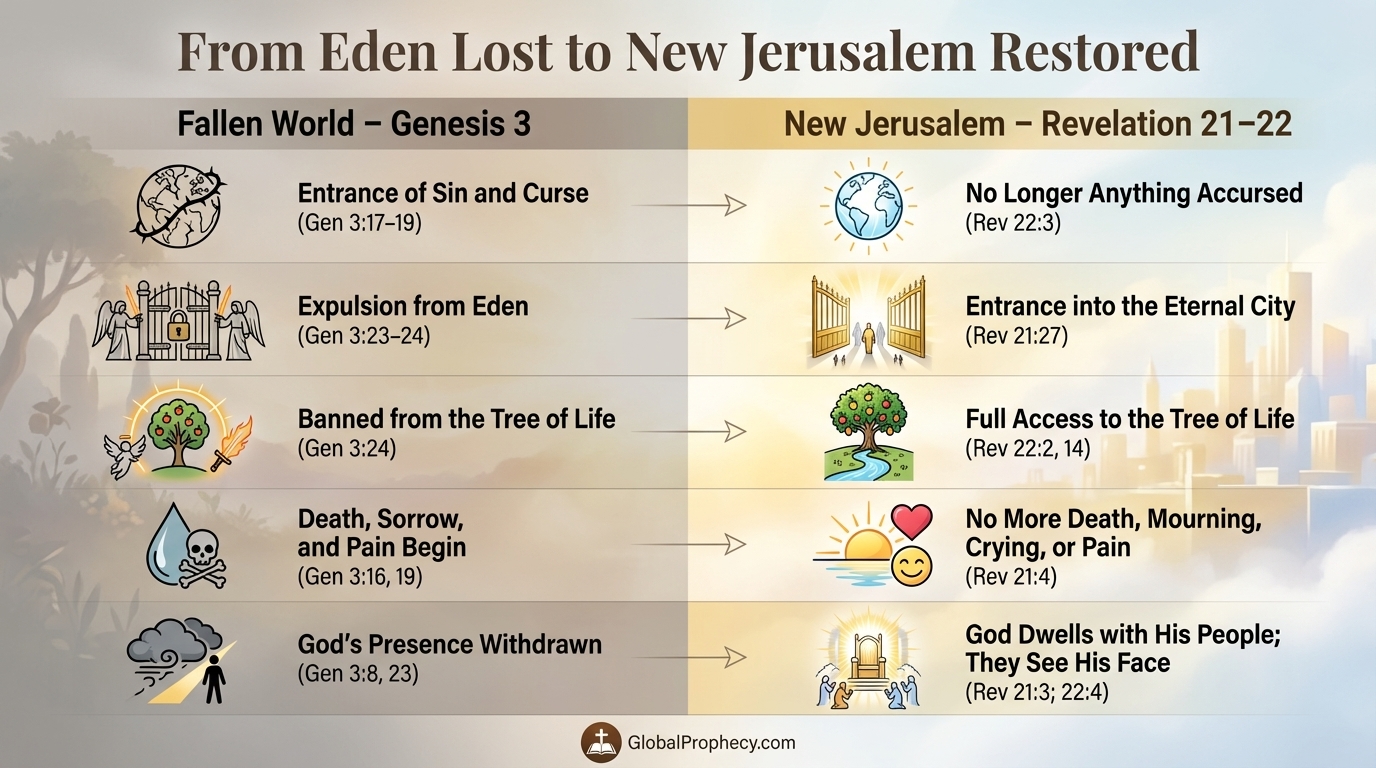
Every wound of the fall is more than healed; it is surpassed by everlasting glory.
5.3 Fulfillment of the Promises and Covenants
The New Jerusalem also fulfills:
- Abrahamic promises of an eternal inheritance (Heb 11:10, 16).
- Davidic promises of an everlasting throne and kingdom, centered on the Lamb’s throne (Rev 22:1, 3).
- The New Covenant, under which God writes His law on hearts and dwells permanently with His people (Jer 31:31–34; Rev 21:3).
All God’s promises find their “Yes” in Christ (2 Cor 1:20), and the New Jerusalem is the visible, enduring expression of that “Yes.”
5.4 The Bride and the City
Revelation presents the New Jerusalem as:
“the Bride, the wife of the Lamb.”
— Revelation 21:9
While the people of God are themselves the bride of Christ, the city is the bridal dwelling place prepared for them, adorned as a bride is adorned for her husband. The imagery conveys:
- Beauty (like a bride on her wedding day)
- Intimacy (God dwelling with His people)
- Permanence (an eternal marital union that can never be broken)
Believers’ eternal dwelling in the New Jerusalem is thus the marriage celebration of the Lamb extended into everlasting life.
6. Living Now in Light of the New Jerusalem
The doctrine of the New Jerusalem is not speculative; it is pastoral and practical. Scripture consistently links the hope of the eternal city with present obedience and endurance:
- Peter says believers are “waiting for new heavens and a new earth in which righteousness dwells” and therefore should live in “holiness and godliness” (2 Pet 3:11–13).
- Paul urges believers to “seek the things that are above, where Christ is” and to “set your minds on things that are above” (Col 3:1–2), which include the believer’s future life in the New Jerusalem.
- Hebrews exhorts us to bear reproach now because “here we have no lasting city, but we seek the city that is to come” (Heb 13:14).
Knowing that our true homeland is the New Jerusalem:
- Encourages perseverance in trials.
- Loosens our grip on this passing world.
- Deepens our assurance, if our names are written in the Lamb’s book of life.
- Inspires evangelism and discipleship, since only those who belong to Christ will enter that city (Rev 21:27).
The New Jerusalem is not an optional curiosity of prophecy; it is the final form of the believer’s hope and the ultimate answer to the Lord’s Prayer: “Your kingdom come, your will be done, on earth as it is in heaven” (Matt 6:10).
7. Conclusion
The New Jerusalem stands at the climax of biblical eschatology as the eternal dwelling place of believers. It is a real, immense, exquisitely beautiful city on the new earth, illuminated by the glory of God and the Lamb, where:
- God dwells personally and visibly with His redeemed.
- The curse is gone, and every tear, sorrow, and pain has disappeared.
- The tree of life and the river of life symbolize unending, abundant life.
- The saints worship, serve, and reign forever in perfect holiness and joy.
This heavenly city is the believer’s true home, already prepared by Christ and guaranteed by His finished work. To belong to Jesus is to have a place reserved in the New Jerusalem. To reject Him is to remain forever outside its gates.
In light of this, Scripture presses upon us both an invitation and a warning:
“The Spirit and the Bride say, ‘Come.’ And let the one who hears say, ‘Come.’ … Let the one who desires take the water of life without price.”
— Revelation 22:17
Entrance into the New Jerusalem is free, but it is only through the Lamb. Those who come to Him now will dwell with Him there—forever.
FAQ
Q: Is the New Jerusalem a literal city or just a symbol for the church?
Revelation 21–22 presents the New Jerusalem as a literal city with measured dimensions, walls, gates, foundations, streets, a river, and a throne. While the city is closely associated with God’s people (called “the Bride, the wife of the Lamb”), the detailed physical description strongly indicates a real, material city that serves as the eternal dwelling place of the redeemed.
Q: Will all believers live in the New Jerusalem forever?
All redeemed people have access to the New Jerusalem and will experience God’s presence there, but Scripture also speaks of “the nations” and “kings of the earth” in the new earth (Rev 21:24–26). The New Jerusalem functions as the capital city and center of God’s presence, with believers dwelling in the city and throughout the renewed creation, moving freely in perfect fellowship and service.
Q: What will daily life be like in the New Jerusalem?
Life in the New Jerusalem will be active and joyful, centered on God. Believers will worship, serve, and “reign forever and ever” (Rev 22:5). There will be no death, sorrow, or pain (Rev 21:4), but there will be meaningful work, learning, fellowship, and enjoyment of God’s glory in a perfect environment, with glorified bodies that never tire or decay.
Q: How does the New Jerusalem relate to heaven?
In the eternal state, the New Jerusalem is heaven come to earth. It currently exists “in heaven” (Heb 12:22), but at the end it descends to the new earth (Rev 21:2). Heaven is no longer a distant realm; it becomes the dwelling place of God with man in this city, uniting the heavenly and earthly dimensions forever.
Q: Who will be excluded from the New Jerusalem?
Revelation is clear that “nothing unclean” and no one who “does what is detestable or false” will ever enter the city; only those whose names are written in the Lamb’s book of life (Rev 21:27). Those who persist in unbelief and impenitence are consigned to the lake of fire (Rev 20:15). Only those who have been cleansed by the blood of Christ will dwell in the New Jerusalem.
Frequently Asked Questions
Is the New Jerusalem a literal city or just a symbol for the church?
Will all believers live in the New Jerusalem forever?
What will daily life be like in the New Jerusalem?
How does the New Jerusalem relate to heaven?
Who will be excluded from the New Jerusalem?
L. A. C.
Theologian specializing in eschatology, committed to helping believers understand God's prophetic Word.
Related Articles
Will We Eat and Drink in Heaven?
Will we eat and drink in heaven? Explore what Scripture reveals about dining in eternity, the marriage supper of the Lamb, and our resurrected bodies.
What Is Heaven?
Heaven in the Bible: explore what heaven is, the three heavens Scripture describes, and what eternal life with God means for believers.
Heaven vs Hell: The Great Contrast
Heaven vs hell: explore the great contrast between eternal life and eternal punishment, highlighting destiny, judgment, joy, and separation from God.
Will We Know Each Other in Heaven?
Will we know each other in heaven? Explore biblical evidence for personal recognition, enduring relationships, and perfected fellowship in eternity.