
The Olivet Discourse: Understanding Matthew 24-25
1. Introduction
The Olivet Discourse in Matthew 24–25 is one of the central texts in biblical eschatology. Delivered by Jesus on the Mount of Olives just days before His crucifixion, it presents a structured prophecy of end‑time events, with a particular focus on Israel, the coming Tribulation, and the Second Coming of Christ.
Matthew’s account is the fullest version of the Olivet Discourse (parallels appear in Mark 13 and Luke 21), and it runs from Matthew 24:1 through 25:46. This passage outlines the future of Israel, the sequence of end‑time judgments, and the necessity of watchfulness and faithfulness in light of Christ’s return.
2. Setting and Questions: Matthew 24:1–3
The discourse is triggered by two key elements:
-
Judgment on Israel’s leaders and temple
In Matthew 23, Jesus denounces the scribes and Pharisees and laments over Jerusalem (Matt 23:37–39). He declares that their “house” (the temple) is left desolate and that they will not see Him again until they say, “Blessed is he who comes in the name of the Lord” (Matt 23:39). -
Prediction of the temple’s destruction
As the disciples admire the temple buildings, Jesus answers:“Truly, I say to you, there will not be left here one stone upon another that will not be thrown down.”
— Matthew 24:2
Crossing to the Mount of Olives, the disciples privately ask in Matthew 24:3:
“Tell us, when will these things be, and what will be the sign of your coming and of the end of the age?”
In Matthew’s Gospel, the emphasis falls on the second part of the question: the sign of Christ’s coming and the end of the age. Luke deals more explicitly with the AD 70 destruction of Jerusalem (Luke 21:20–24), while Matthew largely focuses on Israel’s future in the yet‑to‑come Tribulation and Christ’s glorious return.
Crucially, at this point the disciples know almost nothing about the church age; the discourse addresses Israel, Jerusalem, and the messianic kingdom (cf. references to Judea, the temple, the Sabbath, and the “abomination of desolation” in Matt 24:15–20).
3. Structure of Matthew 24: The Tribulation and the Second Coming
Matthew 24 gives a chronological and thematic outline of end‑time events. From an eschatological perspective, it primarily describes Daniel’s seventieth week (the future seven‑year Tribulation; cf. Dan 9:24–27).
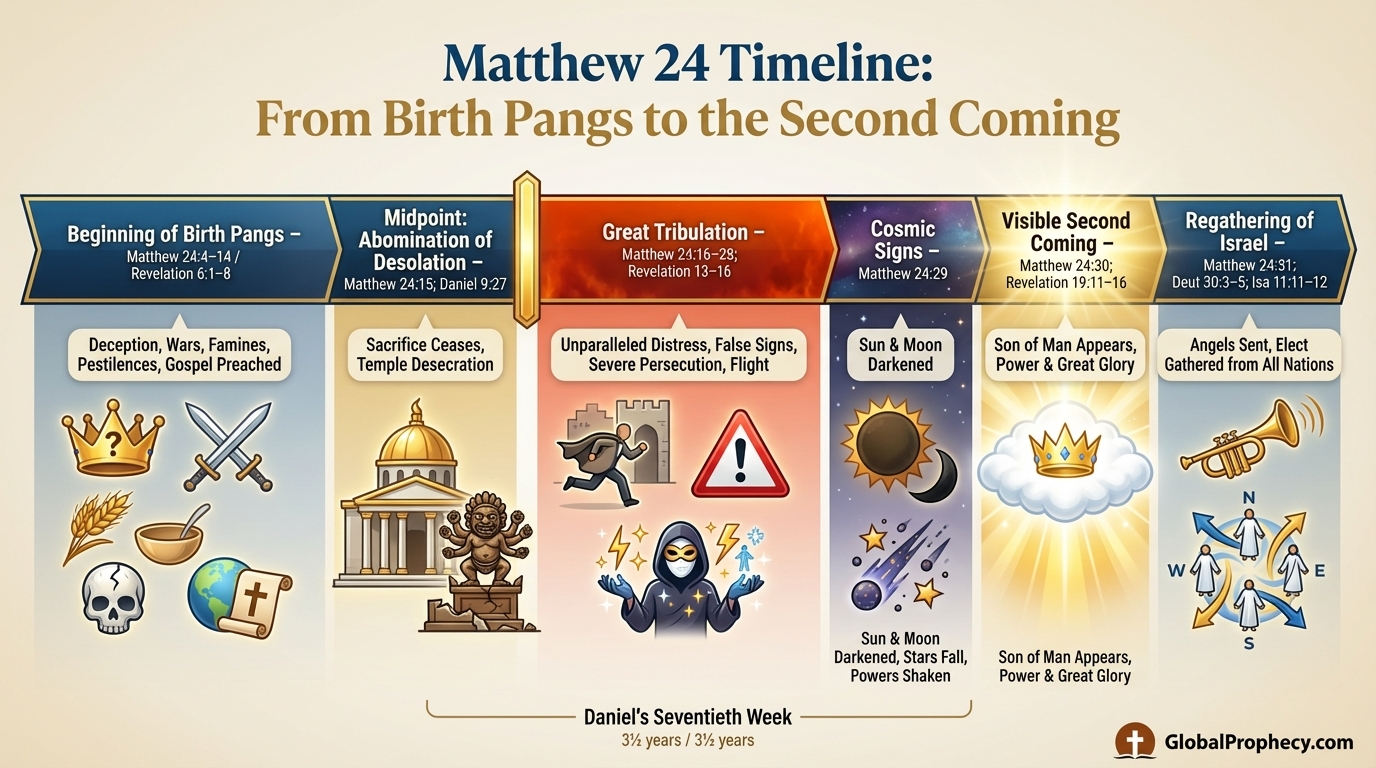
3.1 The Beginning of Birth Pangs: Matthew 24:4–14
In 24:4–14, Jesus describes conditions that correspond to the unfolding seal judgments of Revelation 6 and mark the Tribulation period:
- False christs and religious deception (24:4–5, 11)
- Wars and rumors of wars; nation against nation, kingdom against kingdom (24:6–7)
- Famines, pestilence, and earthquakes (24:7–8)
- Persecution and martyrdom of believers (24:9–10)
- Increased lawlessness and growing coldness of love (24:12)
- Worldwide proclamation of the “gospel of the kingdom” (24:14)
Jesus calls these “the beginning of the birth pains” (Matt 24:8). The metaphor suggests increasing frequency and intensity as history moves toward the climax of the age.
From a dispensational perspective, these verses describe conditions within the future Tribulation, closely parallel to Revelation 6:1–8 (the seal judgments: conquest, war, famine, death) and the martyr scene in Revelation 6:9–11. They set the stage for the Great Tribulation that begins at the midpoint.
3.2 The Abomination of Desolation and the Great Tribulation: Matthew 24:15–28
The turning point of the Olivet Discourse is Matthew 24:15:
“So when you see the abomination of desolation spoken of by the prophet Daniel, standing in the holy place (let the reader understand)…”
— Matthew 24:15
This “abomination” refers back to Daniel 9:27; 11:31; 12:11 and points to a future desecration of a Jewish temple by the Antichrist, who will halt sacrifices and set up an idolatrous image of himself to be worshiped as God (cf. 2 Thess 2:3–4; Rev 13:14–15).
In response, Jesus commands:
- Those in Judea to flee to the mountains (24:16).
- Not to turn back for possessions (24:17–18).
- To pray that their flight is not in winter or on a Sabbath (24:20), underlining the Jewish context.
This event marks the onset of what Jesus calls “great tribulation”:
“For then there will be great tribulation, such as has not been from the beginning of the world until now, no, and never will be.”
— Matthew 24:21
The Great Tribulation is the last three and a half years of the seven‑year period (cf. Dan 9:27; 12:1; Rev 11:2–3; 12:6, 14; 13:5). It is characterized by:
- Unprecedented persecution and slaughter, especially of Jews and tribulation saints (24:21–22).
- Intensified deception by false christs and false prophets, performing great signs and wonders to deceive, if possible, “even the elect” (24:23–26).
These verses anticipate Revelation 13–16, where the Antichrist and False Prophet dominate a global system of worship, persecution, and judgment.
3.3 The Visible Second Coming: Matthew 24:29–31
Following the Tribulation, Jesus describes His glorious return:
“Immediately after the tribulation of those days the sun will be darkened, and the moon will not give its light…”
— Matthew 24:29
Cosmic disturbances signal the climax:
- Darkened sun and moon
- Shaken heavenly powers
Then:
“Then will appear in heaven the sign of the Son of Man, and then all the tribes of the earth will mourn, and they will see the Son of Man coming on the clouds of heaven with power and great glory.”
— Matthew 24:30
This is not a hidden or symbolic coming; it is global, public, and unmistakable (cf. Rev 1:7; 19:11–16). Unbelievers mourn because judgment has arrived.
Verse 31 describes the regathering of Israel:
“And he will send out his angels with a loud trumpet call, and they will gather his elect from the four winds, from one end of heaven to the other.”
— Matthew 24:31
In this eschatological context, the “elect” refers to saved Israel, regathered to the land in fulfillment of Old Testament promises (e.g., Deut 30:3–5; Isa 11:11–12), in preparation for the millennial kingdom.
4. Watchfulness and Faithfulness: Matthew 24:32–25:30
After outlining the sequence of end‑time events, Jesus turns to parabolic exhortations that highlight the necessity of spiritual readiness.
4.1 The Parable of the Fig Tree and the Days of Noah: Matthew 24:32–44
The fig tree (24:32–35) illustrates how end‑time signs function:
- As leaves signal the nearness of summer, the appearance of these prophesied events signals the nearness of Christ’s return.
- The generation that witnesses the unfolding of these Tribulation signs will also witness the completion of the sequence and the Second Coming (24:34).
The days of Noah (24:37–39) emphasize moral and spiritual indifference:
- People were eating, drinking, marrying—ordinary activities—yet ignoring the preaching and warning of coming judgment.
- So it will be at the coming of the Son of Man: normal life continuing while people neglect the reality of looming judgment.
This leads to images of sudden separation (24:40–41) and the command:
“Therefore, stay awake, for you do not know on what day your Lord is coming.”
— Matthew 24:42
4.2 Faithful and Unfaithful Servants: Matthew 24:45–51
The parable of the faithful and wicked servants sharpens the ethical demand:
- The faithful servant continues his assigned work, ready for his master’s unexpected return and rewarded accordingly (24:45–47).
- The wicked servant exploits the delay, abuses others, and lives in self‑indulgence, only to face severe judgment (24:48–51).
In eschatological terms, these parables underscore that proximity to prophetic truth without obedience is spiritually fatal.
4.3 The Ten Virgins and the Talents: Matthew 25:1–30
In Matthew 25, Jesus continues with two major parables:
-
The Ten Virgins (25:1–13)
- Ten attendants await the bridegroom.
- Five are wise, with sufficient oil; five are foolish, unprepared when the groom finally arrives.
- The door is shut; the foolish are excluded.
The parable emphasizes preparedness for delayed but certain arrival—a warning especially for Israel during the end‑time crisis, but with broad application to all who hear Christ’s words.
-
The Talents (25:14–30)
- A master entrusts varying amounts (“talents”) to three servants.
- Two invest and multiply what was entrusted; one buries his talent out of fear and laziness.
- The faithful are rewarded with greater responsibility; the unprofitable servant faces severe loss.
This parable highlights accountability in light of Christ’s return: how one uses what God has given in the “waiting period” reveals true character and determines future reward or loss.
5. The Final Scene: Judgment of the Nations – Matthew 25:31–46
The Olivet Discourse concludes with a majestic scene of post‑tribulational judgment:
“When the Son of Man comes in his glory, and all the angels with him, then he will sit on his glorious throne.”
— Matthew 25:31
Here Jesus describes the judgment of the Gentile nations that survive the Tribulation:
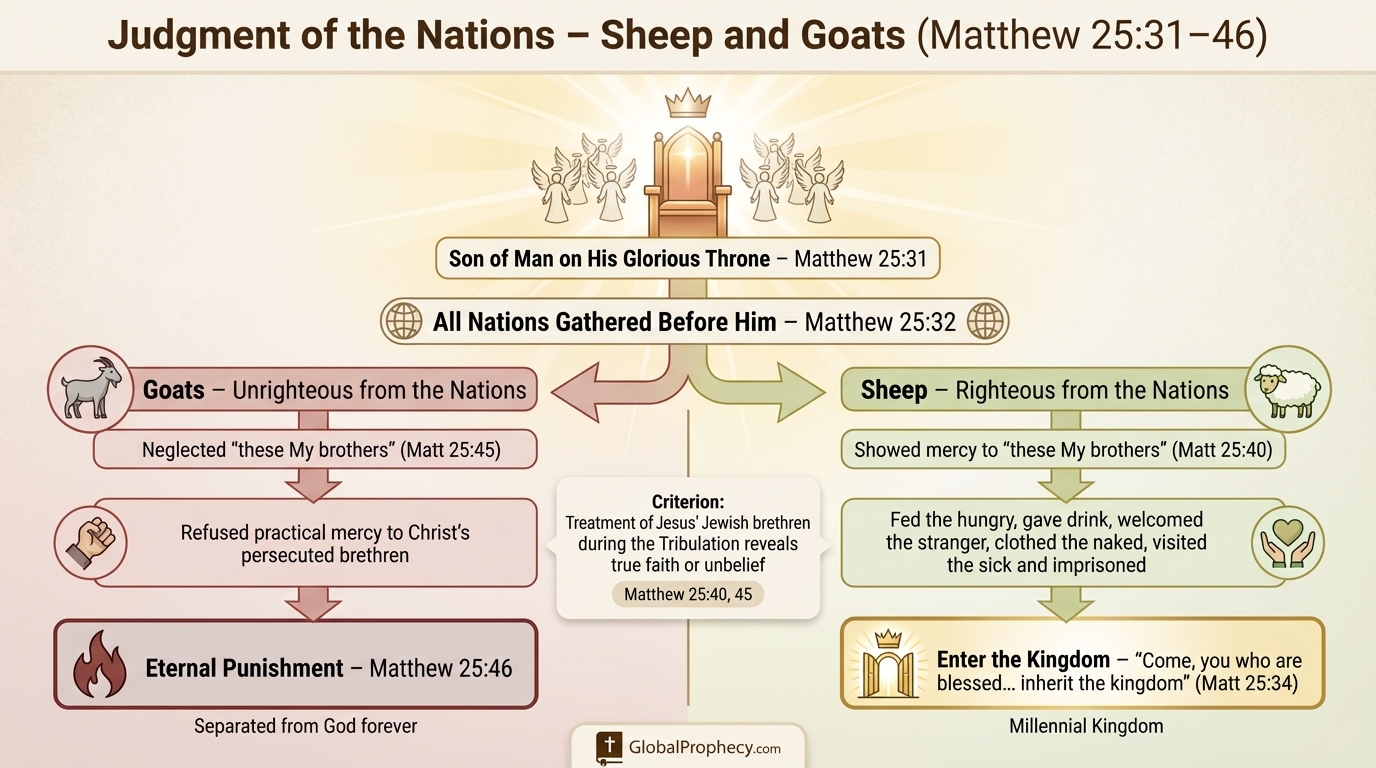
- All the nations are gathered before Him (25:32).
- He separates them as a shepherd separates sheep from goats.
- The criterion is how they treated “these my brothers” (25:40), best understood as Jesus’ Jewish brethren, persecuted during the Tribulation.
Those who, out of genuine faith, aided Christ’s brethren enter the millennial kingdom (“the kingdom prepared for you from the foundation of the world,” 25:34). Those who refused, revealing hardened unbelief, go “into eternal punishment” (25:46).
This judgment scene closes the Olivet Discourse with a vivid portrayal of Christ as King, Judge, and Shepherd, transitioning from the Tribulation to the establishment of His earthly kingdom.
6. Conclusion
Matthew 24–25—the Olivet Discourse—is a foundational text for biblical eschatology. In it, Jesus:
- Explains the future Tribulation, including its beginning “birth pangs,” the midpoint abomination of desolation, and the unparalleled Great Tribulation.
- Describes His visible Second Coming in glory, accompanied by cosmic signs and the regathering of Israel.
- Warns repeatedly about deception, spiritual lethargy, and unfaithfulness, using parables to call for watchfulness, preparedness, and responsible stewardship.
- Concludes with the judgment of the nations, separating those who enter the kingdom from those consigned to eternal punishment.
For readers of Matthew 24–25 today, the Olivet Discourse provides a prophetic blueprint of the end times and a powerful call to live in constant readiness for the return of the Son of Man.
FAQ
Q: What is the Olivet Discourse in Matthew 24–25?
The Olivet Discourse is Jesus’ extended prophetic teaching given on the Mount of Olives, recorded in Matthew 24–25. It outlines future events surrounding the Tribulation, the Second Coming, the regathering of Israel, and the judgment of the nations, and it urges watchfulness and faithfulness in light of His return.
Q: Does the Olivet Discourse refer to the church or to Israel?
In Matthew’s account, the primary focus is Israel and the end of the Jewish age, not the church. This is evident from references to Judea, the temple, the Sabbath, and the “abomination of desolation,” all of which are rooted in Israel’s prophetic program (cf. Dan 9:24–27).
Q: How do Matthew 24–25 and Revelation relate to each other?
The early section of Matthew 24 (vv. 4–14) closely parallels the seal judgments of Revelation 6—false christs, wars, famines, pestilence, and martyrdom. The Great Tribulation described in Matthew 24:15–28 corresponds to the intensifying judgments and Antichrist’s career in Revelation 8–16, while Matthew 24:29–31 aligns with Christ’s return in Revelation 19:11–16.
Q: What does “abomination of desolation” mean in Matthew 24:15?
The “abomination of desolation” refers to a future act in which the Antichrist desecrates a rebuilt Jewish temple, halts sacrifices, and sets up an idolatrous image demanding worship (cf. Dan 9:27; 12:11; 2 Thess 2:3–4; Rev 13:14–15). Jesus identifies this as the key sign marking the onset of the Great Tribulation.
Q: How should Christians today respond to the Olivet Discourse?
While Matthew 24–25 focuses on Israel’s future and the end‑time Tribulation, its ethical calls apply broadly: beware of deception, remain spiritually alert, live faithfully in view of Christ’s return, and steward God‑given resources wisely. The Olivet Discourse is designed not only to inform our eschatology but to transform our daily discipleship.
Frequently Asked Questions
What is the Olivet Discourse in Matthew 24–25?
Does the Olivet Discourse refer to the church or to Israel?
How do Matthew 24–25 and Revelation relate to each other?
What does “abomination of desolation” mean in Matthew 24:15?
How should Christians today respond to the Olivet Discourse?
L. A. C.
Theologian specializing in eschatology, committed to helping believers understand God's prophetic Word.
Related Articles
The 70 Weeks of Daniel: Understanding Bible's Prophetic Timeline
The 70 weeks of Daniel explain God's prophetic timeline for Israel, Christ's first coming, and a future 70th week leading to the end-time climax.
Babylon the Great
Babylon the Great in Revelation 17–18 reveals end-time religious and commercial rebellion against God and its sudden, final destruction in judgment.
What the Bible Says about Antichrist?
Antichrist in the Bible: discover what Scripture reveals about his identity, character, deceptive power, and end-time role in the Tribulation.
What the Bible Says about False Prophet?
False Prophet biblical identity and role in end times. Discover what Scripture reveals about this key figure in Revelation's tribulation prophecy.